If you slipped and fell somewhere in California and you're not sure who's responsible, you're not alone. Premises liability law here can be complicated — the answer changes depending on where the fall happened, who owns the property, and whether anyone there knew about the hazard.
California premises liability law is based on Cal. Civ. Code §1714, which holds property owners to a standard of reasonable care to keep their property safe for anyone lawfully on the premises.
We've recovered over $150,000,000 for injured Californians. Below is a plain-English breakdown of the seven locations where slip-and-fall accidents happen most — and who the law holds responsible in each one.
Quick answer — the 7 most common locations:
- Grocery and retail stores — owner liable if they failed to clean up or warn about a known spill
- Restaurants and bars — liability attaches when greasy floors or poor lighting goes unaddressed
- Apartment complexes — landlords must maintain safe stairs, hallways, and common areas
- Parking lots and garages — the lot owner or manager is responsible for potholes and broken pavement
- Workplaces — usually a workers' comp claim, but a third-party lawsuit may also apply
- Government property — special rules apply; you have only 6 months to file a claim
- Private homes — typically covered by homeowner's or renter's insurance
1. Grocery and Retail Stores
Grocery stores, restaurants, apartment complexes, parking lots, workplaces, government property, and private homes are the seven most common locations where slip-and-fall accidents happen in California.
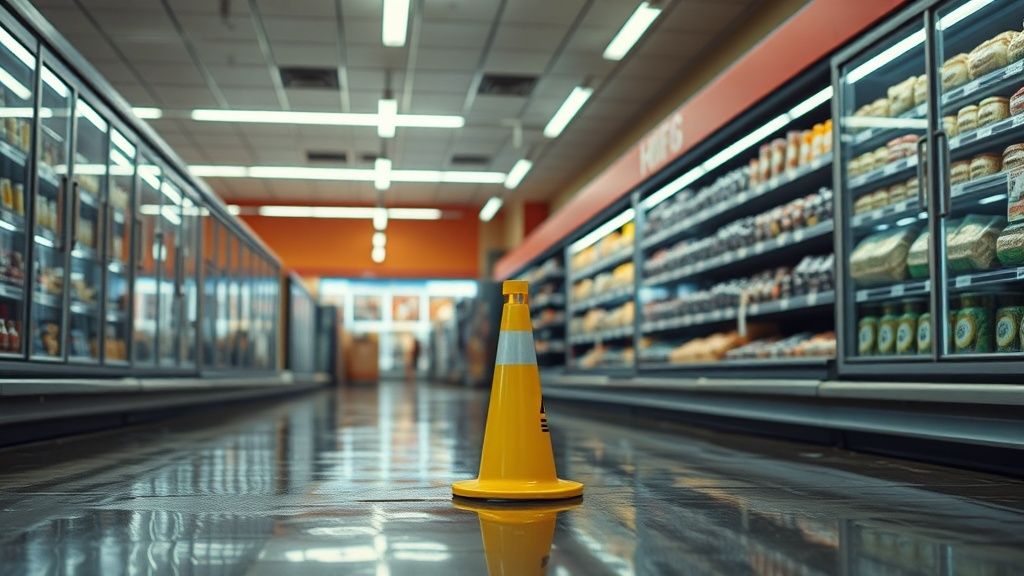
Wet floors from a spilled drink, a broken jar of olive oil, or a freshly mopped aisle are the most common hazard inside grocery and retail stores. California law is clear: a store owner has a duty to inspect their property, fix known dangers, and warn customers of hazards they can't yet fix.
Under Cal. Civ. Code §1714, everyone — including businesses — is responsible for exercising "ordinary care or skill" to avoid injuring others. Courts have consistently applied this to retail floors. To hold a store liable, you must show:
- A dangerous condition existed (the wet floor, the cracked tile, the unsecured mat).
- The store knew about it — or a reasonable inspection would have revealed it.
- The store failed to fix it or post a visible warning.
- You were injured as a result.
The evidence that wins these cases: Store surveillance video is critical. Most large grocery and retail chains retain footage for only 30 to 72 hours. An incident report created the day of the fall locks in the store's own description of the scene. If no warning cone or wet-floor sign was present, photographs taken immediately matter enormously.
Practical takeaway: Report the fall to a manager before you leave the store, photograph the floor and the surrounding area, and get the names of witnesses. Then call an attorney before accepting anything from the store's insurance carrier.
2. Restaurants and Bars
A restaurant or bar floor is a factory for fall hazards — grease and cooking oil tracked out of the kitchen, spilled drinks on tile floors, dim lighting designed for ambiance but dangerous for navigation, and steps between dining levels that patrons don't expect.
California restaurants have the same duty under Cal. Civ. Code §1714 as any other business: maintain safe conditions for customers. What makes these cases distinct is foreseeability. A restaurant or bar owner knows — or should know — that floors near the kitchen will get greasy, that spilled drinks happen constantly, and that customers move around in low light. The law does not require an injured patron to prove the owner saw the specific puddle. It requires proof that the dangerous condition existed long enough that a reasonable inspection would have caught it.
California courts apply a constructive notice standard: if a hazard has been present long enough that a reasonably careful employee patrolling the floor would have found it, the business is on the hook. A spill that's been sitting for 20 minutes while three servers walked past it satisfies constructive notice in most California courtrooms.
What complicates these cases: Dram shop liability (suing a bar for over-serving a customer who then causes a fall) follows different rules in California than in some other states. California does not have a general dram shop statute holding bars liable to third parties for serving a drunk customer who later injures someone — but there are exceptions. If you were hurt by a drunk patron at a bar, call us to walk through your specific facts.
Practical takeaway: Write down everything you remember about the lighting, the floor condition, and any warning signs (or lack of them) while it's still fresh. Same-day documentation is your strongest asset.
3. Apartment Complexes
Landlords in California have one of the most clearly defined duties in premises liability law. Under Cal. Civ. Code §1941, a landlord must maintain a rental property in a "habitable" condition — and California courts have consistently held that this obligation extends to common areas: stairways, hallways, parking structures, laundry rooms, and exterior walkways.
Typical apartment complex hazards that generate slip-and-fall claims:
- Broken or missing stair handrails
- Burned-out bulbs in stairwells or parking structures with no timely repair
- Cracked or uneven exterior walkways
- Water intrusion causing slippery tile in entryways
- Wet leaves or debris accumulating on outdoor stairs with no maintenance schedule
A key legal point: the duty is non-delegable. A landlord cannot escape liability by blaming a property management company or a maintenance contractor. If the landlord owns the property, the landlord is responsible — even if someone else was supposed to handle upkeep.
Notice matters here too. A tenant who reported the broken stair three times in writing — and has the texts or emails to prove it — has a much stronger case than one who never told the landlord. If you live in the property and you've reported the hazard, preserve every record of that communication.
Practical takeaway: Document the hazard with photos and timestamps, preserve any written communications about it, and see a doctor the same day if you're hurt. A landlord's failure to act after written notice is strong evidence of negligence.
4. Parking Lots and Garages
Parking lots look mundane, but they produce a high volume of serious falls — potholes that catch a heel, cracked pavement at the edge of a speed bump, a missing light fixture that leaves an entire row in darkness, black ice in a covered garage. Unlike interior floors, outdoor pavement deteriorates continuously, and owners don't always have maintenance cycles that keep pace.
California premises liability law requires the owner or operator of a parking lot to repair known defects and to conduct reasonable inspections to find hidden ones. Liability turns on three questions:
- Who owns or controls the lot? A private business (a shopping center landlord, a hospital, a hotel), a property management company, or a government agency all have different legal exposure and different claim procedures.
- Did they have notice of the defect? A pothole that's been growing for six months looks very different legally than one that appeared after last night's storm.
- Was the hazard "open and obvious"? California courts have held that a property owner may not be liable for a hazard so visible that a reasonable person would have seen and avoided it. Whether a cracked parking lot surface crosses that threshold is a fact-specific argument.
The government parking lot problem: If the lot is owned by a city, county, or state agency — a municipal parking structure, a DMV lot, a courthouse garage — the Government Claims Act (discussed in item 6 below) controls. You have only 6 months to file, not two years.
Practical takeaway: Photograph the defect immediately, from multiple angles, with something for scale (a coin, your foot). Get the property owner's name from a posted sign or by asking building management before you leave.
5. Workplaces
If you slip and fall at work in California, your primary claim is through the workers' compensation system under Cal. Lab. Code §3600 — not a lawsuit against your employer.
This is the location where the legal path diverges most sharply. California's workers' compensation system is an exclusive remedy against your employer — meaning you generally cannot sue your employer in civil court for a workplace fall. Cal. Lab. Code §3600 creates this no-fault system: if you're hurt at work, your employer's workers' comp insurance covers your medical care and a portion of your lost wages regardless of fault.
What workers' comp covers for a workplace fall:
- Medical treatment — all reasonably necessary care, at no cost to you
- Temporary Disability (TD) — two-thirds of your average weekly wage, subject to the annual state maximum, while you cannot work
- Permanent Disability (PD) — if the fall causes lasting impairment, a permanent disability rating determines additional compensation
- Supplemental Job Displacement Benefit (SJDB) — a voucher for retraining if you can't return to your former job
But here's where it gets more complex — and where a third-party claim may open up:
A slip and fall at work may also support a separate personal injury claim against a third party — such as a property owner, contractor, or equipment manufacturer — in addition to your workers' comp benefits.
If your fall happened at a location your employer sent you to — a client's warehouse, a retail store you were delivering to, a construction site owned by a developer — the owner of that property is not your employer. You can file a workers' comp claim against your employer AND a premises liability lawsuit against the property owner. These are separate claims that can both pay out.
Similarly, if a defective product caused or contributed to your fall — a wet-floor warning cone that shattered and tripped you, a floor-cleaning machine that left an unmarked slick — a products liability claim against the manufacturer may also exist.
Practical takeaway: If you fell at work, report it to your employer immediately and file a DWC claim. Then call us — we'll assess whether a third-party premises liability or products claim runs alongside your workers' comp case.
6. Government Property
California's Government Claims Act requires you to file a written tort claim within 6 months of a slip and fall on government property, or you permanently lose the right to sue.
This is the rule that catches more injured Californians off guard than any other in premises liability law. If you fell on a city sidewalk, in a public park, at a county courthouse, in a state office building, or on any other property owned by a California government entity, the standard two-year personal injury deadline does not apply.
Under Cal. Gov. Code §911.2, you must file a written government tort claim with the responsible public entity within 6 months of the date of injury. Miss that window — even by one day — and you are permanently barred from suing, no matter how serious your injuries.
How the government claim process works:
- Identify the correct public entity (city, county, state agency, transit authority — they are each separate).
- File a completed Government Tort Claim form with that entity within 6 months.
- The entity has 45 days to accept or reject your claim.
- If rejected (most are), you then have 6 months from the rejection date to file a lawsuit in civil court.
Government property hazards that commonly produce falls:
- Cracked or raised sidewalk slabs (city liability — though California municipalities often assert the "trivial defect" defense for minor cracks)
- Poorly maintained public stairways in parks or government buildings
- Unlit public parking structures
- Potholes in city-maintained streets and parking areas
The "trivial defect" defense: California courts allow government entities to avoid liability for defects they characterize as trivial — a sidewalk crack less than half an inch high is often found to be non-actionable. But the analysis is fact-specific. Courts look at the size of the defect, lighting conditions, the location's foot-traffic volume, and whether prior accidents were reported. What looks trivial in a photo can be actionable with the right context.
Practical takeaway: If you fell on anything that looks like public property, call an attorney immediately. Six months disappears faster than you think, and the claim process has procedural traps that can kill a legitimate case.
7. Private Homes
A fall at a friend's house, a family gathering, a holiday party — private home slip-and-fall cases are real, and California law allows them. Under Cal. Civ. Code §1714, homeowners and renters owe a duty of reasonable care to guests.
The legal standard depends on who you are to the homeowner:
- Invited guest (licensee or invitee): If you were there socially or on business — you were invited, you had permission — the homeowner owes you a duty to warn of known hazards and to make the property reasonably safe.
- Trespasser: A homeowner generally does not owe a duty of care to a trespasser, with limited exceptions (most notably for children under the attractive nuisance doctrine).
Common private-home hazards: unlit exterior stairs, broken handrails, cracked porch steps, wet tile near a pool, slippery hardwood floors with no rugs near entryways.
The practical reality — insurance: Most private-home claims are paid through homeowner's insurance or renter's insurance, not out of the homeowner's personal assets. A standard California homeowner's policy typically includes personal liability coverage. Pursuing a claim does not necessarily mean suing your friend personally — it means filing a claim with their insurance carrier.
In California, a property owner is legally responsible for a slip-and-fall accident when they knew about a dangerous condition — or should have known about it through reasonable inspection — and failed to fix it or warn visitors.
Statute of limitations: For a fall at a private home, you have two years from the date of injury to file a personal injury lawsuit under Cal. Code Civ. Proc. §335.1. Don't wait — evidence disappears, witnesses forget details, and insurance policies get harder to trace over time.
Practical takeaway: Document the hazard, get medical care, and talk to an attorney before filing anything directly with the homeowner's insurance. Insurance adjusters work for the insurance company — not for you.
What You Need to Prove in Any California Slip-and-Fall Case
Regardless of where your fall happened, California premises liability law requires you to prove four elements:
- Duty — the property owner owed you a duty of care.
- Breach — they failed to meet that duty by allowing a dangerous condition to exist.
- Causation — their breach caused your fall and your injuries.
- Damages — you suffered real, measurable harm (medical bills, lost wages, pain and suffering).
You have two years from the date of a slip-and-fall injury to file a personal injury lawsuit in California under Cal. Code Civ. Proc. §335.1 — but that window shrinks to 6 months on government property.
The hardest element to prove is usually breach — specifically, that the property owner knew or should have known about the hazard. That's why what you do in the hours immediately after a fall matters as much as anything that happens in a courtroom.
The first 72 hours matter most:
- Photograph every inch of the hazard and the surrounding area
- Get the names and contact information of every witness
- File an incident report if you're at a business
- See a doctor the same day — gaps in medical care are the first thing insurance adjusters attack
- Preserve your clothing and shoes (tread wear matters)
- Do not give a recorded statement to the property owner's insurance carrier
We've Handled These Cases. We Know What They're Worth.
Every case on this list comes down to one thing: who had control of that floor, that stair, that parking lot — and what did they know, and when. Insurance carriers count on injured people not knowing those answers. We do.
At Nordanyan Law, we handle California premises liability and slip-and-fall cases from the first call to the final settlement or verdict. No fee unless we win. We come to you if you can't travel.
Call (818) 794-9947 for a free case review. Available in English and Spanish.
Frequently Asked Questions
Who is liable for a slip and fall in California?
The person or entity that owned, controlled, or managed the property where you fell is potentially liable. Liability attaches when a dangerous condition existed, the owner knew about it or should have found it through reasonable inspection, and they failed to fix it or warn you. This can be a retail business, a landlord, a government agency, a homeowner, or a parking lot operator — it depends entirely on who had control of the property at the time of your fall.
What is premises liability in California?
Premises liability is the area of California civil law that holds property owners and occupiers responsible for injuries caused by unsafe conditions on their property. It is based on Cal. Civ. Code §1714, which requires everyone — including businesses and property owners — to use ordinary care to avoid causing injury to others. Slip-and-fall accidents are the most common premises liability claim in California.
Can I sue a store for a slip and fall?
Yes. If a California grocery store, retail shop, or other business failed to clean up a hazard, fix a known defect, or post a warning, and you were injured as a result, you can file a premises liability lawsuit against the business. To succeed, you must show that the store knew or should have known about the dangerous condition through reasonable inspection. Surveillance footage, incident reports, and witness statements are the key evidence in these cases.
How long do I have to file a slip-and-fall lawsuit in California?
For a fall on private property, you have two years from the date of injury under Cal. Code Civ. Proc. §335.1. For a fall on government property, the deadline is far shorter — you must file a written government tort claim within 6 months of the injury under Cal. Gov. Code §911.2, or you permanently lose your right to sue.
Does workers' comp cover a workplace slip and fall?
Yes. If you slip and fall at work in California, your primary remedy is workers' compensation under Cal. Lab. Code §3600, which covers your medical treatment and a portion of lost wages regardless of fault. You generally cannot sue your employer in civil court. However, if a third party — a property owner, a contractor, or an equipment manufacturer — contributed to the fall, you may have a separate personal injury claim in addition to your workers' comp benefits.
What should I do immediately after a slip and fall?
Report the fall to the property owner or manager before you leave. Photograph the hazard, the surrounding area, and any warning signs (or the absence of them). Get the names of witnesses. See a doctor the same day — even if you feel okay, delayed injuries are common and gaps in medical care hurt your case. Do not give a recorded statement to the property owner's insurance carrier before talking to an attorney. Call (818) 794-9947 for a free case review.
What if I fell on a cracked public sidewalk?
Falls on public sidewalks are claims against a California city or county. The Government Claims Act (Cal. Gov. Code §911.2) requires you to file a written claim with the correct government entity within 6 months. Government agencies frequently raise the "trivial defect" defense for sidewalk cracks, arguing the crack was too small to be actionable. Whether that defense succeeds depends on the specific dimensions of the crack, lighting conditions, and the location's history of prior incidents. An attorney can evaluate your specific facts before that 6-month window closes.
Reviewed by Minas Nordanyan, CA Bar #296806. Last reviewed June 2026. This article is for general informational purposes and does not constitute legal advice. Every case is fact-specific. Call (818) 794-9947 to discuss your situation with a California premises liability attorney. No fee unless we win.