If you've been in a truck accident in California, the next few hours matter more than most people realize. Trucking companies are not waiting. Their insurance adjusters, attorneys, and rapid-response investigators may already be on their way to the scene — while you're still sitting in a damaged car trying to figure out what just happened.
This guide walks you through 8 steps that protect your health, your rights, and your ability to recover full compensation. Each step is built on how California truck-accident cases actually work — not general accident advice.
Quick summary — here's what to do:
- Call 911 and secure an official police report.
- Get medical care the same day, even if you feel fine.
- Photograph the truck's company name, USDOT number, and trailer.
- Document the entire scene before anything is moved or towed.
- Have an attorney send a spoliation letter to preserve the truck's black box data.
- Identify every party that may be liable — it's rarely just the driver.
- Refuse any recorded statement to the trucking insurer's adjuster.
- Know your 2-year filing deadline and act before electronic evidence disappears.
Read on for the specialist depth behind each step.
1. Call 911 and Get an Official Crash Report
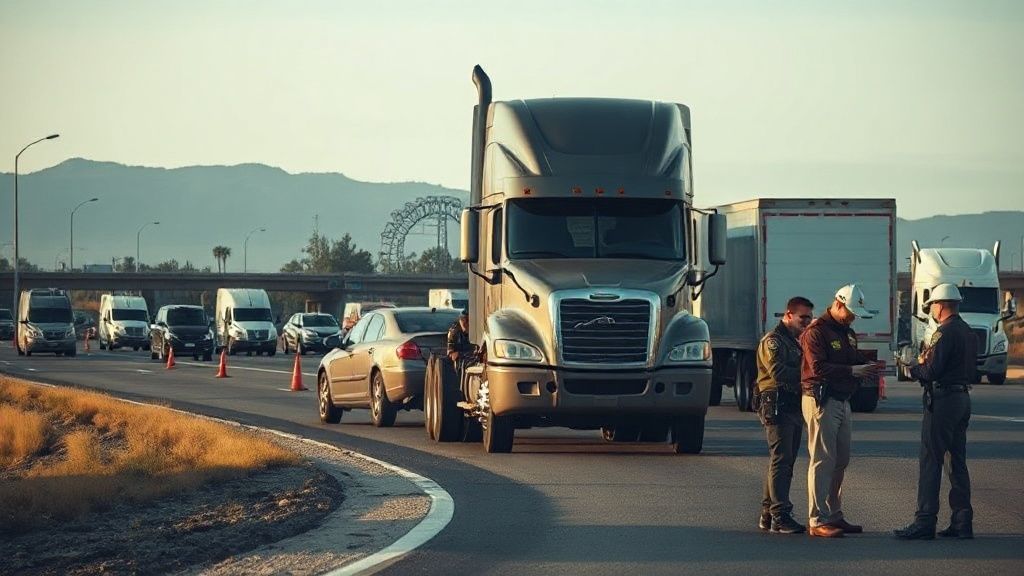
Always call 911 after a truck accident in California — an official police report is the foundational record that trucking-liability cases are built on.
The police report documents the crash scene in real time: road conditions, vehicle positions, witness names and contact information, and the officer's initial observations about cause. In a truck-accident case — where fault may be disputed across multiple parties — that contemporaneous record is evidence no attorney, insurer, or defense expert can recreate after the fact.
Under California law, any traffic collision involving injury or death must be reported. But the practical reason to call 911 immediately is this: trucking companies have experienced insurance professionals who will reconstruct the narrative if you don't document yours first.
Practical takeaway: Call 911 from the scene, wait for the responding officer, and request the report number so you can obtain the full report within days of the crash.
2. Get Medical Care Immediately — Even If You Feel Fine
Truck collisions generate forces powerful enough to cause internal organ damage, spinal trauma, and traumatic brain injury that produce no symptoms until hours or days after the crash.
A fully loaded semi-truck weighs up to 80,000 pounds under federal gross vehicle weight limits (49 C.F.R. § 127.49). When that mass strikes a passenger vehicle, the force is categorically different from a car-to-car collision. Internal bleeding, spinal compression fractures, and traumatic brain injuries often produce no pain or obvious symptoms immediately after impact — adrenaline masks them, and many injuries take hours to manifest.
A same-day emergency room visit or urgent care evaluation does two things: it protects your health, and it creates a contemporaneous medical record that directly links your injuries to the truck crash. Gaps in medical treatment are one of the primary tools defense attorneys and insurance adjusters use to argue that your injuries were pre-existing or unrelated to the accident.
Practical takeaway: Go to an emergency room or urgent care the same day, even if you feel only minor discomfort. Tell the treating physician exactly how the crash occurred.
3. Photograph the Truck, Company Name, USDOT Number, and Trailer
Federal law under 49 C.F.R. § 390.21 requires every commercial truck to display a USDOT number — photograph it before the truck is moved.
Every commercial motor vehicle operating in interstate commerce is required by federal regulation to display the carrier's name and USDOT number on both sides of the cab. That number is the key to unlocking the carrier's federal safety record: accident history, inspection violations, hours-of-service violations, and prior out-of-service orders are all tied to it through the Federal Motor Carrier Safety Administration (FMCSA).
Photograph the following before the truck is towed:
- The full truck cab, both sides
- The company name and any logos
- The USDOT number on the cab door
- The trailer number and any identifying markings
- The license plates (cab and trailer)
- Any dashcam visible through the windshield
Practical takeaway: The USDOT number is the most important piece of information at the scene — photograph it clearly before the truck is moved.
4. Do Not Let the Scene Be Cleared Before You Finish Documenting
Trucking companies dispatch rapid-response legal teams to crash scenes within hours of a collision, so document the scene completely before anything is towed or cleared.
This is the step most injured people miss — because they are injured, frightened, and waiting for an ambulance while the scene is being managed by officers and tow trucks.
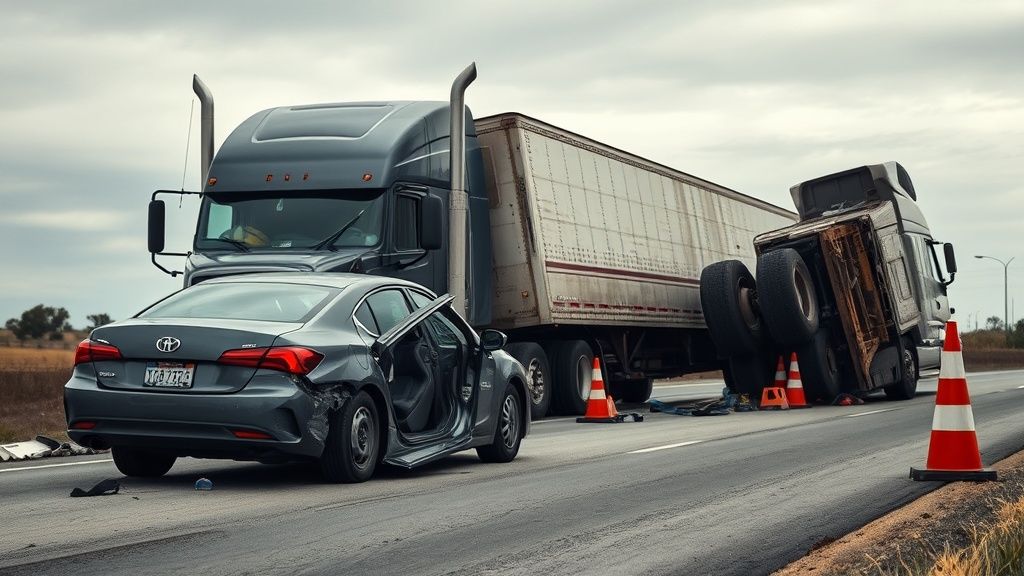
Physical evidence at a truck-accident scene is irreplaceable: skid marks reveal braking distance; cargo spill patterns show whether the load was secured properly; vehicle resting positions establish impact angles. Once the road is cleared, that evidence is gone.
If you are physically able to do so — or if a passenger or bystander can help you — photograph:
- All skid marks and gouge marks on the road surface
- The final resting positions of all vehicles before they are moved
- Any cargo, debris, or fluid spill
- Road conditions, lighting, and any traffic control signs or signals
- The surrounding environment, including any surveillance cameras on nearby buildings
Practical takeaway: Take wide-angle and close-up photographs from multiple angles before any vehicle is towed or any debris is cleared from the road.
5. Preserve the Truck's Black Box and ELD Data With a Spoliation Letter
An attorney's spoliation letter puts the trucking carrier on legal notice to preserve electronic logging device data, dashcam footage, and maintenance records before they are overwritten.
Modern commercial trucks carry two critical electronic systems: an event data recorder (EDR) — commonly called a black box — and an electronic logging device (ELD). Under federal regulations (49 C.F.R. Part 395), motor carriers are required to use ELDs to record hours-of-service data, which tracks whether the driver was fatigued at the time of the crash. The EDR captures speed, braking, throttle position, and steering inputs in the seconds before impact.
The problem: trucking companies are not legally required to preserve this data indefinitely. ELD data may be automatically overwritten within weeks. Dashcam footage stored on an internal loop may be erased within days. Without a formal legal demand, the carrier has no ongoing obligation to hold it.
A spoliation letter — sent by your attorney to the trucking carrier, its insurer, and any broker immediately after the crash — places the carrier on written notice that the data is evidence in anticipated litigation. If the carrier destroys data after receiving a spoliation letter, it can face severe sanctions in court, including an instruction to the jury that the destroyed evidence would have been unfavorable to the carrier.
This is not something you can do yourself. An attorney must send it — and the sooner it goes out, the better.
Practical takeaway: Contact a truck-accident attorney as quickly as possible after the crash so a spoliation letter can be sent before critical data is overwritten.
6. Identify All Liable Parties: Driver, Carrier, Broker, Maintenance Company, and Cargo Loader
A California truck accident routinely involves multiple defendants beyond just the driver — and identifying all of them matters because each may carry separate insurance and separate legal responsibility.
The potentially liable parties in a California truck-accident case include:
- The truck driver — for negligent operation, fatigue, distracted driving, or impairment.
- The motor carrier (trucking company) — for negligent hiring, inadequate training, hours-of-service violations, or pressure on drivers to skip rest breaks.
- The freight broker — if the broker hired an unqualified carrier or failed to verify the carrier's FMCSA safety rating.
- The maintenance contractor — if a third party was responsible for brake inspections, tire maintenance, or other mechanical systems that failed.
- The cargo loading company — if improperly loaded or unsecured cargo caused the truck to tip, jackknife, or shed debris.
- The truck or parts manufacturer — if a defective component (brake system, tire, coupling) contributed to the crash.
California's pure comparative fault rule — established by the California Supreme Court in Li v. Yellow Cab Co., 13 Cal.3d 804 (1975) — means that each defendant's share of responsibility is assessed separately, and your recovery is reduced only by your own percentage of fault, if any. You are not barred from recovery even if you bear some responsibility for the crash.
Practical takeaway: Do not assume the only defendant is the driver. A thorough investigation — including FMCSA records, maintenance logs, and broker contracts — is necessary to identify every liable party.
7. Avoid the Trucking Insurer's Rapid-Response Adjuster and Any Recorded Statement
Do not give a recorded statement to the trucking company's insurance adjuster — you have no legal obligation to speak with them, and anything you say will be used to reduce your claim.
Large trucking carriers and their insurers maintain rapid-response programs staffed by experienced claims investigators, accident reconstructionists, and defense attorneys. Their job begins the moment the company learns of a crash. They may call you within 24 to 48 hours of the accident — while you are still in a hospital or managing acute pain — asking for a recorded statement "to process your claim."
You have no legal obligation to give that statement. Under California law, you are required to cooperate with your own insurer under your policy's cooperation clause — but you are not required to speak with the adverse party's insurer.
Recorded statements taken in the early aftermath of a crash are dangerous for two reasons:
- You do not yet know the full extent of your injuries. Agreeing early that you feel "okay" or had "minor" pain can be used to argue that your later-diagnosed injuries are exaggerated.
- You do not yet know the full facts of the crash. The adjuster does. They may already have the truck's ELD data, dashcam footage, and the driver's account. You are answering questions at a severe information disadvantage.
Practical takeaway: Politely decline any recorded statement request from the trucking carrier or its insurer and refer them to your attorney.
8. Note the 2-Year Filing Deadline and Act Before Evidence Disappears
California's statute of limitations for truck accident personal injury claims is two years from the date of the crash under Cal. Code Civ. Proc. § 335.1.
Under Cal. Code Civ. Proc. § 335.1, you have two years from the date of a truck accident to file a personal injury lawsuit in California. Miss that deadline and your claim is almost certainly barred forever, regardless of how severe your injuries are.
But two years is not as long as it sounds — because the most critical evidence in your case has a much shorter shelf life:
ELD / hours-of-service data: Weeks (auto-overwrite cycles)
Dashcam footage: Days to weeks (loop recording)
Crash scene physical evidence: Days (road crews clear it)
Driver's drug/alcohol test results: 3 years under 49 C.F.R. § 382.401
Maintenance and inspection records: Varies by carrier policy
Witness memory: Degrades rapidly
There are also exceptions that can shorten the deadline. If the truck was operated by a government entity — a municipality, a public transit authority, a state agency — California's Government Claims Act (Gov. Code § 911.2) requires you to file an administrative claim within six months of the incident before you can sue. Miss that six-month window and you may be barred entirely.
Practical takeaway: The two-year statute of limitations is the legal deadline — but the real deadline to act is now, because evidence disappears in days and weeks, not years.
Why Truck Accident Cases Are Different From Car Accident Cases
Truck accidents are governed by a separate federal regulatory framework that most personal-injury attorneys rarely work with. The Federal Motor Carrier Safety Administration (FMCSA) sets hours-of-service limits, mandatory maintenance inspection schedules, driver qualification standards, and cargo securement rules that apply to every commercial truck on California highways. Violations of those federal regulations — called FMCSRs — are often central to proving liability.
That regulatory complexity, combined with the rapid-response infrastructure that large carriers maintain, means a truck-accident case requires a different level of preparation than a standard auto collision. The evidence you preserve — or fail to preserve — in the first 48 to 72 hours can determine the outcome of a case worth hundreds of thousands of dollars.
We handle every case as if it were going to trial, because insurance companies — including the specialized trucking carriers — settle for more when they know the other side is prepared to fight. We've recovered over $150,000,000 for injured workers and accident victims in Southern California. If you've been hit by a commercial truck, call (818) 794-9947 for a free case review. No fee unless we win.
Visit our truck accidents practice area or our personal injury page for more information. You can also start with our contact page if you'd like to reach us in writing.
Frequently Asked Questions
What should I do immediately after a semi-truck accident in California?
Call 911, stay at the scene, and seek medical care as soon as possible — even if you feel fine. Photograph the truck's USDOT number, company name, and trailer before the truck is moved, and document the entire crash scene including skid marks and vehicle positions. Do not give any statement to the trucking company's insurance adjuster, and contact a truck-accident attorney quickly so a spoliation letter can be sent to preserve the truck's electronic data.
Who is liable in a California truck accident?
Liability in a California truck accident can extend well beyond the driver. Potentially liable parties include the motor carrier (trucking company), a freight broker that hired an unqualified carrier, a third-party maintenance contractor, a cargo loading company, and the truck or parts manufacturer if a mechanical defect contributed to the crash. California's pure comparative fault rule — established by Li v. Yellow Cab Co., 13 Cal.3d 804 (1975) — allows you to recover against any and all at-fault parties, with your recovery reduced only by your own percentage of fault.
What is an ELD or black box in a truck?
An electronic logging device (ELD) is a federally mandated device — required under 49 C.F.R. Part 395 — that records a commercial truck driver's hours of service, GPS location, and driving activity to prevent fatigued driving. An event data recorder (EDR), commonly called a black box, captures pre-crash data including vehicle speed, braking, throttle position, and steering inputs. Both are critical evidence in a truck-accident case, but both can be automatically overwritten within weeks — which is why an attorney must send a spoliation letter as quickly as possible after the crash.
How long do I have to file a lawsuit after a truck accident in California?
California's statute of limitations for personal injury claims — including truck accidents — is two years from the date of the crash under Cal. Code Civ. Proc. § 335.1. If the truck was operated by a government entity, the Government Claims Act under Gov. Code § 911.2 requires you to file an administrative claim within six months of the incident. Either way, critical electronic evidence is typically lost within days or weeks — act immediately.
Do I have to give a statement to the trucking company's insurance adjuster?
No. You have no legal obligation to give a recorded statement to the adverse party's insurance adjuster. You may be required to cooperate with your own insurer under your policy's cooperation clause, but that obligation does not extend to the carrier's insurer. Recorded statements given in the early aftermath of a crash — before you know the full extent of your injuries or all the facts — are routinely used by defense adjusters and attorneys to minimize claims.
What if I was partly at fault for the truck accident?
California follows a pure comparative fault rule established by the California Supreme Court in Li v. Yellow Cab Co., 13 Cal.3d 804 (1975). Under that rule, your compensation is reduced by your percentage of fault — but you are not barred from recovery even if you bear significant responsibility for the crash. For example, if a jury finds you 20% at fault and awards $500,000 in total damages, you recover $400,000. Do not assume that any fault on your part eliminates your right to recover.
Should I accept the trucking insurer's first settlement offer?
In most cases, no. Initial settlement offers from trucking carriers are made before the full extent of your injuries is known and before your attorney has obtained all the evidence. Accepting early forfeits your right to recover for future medical costs, long-term disability, and lost earning capacity that may not be fully apparent for months. Once you sign a release, your claim is closed permanently. Consult a truck-accident attorney before accepting any offer.
How is a truck accident different from a regular car accident in California?
Truck accidents are governed by a separate federal regulatory framework — the Federal Motor Carrier Safety Regulations (FMCSRs) administered by the FMCSA — covering driver qualifications, hours-of-service limits, mandatory inspections, and cargo securement. Violations of those regulations are central to proving liability in most trucking cases. Truck-accident cases also typically involve multiple defendants, larger insurance policies, and a rapid-response defense infrastructure that large carriers deploy immediately after a crash — all of which require a level of preparation that goes well beyond a standard auto collision case.
Reviewed by Minas Nordanyan, CA Bar #296806. Last reviewed June 2026. This article is for general informational purposes only and does not constitute legal advice. Every case is different — call (818) 794-9947 for a free, confidential consultation about your specific facts.