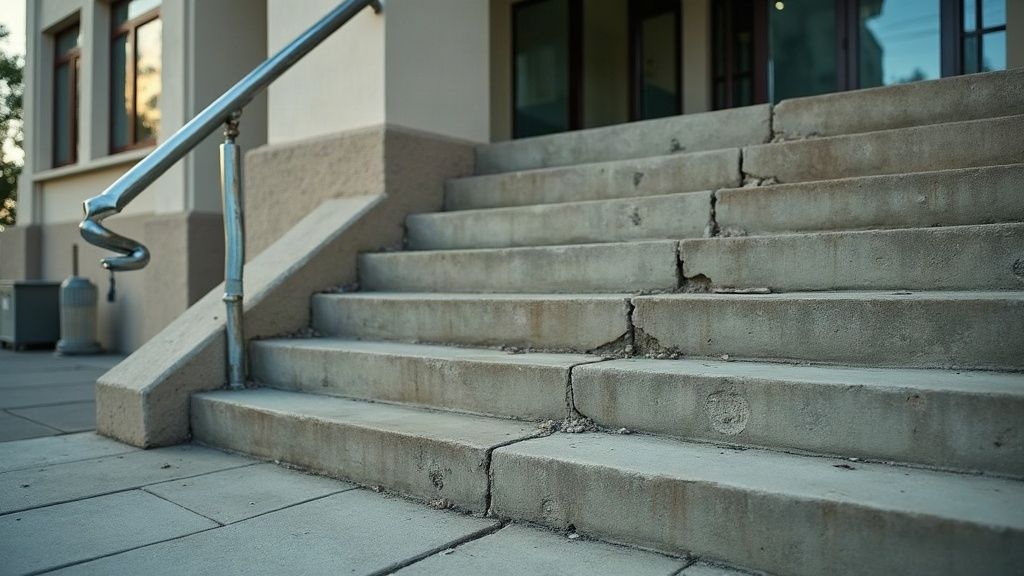
If you've been hurt in a slip and fall in California, there's a question that shapes the entire value of your claim: was the condition that caused your fall something the property owner was legally required to fix?
Building codes exist to set a minimum safety floor. When a property owner ignores them, a fall is not just an accident. It becomes evidence of negligence. A documented code violation connects your injury to a specific, measurable failure, and that connection makes your premises liability case substantially stronger.
Here are 10 signs your fall may have been caused by a building code violation.
Quick answer: Your fall may involve a building code violation if you notice:
- Missing or broken handrails on stairs
- Uneven flooring transitions or trip hazards above one-quarter inch
- Inadequate lighting in stairwells or walkways
- Steps that don't meet dimensional standards for the building type
- Lack of required non-slip surfaces
- Blocked or missing emergency exits
- Missing or broken warning signage
- Doors that don't comply with accessibility standards
- A pattern of prior complaints or failed inspections
- Conditions that differ measurably from the surrounding area
1. Missing or Broken Handrails on Stairs
California Building Code Section 1012 requires handrails on stairways with four or more risers, and a missing or broken handrail is a documented code violation.
California Building Code Section 1012 is specific: handrails must be continuous, graspable, and installed at a height between 34 and 38 inches above the stair nosing. If any of those requirements are not met, the property owner is in violation. If you fell on those stairs because you could not grip a handrail, that violation is direct evidence of negligence.
Property owners sometimes argue a rail was "slightly loose" rather than broken. The code does not grade on a curve. A handrail that wobbles, pulls from the wall, or is absent entirely fails the standard, regardless of how the owner characterizes it.
Takeaway: Photograph the handrail from multiple angles and note whether it moved when you tried to grip it. That evidence ties your fall to a specific code failure.
2. Uneven Flooring Transitions or Trip Hazards
A vertical change in floor level that is not properly beveled is one of the most common code violations in California slip and fall cases.
California Building Code accessibility standards (CBC Chapter 11B, Section 11B-303) and related floor-finish standards limit abrupt vertical changes in floor level to one-quarter inch. A change between one-quarter inch and one-half inch must be beveled with a maximum slope. Anything above one-half inch requires a ramp. A lip between two floor surfaces, a sunken tile, or a raised threshold that exceeds these limits is a code violation, and it is a recognized mechanical cause of trip-and-fall injuries.
Property owners sometimes claim the transition was visible or that the injured person should have watched where they were walking. Comparative fault arguments like this can reduce a damages award under California's pure comparative fault rule, but they do not erase the property owner's underlying duty to maintain a code-compliant floor.
Takeaway: If possible, measure the height difference with a coin or a ruler before the property is repaired. A photograph next to a common object for scale can also establish the dimension.
3. Inadequate Lighting in Stairwells or Walkways
Darkness is not just uncomfortable. Below a certain level, it is a code violation.
California Building Code Section 1008 establishes minimum illumination requirements for exit access corridors, stairwells, and exterior paths. The standard is measured in foot-candles at floor level. A burned-out bulb, a broken fixture, or a property owner who never installed adequate lighting in the first place can each create a violation. When a person misses a step or fails to see a hazard because the area was too dark, the lighting deficiency becomes causally connected to the fall.
Courts have consistently held that property owners have a duty to inspect and maintain lighting in common areas. A single burned-out bulb that the owner knew about and did not replace within a reasonable time is sufficient to establish notice of the dangerous condition.
Takeaway: Note the time of your fall, whether any lights were out, and whether other people in the area also had trouble seeing. A light-meter reading from an investigator can quantify the deficiency against the code's foot-candle standard.
4. Steps That Do Not Meet Required Dimensional Standards
Stairway geometry is tightly regulated for a reason. When stairs are irregular, the human body cannot adapt its rhythm, and falls follow.
The California Building Code sets dimensional requirements for stair risers and treads that vary by occupancy type. Residential, commercial, and assembly occupancies carry different specific limits. What the code is uniform about is this: within a single flight, riser heights and tread depths must be consistent. A stairway where one step is noticeably taller or shorter than the others is non-conforming regardless of the individual step's absolute dimension.
Non-uniform stairs are particularly dangerous because people calibrate their stride after the first step and do not visually inspect every subsequent step. When one riser breaks the pattern, the body's expectation is wrong, and a fall occurs.
Takeaway: After a stairway fall, try to note or photograph whether any step looked or felt different in height or depth compared to the others. An inspector can measure each riser and tread to document the non-uniformity precisely.
5. Lack of Non-Slip Surfaces in Required Areas
Some surfaces require grip by law. When a property owner skips that requirement, a fall on that surface is not just foreseeable, it is precisely what the code was designed to prevent.
California Building Code Section 1010 and Title 24 accessibility standards require slip-resistant surfaces on ramps, accessible routes, and surfaces likely to become wet. Cal-OSHA regulations under Title 8, Section 3221 impose similar requirements in workplace settings, including wet-process areas and slippery floors. The required coefficient of friction for a surface depends on whether it is level, sloped, or subject to wet conditions.
A property owner who installs polished marble at a building entrance, skips the required non-slip mat or surface treatment, and fails to address the foreseeable wet conditions created by rain or cleaning has violated the standard and created a trap.
Takeaway: Note the type of flooring and whether it was wet, recently cleaned, or in an area exposed to weather or spills. A materials expert can test the surface's friction coefficient and compare it against the applicable code standard.
6. Blocked or Missing Emergency Exits
A blocked emergency exit is a life-safety code violation that can also cause falls when people are forced to navigate unlit, unfamiliar, or cluttered alternative routes.
California Fire Code and California Building Code Sections 1003 through 1013 require exit routes to remain clear, properly illuminated, and immediately accessible at all times. Stacked merchandise, locked doors during business hours, and removed exit signs are common violations. When a person is detoured through an unintended path because the proper exit is blocked, and that path has a hazard that causes a fall, the property owner's exit-code violation is part of the chain of causation.
Takeaway: If a blocked exit contributed to where you were walking when you fell, photograph the blocked exit, the sign, and the route you were forced to take. This documents the causal connection between the violation and your location at the time of the fall.
7. Broken or Missing Warning Signage
A "wet floor" sign is not just a courtesy. In many situations, it is a legal requirement.
Cal-OSHA regulations and California Building Code provisions require property owners and employers to post warnings near wet floors, steps with limited headroom, low ceilings, and other recognized hazards. California's premises liability standard under Cal. Civ. Code §1714 requires property owners to use reasonable care to prevent harm. Failing to warn of a known hazard, when a warning sign was required or would have been adequate protection, can establish both the violation and the owner's knowledge of the dangerous condition.
Courts have held that a property owner's decision not to post a warning, or to remove a warning before the hazard was corrected, is evidence of negligence.
Takeaway: Note whether any warning was present at the time of your fall. If workers had already placed cones or signs and then removed them before the floor dried or the repair was completed, that sequence is critical to your case.
8. Doors That Do Not Meet Accessibility Standards
A door that is too heavy, swings unexpectedly, has a raised threshold, or requires the wrong type of hardware is not just an inconvenience. It is a code violation that can cause a fall.
California's Title 24 accessibility regulations and the federal Americans with Disabilities Act set specific requirements for door opening force, clear floor space, threshold height, and hardware type. Threshold heights above one-half inch are generally prohibited. Doors that require excessive pushing or pulling force to open can cause a person to lose balance and fall. Hardware that requires tight grasping or twisting, rather than a simple push or lever, is non-compliant and can cause hand or wrist injuries when a person tries to brace against a fall.
When a building is subject to accessibility requirements and the door does not comply, the violation is documented in the building's permit records and can be established through a building inspector's review.
Takeaway: If a door's threshold, weight, or hardware contributed to your fall, note the exact door location and whether you observed a permit or inspection certificate posted nearby. An accessibility consultant can measure the door against Title 24 standards.
9. How Code Violations Can Strengthen a Premises Liability Case
A building code violation is not automatically proof of liability, but California courts treat it as strong evidence that a condition was unreasonably dangerous.
California premises liability law under Cal. Civ. Code §1714 requires an injured person to prove that the property owner was negligent, that the negligence caused the dangerous condition, and that the condition caused the injury. A building code violation advances all three elements simultaneously.
First, it establishes the standard of care. The code defines what a reasonably safe property looks like for that type of building. Second, it shows the owner departed from that standard. Third, because codes are written specifically to prevent the type of harm that occurred, a court may apply the negligence-per-se doctrine. Under negligence per se, a statutory or regulatory violation that causes the type of harm the rule was designed to prevent can substitute for the reasonable-person negligence analysis entirely.
One additional point: if you were injured on a property owned by someone other than your employer, for example a landlord or a non-employer building owner, you may have a claim against that third party in addition to any workers' compensation benefits. Workers' compensation in California is generally the exclusive remedy against your own employer under Cal. Lab. Code §3602, but it does not bar claims against independent third-party property owners whose code violations contributed to your fall.
Takeaway: A documented code violation is the strongest factual foundation for a California premises liability claim because it ties your injury to a specific, measurable legal duty the owner failed to meet.
10. How to Document These Issues After a Fall
Photographing the hazard, measuring the defect, and requesting the property's inspection records immediately after a fall are the most important steps to preserving your claim.
Property owners and their insurers move quickly. Repairs are made, surfaces are replaced, and lighting is fixed. Evidence that existed on the day of your fall can disappear within 24 to 48 hours. Here is what to do immediately:
- Photograph everything. Take photos of the exact hazard from multiple angles, including close-up and wide shots that show the location within the building. Photograph the lighting conditions, any signage (or the absence of it), and the floor surface.
- Measure the defect. If there is a vertical height difference, a coin, ruler, or even a credit card in the frame gives scale. A height difference of less than one-quarter inch looks similar to one of three-quarters of an inch in a photo without a reference.
- Preserve your clothing and footwear. The shoes you wore that day can be tested for adequate tread and slip resistance. Do not wash the clothing. Both items may be relevant to a defense argument about comparative fault.
- Request inspection records. Building departments maintain records of inspections, complaints, and violations. These records can show the property owner had prior notice of the exact condition that caused your fall.
- Get witness information. Anyone who saw the fall or who has previously complained about the same hazard is a potential witness. Their statements corroborate that the condition existed and that the owner had, or should have had, notice of it.
- See a doctor the same day. Medical records that begin on the day of the fall are far stronger than records that begin days or weeks later. A gap gives the defense an opening to argue the injury did not come from the fall.
In California, you generally have two years from the date of a slip and fall to file a personal injury lawsuit under Cal. Code Civ. Proc. §335.1. Claims against government entities have a much shorter window, typically six months to file a government tort claim, so if the property is publicly owned, contact an attorney immediately.
Takeaway: Evidence preservation in the first 48 hours determines whether a strong premises liability case becomes a provable one. An attorney can send a preservation letter to the property owner immediately, which creates a legal duty to retain all evidence related to the condition.
Frequently Asked Questions
How do I know if a building code violation caused my fall?
Start with the physical condition that caused your fall. If there was a missing handrail, a raised floor edge, poor lighting, or a slippery surface in an area that should have been treated, compare that condition against the California Building Code requirements for that type of building. A building inspector or a personal injury attorney with premises liability experience can evaluate whether the condition fell below the code standard.
Can I sue a property owner for a building code violation in California?
Yes. Under Cal. Civ. Code §1714, California property owners have a duty to use reasonable care in maintaining their property. A documented building code violation is strong evidence that the owner breached that duty. If the violation caused your injury, you can pursue a premises liability claim for your medical costs, lost wages, and pain and suffering.
Do I need an inspector to prove a code violation?
An inspector is not legally required, but their report is far more persuasive than photographs alone. A licensed building inspector or a construction expert can measure conditions against the specific code standard, document findings in a report, and testify as an expert witness. That testimony carries weight with insurance adjusters and juries that a layperson's photographs do not.
What is the difference between a building code violation and normal wear and tear?
Normal wear and tear refers to gradual deterioration that a property owner cannot reasonably prevent, such as slight fading or minor surface scuffing. A building code violation is a condition that falls below a minimum legal standard, such as a handrail that has detached from the wall or a floor transition that exceeds the maximum allowed height difference. The distinction matters legally because a code violation demonstrates that the owner failed a defined duty, while ordinary wear and tear may only require proof that the owner failed to act after receiving actual notice of the hazard.
How long do I have to file a slip and fall claim in California?
For most private property slip and fall claims, California law gives you two years from the date of injury under Cal. Code Civ. Proc. §335.1. If the property is owned by a government entity, such as a city, county, or school district, you must file a government tort claim within six months of the incident under Cal. Gov. Code §911.2 before you can sue. Missing either deadline can permanently bar your claim.
What if the code violation was on my employer's property?
If the hazardous condition was on your employer's premises and you were injured during the course of your employment, California workers' compensation is generally your exclusive remedy against the employer under Cal. Lab. Code §3602. However, if a third-party property owner, a building landlord, or another non-employer entity controlled the defective condition, you may have a separate premises liability claim against that party in addition to your workers' comp benefits. An attorney can evaluate both tracks simultaneously.
Building code violations are not technical footnotes. They are documented proof that a property owner failed a specific legal duty, that the failure created a dangerous condition, and that the condition injured you. If any of the signs in this article match what you experienced, the next step is getting someone with premises liability experience to evaluate the facts before the evidence disappears.
If you've been hurt in a slip and fall in California, call (818) 794-9947 for a free case review. We handle premises liability and workers' compensation claims across Southern California. No fee unless we win.
Reviewed by Minas Nordanyan, CA Bar #296806. Last reviewed September 2026.