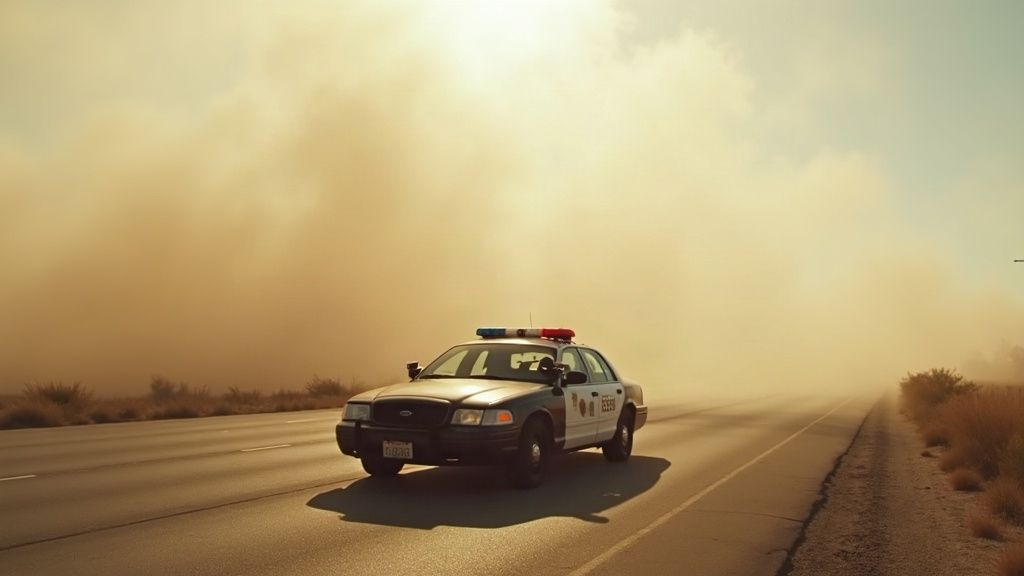
If you were caught in a dust storm pileup on a California highway, you already know how fast everything happened. One moment the road was clear. The next, a wall of dust erased every car, lane marker, and sign ahead of you. What came after that, whether it was a single impact or a chain-reaction crash involving a dozen vehicles, was the result of a few seconds of extreme conditions that the law treats differently from an ordinary rear-end collision.
This article breaks down the nine things that matter most about dust storm car accident claims in California, from who investigators typically find at fault to what evidence survives and what you need to do before you talk to an insurance adjuster.
Quick summary:
- Dust storms on I-5 and I-10 create near-zero visibility that produces multi-car pileups.
- Zero-visibility events involve different legal analysis than standard rear-end chains.
- Speeding for conditions under Cal. Veh. Code §22350 is the most common fault finding.
- Caltrans warning sign logs can help or hurt your case depending on what was posted.
- Stopping in a travel lane can create shared fault even if stopping felt safer.
- The "act of God" defense fails when human choices made the crash worse.
- Dashcam footage, EDR data, and weather records are your strongest evidence.
- Seek medical care the same day, even if you feel fine.
- The personal injury filing deadline is two years under Code of Civ. Proc. §335.1.
1. Why Sudden Dust Storms Cause Pileups on California Highways Like I-5 and I-10
Driving faster than you can stop within the distance you can see violates California Vehicle Code §22350, and that violation is the leading fault finding in dust storm pileups.
Haboobs and agricultural dust plumes are a documented hazard on California's Central Valley highways, particularly on I-5 between Stockton and Bakersfield and on I-10 east of the Los Angeles basin. These storms can develop from dry lake beds, tilled farm fields, or construction sites and travel at speeds that give drivers almost no warning. Visibility can drop from a quarter mile to essentially zero in under ten seconds.
At 65 miles per hour, a vehicle is covering roughly 95 feet per second. A driver who sees the dust wall with three seconds of clearance has less than 300 feet to decelerate. When the car ahead has already stopped and the approaching driver cannot see it, the physics produce a chain-reaction crash that can involve dozens of vehicles before the first responders even receive a call.
The recurring pattern on these corridors is documented in California Highway Patrol (CHP) incident records and National Weather Service storm reports. Understanding why these crashes happen is the first step to understanding why the law holds certain drivers accountable and not others.
2. How Zero-Visibility Events Differ Legally from Ordinary Rear-End Chains
In a standard California rear-end collision, courts and insurers frequently apply a rebuttable presumption of negligence against the following driver. The reasoning is straightforward: a driver who maintains a safe following distance and appropriate speed can generally stop before hitting the car ahead.
A sudden zero-visibility dust storm complicates that analysis. When visibility drops to zero in seconds and multiple drivers encounter the same conditions at the same moment, the question is no longer simply whether the rear driver was following too closely. The question becomes what each individual driver did in the seconds before the storm hit, whether they had any prior warning, and whether their specific choices under the circumstances met or fell below the standard of care.
California's pure comparative fault rule, established by the California Supreme Court in Li v. Yellow Cab Co. (1975) 13 Cal.3d 804, means each driver's percentage of fault is determined separately. A driver who was speeding when the storm hit carries more fault than one who had already slowed to match conditions. A driver who ignored a posted warning sign carries more fault than one who encountered the storm without any advance notice. Each driver's recovery is reduced by their own percentage of fault, but partial fault does not bar recovery entirely.
Practical takeaway: In a multi-car dust storm pileup, fault is not automatically assigned to the rear vehicle. Every driver's conduct is analyzed individually.
3. Who Investigators Typically Find at Fault When Visibility Drops Instantly
CHP officers and accident reconstructionists focus on three main variables when investigating a dust storm crash: speed relative to actual visibility at the time of impact, whether the driver had their headlights and hazard lights activated, and whether any prior warning of low-visibility conditions was available.
Cal. Veh. Code §22350, the basic speed law, prohibits driving at a speed greater than is reasonable or prudent given weather, visibility, traffic, and road conditions. This statute does not set a number; it sets a standard. If the dust wall had reduced visibility to 50 feet and a driver was traveling at 70 miles per hour, that driver almost certainly violated §22350 regardless of the posted speed limit. That violation typically becomes the foundation of a negligence finding.
Additionally, Cal. Veh. Code §24400 requires headlights during conditions that prevent clearly discerning persons or vehicles at 1,000 feet. Driving through a dust cloud without headlights is an independent statutory violation that investigators and plaintiff attorneys both flag.
Practical takeaway: Speed logs from your vehicle's event data recorder and any dashcam footage showing conditions at the moment of impact are often more persuasive than driver testimony in these cases.
4. What Caltrans Warning Systems and Highway Closures Mean for Your Case
The California Department of Transportation (Caltrans) operates dynamic message signs (DMS) on major California corridors, including the stretches of I-5 and I-10 most prone to dust events. When conditions are anticipated or observed, Caltrans can activate messages warning of low visibility, reduced speed advisories, or full highway closures.
Those sign logs are timestamped and stored. They are discoverable in litigation and can be obtained through public records requests. If a DMS warning was active before your crash, and a defendant driver passed it and maintained highway speed anyway, that is strong evidence of negligence. Their choice to continue despite a posted warning defeats any argument that the storm was completely unforeseeable.
Conversely, if no warning had been posted before the storm struck, that absence matters too. It supports the position that conditions developed too rapidly for any advance notice, which weakens arguments that the plaintiff should have known to slow down or exit earlier.
Practical takeaway: Request Caltrans DMS logs for the relevant sign locations and timestamps within the first few weeks of your crash. Those records may not be preserved indefinitely.
5. Why Stopping on the Shoulder Mid-Storm Can Still Create Liability
California Vehicle Code §21718 generally prohibits stopping on a freeway, so a driver who stops in a travel lane during a dust storm can share fault for any resulting collision.
Cal. Veh. Code §21718 generally prohibits stopping, parking, or leaving a vehicle on a freeway, except in an emergency or when directed by a peace officer. The statute does allow for genuine emergencies, and a sudden total loss of visibility can qualify. But drivers who stop in a travel lane, rather than pulling entirely off the roadway or reaching an exit, have created a stationary hazard at freeway speed.
If another vehicle collides with a car stopped in a travel lane during a dust storm, the stopped driver may share comparative fault. Insurance adjusters know this and often use it to reduce claims against the driver who caused the initial stop. The legally cleaner position, when the dust wall is visible ahead, is to reduce speed immediately, activate hazard lights, and exit the freeway if an off-ramp is reachable before entering zero visibility.
Practical takeaway: If you stopped in a travel lane and were hit, you may still have a valid claim, but expect comparative fault arguments. Document why pulling entirely off the roadway was not feasible.
6. How Insurers Try to Use Weather as an 'Act of God' Defense
An insurer's act of God defense fails whenever evidence shows a driver had prior warning of low visibility or chose to maintain highway speed despite reduced sight distance.
An "act of God" or force majeure defense argues that an unforeseeable natural event was the sole cause of a loss, breaking the causal chain between human conduct and injury. Insurers raise this defense in dust storm cases to argue that no driver could have anticipated or avoided the crash.
California courts do not accept this defense when human negligence contributed to the harm. The standard question is whether a reasonably prudent driver, faced with the same conditions, would have taken different steps. If a driver received a DMS warning and ignored it, that is human negligence, not an act of God. If a driver maintained 65 miles per hour as visibility deteriorated around them, that is a choice, not an inevitability. The weather may have created the hazard, but the driver's speed determined whether the crash happened.
The defense also fails in cases where the storm's general risk in a particular corridor was foreseeable even if its exact timing was not. Central Valley dust storms are a documented recurring event. Courts and juries weigh that regional knowledge when evaluating whether a driver's conduct was reasonable.
Practical takeaway: When an insurer raises the act of God defense, the response is evidence of the driver's specific choices before and during the storm.
7. What Evidence Supports Your Claim Despite Low-Visibility Conditions
Caltrans dynamic message sign logs, National Weather Service data, dashcam footage, and vehicle EDR downloads are the evidence categories that matter most in low-visibility crash claims.
Low-visibility crashes are not evidence-free. Several categories of documentation survive and are routinely used in litigation:
- CHP incident report: Contains officer observations, witness statements, and preliminary fault determinations. Request it as soon as it is available.
- Caltrans DMS logs: Timestamped records of what was posted on dynamic message signs before and during the crash.
- National Weather Service records: Archived data on dust storm timing, location, and intensity for the specific date and corridor.
- Vehicle event data recorders (EDR): Most modern vehicles record speed, throttle position, brake application, and seatbelt status in the seconds before a collision. This data is highly probative of whether a driver was speeding.
- Dashcam footage: From any vehicle in the crash chain, not just yours. Video showing conditions at the moment of impact is often the most persuasive evidence at trial or in settlement negotiations.
- Cell phone records: Distracted driving is a separate negligence theory; records can show whether any driver was on a call or texting.
- Witness statements: Truckers who were in the area before the storm hit often have the most useful observations about when and how fast conditions deteriorated.
Practical takeaway: Preserve your own dashcam footage immediately and request a litigation hold on evidence from other vehicles as early as possible. EDR data can be overwritten.
8. Steps to Take If You're Caught in a Chain-Reaction Dust Storm Crash
If you are involved in a dust storm pileup, your actions in the minutes and hours after impact directly affect both your safety and your legal options. Follow these steps:
- Activate your hazard lights immediately if you are still able to do so.
- Do not remain stopped in a travel lane if you can safely move your vehicle to the shoulder or off the freeway entirely.
- Call 911 as soon as it is safe. Request CHP, fire, and medical response.
- Stay in your vehicle with your seatbelt on until emergency personnel arrive, unless fire or a life-threatening hazard requires you to exit.
- Document the scene with your phone once conditions permit: the position of all vehicles, any visible road markings or signs, and any weather conditions you can capture.
- Collect information from every other driver involved: name, license, insurance carrier, and policy number.
- Seek medical evaluation the same day, even if you feel uninjured. Whiplash, traumatic brain injury, and internal injuries frequently do not produce full symptoms for 24 to 72 hours after impact.
- Do not give a recorded statement to any insurance adjuster, including your own, before speaking with an attorney.
Medical records from a same-day visit establish the link between the crash and your injuries. A gap in treatment gives insurers an argument that your injuries were not serious or were caused by something else.
Practical takeaway: Your actions in the first 24 hours shape how clearly your medical and legal record documents what happened to you.
9. When It's Time to Call a Personal Injury Attorney After a Weather-Related Pileup
The personal injury statute of limitations in California is two years from the date of the accident under Code of Civil Procedure §335.1.
Call an attorney before you speak with any insurance adjuster if any of the following apply:
- Your crash involved more than two vehicles.
- Liability is disputed or the insurer has raised a weather-defense argument.
- You have any injury symptoms, even minor ones.
- The other driver was uninsured or underinsured.
- A commercial vehicle, a government vehicle, or a driver working at the time of the crash was involved.
California's personal injury statute of limitations is two years from the date of the accident under Code of Civ. Proc. §335.1. If a government entity such as Caltrans is a potential defendant for failure to warn, a government tort claim under Gov. Code §911.2 must be filed within six months of the incident, a much shorter window.
Multi-car dust storm crashes are among the most complex personal injury cases in California. Evidence degrades, witnesses scatter, and insurance carriers for multiple defendants often take conflicting positions. An attorney who understands California's pure comparative fault framework, Caltrans's documentation practices, and the act of God defense landscape can build the record that supports your claim before that evidence disappears.
We've recovered over $150,000,000 for injured workers and accident victims across Southern California. If you were hurt in a dust storm crash, call (818) 794-9947 for a free case review. No fee unless we win.
Frequently Asked Questions
Who is at fault in a dust storm car accident in California?
Fault depends on each driver's individual conduct. California uses a pure comparative fault rule established in Li v. Yellow Cab Co. (1975) 13 Cal.3d 804, meaning every driver's percentage of negligence is determined separately. The most common fault finding is speeding for conditions in violation of Cal. Veh. Code §22350. Drivers who ignored posted warnings, failed to activate headlights, or maintained highway speed as visibility dropped typically bear the largest shares of fault.
Can insurance deny a claim caused by a dust storm?
Insurers may raise an act of God defense, arguing that the storm was an unforeseeable natural event that breaks the chain of negligence. California courts reject this defense whenever human choices, such as speeding or ignoring a warning sign, contributed to the crash. An experienced personal injury attorney can counter this defense with EDR data, DMS logs, and weather records showing what each driver knew and did.
What should I do if I'm in a multi-car crash during low visibility?
Activate hazard lights, call 911, stay in your vehicle with your seatbelt fastened if possible, document the scene once it is safe, collect every other driver's insurance information, seek medical evaluation the same day, and do not give a recorded statement to any insurer before speaking with an attorney. Your actions in the first 24 hours shape your legal and medical record.
Are dust storm accidents considered an act of God in California?
Not automatically. California courts apply the act of God label only when the event was the sole and unforeseeable cause of the loss with no human negligence contributing. Because drivers have an independent duty under Cal. Veh. Code §22350 to slow to a speed safe for actual conditions, courts regularly find that the act of God defense fails when a driver could have reduced speed, heeded a warning, or exited the freeway but chose not to.
How long do I have to file a lawsuit after a dust storm crash in California?
The standard personal injury statute of limitations is two years from the date of the accident under Code of Civ. Proc. §335.1. If a government entity such as Caltrans is a potential defendant, a government tort claim must be filed within six months under Gov. Code §911.2. Missing either deadline can eliminate your right to compensation.
What if the driver who hit me had no insurance?
Your own uninsured motorist (UM) coverage under Cal. Ins. Code §11580.2 may cover your injuries and vehicle damage when an at-fault driver is uninsured. An attorney can help you make a UM claim and negotiate with your own carrier, which has a duty of good faith to handle your claim fairly.
Does stopping on the freeway during a dust storm make me liable?
Stopping in a travel lane can create shared comparative fault under California's rules, because Cal. Veh. Code §21718 generally prohibits stopping on a freeway. If stopping was a genuine emergency response and you had no other reasonable option, that context matters to the analysis. Expect insurers to raise the point; an attorney can present the full factual record.
Reviewed by Minas Nordanyan, CA Bar #296806. This article is general legal information about California law and does not constitute legal advice for your specific situation. If you were injured in a dust storm crash, call (818) 794-9947 for a free, confidential case review. No fee unless we win.