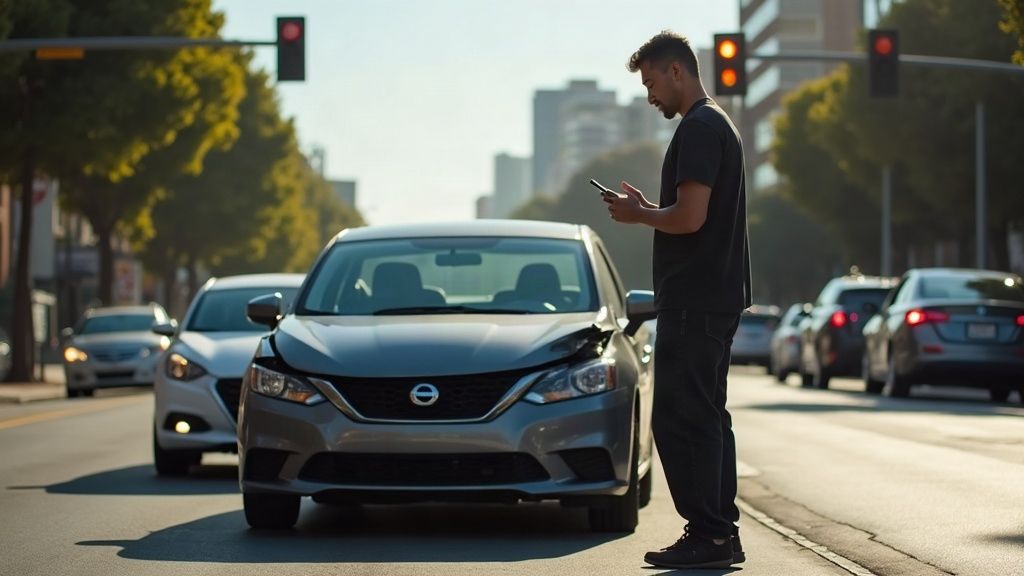
If you drive for Uber or Lyft in California and you have been in a car accident, the next 48 hours will determine whether you recover full compensation or walk away with a fraction of what you are owed. Rideshare crashes are not handled like ordinary car accidents. Up to three separate insurance policies can be in play at once, the coverage available changes depending on what you were doing inside the app at the exact moment of impact, and the insurers on all sides have strong financial incentives to pay as little as possible.
We have seen injured rideshare drivers leave tens of thousands of dollars on the table because they made one or more of the mistakes below. Every item on this list comes from real claims patterns in California. Read each one carefully, because the mistakes compound quickly.
Here is a quick summary of all 10:
- Not confirming which insurance period they were in when the crash happened
- Assuming the rideshare company's policy automatically covers everything
- Failing to notify their personal auto insurer at all
- Not documenting whether a passenger was in the vehicle at the time
- Giving a recorded statement before understanding which policy applies
- Continuing to drive for the app before the vehicle is inspected
- Not saving the trip receipt or app screenshots showing their status
- Overlooking their own injury claim because they assume gig work is not covered
- Accepting a quick settlement without checking all applicable coverage layers
- Not asking how a multi-policy claim affects their long-term ability to drive for the app
1. Not Confirming Which Insurance Period Applies
California law divides rideshare driving into three coverage periods, and the period you were in when the crash happened determines which insurance policy responds to your claim.
California Insurance Code §11580.01 requires transportation network companies (TNCs) like Uber and Lyft to carry specific minimum coverage tied to distinct app states:
- Period 1: App is on, driver is waiting for a match. TNC contingent liability coverage of at least $50,000 per person / $100,000 per occurrence / $30,000 property damage applies, but only if the driver's personal policy does not cover the loss.
- Period 2: A ride request has been accepted and the driver is on the way to pick up the passenger. TNC primary liability coverage of at least $1,000,000 applies.
- Period 3: A passenger is in the vehicle. TNC primary liability of at least $1,000,000 applies.
If your app was off, none of the TNC coverage applies at all. Your personal auto policy is the only policy in play.
The first thing you must establish, and document, is precisely which period you were in. Request a copy of your trip log from the app immediately after the crash. That timestamp is everything.
2. Assuming the Rideshare Company's Policy Covers Everything
During Period 3, when a passenger is in the vehicle, Uber and Lyft each carry up to one million dollars in third-party liability coverage, but that amount drops significantly during Period 2 and Period 1.
Many drivers assume the rideshare company's million-dollar policy backstops every crash. It does not. During Period 1, the TNC policy is contingent and subject to deductibles that often exceed $2,500. During Period 2, coverage is primary, but it covers third-party liability, not necessarily first-party damage to your vehicle or your own medical bills.
Uber and Lyft also carry contingent comprehensive and collision coverage during Periods 2 and 3, but only if your personal policy carries the same coverage first. If your personal policy excludes TNC use, the contingent collision coverage may not trigger at all.
Read both your personal policy and the TNC's posted insurance summary before you are in a crash, not after. If you already have a crash, pull both documents immediately and compare the exclusion language side by side.
Takeaway: The rideshare company's coverage has gaps. Knowing exactly where they are before you speak to any adjuster protects your rights.
3. Failing to Notify Your Personal Auto Insurer
California Insurance Code §11580.1 allows personal auto insurers to exclude coverage during TNC activity, but your duty to report an accident under your personal policy still exists regardless of which policy you believe is primary.
Every personal auto policy includes a prompt-notification clause. If you delay reporting the crash because you believe the TNC policy covers it, and the TNC later disputes the period or denies the claim, you may find your personal insurer also denies coverage on late-notice grounds.
Notify your personal insurer within 24 hours of the crash. State the facts plainly. Do not speculate about fault. Do not instruct them to close the claim because you think TNC coverage applies. Let the coverage-coordination process play out with both insurers informed.
Takeaway: Reporting to your personal insurer costs nothing and preserves your rights. Silence costs you a policy you paid for.
4. Not Documenting Whether a Passenger Was in the Vehicle
The presence or absence of a passenger at the moment of impact is not just a factual detail. It is the single fact that moves you between Period 2 and Period 3, a distinction that can affect available coverage limits and which insurer is primary.
Document this at the scene:
- Take a photo of the backseat showing whether it is occupied.
- Get the passenger's name, phone number, and any statement they are willing to give.
- Note the time on your app and on your phone clock.
- If there are witnesses, ask them whether they saw a passenger exit the vehicle.
If a passenger was present, they may also have their own injury claim, which adds a layer of complexity to how the million-dollar liability policy is allocated. Knowing from day one that a passenger was on board lets your attorney protect the coverage before the passenger's attorney takes the lead.
Takeaway: A timestamped photo of your backseat taken immediately after the crash is worth more than a later verbal account.
5. Giving a Recorded Statement Before Understanding Which Policy Applies
You have no legal obligation to give a recorded statement to a third-party insurer before you have confirmed which policy governs your claim.
Third-party adjusters, meaning adjusters for the other driver's insurer, will often call within hours of a crash and request a recorded statement. They are trained to ask questions in a way that pins down your account before you have reviewed the evidence. Statements given at that stage can be used across all applicable policies, including policies you have not yet identified.
Your own insurer is different. Your personal policy likely contains a cooperation clause that requires you to cooperate with their investigation, which may include a recorded statement to them. Read your policy carefully. But even under a cooperation clause, you are entitled to review the facts and consult with an attorney before you record.
There is no California statute that requires you to give a recorded statement to a third-party adjuster on demand. Decline politely and in writing. Say that you are reviewing the applicable coverage and will respond through counsel.
Takeaway: One poorly worded sentence in a recorded statement can collapse coverage across multiple policies. Wait until you know which policies apply.
6. Continuing to Drive After the Crash Without a Vehicle Inspection
California Vehicle Code §20002 requires a driver involved in a property-damage accident to stop, locate the other party, and exchange information. That is your first legal obligation. Your second obligation, under California Vehicle Code §24002, is not to operate a vehicle in an unsafe or unequipped condition.
Returning to the app and taking rides before your vehicle has been inspected creates three problems:
- If the vehicle causes a second accident while in a damaged condition, you may face personal liability arguments that your insurer and the TNC will use to dispute coverage.
- Crash evidence, including paint transfer, impact geometry, and airbag sensor data, degrades or disappears once the vehicle is driven. That evidence is often essential to establishing fault.
- Continuing to drive may be construed as evidence that you did not believe the vehicle was significantly damaged, which can be used against you in a property damage dispute.
Take the vehicle out of service. Have it inspected before you log back into the app.
Takeaway: A post-crash inspection protects the evidence and protects your coverage. Take yourself offline until it is done.
7. Not Saving the Trip Receipt or App Screenshots
Saving the app's GPS timestamp and trip status at the exact moment of the crash is the primary evidence that determines which insurance period applies to your accident.
The Uber and Lyft apps generate a continuous log of your activity: when you logged in, when you accepted a ride, when the passenger entered the vehicle, and when the trip ended. That log is the authoritative record of which coverage period applies. The problem is that data can become inaccessible if the trip resets, your account is deactivated as part of an accident review, or the app updates.
Within minutes of the crash, before you do anything else:
- Screenshot your current trip status.
- Screenshot the trip receipt showing the pickup time and GPS path.
- Email those screenshots to yourself with a timestamp.
- Request the full trip data from the app's support portal in writing.
If the TNC later disputes which period you were in, your own preserved screenshots are independent corroboration of the app's internal records.
Takeaway: The app's trip log is the most powerful evidence in a rideshare insurance dispute. Capture it before it disappears.
8. Overlooking Your Own Injury Claim
Rideshare drivers who are injured in a crash may have claims under a TNC occupational accident policy, personal uninsured or underinsured motorist coverage, or in limited circumstances a workers' compensation claim.
Because rideshare drivers are classified as independent contractors under California law (see the ongoing legal framework established by Proposition 22 for app-based drivers), traditional workers' compensation coverage through the TNC is generally unavailable. However, Uber and Lyft are required under California law to provide an occupational accident policy for drivers actively using the app. Those policies typically cover medical expenses and disability benefits up to specified limits.
In addition, if the at-fault driver carries insufficient liability insurance, your personal uninsured or underinsured motorist (UM/UIM) coverage may respond. Uninsured motorist coverage is mandatory under California Insurance Code §11580.2 unless waived in writing. If you never waived it, it is likely on your policy.
Finally, if you were driving for a company-owned vehicle or in a specific employer-driver arrangement that falls outside the Proposition 22 framework, traditional workers' compensation under the California Labor Code §3700 may apply. An attorney who handles both personal injury and workers' compensation can evaluate which avenue applies to your specific situation.
Takeaway: Do not assume your injuries are not covered because you are a gig worker. Multiple coverage sources may apply, and none of them are automatic.
9. Accepting a Quick Settlement Without Checking All Coverage Layers
A rideshare accident in California can simultaneously involve your personal auto policy, the TNC's commercial policy, the at-fault driver's liability policy, and your own UM/UIM coverage. Each policy is a separate source of recovery. Settling with one without identifying the others is one of the most expensive mistakes a rideshare driver can make.
California Insurance Code §11580.1 governs stacking and coordination of coverage. Once you accept a settlement from one insurer and sign a release, that release may bar claims against all parties, not just the settling insurer, depending on how the release is worded. Adjusters know this. They often make early low offers precisely because injured drivers do not know how many policies are available.
Before you sign any release:
- Identify every policy that could respond.
- Get your medical treatment to a point where you understand the full scope of your injuries and costs.
- Have an attorney review the release language.
The results page at Nordanyan Law shows what complete coverage analysis looks like in practice. Cases that appeared to be worth a single policy limit often recovered across multiple layers.
Takeaway: Sign nothing until every applicable policy has been identified and evaluated. A release is permanent.
10. Not Asking How a Multi-Policy Claim Affects Your TNC Account
Filing a claim against the rideshare company's commercial policy can trigger an internal review of your driver account. Uber and Lyft both reserve the right to deactivate drivers while safety reviews are pending. If a claim is resolved against you as the at-fault driver, deactivation may become permanent in some circumstances.
This does not mean you should avoid filing a legitimate claim. It means you should understand the process before you begin it, so you document the crash in a way that accurately reflects fault and protects your account status.
Specifically:
- File a detailed crash report with law enforcement and, where required, a DMV SR-1 before the TNC's internal review begins.
- Preserve all evidence showing the other party's fault, including the police report, witness statements, and the other driver's insurance information.
- If the TNC deactivates your account during the review, consult an attorney promptly. California courts have addressed the arbitration clauses in TNC driver agreements, and your remedies may be broader than the deactivation notice implies.
Takeaway: A well-documented, fault-clear claim protects your legal rights and gives you the strongest possible position if your account is reviewed.
What to Do Right Now If You Were in a Rideshare Accident
If you drive for Uber or Lyft and you have been in a crash, the steps that matter most in the first 24 hours are:
- Confirm and preserve which app period you were in.
- Photograph the vehicle interior and exterior before anything is moved.
- Notify both your personal insurer and the TNC through their accident reporting channels.
- Do not give a recorded statement to any third-party adjuster.
- Call an attorney before you accept any offer or sign any document.
We handle both personal injury and workers' compensation claims for injured California workers, including rideshare drivers navigating multi-policy crashes. A free case review takes about 15 minutes and costs nothing. No fee unless we win.
Call (818) 794-9947 today.
Frequently Asked Questions
What should a rideshare driver do after a car accident in California?
Document which app period you were in at the time of the crash, photograph the scene and vehicle, notify both your personal insurer and the TNC within 24 hours, preserve all app screenshots showing your trip status, and consult an attorney before giving any recorded statement or accepting any settlement offer.
Does Uber or Lyft insurance cover the driver in an accident?
It depends on the period. During Period 3 (passenger on board) and Period 2 (ride accepted, on the way to pickup), Uber and Lyft each provide primary liability coverage of up to $1,000,000 under California Insurance Code §11580.01. During Period 1 (app on, waiting for a match), TNC coverage is contingent and lower. When the app is off, no TNC coverage applies.
Can a rideshare driver file a claim against a passenger's insurer?
Generally, no. A passenger is not liable for the driver's crash unless the passenger caused or contributed to the accident through their own conduct. However, if a passenger is injured and files a claim against the driver, that claim flows through the TNC's liability policy during Periods 2 and 3.
Is a rideshare driver's own insurance involved after a crash?
Yes, potentially. Your personal policy may respond if the app was off, if TNC coverage is disputed, or if you carry uninsured or underinsured motorist coverage that provides benefits when the at-fault driver's limits are insufficient. California Insurance Code §11580.2 makes UM/UIM coverage mandatory unless the insured waives it in writing.
What happens to my Uber or Lyft account if I file an insurance claim?
Filing a claim against the TNC's commercial policy can trigger an internal safety review and, in some cases, temporary deactivation. Documenting fault clearly and promptly gives you the strongest position in any account review. If you are deactivated while a legitimate claim is pending, consult an attorney about your options.
Do rideshare drivers qualify for workers' compensation in California?
Most rideshare drivers are classified as independent contractors under the Proposition 22 framework and are not covered by traditional workers' compensation through the TNC. However, Uber and Lyft are required to provide occupational accident policies for drivers injured while the app is active. If your specific driving arrangement falls outside the Proposition 22 structure, workers' compensation coverage under California Labor Code §3700 may apply.
How long do I have to file a claim after a rideshare accident in California?
For personal injury claims against another driver, California's statute of limitations is generally two years from the date of injury under California Code of Civil Procedure §335.1. Claims against a government entity require a government tort claim within six months. Do not wait near the deadline. Evidence and witness recollections degrade, and the insurer's early offers often expire.
Reviewed by Minas Nordanyan, CA Bar #296806. This article is for general informational purposes and does not constitute legal advice. Coverage determinations depend on your specific policy language, the facts of your accident, and applicable California law. Call (818) 794-9947 for a free case review.