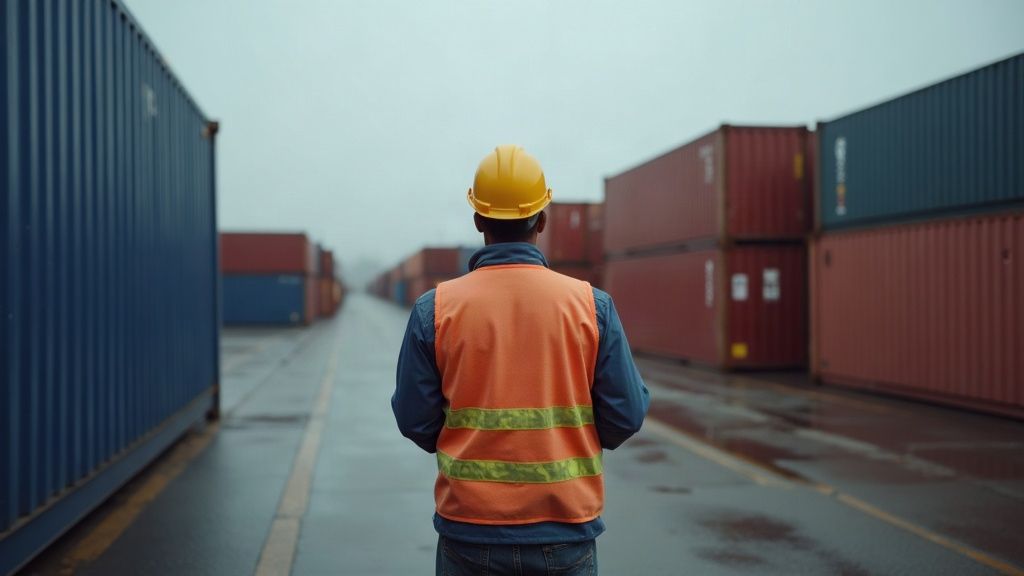
If you were hurt at the Port of Long Beach, the Port of Los Angeles, or any other California marine terminal, you are facing a question that stops many injured workers cold: which law actually covers your injury? California workers' comp? The federal Longshore and Harbor Workers' Compensation Act? Both? Neither?
The answer depends on exactly where you were standing when you got hurt, and exactly what job you were doing at that moment. Get it wrong and you may chase the wrong claim, miss the right deadline, and walk away with far less than you deserve.
We've recovered over $150,000,000 for injured workers in Southern California. We handle these cases. This article explains the two-system framework so you understand your options before you call anyone.
If you need to talk through your specific facts today, call (818) 794-9947. Free consultation. No fee unless we win.
Quick Answer (TL;DR)
- Two separate workers' comp systems can apply to port and dock injuries: California's state system under the California Labor Code and the federal Longshore and Harbor Workers' Compensation Act.
- Longshore Act coverage requires passing a "situs" test (where you were hurt) AND a "status" test (what you were doing).
- Seamen, vessel crew members, and masters are excluded from the Longshore Act and fall under the Jones Act instead.
- In many California port-injury situations, both systems overlap, and you can pursue either path.
- If you recover under both, the Longshore Act credit provision prevents a true double recovery.
- Deadlines are different under each system, and missing one can be fatal to that claim.
Two Systems Cover the Same Dock, and Which One Pays Is Not Obvious
A warehouse clerk working inside a Long Beach container terminal building, a crane operator loading a ship, and a truck driver waiting at the gate are all, in a very real sense, "at the port." But the law that covers their injuries may be completely different.
California workers' compensation, governed by the California Labor Code, was built for most on-the-job injuries in this state. The DWC (Division of Workers' Compensation) administers it, and Cal. Lab. Code §3600 makes an employer liable for benefits when an employee is injured in the course of employment.
The federal Longshore and Harbor Workers' Compensation Act (LHWCA), codified at 33 U.S.C. §901 et seq., is a separate federal workers' comp system. It was created specifically for maritime workers who are not seamen, covering injuries that happen on or near navigable waters. The U.S. Department of Labor's Office of Workers' Compensation Programs administers it, not the California DWC.
For most injured workers, only one of these two systems applies. For some port and dock workers in California, both apply at the same time. That overlap is called concurrent jurisdiction, and it matters enormously for your recovery.
The Situs Test: Where You Were Hurt
The first question the Longshore Act asks is geographic. Under 33 U.S.C. §903(a), the Act covers injuries that occur on the navigable waters of the United States, including any adjoining pier, wharf, dry dock, terminal, building way, or marine railway.
That list is broader than most people realize. You do not have to fall into the ocean or even set foot on a vessel. If you were hurt on a pier, a wharf, a dry dock, a container terminal, or a marine railway, you may already satisfy the situs test.
What counts as a covered situs:
- A pier or wharf extending over navigable water
- A dry dock facility where ships are repaired
- A marine terminal, including indoor buildings within the terminal where cargo is stored or processed
- A building way used in ship construction or repair
What does NOT count:
- A purely inland warehouse with no functional connection to maritime commerce
- A parking lot or administrative office building that is adjacent to a port but not part of the terminal's operational footprint
- A street or public right-of-way adjoining a port facility
The boundary between a covered situs and a non-covered situs is called the Jensen line, named after a 1917 Supreme Court case. Injuries that happen clearly landward of this line, away from navigable waters and not on a covered structure, typically fall under California workers' comp alone, not the Longshore Act.
The Status Test: What You Were Doing
Passing the situs test is not enough on its own. The Longshore Act also requires that the worker was engaged in maritime employment at the time of the injury. This is the status test, and it comes from 33 U.S.C. §902(3).
The statute defines maritime employment to include longshore workers, ship repairers, shipbuilders, ship breakers, and harbor workers. Courts have interpreted this list to cover a wide range of people who handle, move, or process cargo in connection with vessels.
Workers who typically satisfy the status test:
- Longshoremen loading and unloading cargo
- Crane operators working on a dock or terminal
- Ship repairers and shipfitters working on vessels in dry dock
- Cargo checkers and dock clerks whose work is functionally tied to vessel cargo operations
- Warehouse workers inside a marine terminal who handle cargo in transit between vessel and shore
Workers who typically do NOT satisfy the status test:
- Security guards whose job is unrelated to maritime cargo operations
- Office workers in a port-adjacent building who perform only administrative tasks
- Retail workers in a port area restaurant or gift shop
- Construction workers building or renovating a port facility (who are not building a vessel)
If you work at a California port and are unsure whether your job title qualifies, the specific nature of what you do day to day matters more than your job title. A dock superintendent who primarily supervises maritime cargo operations is more likely to qualify than a supervisor whose role is purely administrative.
Who Is Expressly Excluded: Vessel Crew Members and the Jones Act
There is one category of maritime worker who is explicitly excluded from the Longshore Act, and that is a master or member of a crew of any vessel. This exclusion is in 33 U.S.C. §902(3) itself.
If you are a seaman, a captain, an engineer, a deckhand, or any other person whose employment contributes to the function and mission of a vessel in navigation, you are a Jones Act seaman. Your injury claims arise under the Jones Act, 46 U.S.C. §30104, which is a completely different federal statute with different rules, different procedures, and in many cases the ability to sue in court rather than through an administrative claims process.
The practical distinction matters because:
- Seamen under the Jones Act can often sue their employer directly in federal court for negligence.
- Longshore Act claimants proceed through a federal administrative process, not a traditional lawsuit.
- California workers' comp runs on its own administrative track through the WCAB (Workers' Compensation Appeals Board).
If your employer is telling you that you are a Jones Act seaman when you primarily work on the dock, that classification may be wrong, and the distinction has enormous financial consequences. This is one of the first things we look at when a port or dock worker calls us.
Concurrent Jurisdiction: When Both Systems Apply
The 1972 amendments to the Longshore Act deliberately extended coverage landward, into the piers, wharves, and terminals adjacent to navigable waters. Those amendments did NOT eliminate California workers' comp for injuries in those same areas. Instead, they created a zone of concurrent jurisdiction.
This means a cargo checker injured on a Long Beach terminal wharf may have a valid claim under BOTH the Longshore Act AND California workers' comp. That is not a loophole or an accident. It is the result of Congress choosing to supplement state law rather than replace it.
For an injured worker, concurrent jurisdiction is valuable because:
- Each system has different benefit structures, and one may pay more for a particular type of disability.
- Each system has different procedural paths, and one may be faster or more favorable depending on the injury.
- Having both options gives you and your attorney leverage in how the case is structured.
Concurrent jurisdiction does NOT mean you collect full benefits twice. See the section on the credit provision below.
How the Credit Provision Works: No Double Recovery
33 U.S.C. §903(e) provides that if a worker receives compensation under a state workers' comp law for the same injury, that amount is credited against any Longshore Act award. The employer or its insurance carrier is credited for state comp payments already made.
Here is what that means in plain terms:
Say a dock worker is injured and receives $40,000 in California workers' comp benefits. If that same worker later obtains a Longshore Act award of $90,000, the employer gets a credit of $40,000, and the net additional payment under the Longshore Act is $50,000. The total recovery is $90,000, not $130,000.
The credit runs in one direction only. State comp paid out is credited against Longshore awards. This prevents a true windfall, but it does not prevent you from recovering under the system that ultimately pays the most. Because the two systems have different benefit rates and different methods for calculating permanent disability, the system that produces the higher number varies from case to case.
Figuring out which system maximizes your total recovery is exactly the kind of analysis you need a workers' comp attorney to run before you file.
Deadlines and Benefit Levels: The Two Systems Are Different
Deadlines
California workers' comp:
- Under Cal. Lab. Code §5400, you must give your employer written notice of a work injury within 30 days.
- Under Cal. Lab. Code §5405, the deadline to file a workers' comp claim is generally one year from the date of injury. However, the clock can also run from the last date employer-provided benefits were furnished or the date a disability period ends, depending on the circumstances.
- For cumulative trauma injuries, the discovery rule under Cal. Lab. Code §5412 starts the clock when the worker first suffered disability AND knew or should have known it was work-related.
Longshore Act:
- Under 33 U.S.C. §913(a), the deadline to file a Longshore claim is one year from the date of injury, or one year from the date the worker knew or should have known the injury was work-related for occupational disease claims.
- An employer who has actual knowledge of an injury and pays voluntary benefits can extend this period under certain conditions, but do not count on that protection.
Missing either deadline can terminate your rights under that specific system entirely. If you work at a California port and have any uncertainty about where your deadlines stand, call us at (818) 794-9947 today.
Benefit Levels
The Longshore Act and California workers' comp calculate benefits differently, and neither system is universally better for every injured worker.
Temporary disability:
- California workers' comp pays two-thirds of the worker's average weekly wage, subject to a maximum set annually by the state under Cal. Lab. Code §4653.
- The Longshore Act also pays two-thirds of the average weekly wage under 33 U.S.C. §908(b), but its maximum and minimum rates are set by the federal government and differ from California's caps. For higher-wage maritime workers, the federal maximum is sometimes higher.
Permanent disability:
- California uses a Permanent Disability Rating system based on the AMA Guides (Fifth Edition), modified by occupational and age adjusters, under Cal. Lab. Code §4660.1.
- The Longshore Act uses a schedule of compensation for specific injuries under 33 U.S.C. §908(c) and calculates permanent total and partial disability differently, often in ways that are more favorable for severe injuries.
Medical care:
- California workers' comp provides medical care through a Medical Provider Network (MPN) selected by the employer or insurer, with QME (qualified medical evaluator) processes for disputed injuries under Cal. Lab. Code §4062.
- The Longshore Act provides for medical treatment directed at the worker's choice of physician initially, with the employer having the right to direct care in some circumstances.
The right choice is not always obvious from the outside. For a severely injured dock worker, the Longshore Act's permanent disability schedule may pay substantially more. For a worker with a moderate injury in a high-wage job, the differences may be smaller. This is not a decision to make without an attorney who knows both systems.
What This Means for Long Beach Port Workers Specifically
The Port of Long Beach and the Port of Los Angeles together form the largest port complex in the United States. Tens of thousands of workers, in dozens of job categories, work at these terminals every day. Many of them are International Longshore and Warehouse Union (ILWU) members, with collective bargaining agreements that add another layer of complexity to their injury claims.
Long Beach workers' compensation lawyers at our firm see these cases regularly. The port environment creates specific injury risks:
- Crane and rigging failures
- Container handling equipment accidents
- Falls on wet or uneven terminal surfaces
- Forklift and yard tractor collisions
- Crush injuries from shifting cargo
- Repetitive trauma from longshore work over time
If a Long Beach port or dock injury brought you to this article, the concurrent-jurisdiction issue is almost certainly relevant to your case. The situs test is easy to satisfy on a Long Beach wharf. The status test depends on what you were doing. And the question of which system maximizes your recovery requires a case-specific analysis.
The Most Important Step: Get Your Case Analyzed Before You Choose a Path
A California port or dock worker who is injured on a pier, wharf, marine terminal, or other navigable-waters-adjacent structure may be covered by the federal Longshore and Harbor Workers' Compensation Act rather than, or in addition to, California workers' comp.
To qualify for Longshore Act coverage, a worker must satisfy both a situs test, meaning the injury happened on a covered location under 33 U.S.C. §903(a), and a status test, meaning the worker was engaged in maritime employment under 33 U.S.C. §902(3).
In many port and dock injury situations in California, both federal Longshore coverage and state workers' comp coverage apply at the same time, giving the injured worker more than one path to benefits.
Any amount recovered under California workers' comp is credited against a Longshore Act award for the same injury, so collecting under both systems does not produce a double recovery.
Seamen who are masters or members of a vessel's crew do not qualify for the Longshore Act and must bring their claims under the Jones Act instead.
The Longshore Act's filing deadline is one year from the date of injury, while California workers' comp requires reporting the injury to your employer within 30 days and filing a claim within one year of the injury date.
Choosing the wrong system, missing a deadline under the right one, or accepting an employer's characterization of your job without scrutiny can cost you hundreds of thousands of dollars over the life of your injury claim.
We have recovered over $150,000,000 for injured workers across Southern California. Every injured worker deserves the same quality of legal representation as any corporation. That is the principle this firm was built on.
If you were hurt at a California port, marine terminal, or dock, call (818) 794-9947 for a free consultation. No fee unless we win.
Frequently Asked Questions
Am I covered by the Longshore Act or California workers' comp?
You may be covered by one or both, depending on where you were hurt and what you were doing. The Longshore Act applies when you satisfy both the situs test, meaning the injury happened on a covered location such as a pier, wharf, dry dock, or marine terminal under 33 U.S.C. §903(a), and the status test, meaning you were engaged in maritime employment under 33 U.S.C. §902(3). California workers' comp under Cal. Lab. Code §3600 applies to work injuries that happen in California employment. In many port and dock injury situations, both systems have concurrent jurisdiction.
Can I file both a Longshore claim and a California workers' comp claim?
You can pursue claims under both systems when concurrent jurisdiction exists. However, under 33 U.S.C. §903(e), any benefits you receive under California workers' comp are credited against your Longshore Act award for the same injury. You collect the higher of the two, not the full amount of both combined.
Does the Longshore Act cover warehouse workers at a port terminal?
It can. If the warehouse is located within a marine terminal that qualifies as a covered situs under 33 U.S.C. §903(a), and the worker's duties are functionally tied to maritime cargo operations, the warehouse worker may satisfy both the situs and status tests. A purely inland warehouse with no functional connection to vessel cargo operations would not qualify.
What does the Longshore Act pay that California workers' comp does not?
The Longshore Act and California workers' comp use different formulas and different caps. For some severely injured maritime workers, the Longshore Act's permanent disability schedule under 33 U.S.C. §908(c) produces higher compensation than California's permanent disability rating system. The Longshore Act also sets its own maximum temporary disability rate independent of California's cap. Whether the Longshore Act pays more in a specific case depends on the nature of the injury, the worker's wages, and how each system calculates the permanent impairment.
What is the deadline to file a Longshore Act claim?
Under 33 U.S.C. §913(a), the filing deadline is one year from the date of injury, or for occupational diseases, one year from the date the worker knew or should have known the condition was work-related. California workers' comp separately requires notice to your employer within 30 days under Cal. Lab. Code §5400 and a claim filing within one year under Cal. Lab. Code §5405.
I work on a vessel crew. Does the Longshore Act cover me?
No. Under 33 U.S.C. §902(3), masters and members of a vessel's crew are expressly excluded from the Longshore Act. If you are a seaman whose work contributes to the mission of a vessel in navigation, your injury claims arise under the Jones Act, 46 U.S.C. §30104, not the Longshore Act.
My employer says I am only covered by California workers' comp. Is that right?
It may or may not be. Employers sometimes mischaracterize coverage, whether deliberately or because their own understanding of the situs and status tests is incomplete. If you were injured at or near navigable waters and your work involves maritime cargo operations, you may have federal Longshore Act rights regardless of what your employer tells you. An attorney familiar with both systems can evaluate your specific facts.
Can I choose which system to use?
When both systems apply, you generally have the ability to pursue the system that produces the better result for your specific injury. This is one reason why a case-specific analysis before you file is so important. Filing under the wrong system first can complicate your ability to maximize recovery under both.
What if my injury happened on a vessel that was docked?
A vessel that is docked and secured to a pier is typically considered to be in navigation for Jones Act purposes if it is a functioning vessel. Workers who are crew members of that vessel would be covered by the Jones Act, not the Longshore Act. Workers who are longshore workers loading or unloading cargo from the docked vessel may be covered by the Longshore Act, California workers' comp, or both, depending on the situs and status analysis.
How do I know which attorney to hire for a port injury case?
You need an attorney who is familiar with both the California workers' comp system administered by the DWC and the federal Longshore Act process. These are separate legal systems with different deadlines, different benefit calculations, and different administrative procedures. An attorney who handles only California workers' comp cases or only maritime claims may miss the overlap. Call (818) 794-9947 to speak with our team and get a free evaluation of which system or combination of systems applies to your situation.
Reviewed by Minas Nordanyan, CA Bar #296806. This article is for general information only and does not create an attorney-client relationship. The law governing specific port and dock injury claims depends on the precise facts of each case. Call (818) 794-9947 for a free consultation.