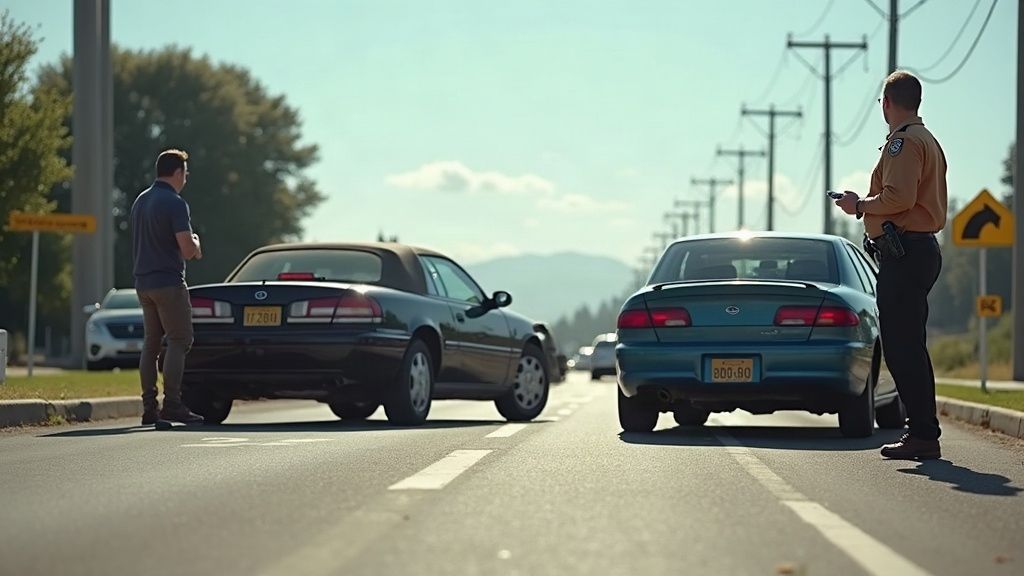
If you've been in a car accident in California, the other driver's insurance company will work hard to minimize what they pay you. One of the most powerful tools on your side is someone who saw the crash and has no reason to favor either party: an eyewitness.
Getting a useful witness statement means asking the right questions in the right order, starting at the scene and continuing through your attorney's follow-up months later. This guide walks you through all nine steps.
Here is a quick summary of every question and approach covered below:
- Why eyewitness accounts can make or break a disputed claim
- How to approach a witness calmly at the scene
- Key questions about what they actually saw versus assumed
- Getting their contact information and confirming accuracy
- Asking about their vantage point and distance from the crash
- Questions about traffic signals, speed, and driver behavior observed
- Why it helps to ask them to write or record their account immediately
- How to locate witnesses if you didn't get information at the scene
- How your attorney can follow up with witnesses later in the claim
1. Why Eyewitness Accounts Can Make or Break a Disputed Claim
In a disputed California car accident, a neutral eyewitness is often the single most persuasive piece of evidence you can have.
When two drivers tell opposite stories about who ran the red light or who changed lanes without signaling, the insurer's adjuster has to decide whom to believe. A neutral third party who saw the collision with no financial stake in the outcome tips that balance in a way that physical evidence alone often cannot.
California uses a pure comparative fault rule, which means the percentage of fault assigned to each driver directly determines how much compensation you can recover.
Under California Civil Code §1714, each party is responsible for damages in proportion to their share of fault. A single credible witness who places the other driver at fault for 80% of the crash is worth tens of thousands of dollars in a serious injury case. Without that witness, an adjuster may split fault 50/50 or worse.
Practical takeaway: Securing even one neutral eyewitness account is worth the two minutes it takes to ask at the scene.
2. How to Approach a Witness Calmly at the Scene
Most people who see a car accident are willing to help, but they are also in a hurry and do not want to be pressured. How you approach them determines whether they stay or walk away.
Step toward them, make eye contact, and introduce yourself by first name. Say something straightforward: "Hi, I'm one of the drivers. Did you happen to see what happened? I just need a couple of minutes." Keep your voice calm and your body language open. Do not block their path or make them feel trapped.
Avoid asking leading questions immediately, such as "You saw him run the light, right?" A witness who feels coached will either disengage or give a statement that an opposing attorney will later tear apart on cross-examination. Let them tell you what they saw before you ask any specific questions.
Practical takeaway: A calm, neutral introduction gets more cooperation than urgency or anger ever will.
3. Key Questions About What They Actually Saw Versus Assumed
The most important distinction in any witness account is between direct observation and inference. Courts and insurers weigh those two things very differently.
Start with open-ended questions: "What did you see right before the crash?" and "Can you describe what happened from start to finish?" Then, if they say something like "the guy was obviously texting," follow up with: "Did you see his phone in his hand, or is that your impression of how he was driving?" That follow-up separates evidence from opinion.
Questions to ask at this stage include:
- "What were you doing when you noticed the vehicles?"
- "What was the first thing that caught your attention?"
- "Did you see either car before the moment of impact, or did you first notice the collision itself?"
- "Is there anything you are not sure about?"
That last question matters. A witness who volunteers their own uncertainty is far more credible than one who claims to have seen everything perfectly. Defense attorneys look for overconfidence in witness statements and use it to discredit the entire account.
Practical takeaway: Ask what they saw, not what they think, and let them identify their own limits of certainty.
4. Getting Their Contact Information and Confirming Accuracy
A witness account you cannot follow up on is nearly useless. Before the witness leaves, you need their full name, a working phone number, and ideally an email address.
Ask specifically: "Can I get your full name and the best phone number to reach you?" Then read it back to them: "So that's Maria Garcia at 818-555-0147?" People transpose numbers when writing in a hurry, and a single wrong digit means your attorney has no way to reach them.
If they are willing, also ask for their home address or city of residence, not for privacy-invasive reasons, but because if their phone number later becomes unreachable, a skip-trace search by a private investigator starts with a city.
Note the make, model, and license plate of their vehicle if they drove to the scene. That information is a backup locator if their phone number proves wrong.
Practical takeaway: Collect name, phone, and email, read it back before they leave, and note their vehicle as a backup.
5. Asking About Their Vantage Point and Distance from the Crash
A witness who was 200 feet away at an angle behind a parked bus gives a weaker account than one who was standing at the corner 30 feet from the intersection. You need to document both scenarios accurately, because each will be scrutinized.
Ask the witness: "Where were you when the crash happened?" and "About how far away from the vehicles were you?" If they were in a vehicle themselves, ask: "Were you moving or stopped? Which direction were you facing?"
Follow up with: "Was there anything blocking your view, like another car, a sign, or the sun?"
These questions are not designed to undermine the witness. They are designed to document the context of their account accurately so it holds up later. An attorney who knows the witness was at a clear angle with an unobstructed sightline 40 feet from the intersection can argue that testimony confidently. An attorney who does not know those details cannot.
Practical takeaway: Document the witness's exact location, facing direction, distance, and any obstructions before they leave.
6. Questions About Traffic Signals, Speed, and Driver Behavior Observed
These are the questions that directly address the fault analysis. California's pure comparative fault framework makes specific details about signal state, speed, and driver attention especially valuable.
Ask the witness:
- "What color was the light when each car entered the intersection, if you could see it?"
- "Did either vehicle look like it was going faster than the other cars around it?"
- "Did you notice whether either driver seemed distracted, like looking at their phone or away from the road?"
- "Did either driver brake before the impact? Did you hear tires squeal?"
- "What did you hear right before the crash?"
The question about sound matters. A witness who heard a long screech of tires suggests one driver attempted to brake. No squeal at all may suggest a driver who never saw the other vehicle coming. These details map directly onto the negligence analysis under California Civil Code §1714.
Practical takeaway: Ask specifically about signal state, speed, distraction, and braking, because those are the four facts that drive fault percentages in a California collision claim.
7. Why It Helps to Ask Them to Write or Record Their Account Immediately
The best time to get a witness account is at the scene, before anyone leaves, because memories change faster than most people expect.
Research on memory in legal contexts is consistent: the details of an event begin to fade and shift within hours, especially after exposure to other people's accounts, news coverage, or conversations about the event. A witness who sees the other driver and you trading information may unconsciously update their memory to match who appeared calmer or more apologetic.
Ask the witness: "While it's fresh, would you be willing to write down what you saw, or just record a voice memo on your phone?" Most people will do this if you frame it as quick and low-effort. If they are willing to write, give them a clean notepad or have them type into their own phone's notes app. If they prefer, have them record a 60-second voice memo describing what they saw.
Ask them to include: the date and time, their location at the time of the crash, what they saw before and during the impact, and anything that stood out as unusual.
An immediate written or recorded account created by the witness, in their own words, on their own device, is the most reliable version of their testimony. It can be used to refresh their memory at deposition months later, and any deviation between their immediate account and their later statement must be explained.
Practical takeaway: Ask the witness to record a voice memo or write a short note on their phone before leaving the scene.
8. How to Locate Witnesses If You Didn't Get Information at the Scene
Not every accident victim has the physical or mental capacity to collect witness information at the scene. Shock, injury, and confusion are real. If you left without any witness contacts, you still have options.
If you did not get a witness's contact information at the scene, the police report filed after a California collision may list witness names and contact information.
The official California Traffic Collision Report (Form 555), filed by the responding officer with the California Highway Patrol or local law enforcement, often includes the names and contact details of any witnesses who spoke with officers. You can request a copy of this report from the responding agency, typically through their online records request portal or in person. Reports are generally available a few days after the collision.
Additional places to look:
- Business surveillance cameras. If the crash happened near a gas station, parking lot, restaurant, or retail store, their exterior cameras may have captured footage or even recorded the witness on the scene. Visit in person, identify yourself, and ask to speak with the manager. Footage is typically overwritten on a cycle of days to weeks, so act quickly.
- Doorbell and dashcam footage. Nearby residences, rideshare drivers, or truckers with dashcams may have caught the crash or the witness. Your attorney can send formal preservation requests to dashcam owners identified from bystander photos or police records.
- Canvassing the area. If the crash occurred on a residential street or near a business district, it may be worth returning to the location at the same time of day to speak with people who regularly work or pass through the area. Delivery drivers, bus drivers, and shop owners who keep a regular schedule may have seen the crash or know who witnessed it.
- Social media. Local neighborhood groups on platforms like Nextdoor or community Facebook groups sometimes include posts asking whether anyone saw a crash. This approach has no guarantee of success, but it costs nothing.
Practical takeaway: Start with the police report, then move to nearby surveillance footage immediately, because digital footage is deleted on short cycles.
9. How Your Attorney Can Follow Up with Witnesses Later in the Claim
An attorney can send a preservation letter to a witness, formally requesting they hold onto any photos, videos, or notes before those materials disappear.
Collecting a name and number at the scene is the first step. Using that information effectively over the months-long course of a California personal injury claim takes more than a phone call.
An experienced attorney handling a California car accident case can take several formal steps with witnesses:
Preservation letters. A formal letter sent by an attorney to a witness requests that the witness retain any photos, videos, dashcam footage, or written notes related to the collision. It documents the request and creates a record if those materials are later destroyed or lost.
Recorded statements. With the witness's consent, an attorney or their investigator can take a recorded statement that is more detailed and structured than a voice memo taken at the scene. This recorded statement becomes a fixed record of the witness's account that can be used at deposition or trial if the witness's memory later shifts.
Formal depositions. In litigation, an attorney can subpoena a witness for a deposition under California Code of Civil Procedure §2025.010, requiring them to answer questions under oath before a court reporter. A deposition locks in testimony and creates accountability for any later changes to the witness's account.
Private investigators. When a witness becomes difficult to reach, an attorney can retain a licensed California private investigator to locate them using public records and skip-trace databases. This is especially valuable when a witness moved, changed their phone number, or was never fully identified at the scene.
You have two years to file a California car accident lawsuit, but do not wait that long to secure witness statements, because memories and evidence do not keep.
The statute of limitations for a California car accident personal injury claim is two years from the date of injury under California Code of Civil Procedure §335.1. That deadline sounds distant, but insurance negotiations, claim investigations, and demand letters all happen long before any lawsuit is filed. The earlier an attorney preserves witness information, the more valuable that information will be.
If you were injured in a car accident because of someone else's negligence, or if the other driver is disputing fault, the witness information you gathered at the scene is one of the first things your attorney will want to see. At Nordanyan Law, we've recovered over $150,000,000 for injured Californians, and eyewitness accounts have played a role in many of those outcomes.
Call (818) 794-9947 for a free consultation. No fee unless we win.
Frequently Asked Questions
How do I get a witness statement after a car accident?
Ask any witnesses at the scene for their contact information, including full name, phone number, and email. Request that they write down or record a voice memo describing what they saw before leaving. If you are working with an attorney, they can contact the witness directly, take a formal recorded statement, and if necessary, subpoena the witness for a deposition under California Code of Civil Procedure §2025.010.
Are eyewitness accounts important in California car accident claims?
Yes. California uses a pure comparative fault rule under California Civil Code §1714, which means every percentage point of fault affects the value of your claim. A neutral eyewitness who can place the other driver at fault for running a signal or driving distracted can shift that fault allocation significantly, which directly changes your compensation.
What if a witness leaves the scene before I get their information?
Start by requesting the police report (California Traffic Collision Report Form 555), which often lists the names and contact information of any witnesses who spoke with the responding officer. You can also check whether nearby businesses have surveillance cameras that may have captured the witness or the collision itself. An attorney can send formal preservation requests for that footage before it is deleted.
Can a witness statement change over time?
Yes, and this is one of the reasons an immediate written or recorded account is so valuable. Memory is not a fixed recording. It shifts in response to conversations, news coverage, and the passage of time. A witness account recorded at the scene in the witness's own words becomes a fixed baseline. If the witness later changes their story, the original account can be used to challenge that change at deposition or trial.
Do I have to wait for a police report to find witnesses?
No. You can and should collect witness contact information yourself at the scene whenever you are physically able to do so. The police report is a backup resource, not the first step. Officers may not speak with every bystander, and witnesses who leave before officers arrive will not appear on the report.
What questions should I ask a witness at the scene?
Ask what they saw right before the crash, where they were standing or sitting when it happened, how far from the vehicles they were, whether anything blocked their view, what color any traffic signals were, whether either driver appeared to be speeding or distracted, and whether they heard tires squeal before impact. Then ask for their contact information and read it back to confirm accuracy.
Can a witness be deposed in a California car accident case?
Yes. Under California Code of Civil Procedure §2025.010, any person with knowledge of relevant facts can be subpoenaed for a deposition in a civil lawsuit. A deposition requires the witness to answer questions under oath before a court reporter, and the transcript is a formal legal record that can be used at trial.
Is it legal to record a witness at the scene?
California is a two-party consent state under California Penal Code §632, which means recording a private conversation without the other person's consent is generally prohibited. At the scene of a public accident, the analysis can be more complex. The safest approach is to ask the witness directly: "Would you be willing to record a voice memo on your own phone describing what you saw?" That way, the witness creates their own record on their own device, and there is no consent issue.
Reviewed by Minas Nordanyan, CA Bar #296806. Last reviewed 2026-10-18. This article is for general informational purposes and does not constitute legal advice. For guidance specific to your situation, call (818) 794-9947 for a free consultation.