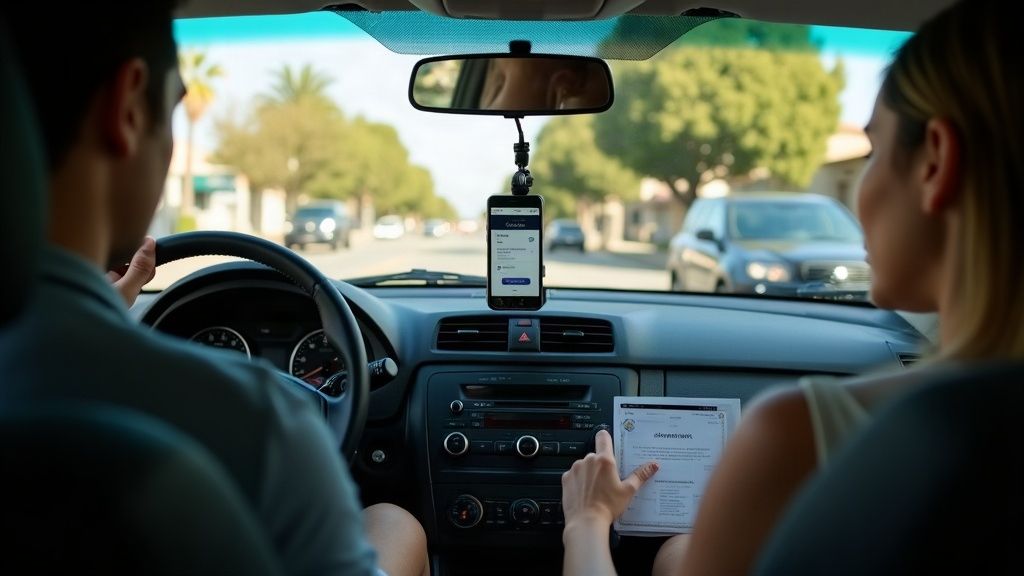
If you drive for Uber or Lyft in California, the amount of insurance covering you can swing from zero to one million dollars depending on a single variable: what the app says at the moment of an accident. That variable is the coverage period, and most drivers do not learn how it works until a claim gets denied.
We've recovered over $150,000,000 for injured workers and accident victims in Southern California. Rideshare coverage disputes are some of the most complicated injury claims we see, because two or more insurers often blame each other while the driver waits without payment. This guide breaks down exactly how the four coverage periods work, where the gaps are, and what to do if you fall into one.
Here are the 8 things every California Uber and Lyft driver needs to know:
- The four rideshare coverage periods and how insurance shifts in each
- Period 0: app off means personal policy only
- Period 1: app on but no ride accepted creates a real coverage gap
- Periods 2 and 3: TNC's $1,000,000 policy applies
- Personal auto policies commonly exclude rideshare driving
- Your rideshare company's insurance addendum has terms you must read
- Steps to take immediately if you're hurt during a coverage gap
- When competing insurers require a lawyer to sort out
1. The Four Periods of Rideshare Driving and How Coverage Changes in Each
California law divides TNC driving into four coverage periods, and a different insurance policy applies in each one.
California's Public Utilities Commission (PUC) and state statutes structure TNC (transportation network company) insurance around four named periods, each tied to what the app shows at the moment of an incident:
- Period 0: App is closed or you are logged out entirely.
- Period 1: App is open and you are available to accept rides, but no request has been matched yet.
- Period 2: A ride request has been accepted and you are driving to pick up the passenger.
- Period 3: The passenger is in the vehicle, from pickup to drop-off.
The coverage available to you, your vehicle, and anyone you injure shifts dramatically across these four windows. Getting the period wrong in a claim is not a paperwork issue. It is the difference between a covered loss and a denial letter.
Takeaway: Identify and document the period immediately after any accident. A screenshot of the app status is your first piece of evidence.
2. Period 0: App Off, Personal Policy Only
When the Uber or Lyft app is closed and you are not logged in as an available driver, you are operating as a private individual. No TNC insurance applies. Your personal auto policy is the only coverage in force.
This matters more than it sounds. Drivers sometimes assume the TNC's policy follows them whenever the car is associated with a rideshare account. It does not. The TNC's insurance is triggered by app status, not vehicle registration.
Under Cal. Ins. Code §11580.1, personal auto policies issued in California must provide minimum liability coverage for private use. During Period 0 that minimum floor applies normally. If you carry collision or comprehensive coverage on your personal policy, those also apply in Period 0 without restriction, provided the policy does not contain a broader exclusion for commercial vehicle use that extends to Period 0 driving.
Takeaway: Period 0 is the one window where TNC coverage is irrelevant. Keep your personal policy limits high enough to protect you even when the app is off.
3. Period 1: App On, Waiting for a Ride Request
During Period 1, when the app is on but no ride has been accepted, California requires TNCs to carry at least $50,000 per person in liability coverage, but your personal auto insurer may still deny the claim.
Period 1 is the most dangerous coverage window for California rideshare drivers, and it is where most coverage disputes begin.
California Public Utilities Code §5431 requires TNCs to maintain the following minimum liability coverage during Period 1:
- $50,000 per person for bodily injury
- $100,000 per accident for bodily injury
- $30,000 for property damage
These minimums are higher than the state's standard personal auto minimums, but they come with an important catch. The TNC's Period 1 coverage is typically contingent, meaning it only pays after your personal policy's limits are exhausted. If your personal insurer denies the claim because of a commercial-use exclusion (see Item 5), the TNC's contingent policy may still pay, but the insurer may dispute whether the exclusion was properly applied and delay payment while that dispute is sorted out.
Additionally, the statutory minimums for Period 1 do not include uninsured motorist (UM) or underinsured motorist (UIM) coverage. If you are struck by an uninsured driver while waiting for a request, your UM/UIM protections during Period 1 depend on whether the TNC's policy or your personal policy provides them and whether either policy's exclusions apply.
Takeaway: Period 1 is the gap. The TNC's limits are low, the coverage is often contingent, and your personal policy may deny the claim. Understand this before your next shift.
4. Periods 2 and 3: En Route and During a Ride, TNC Coverage Applies
During Periods 2 and 3, Uber and Lyft must carry at least one million dollars in third-party liability coverage under California Public Utilities Code Section 5431.
Once you accept a ride request (Period 2) or have a passenger in the vehicle (Period 3), California law requires a substantially higher level of coverage.
Under Cal. Pub. Util. Code §5431, TNCs must carry:
- At least $1,000,000 in third-party liability coverage per occurrence
- Uninsured motorist and underinsured motorist coverage in the same amount
This is the period where the TNC's policy is typically primary, meaning it pays before your personal policy is implicated. The $1,000,000 limit is designed to protect passengers, injured third parties, and drivers alike from catastrophic losses.
Uber's and Lyft's published insurance summaries confirm these minimums, and both companies carry commercial umbrella layers above the statutory floor. However, the $1,000,000 applies to the total accident, not per injured person. In a multi-vehicle collision with multiple injuries, that limit can be allocated across many claimants.
Coverage of your own vehicle damage (collision) during Periods 2 and 3 generally requires a separate TNC collision policy or a rideshare endorsement on your personal policy. The liability floor does not pay to repair your own car unless another driver was at fault.
Takeaway: Periods 2 and 3 provide the strongest protection, but collision coverage for your own vehicle still requires a rideshare endorsement or the TNC's optional collision coverage, which typically carries a significant deductible.
5. Where Personal Auto Policies Commonly Deny Rideshare-Related Claims
Most personal auto policies include a commercial-use exclusion that lets the insurer deny rideshare claims, especially during Period 1.
California's minimum-liability floor under Cal. Ins. Code §11580.1 prevents personal insurers from denying liability claims below the statutory minimum for private use. But during Period 1, many insurers argue the vehicle was in commercial use, which triggers one of the most common policy exclusions in personal auto insurance.
Common exclusion language you will find in personal auto policies:
- Livery exclusion: Bars coverage when the vehicle is "used to carry persons or property for a charge."
- Commercial use exclusion: Bars coverage when the vehicle is used "primarily for business purposes."
- Transportation network company exclusion: Some policies now include an explicit TNC exclusion by name, effective the moment the app is open.
California law has responded to this problem. Insurance Code §11580.01 (added in 2015 and amended subsequently) requires personal auto insurers that exclude rideshare driving to disclose that exclusion clearly. But disclosure does not eliminate the gap. It only means the insurer told you the gap exists.
The practical result: during Period 1, a driver in an at-fault accident may find that the personal insurer denies the claim and the TNC's contingent coverage argues the personal policy should have paid first. The driver is caught in the middle while both insurers dispute priority.
Takeaway: Read your personal auto policy for the words "livery," "transportation network company," or "commercial use." If those exclusions are present and you have no rideshare endorsement, you are exposed during Period 1.
6. What to Check in Your Rideshare Company's Insurance Addendum
Both Uber and Lyft publish insurance summary documents, sometimes called certificates of insurance or driver insurance documents, that describe coverage by period. Before your next shift, locate that document in your driver app or the company's help center and check the following:
Is Period 1 coverage primary or contingent?
Contingent means your personal policy is expected to pay first. If your personal policy has a TNC exclusion, contingent TNC coverage should still respond, but the insurer may dispute the sequencing and delay payment.
What is the deductible for collision coverage during Periods 2 and 3?
Both Uber and Lyft offer optional collision coverage during active trips, but the deductible has historically been $1,000 or more. If your car is totaled during a Period 2 accident and the at-fault party is unknown or underinsured, you may need to pay that deductible before the TNC's coverage responds for your vehicle.
Is occupational-accident coverage included?
Under Cal. Bus. and Prof. Code §7451 (Proposition 22), upheld unanimously by the California Supreme Court in Castellanos v. State of California (2024) 16 Cal.5th 588, qualifying app-based rideshare drivers are independent contractors, not employees, and are generally excluded from California workers' compensation. Because workers' comp does not cover most Uber and Lyft drivers, both companies instead offer an occupational-accident policy that provides limited medical and disability benefits for on-the-job injuries. The limits and conditions of that policy are entirely separate from the auto liability coverage and must be reviewed independently.
What conditions must you meet to trigger each period's coverage?
Some provisions require the driver to have an active, in-good-standing account and to be operating within the platform's geographic service area. Violations of platform terms of service can void coverage.
Takeaway: Do not assume the coverage you read about in a news article reflects your current addendum. Uber and Lyft update these documents, and the controlling version is the one in effect on the date of the accident.
7. Steps to Take If You're Hurt During an App-On Coverage Gap
Under Proposition 22, upheld unanimously by the California Supreme Court in 2024, qualifying app-based rideshare drivers are independent contractors and are generally not covered by California workers' compensation.
If you are injured during Period 1, or if you believe coverage is being disputed between your personal insurer and the TNC's insurer, take these steps immediately:
1. Screenshot the app status before closing it.
The app display at the moment of the accident is the single most important piece of coverage evidence. Take a screenshot or ask a witness to photograph your phone. Date and time stamps matter.
2. Seek medical care and document every treatment.
Your health, and the medical records that document your injuries, are the foundation of any claim. Even if you feel you can wait, see a provider promptly. Delayed treatment is one of the most common reasons insurers undervalue injury claims.
3. File a claim with the TNC through the app's accident reporting tool.
Both Uber and Lyft have in-app accident reporting. File immediately. This creates a timestamped record with the company and triggers the claims process on their side.
4. File a claim with your personal auto insurer and preserve the response.
Even if you expect a denial based on a commercial-use exclusion, file the claim. A written denial is evidence of the gap and may be relevant to a bad-faith argument later.
5. Understand the workers' comp limitation for Uber and Lyft drivers.
Under Prop 22 (Cal. Bus. and Prof. Code §7451), upheld in Castellanos (2024), qualifying app-based rideshare drivers are independent contractors excluded from California workers' compensation. If you are injured during app-on driving, your routes are: (a) the TNC's occupational-accident policy, (b) the at-fault driver's liability insurance if another driver caused the accident, or (c) your own uninsured/underinsured motorist coverage if the at-fault party is uninsured or underinsured.
6. Do not give a recorded statement to any insurer before consulting an attorney.
Recorded statements are used to lock in facts that insurers later use to limit or deny claims. You are not required to provide one before speaking with counsel.
Takeaway: A screenshot of the app, a written claim with both insurers, and preserved denial letters are the three documents that make or break a Period 1 coverage dispute.
8. When You May Need a Lawyer to Sort Out Competing Insurers
If two insurers deny your rideshare injury claim, an attorney can identify the primary policy and pursue bad-faith remedies if an insurer unreasonably delays payment.
Rideshare insurance disputes can involve three separate insurers simultaneously: your personal auto carrier, the TNC's commercial carrier, and the at-fault driver's liability insurer. When all three point at each other, an injured driver can go months without payment for medical bills or lost income.
A California attorney experienced in TNC coverage disputes can help in several specific ways:
Identify the primary policy and enforce payment priority.
California follows a priority-of-coverage framework. When two or more policies arguably cover the same loss, courts and arbitrators apply rules to determine which pays first. An attorney analyzes the policy language and applicable statutes to build the argument for which insurer must step up.
File a bad-faith claim if an insurer unreasonably delays or denies.
Under California law, an insurer that unreasonably denies or delays payment of a covered claim can be liable for damages beyond the policy limit, including attorney's fees and in some circumstances punitive damages. If a TNC insurer or personal carrier is stalling without a legitimate basis, a bad-faith demand letter changes the calculus quickly.
Pursue third-party liability against the at-fault driver.
If another driver caused the accident during any period, their liability policy is the starting point. An attorney pursues that claim in parallel with the TNC and personal insurer coverage dispute, so no source of recovery is left on the table.
Coordinate the occupational-accident claim with the larger case strategy.
If the TNC's occupational-accident policy is the primary source of benefits for your injuries, its limits are modest compared to workers' comp. An attorney can help you exhaust those benefits in a way that does not inadvertently waive rights against third parties.
If you've been injured in a rideshare accident in California and two insurers are pointing at each other, every day without payment is a real financial loss. Call (818) 794-9947 for a free consultation. No fee unless we win.
Frequently Asked Questions
What insurance covers me while driving for Uber in California?
The answer depends on which coverage period you were in. During Period 0 (app off), only your personal auto policy applies. During Period 1 (app on, no ride accepted), Uber is required by Cal. Pub. Util. Code §5431 to carry at least $50,000 per person in liability, but that coverage is often contingent on your personal policy denying the claim first. During Periods 2 and 3 (en route or passenger in vehicle), Uber must carry at least $1,000,000 in third-party liability and UM/UIM coverage.
Am I covered if I'm logged into the app but haven't accepted a ride?
Yes, but with important limitations. That is Period 1. California law requires Uber and Lyft to carry minimum liability coverage during Period 1, but those minimums are lower than the $1,000,000 required during active trips, and the TNC's coverage is typically contingent. Your personal auto policy may deny the claim because of a livery or commercial-use exclusion. Period 1 is specifically where the coverage gap most often hurts drivers.
Does my personal car insurance cover rideshare accidents in California?
It depends on your policy. Most standard personal auto policies include a commercial-use or livery exclusion that bars coverage when the vehicle is used for hire. Many insurers have added explicit TNC exclusions by name. California Insurance Code §11580.01 requires these exclusions to be disclosed, but disclosure does not close the gap. The fix is a rideshare endorsement added to your personal policy, which some California insurers now offer. Without that endorsement, your personal policy is likely to deny Period 1 and potentially Period 2 and 3 claims.
What should I do if two insurance companies deny my rideshare claim?
First, preserve both denial letters in writing. Second, do not give recorded statements to either insurer without legal counsel. Third, consult an attorney experienced in TNC coverage disputes. When two insurers deny the same loss, the dispute often turns on policy language, the sequence of coverage (which policy is primary), and whether either insurer is acting in bad faith by refusing to investigate the claim properly. A lawyer can force resolution through demand letters, arbitration, or litigation. Call (818) 794-9947 for a free case review.
Does workers' compensation cover Uber and Lyft drivers in California?
Generally, no. Under Proposition 22, codified at Cal. Bus. and Prof. Code §7451, qualifying app-based rideshare drivers are classified as independent contractors. The California Supreme Court unanimously upheld Prop 22 in Castellanos v. State of California (2024) 16 Cal.5th 588, confirming that qualifying drivers are not employees and are generally not covered by California workers' compensation. Instead, Uber and Lyft provide a separate occupational-accident policy with its own limits and conditions.
What is the deductible on the TNC's collision coverage during Periods 2 and 3?
The deductible varies and can change. Historically, both Uber and Lyft have set deductibles on their collision coverage at approximately $1,000 or more. Check the current insurance addendum in your driver app for the exact amount in effect on any given date, because these terms are updated periodically and the controlling version is the one in force at the time of the accident.
Can I sue Uber or Lyft directly if I'm hurt while driving for them?
It depends on the facts and how the accident happened. Under Prop 22, Uber and Lyft are not your employer, which limits certain direct claims against them. However, if the accident was caused by a third party (another driver), you pursue that driver's liability policy. If the TNC's own coverage unreasonably denies or delays a valid claim, a bad-faith action against the insurer may be available. An attorney can evaluate whether a direct claim against the TNC is viable in your specific situation.
How long do I have to file a claim after a rideshare accident in California?
For personal injury claims against a third-party driver, the standard California statute of limitations is two years from the date of injury under Cal. Code of Civ. Proc. §335.1. Claims against a government entity require a government tort claim within six months. First-party insurance claims are governed by your policy's notice requirements, which are often much shorter. Do not wait to report an accident or consult an attorney. Missed deadlines can permanently bar your right to recovery.
If you were hurt in a rideshare accident in California and you're not sure which insurer is responsible, call (818) 794-9947. The consultation is free, and we charge no fee unless we win. From the moment you describe what happened to the final resolution of your claim, we handle every aspect of your case. No step is too small. No fight is too big.
Reviewed by Minas Nordanyan, CA Bar No. 296806. This article is for general informational purposes and does not constitute legal advice. The law applicable to your situation depends on the specific facts of your case.