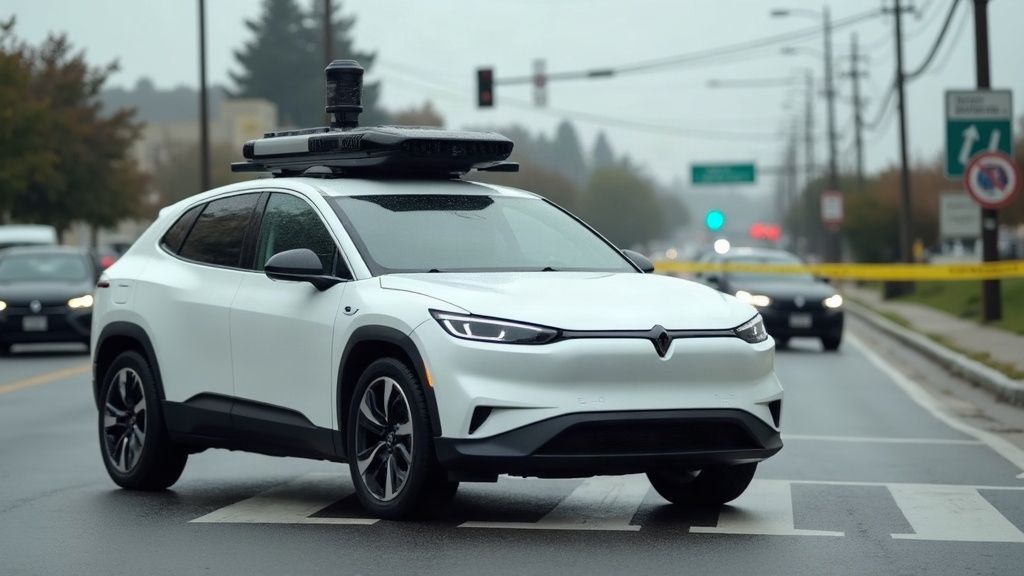
Who's Liable When a Self-Driving Car Causes an Accident in California?
If a self-driving car hit you, rear-ended you, or struck you while you were on foot in California, you're facing a legal situation most attorneys have seen only a handful of times. The technology is new. The companies involved are large and well-resourced. And the question of who actually owes you compensation is genuinely more complicated than in a standard car crash.
This article answers that question directly: who is liable, which California laws apply, what evidence you need to preserve, and what steps to take right now.
If you've been hurt by an autonomous vehicle in California, call (818) 794-9947 for a free consultation. No fee unless we win.
Quick Answers (TL;DR)
- Liability in a California AV crash is not automatic. It is determined under general negligence and product-liability law.
- Responsible parties can include the vehicle manufacturer, the software/AI developer, a fleet operator, or a human safety driver, depending on what caused the crash.
- Cal. Veh. Code §38750 governs AV permits, insurance, and deployment requirements in California. The duty-of-care standard in an actual crash comes from Cal. Civ. Code §1714 and established product-liability doctrine.
- A software defect or sensor failure can support a strict product-liability claim, meaning you may not need to prove anyone was careless.
- Sensor data, LiDAR logs, and the onboard event recorder are the most critical evidence and can be deleted unless you act fast.
- You typically have two years to file a personal-injury lawsuit in California, but shorter deadlines apply if a government entity is involved.
The Rise of Robotaxis and Autonomous Vehicles on California Roads
California roads carry more autonomous vehicles than almost anywhere else in the world. The California DMV has issued deployment permits to multiple companies, and robotaxi services operated by companies like Waymo have logged millions of miles in cities including San Francisco, Los Angeles, and the surrounding metro areas.
That's a lot of miles. And miles bring crashes.
The DWC tracks work-related injuries, and the California Highway Patrol and DMV track autonomous vehicle collision reports. As of recent reporting periods, AV companies operating under California permits are required to submit collision reports within 10 days of any crash, giving regulators a public dataset that didn't exist five years ago.
When one of these vehicles causes a crash, the injured person is left with an urgent and unfamiliar set of questions: Is there a human driver to sue? Do I call my insurance? Does the same law that covers a normal car crash cover this?
The short answer is: mostly yes, but with important additions.
How Liability Works When There's No Human Driver
In California, liability after a self-driving car crash is determined under general negligence and product-liability law, not a single autonomous-vehicle statute.
In a typical two-car crash, the analysis is straightforward. You identify the at-fault driver, and you pursue a negligence claim backed by Cal. Civ. Code §1714, which holds that every person is responsible for injury caused by their lack of ordinary care.
When there's no human at the wheel, or the human was in a monitoring role and did nothing wrong, that analysis shifts in two ways.
First, traditional negligence may still apply. If a human safety driver was present and failed to intervene when intervention was possible, that driver, and the company that employed them, can be sued for negligence under the same §1714 standard.
Second, product liability often becomes the stronger theory. Under strict product-liability doctrine first established in Greenman v. Yuba Power Products (1963) 59 Cal.2d 57, a manufacturer can be held liable for injuries caused by a defective product regardless of whether the company was careless. The injured person does not need to prove negligence, only that the product was defective and that defect caused the harm.
If a software defect or sensor failure caused the crash, the injured person may have a strict product-liability claim against the manufacturer or developer without needing to prove the company was careless.
In an AV crash, the "product" can be the vehicle itself, the sensors (LiDAR, radar, cameras), the AI decision-making software, or the map data the vehicle relied on. Any one of these can be the basis of a strict liability claim.
What California Veh. Code §38750 Actually Does
California Vehicle Code §38750 governs permits, insurance, and deployment requirements for autonomous vehicles, but the duty of care in a crash flows from Cal. Civ. Code §1714 and established product-liability doctrine.
Cal. Veh. Code §38750 is the primary California statute governing autonomous vehicles. It requires manufacturers to certify their vehicles meet certain safety standards before testing or deployment, maintain minimum levels of insurance or a surety bond, obtain a permit from the DMV before operating on public roads, and report collisions to both the DMV and the California Highway Patrol within 10 days.
What §38750 does NOT do is establish a specific liability standard for crashes. It does not say that an AV manufacturer is automatically responsible whenever their vehicle causes a collision, nor does it codify a "same duty of care as a human driver" rule.
Liability in a crash is still governed by general tort law, primarily Cal. Civ. Code §1714 for negligence claims, and the Greenman strict-liability doctrine for product-defect claims.
Why does this distinction matter for your claim? Because your attorney needs to identify the correct legal theory, not just cite the permitting statute. Strict product liability is often a stronger path in AV cases because it removes the burden of proving the company knew about or caused the defect through carelessness.
Potential Defendants: Who Can You Sue?
In a conventional car crash, you typically have one defendant. In an AV crash, you may have several.
The Vehicle Manufacturer
If the car itself was defective, regardless of software, the manufacturer can be held strictly liable. Think brake failures, steering system defects, or a hardware sensor that malfunctioned.
The Autonomous Driving Software Company
The company that wrote, trained, and deployed the AI system is a separate potential defendant. In some cases, the vehicle manufacturer and the software company are the same entity (Waymo, a subsidiary of Alphabet, is both). In others, they are separate companies with a licensing relationship. Your attorney needs to identify which company controlled which component.
The Fleet Operator or Robotaxi Service
Even if the manufacturer and software company are distinct from the company providing the rideshare or delivery service, that operator may be liable for negligent deployment, inadequate monitoring, or failure to maintain the vehicle.
A Human Safety Driver or Remote Monitor
Some AV deployments still use a human in the driver's seat or a remote operator monitoring multiple vehicles. If that person failed to intervene when they reasonably should have, standard negligence applies to them and their employer.
Another Driver
If a human driver contributed to the crash, your claim against that driver proceeds normally. AV cases often involve multi-party crashes where a human driver's negligence triggered the AV's response, or where the AV's behavior contributed to a crash caused partly by a human.
Product Liability vs. Traditional Negligence Claims
These two theories work differently, and in AV cases, both often apply simultaneously.
| Theory | What You Must Prove | Key Advantage |
|, |, |, |
| Negligence (Cal. Civ. Code §1714) | Defendant owed a duty, breached it, and that breach caused your harm | Covers human safety drivers and operators directly |
| Strict Product Liability (Greenman) | Product was defective in design, manufacture, or warning and caused harm | No need to prove carelessness by the manufacturer |
In practice, a well-constructed AV injury claim pleads both. If the evidence shows a software decision error (strict liability territory), and also that the company's testing process was unreasonably lax (negligence territory), you want both theories available at trial.
Evidence Unique to Autonomous Vehicle Cases
Sensor logs, LiDAR data, camera footage, and the onboard event-data recorder are the most critical evidence in an autonomous vehicle crash case and must be preserved immediately.
This is where AV cases differ most dramatically from a regular car crash. The vehicle itself recorded what happened, often in more detail than any dashcam or eyewitness could provide.
The evidence your attorney needs to preserve and obtain includes:
- Onboard event-data recorder (EDR/black box): Records speed, steering commands, braking, and sensor inputs in the seconds before and during a crash.
- LiDAR point-cloud data: A three-dimensional map of everything around the vehicle at the moment of impact, updated many times per second.
- Camera footage (interior and exterior): Multiple cameras capture the environment, lane markings, pedestrians, and other vehicles.
- Radar and ultrasonic sensor logs: Detect nearby objects and feed real-time data to the AI decision system.
- AI decision logs: The vehicle's own record of what it "saw," what decision it made, and why. This is proprietary and companies resist producing it, but it is discoverable in litigation.
- GPS and mapping data: The route the vehicle was navigating, including any discrepancy between the vehicle's map data and the actual road conditions.
- Collision report filed with the DMV: Required within 10 days under Cal. Veh. Code §38750; a public record your attorney can obtain.
Preservation is urgent. Large data files are often overwritten on a rolling basis. As soon as you retain an attorney, a litigation hold letter should go to the AV company immediately, demanding preservation of all of the above. Waiting even a few weeks can result in the loss of irreplaceable evidence.
What To Do If You're Hit By a Self-Driving Car
If you were injured by an autonomous vehicle in California, the steps in the first 24 to 72 hours matter significantly.
Step 1: Call 911 and get a police report. Ask the responding officer to specifically note in the report that the vehicle involved was an autonomous or self-driving vehicle. This becomes part of the official record.
Step 2: Photograph everything at the scene. Take pictures of the vehicle (including any sensor pods, cameras, or exterior markings identifying it as an AV), your injuries, the road conditions, traffic signs, and the positions of all vehicles.
Step 3: Identify the company and vehicle. Robotaxis typically display the company's name and a vehicle identification number. Note the AV company's name, any vehicle number or fleet marking, and the license plate.
Step 4: Get the names of any human safety driver or remote operator. If a person was present in the vehicle or arrives after the crash, get their name, employer, and contact information.
Step 5: Seek medical care immediately. Adrenaline masks pain. A same-day or next-day medical evaluation documents the connection between the crash and your injuries, which is critical for any future claim.
Step 6: Do not give a recorded statement to the AV company or its insurer. These companies have legal teams. You do not have to speak to them before consulting an attorney.
Step 7: Call a California personal-injury attorney. The sooner you do this, the sooner a litigation hold letter can go out to preserve the data.
Challenges in Proving These Emerging Claims
Honesty matters here. AV injury cases are genuinely more difficult than standard car-crash cases, for several reasons.
The data is proprietary. AV companies treat their AI decision logs and sensor data as trade secrets. Obtaining full discovery often requires court orders and expert witnesses who can interpret what the data shows. These fights take time and cost money.
The law is still developing. California's autonomous vehicle statutory framework is primarily a permitting and reporting system. Courts in California have not yet issued a large body of published decisions on AV-specific liability questions, meaning your case may be decided on first-impression legal arguments.
Multiple corporate defendants have deep pockets and experienced defense teams. Companies like Waymo and their insurers have handled these claims before. They know the arguments, and they know that many injured people will accept a low settlement rather than fight through complex litigation.
Causation requires expert testimony. You will almost certainly need an expert in autonomous vehicle systems, AI decision-making, and possibly accident reconstruction to explain to a judge or jury what the AV's systems did, why, and how that caused your specific injuries.
None of these challenges makes a valid claim impossible. They make experienced representation more important, not less.
What If a Self-Driving Car Hits You While You're Working?
If you were driving for work, making a delivery, or otherwise on the job when an autonomous vehicle hit you, you may have both a workers' compensation claim against your employer and a third-party personal-injury claim against the AV company.
These two claims run on separate tracks. Workers' comp covers your medical bills and a portion of your lost wages regardless of fault, under the California Labor Code. A third-party PI claim against the AV company lets you recover damages workers' comp does not cover, including full lost wages, pain and suffering, and future losses.
If this applies to your situation, visit our workers' compensation practice area to understand how the two claims interact, and call us so we can evaluate both at the same time.
Statute of Limitations: How Long Do You Have?
In most California personal-injury cases, the statute of limitations is two years from the date of injury under Cal. Code of Civil Procedure §335.1. Miss that deadline and you generally lose the right to sue, regardless of how strong your case is.
Important exception: If the AV was operated by a government agency, or if a public entity's road conditions contributed to the crash, the Government Claims Act (Cal. Gov. Code §945.4) requires you to file a government tort claim with the agency within six months of the incident before you can sue. Missing the six-month claim deadline can bar your lawsuit entirely.
Given that California's robotaxi landscape includes both private companies and, increasingly, publicly contracted services, confirming whether any government entity is involved is one of the first things your attorney should assess.
Challenges in Summary
The legal framework for AV crashes in California is built on existing tort and product-liability law, applied to a new technology. The tools exist to pursue these claims. The challenges are practical: obtaining proprietary data, navigating multiple corporate defendants, and building expert testimony in an emerging field.
Our results page shows what we have recovered for injured clients. If an autonomous vehicle caused your injury, we want to evaluate whether you have a claim.
Call (818) 794-9947 for a free consultation. No fee unless we win.
Frequently Asked Questions
Who is at fault in a self-driving car accident in California?
Fault depends on what caused the crash. If a defect in the vehicle's software, sensors, or hardware caused the collision, the manufacturer or software developer may be strictly liable under California product-liability doctrine, without needing to prove carelessness. If a human safety driver failed to intervene, that person and their employer may be negligent under Cal. Civ. Code §1714. If another human driver contributed, standard negligence applies to them as well. Most AV crashes involve at least one corporate defendant.
Can you sue Waymo or Cruise after an accident in California?
Yes. As private companies deploying products on California roads, Waymo, Cruise (now restructured), and similar operators can be sued under negligence and strict product-liability theories. They must also maintain minimum insurance under Cal. Veh. Code §38750 and report crashes to the DMV and CHP. Having a defendant who is required to carry insurance does not mean a settlement comes quickly, however. These companies have experienced legal teams and will defend claims vigorously.
Does California law treat autonomous vehicle accidents differently?
California has a specific statutory framework for AV testing, deployment, and reporting under Cal. Veh. Code §38750, but the liability standards that apply in a crash are the same general negligence and product-liability doctrines that govern all California injury cases. The difference is practical, not legal: AV crashes involve proprietary sensor data, AI decision logs, and multiple corporate defendants that a standard car crash does not.
What if a self-driving car hits a pedestrian in California?
A pedestrian hit by an AV has the same legal claims available as any other injured party: negligence against the operator or safety driver, and strict product liability against the manufacturer or software developer if a defect caused the crash. Pedestrian cases are often stronger because pedestrians are highly vulnerable road users and the AV had a clear duty to detect and avoid them. Preserving medical records and scene evidence is especially important when there is no other vehicle involved.
What evidence is most important in a self-driving car accident case?
The most important evidence is the AV's own data: the onboard event-data recorder, LiDAR point-cloud logs, camera footage, and AI decision logs. This data is often overwritten on a rolling schedule, so preservation must happen immediately through a litigation hold demand to the AV company. Police reports, witness statements, and medical records are also essential.
What is the deadline to file a lawsuit against an AV company in California?
In most cases, two years from the date of injury under Cal. Code of Civil Procedure §335.1. If a government entity is involved, you may have as little as six months to file a government tort claim under the Government Claims Act before the right to sue expires. The shorter deadline applies even if you are also pursuing a claim against a private company.
Do I need an expert witness to prove my AV crash case?
Almost certainly yes. Because the cause of a crash often lies in the AV's sensor readings, AI decision sequence, or software logic, a court will require an expert in autonomous systems or accident reconstruction to explain what happened and why. Identifying and retaining the right expert early is one of the most important steps your attorney will take.
Will my own car insurance cover a crash caused by a self-driving car?
Your uninsured/underinsured motorist (UM/UIM) coverage and collision coverage may respond initially, depending on your policy terms and whether the AV company's insurance is engaged. California requires AV operators to maintain minimum insurance under Cal. Veh. Code §38750, so there should be a policy to pursue. Your attorney can coordinate between your insurer and the AV company's insurer to make sure you are not leaving money on the table.
What if I was a passenger in the self-driving car when it crashed?
As a passenger, you were not at fault. Your claims run against the AV company as both the operator and product manufacturer, against any human safety driver present, and against any other at-fault driver involved in the crash. Passenger claims in product-liability cases are generally strong because you had no control over the vehicle and no ability to prevent the crash.
How is an AV crash different from a standard car accident in terms of the legal process?
The legal theories are similar, but the discovery process is more complex. You are dealing with corporate defendants who treat their AI systems as proprietary, litigation holds over large datasets, expert witnesses in specialized fields, and often multiple defendants at different levels of the supply chain. Cases take longer and require more resources than a standard two-car collision. That is why experienced representation matters from day one.
Reviewed by Minas Nordanyan, CA Bar #296806. This article is for general informational purposes and does not constitute legal advice. Every case is different. Call (818) 794-9947 to discuss the specific facts of your situation.