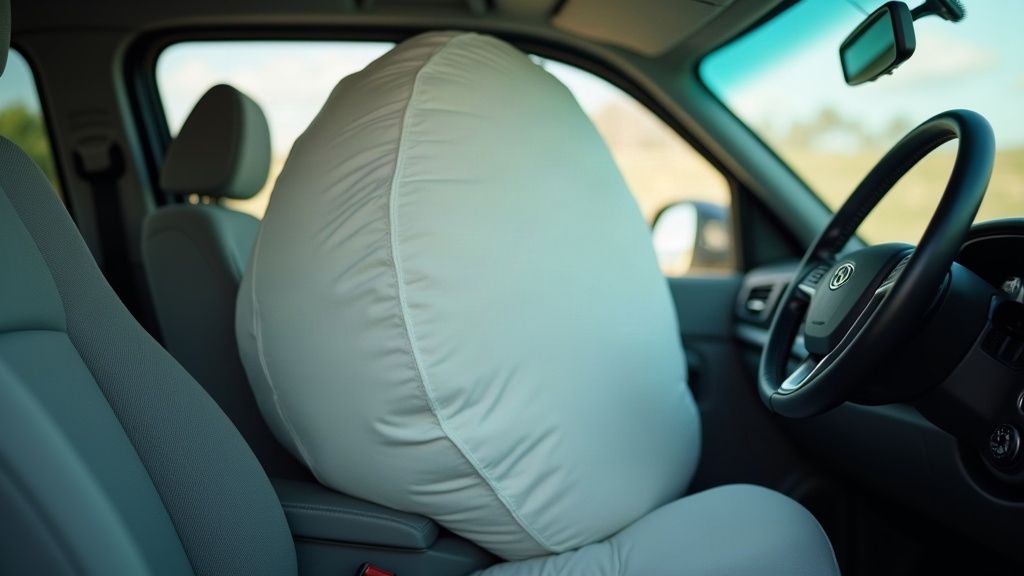
If you were in a car crash in California and an airbag deployed, you may have expected the bag to save you from a windshield or a steering column. Sometimes it does. But airbags also deploy with explosive force in a fraction of a second, and that force can fracture cheekbones, burn skin, shatter eye sockets, and snap wrists. When the device meant to protect you is the device that hurts you, California law gives you real options for compensation.
This article explains those options in plain terms: the types of injuries airbag deployment causes, the difference between a normal-deployment injury and a defective-product claim, how California insurance minimums work, and what your claim needs to succeed. If you have questions about your specific situation, call Nordanyan Law at (818) 794-9947 for a free consultation. No fee unless we win.
Quick-Answer Summary
- Airbag deployment can cause serious injuries even in crashes where the airbag performed exactly as designed.
- You may have a claim against the at-fault driver, the airbag manufacturer, or both.
- California's statute of limitations for personal injury is two years from the date of injury under Cal. Code Civ. Proc. §335.1.
- As of January 1, 2025, California's minimum bodily-injury liability limits are $30,000 per person and $60,000 per accident.
- Strong medical documentation is the foundation of every successful airbag injury claim.
- California's pure comparative fault rule, established in Li v. Yellow Cab Co. (1975), means partial fault on your part reduces but does not eliminate your recovery.
How Airbags Are Designed to Prevent Injury, and Where They Fall Short
Modern airbags are supplemental restraint systems. They are supposed to work with a seat belt, not replace it. When sensors detect a collision above a certain impact threshold, a chemical reaction ignites an inflator that fills the bag with nitrogen gas in roughly 30 milliseconds. The bag cushions the driver and passenger before they contact the hard surfaces in front of them.
The force needed to fill a bag that fast is substantial. The bag typically inflates to roughly 200 miles per hour, then immediately begins to deflate. In that window, if a person's face, arms, or chest are too close to the bag at the moment of deployment, the impact from the bag itself, before the cushioning phase, can cause serious injury.
Manufacturers account for this by calibrating sensors, specifying seat positions, and warning against placing children in the front seat. But the calibration is not perfect, and individual body size, seat position, seating posture, and the exact geometry of a crash all affect how severe the contact is.
Defects in any part of that system, from the sensor to the inflator to the bag material, can make a dangerous deployment even worse.
Common Airbag-Related Injuries: Facial Fractures, Chemical Burns, Eye and Wrist Trauma
Airbag injuries tend to cluster in a predictable set of body regions, because those are the parts closest to the bag at the moment of deployment.
Facial fractures. The nose, cheekbones, and orbital bones around the eye socket absorb a disproportionate share of bag-contact force. Nasal fractures are among the most commonly reported airbag injuries. Orbital fractures can require surgery and carry a risk of permanent vision changes.
Chemical burns and abrasions. The chemicals used to inflate the bag, primarily sodium azide in older systems and alternative propellants in newer ones, produce a fine powder or particulate residue. Contact with skin or mucous membranes can cause chemical burns, respiratory irritation, and skin abrasions from the woven fabric itself.
Eye injuries. Particles, bag fabric, and deployment pressure can all cause corneal abrasions, traumatic iritis, and in serious cases, retinal damage or lens dislocation.
Wrist and hand fractures. Drivers with hands on the steering wheel at the moment of deployment often absorb bag force through their wrists and hands, leading to distal radius fractures (the most common wrist fracture in adults), carpal fractures, and ligament tears.
Hearing damage. The deployment noise is brief but extremely loud. Temporary or permanent tinnitus and noise-induced hearing loss are documented in emergency and specialty records following airbag events.
Chest injuries. Despite seat belts, chest wall contusions and rib fractures occur, particularly in smaller-framed individuals sitting closer to the wheel.
Airbag chemical burns, facial fractures, and eye injuries are among the most common deployment-related injuries documented in emergency rooms after collisions.
Normal Deployment Injury vs. Defective Product Malfunction
This distinction shapes what kind of legal claim you bring, against whom, and what evidence you need.
When the Airbag Worked as Designed
If an airbag deploys correctly in response to a real collision and you are still injured by the force of deployment, your primary claim is against the at-fault driver who caused the collision. The airbag did what it was supposed to do. The injury occurred because another driver put you in the position of needing that protection in the first place.
Your claim in that situation is a standard California personal injury negligence action: the at-fault driver owed you a duty of care on the road, breached that duty, the breach caused the collision, and the collision caused your airbag-deployment injuries. You pursue that claim through the other driver's liability insurance, and if their policy limits are inadequate, through your own underinsured motorist (UIM) coverage.
When the Airbag Itself Failed or Malfunctioned
If the airbag deployed when it should not have, failed to deploy when it should have, or deployed with disproportionate force due to a manufacturing or design problem, you may have a separate products liability claim against the manufacturer, the supplier of the inflator component, or the distributor, depending on where in the supply chain the defect originated.
California strict products liability, developed through Greenman v. Yuba Power Products (1963) and its progeny, does not require you to prove the manufacturer was negligent in the ordinary sense. You must show:
- The product had a defect (manufacturing, design, or failure to warn).
- The defect existed when the product left the manufacturer's control.
- The defect was a cause of your injury.
This is a meaningful advantage for injured people. You do not have to prove the engineer who designed the inflator made a careless mistake. You only need to show the product was not as safe as a reasonable person would expect, and that the defect caused harm.
To prove a defective airbag claim in California, an injured person must show the product had a manufacturing defect, a design defect, or a failure to warn, and that the defect was a cause of the injury.
Recalled Airbags: What Drivers Should Check After a Crash
The largest airbag recall in U.S. automotive history involved Takata inflators, which used ammonium nitrate as a propellant. Heat and humidity could cause the propellant to degrade over time, leading to inflators that ruptured at deployment, sending metal fragments into the vehicle cabin. Tens of millions of vehicles were affected, and deaths and severe injuries were documented before and after recalls were issued.
If your vehicle was manufactured between roughly 2002 and 2015, it may have been equipped with a Takata inflator. The recall and replacement program continued for years, and some vehicles still carry unreplaced inflators because owners did not receive or respond to recall notices.
You can check whether your vehicle has an open recall by entering your Vehicle Identification Number (VIN) at the National Highway Traffic Safety Administration (NHTSA) recall database at nhtsa.gov. This takes about two minutes and should be one of your first steps after any crash where an airbag deployed and caused injury.
If your vehicle had an open, unremedied recall at the time of the crash, that fact is significant evidence in a products liability claim. It also means the manufacturer had actual notice of the defect before your injury occurred.
Preserve the vehicle. Do not allow the vehicle to be repaired, crushed, or sold before a qualified expert has inspected the airbag system. Physical evidence from the airbag and the inflator, the electronic data stored in the vehicle's event data recorder, and photographs of the deployment pattern and residue are all potentially critical to a products liability case. Once the vehicle is repaired or destroyed, much of that evidence is gone.
Filing Against the At-Fault Driver's Insurance vs. a Product Liability Claim
Most airbag injury cases involve at least one of these two tracks, and some involve both simultaneously. Understanding how they work differently helps you know what to expect.
The At-Fault Driver's Liability Insurance
For policies issued or renewed on or after January 1, 2025, California requires minimum bodily-injury liability coverage of $30,000 per person and $60,000 per accident under Cal. Veh. Code §16056.
Under Cal. Veh. Code §16056, as amended by SB 1107, these are the current statutory minimums. Serious airbag injuries, including those requiring facial surgery, eye treatment, or hand reconstruction, frequently produce medical bills and lost wages that exceed those minimums. When they do, your own UIM policy becomes relevant, and so does a products liability claim against the manufacturer.
California law allows you to pursue both the at-fault driver and a manufacturer in the same lawsuit if the facts support it. You do not have to choose.
Comparative Fault and Your Recovery
California's pure comparative fault rule, established in Li v. Yellow Cab Co. (1975), means your compensation is reduced by your percentage of fault but is not eliminated, even if you were partly responsible for the crash.
California follows pure comparative fault, as established by the California Supreme Court in Li v. Yellow Cab Co. (1975) 13 Cal.3d 804. If a jury or adjuster determines you were 30 percent at fault for the collision, your damages are reduced by 30 percent. You are not barred from recovery entirely. This is a meaningful protection for people who may have contributed to a crash in some way, because it keeps a partial recovery available even in imperfect situations.
The Products Liability Track
A products liability claim against an airbag manufacturer or component supplier is filed in civil court and is governed by California's strict liability doctrine. These cases almost always require expert witnesses: a mechanical engineer or automotive safety expert to analyze the airbag system, a medical expert to connect the defect to your specific injuries, and often an economist to project lost earning capacity if the injuries are severe.
Products liability cases tend to take longer than standard auto negligence cases. They also tend to produce larger recoveries when the defect is provable, because the damages available include all economic losses (medical bills past and future, lost income, vocational rehabilitation) and all non-economic losses (pain and suffering, loss of enjoyment of life, emotional distress). California law does not cap non-economic damages in personal injury cases outside of the medical malpractice context.
The Statute of Limitations
The general deadline to file a personal injury lawsuit in California is two years from the date of injury under Cal. Code Civ. Proc. §335.1.
Two years is the general rule. Specific facts can shorten or extend it. Claims against government entities require a government tort claim to be filed within six months of the incident under Cal. Gov. Code §911.2. If an injury is not discovered until later, the discovery rule may extend the deadline. If the injured person is a minor, tolling rules under Cal. Code Civ. Proc. §352 apply. Missing the filing deadline typically ends the case permanently, so early consultation with an attorney matters.
Medical Documentation That Supports an Airbag Injury Claim
The strength of your claim depends heavily on the quality of your medical records. Insurance adjusters and defense attorneys look for gaps, inconsistencies, or delays in treatment as reasons to discount your injuries. The following documentation, compiled from the beginning, closes those gaps.
Emergency room records. The ER visit immediately after the crash is the baseline. It should document your complaint of injury, the physical examination findings, any imaging taken (X-ray, CT), and the treating physician's clinical impression. If you went to the ER, obtain those records in full.
Specialist visits. Airbag injuries often require specialists: an ophthalmologist for eye injuries, an orthopedic surgeon for fractures, a plastic surgeon or ENT for facial fractures, an audiologist for hearing damage. Each specialist's notes, treatment plans, and operative reports are part of your documentation.
Photographs. Pictures of burns, abrasions, bruising, and swelling taken on the day of the crash and in the days following show the physical reality of the injury in a way that verbal description cannot. Take them with a timestamp.
Documentation of deployment evidence. Photographs of the deployed airbag, the residue pattern on the steering wheel and dashboard, and the vehicle damage help an expert reconstruct the deployment event.
Records of missed work and lost income. Pay stubs, employer letters, and tax records establish the economic dimension of your damages. Lost wages are recoverable in California personal injury claims.
Ongoing treatment records. If your injuries require physical therapy, follow-up imaging, or repeated specialist visits, those records demonstrate the duration and seriousness of the harm. Gaps in treatment are used against you; consistent documented care supports your claim.
In California, you can sue both the at-fault driver and the airbag manufacturer when a deployed airbag causes injury, one claim sounds in negligence and the other in strict products liability.
FAQ
Can you sue for injuries caused by an airbag?
Yes. In California, you can pursue a personal injury claim against the at-fault driver whose negligence caused the crash, a products liability claim against the airbag manufacturer or component supplier if the device was defective, or both. The legal theories are different, but the cases can be pursued together in the same litigation.
What injuries can airbags cause in a crash?
Airbag deployment can cause facial fractures (nose, cheekbones, orbital bones), chemical burns and skin abrasions from the propellant residue and bag fabric, eye injuries including corneal abrasions and more serious structural damage, wrist and hand fractures from contact at the steering wheel, hearing damage from deployment noise, and chest wall injuries. These injuries can occur even when the airbag functioned as designed.
Is airbag injury covered by car insurance in California?
It depends on the type of insurance. If another driver was at fault, their bodily injury liability policy covers your airbag injuries up to their policy limits. As of January 1, 2025, California's minimum bodily injury limits are $30,000 per person and $60,000 per accident under Cal. Veh. Code §16056. Your own underinsured motorist (UIM) coverage applies if the at-fault driver's limits are inadequate. Medical payments (MedPay) coverage on your own policy, if you have it, can also pay regardless of fault.
How do you prove an airbag was defective?
To establish a defective airbag claim under California strict products liability, you need to show: (1) the product had a defect, in its manufacturing, design, or warnings; (2) the defect existed when the product left the manufacturer; and (3) the defect was a cause of your injury. In practice, this usually requires an automotive engineering expert to analyze the airbag system, the inflator, and the electronic event data, and a medical expert to connect the defect to your specific harm.
What is the deadline to file an airbag injury lawsuit in California?
The general statute of limitations for personal injury in California is two years from the date of injury under Cal. Code Civ. Proc. §335.1. Some exceptions apply: claims against government entities require a government tort claim within six months under Cal. Gov. Code §911.2, and the discovery rule may extend the deadline in limited circumstances. Consulting an attorney promptly after an airbag injury helps ensure you do not inadvertently waive your right to file.
Does it matter if my vehicle had a Takata or other recalled airbag?
Yes. An open, unremedied recall at the time of the crash is significant evidence in a products liability case. It shows the manufacturer had prior notice of the defect. Check your VIN on the NHTSA recall database. Preserve the vehicle and the airbag components before any repair or disposal.
Does comparative fault affect my airbag injury claim?
California follows pure comparative fault, established in Li v. Yellow Cab Co. (1975) 13 Cal.3d 804. If you were partly at fault for the collision, your damages are reduced proportionally by your percentage of fault. You are not barred from recovery entirely. For example, if your total damages are $100,000 and you are found 20 percent at fault, you recover $80,000.
What damages can I recover for an airbag injury in California?
In a California personal injury case, you can recover economic damages (medical bills past and future, lost wages, lost earning capacity, rehabilitation costs) and non-economic damages (pain and suffering, emotional distress, loss of enjoyment of life). California law does not cap non-economic damages in personal injury cases arising from auto accidents or products liability.
Airbag injuries are real, they are often serious, and California law gives injured people two distinct legal tracks to pursue compensation, one against the at-fault driver, one against a manufacturer whose device failed. The key is acting quickly: preserving the vehicle and its evidence, starting medical documentation from day one, and understanding your deadlines.
If you or someone close to you was injured by an airbag in a California crash, call Nordanyan Law at (818) 794-9947 for a free consultation. We've recovered over $150,000,000 for injured people across Southern California. No fee unless we win.
Reviewed by Minas Nordanyan, CA Bar #296806. Last reviewed: 2026-08-27. This article is for general informational purposes. It does not create an attorney-client relationship. Specific legal questions about your case should be directed to a licensed California attorney.