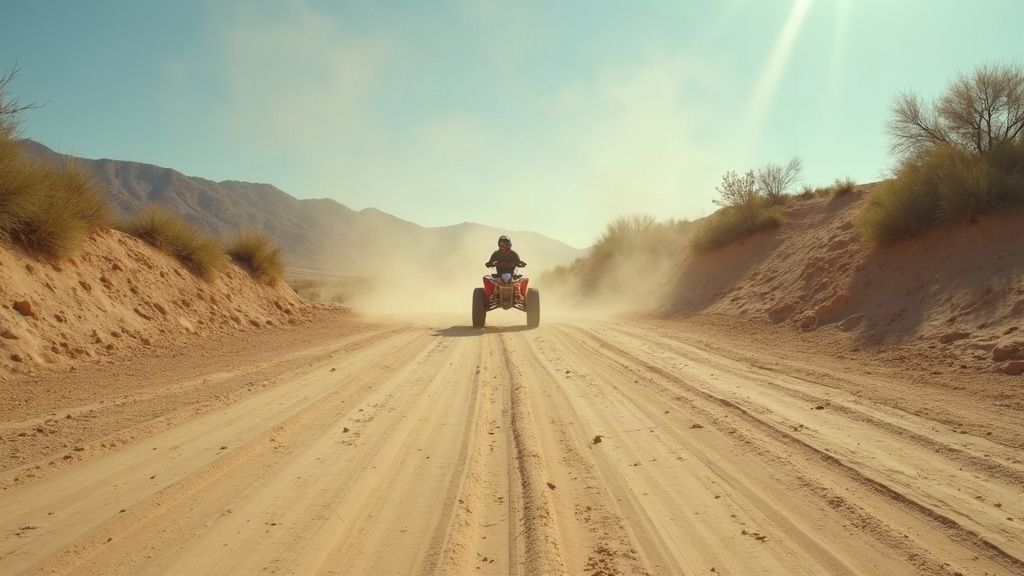
If you've been hurt in an ATV or off-road vehicle crash in California, your first question is probably who owes you something, and your second is how much time you have to find out. The answers depend on where the accident happened, who owned the land, and what gear everyone was wearing. California law gives injured riders real rights, but those rights shrink fast when deadlines pass and evidence disappears.
We've recovered over $150,000,000 for injured Californians. Here are the ten things every rider, passenger, or family member needs to know before filing a claim.
Quick summary of what's covered below:
- Where these accidents most often happen in California
- How liability changes on public land versus private property
- Who you can hold responsible, from rental companies to manufacturers
- The most common causes and injuries
- How helmet use affects your recovery
- Insurance coverage gaps that catch riders by surprise
- How comparative fault can raise or lower your payout
- The exact steps to take at the scene
- When the clock starts on your claim
1. Where ATV and Off-Road Accidents Commonly Happen in California
California has some of the most popular off-highway vehicle terrain in the country, and some of the highest ATV injury rates to match.
The most common accident locations include designated OHV (off-highway vehicle) parks operated by California State Parks, Bureau of Land Management (BLM) land, private ranches and farms, rural construction sites, and privately owned recreational properties. High-volume destinations, such as Ocotillo Wells State Vehicular Recreation Area, Glamis (Algodones Dunes), and Hungry Valley SVRA near Gorman, see a significant share of California's ATV injuries every year.
The location matters legally because it determines which law governs your claim, which deadlines apply, and which agency or person owes you a duty of care.
Practical takeaway: Write down the exact address or GPS coordinates of the crash site immediately. The legal rules that apply to your case depend on it.
2. How Liability Differs on Public Land Versus Private Property
The rules that govern who owes you compensation shift significantly depending on whether you were on public or private land when you got hurt.
On public land, such as a state OHV park or BLM property, you are generally dealing with a government entity. To recover, you must show that the agency created or maintained a dangerous condition on the property, and that the condition was a substantial factor in causing your injury. California Government Code section 835 sets the standard. Government claims also carry a much shorter deadline, discussed in Item 10.
On private property, the owner's liability turns on your legal status as a visitor. A landowner who invites guests to ride owes a general duty of reasonable care under California Civil Code section 1714. A trespasser receives fewer protections, although the landowner still cannot create intentionally dangerous conditions designed to harm people.
Practical takeaway: Save any permission texts, tickets, or waivers you received before riding. Waivers are not automatically enforceable in California, especially when gross negligence is involved.
3. Who Can Be Held Responsible: Rider, Rental Company, or Landowner
ATV accident liability is rarely simple. More than one party can be responsible at the same time, and California's comparative fault system allows recovery against all of them.
The rider who caused the crash is the most obvious defendant. If another rider operated their vehicle recklessly, at excessive speed, or while impaired, they can be held liable for your injuries.
A rental company that provided a defective vehicle, failed to inspect its equipment, or put an inexperienced rider on a machine too powerful for their skill level can face liability under negligence or products liability theories. California courts have held rental operators to a duty of care in providing safe equipment and adequate instruction.
A landowner or event organizer can be liable if a dangerous course design, hidden obstacle, or inadequate warnings contributed to the crash. This includes private motocross tracks, guided trail tours, and ranch events.
A manufacturer or parts supplier can be liable under strict products liability when a defect in the ATV itself, such as a faulty throttle, defective brake component, or unstable chassis design, caused or worsened the crash. You do not need to prove the manufacturer was careless, only that the product was defective when it left the factory.
Practical takeaway: Do not repair or sell the vehicle after a crash. The physical condition of the ATV is evidence in every one of these theories.
4. Common Causes of Off-Road Vehicle Accidents
Understanding what caused your crash is not just factual curiosity. It is the foundation of your liability theory.
The leading causes of ATV and dirt bike accidents in California include:
- Rollover crashes. ATVs have a high center of gravity and are inherently unstable on uneven terrain, particularly when turning at speed.
- Excessive speed for the terrain, visibility conditions, or rider skill level.
- Rider inexperience. Many rental operators and event organizers do not provide adequate training before putting riders on machines.
- Carrying a passenger. Most ATVs are designed for a single rider. Adding a passenger shifts the center of gravity and dramatically increases rollover risk.
- Equipment defects. Brake failures, throttle sticking, and steering malfunctions have all been documented causes of serious crashes.
- Hidden terrain hazards. Unmarked drop-offs, irrigation ditches, embedded rocks, and ruts that are invisible at riding speed are a recurring cause of crashes on both public and private land.
- Impaired operation. Alcohol and drug impairment is a factor in a significant share of ATV fatalities nationally.
Practical takeaway: Each cause points to a different defendant. Document the scene thoroughly before anything is moved.
5. How Helmet and Safety Gear Use Can Affect a Claim
California requires all ATV riders under age 18 to wear a helmet, and adult riders who skip a helmet may have their damages reduced under the state's comparative fault rules.
California Vehicle Code section 38505 requires every person under 18 operating or riding on an OHV on public land to wear a helmet. Violation of a safety statute is evidence of negligence per se under California law.
For adult riders, helmet use is not legally required off public roads, but the absence of a helmet is still relevant in litigation. If the defense can argue that your head injury would have been less severe had you worn a helmet, a jury can assign you a portion of fault for those specific damages. The same logic applies to other protective gear: goggles, gloves, boots, and protective padding.
California's pure comparative fault system means this does not bar your claim. It only reduces your recovery by your assigned percentage of responsibility.
Practical takeaway: If you were wearing a helmet and proper gear, document it with photos. If you were not, talk to an attorney before giving any recorded statements about your protective equipment.
6. Insurance Coverage Gaps Unique to Off-Road Vehicles
This is the issue that catches most injured riders by surprise.
Standard auto insurance policies in California almost never cover off-road vehicles used off public roads, so riders should carry a separate OHV or specialty insurance policy.
California law does not require off-road vehicles to carry liability insurance when operated exclusively off public roads. Many riders assume their standard auto policy extends to their ATV or dirt bike. In most cases, it does not. The exclusion language typically covers vehicles "designed for use principally off public roads" once they leave the pavement.
The result: if you are injured through no fault of your own, and the at-fault rider carries no OHV policy, your own medical bills may go uncovered unless you have med-pay coverage on a separate specialty policy or your health insurance picks them up.
If you were injured on the job, whether you were a ranch hand, a site surveyor, or a construction worker riding an ATV as part of your duties, a California workers' compensation claim may cover your medical treatment and lost wages regardless of fault. Cal. Lab. Code section 3600 provides that workers' comp coverage applies to injuries arising out of and in the course of employment.
Practical takeaway: Before you ride, confirm in writing with your insurer that your policy covers OHV use in the location and context you plan to ride. If it does not, get a rider or a separate OHV policy.
7. Common Injuries Seen in ATV and Dirt Bike Crashes
ATV and dirt bike accidents produce some of the most serious injuries seen in California personal injury cases. The combination of high speeds, unstable vehicle dynamics, open-air exposure, and hard terrain means there is nothing absorbing the impact when things go wrong.
The most frequently treated injuries include:
- Traumatic brain injuries (TBI). Helmeted or not, a high-speed ejection or rollover can cause a TBI severe enough to require long-term rehabilitation. Head and neck injuries account for a disproportionate share of ATV fatalities.
- Spinal cord injuries. Rollovers and high-speed falls can fracture vertebrae or compress or sever the spinal cord, leading to partial or complete paralysis.
- Broken bones. Wrists, forearms, clavicles, and legs are the most frequently fractured bones, often from riders instinctively bracing during a fall.
- Internal organ damage. Crush injuries from a vehicle rollover can rupture the spleen, liver, or kidneys without any visible external wound.
- Severe lacerations and abrasions. Contact with rocks, desert brush, or the vehicle itself causes deep cuts and road rash that can become infected or leave permanent scarring.
The severity of these injuries means medical costs can run into six figures quickly. A complete damages calculation in an ATV case must include emergency care, surgery, rehabilitation, lost income, future medical needs, and non-economic damages like pain and suffering.
Practical takeaway: See a doctor immediately after any crash, even if you feel fine. Internal injuries and TBIs often have delayed symptoms, and a gap in treatment is one of the first things an insurance adjuster will use to minimize your claim. Visit our results page to see what recoveries in serious injury cases can look like.
8. How Comparative Fault Applies to Off-Road Accidents
California follows pure comparative fault, meaning an injured ATV rider can recover damages even if they were partly at fault, but their payout is reduced by their share of responsibility.
California Civil Code section 1431.2 establishes California's pure comparative fault system. Unlike states with a "51% bar" rule, California allows an injured party to recover even if they were 99% at fault. Their recovery is simply reduced by their percentage of fault.
In ATV and off-road cases, defendants commonly argue that the injured rider:
- Was riding at an unsafe speed
- Ignored posted OHV park warnings or speed limits
- Was operating a vehicle beyond their skill level
- Was not wearing protective equipment
- Was riding with a passenger on a single-rider vehicle
Each of these arguments is designed to raise your fault percentage and reduce what you recover. A skilled personal injury attorney will counter each argument with evidence from the scene, vehicle condition, witness accounts, and expert testimony on ATV safety standards.
Practical takeaway: Do not admit fault or apologize at the scene. Statements made immediately after a crash are admissible and can be used to assign you a higher share of responsibility.
9. Steps to Take Right After an ATV Accident
What you do in the first hour after an ATV crash shapes the strength of your claim for the next two years.
- Call 911. Get law enforcement and medical personnel to the scene, even if the injuries seem minor. A police or ranger report creates an official record.
- Do not move the vehicles unless there is an immediate safety hazard. The position of the vehicles is evidence of how the crash occurred.
- Photograph and video everything. The vehicles, the terrain, any hazard markings or their absence, tire tracks, debris, and your visible injuries.
- Get witness information. Names, phone numbers, and a brief written account from anyone who saw the crash. Witnesses at OHV parks often leave before a report is completed.
- Seek medical care the same day. Emergency room or urgent care records tie your injuries to the crash date. Do not wait to see if symptoms improve.
- Report the accident to the landowner, park authority, or event organizer, and keep a copy of any report you file.
- Do not post about the crash on social media. Insurance adjusters monitor plaintiff social media accounts.
- Preserve the vehicle. Do not repair, sell, or allow it to be scrapped. If a defect is part of your claim, the physical evidence is irreplaceable.
- Contact a personal injury attorney before speaking with any insurance adjuster. Early representation protects you from recorded statements used to minimize your claim.
Practical takeaway: Follow all nine steps in order. Skipping even one, especially medical care or evidence preservation, creates gaps that insurers use to challenge the value of your claim.
10. When to Contact an Attorney About Your Claim
California's statute of limitations for most ATV personal injury claims is two years from the date of the accident under Code of Civil Procedure section 335.1.
California Code of Civil Procedure section 335.1 gives most injured riders two years from the date of the crash to file a lawsuit. Miss that deadline and your claim is barred, regardless of how strong the evidence is.
There is a critical exception: if the at-fault party is a government entity, such as California State Parks, a county OHV district, or the BLM, you must first file a government tort claim with the agency under California Government Code section 945.4. That government tort claim must be filed within six months of the injury. Missing the six-month deadline permanently bars your claim against the government, even if the two-year window has not closed.
Claims against a California government agency for dangerous conditions on public off-road land must be filed as a government tort claim within six months of the injury.
Beyond the deadlines, early attorney involvement matters because:
- Evidence disappears. Tracks wash away, vehicles get repaired, witnesses forget details.
- Rental companies and insurers open their investigation immediately. You should not be the only one without counsel in that process.
- Medical liens, workers' comp subrogation rights, and insurance coordination are complicated. An attorney structures the case from the start to protect your net recovery.
You can explore your options at our personal injury practice area page or speak directly with an attorney by calling (818) 794-9947 for a free case review. You can also start with a free consultation online.
Frequently Asked Questions
Who is liable for an ATV accident on private land in California?
Liability on private land depends on whether the landowner created a dangerous condition, failed to warn of a known hazard, or gave permission for riding. Under California Civil Code section 1714, a landowner who invites guests to ride owes a duty of reasonable care. A rider who caused the crash through reckless operation can also be directly liable. Both parties can share fault under California's comparative fault rules.
Do you need insurance for an ATV in California?
California does not require liability insurance for ATVs operated exclusively off public roads. However, standard auto insurance policies almost always exclude coverage for off-road vehicles used off pavement. Riders without a separate OHV or specialty policy face uncovered medical bills and property damage unless a third party is liable. If you ride, confirm your coverage in writing with your insurer before your next trip.
Can you sue a rental company after an ATV accident in California?
Yes. A rental company in California can be held liable if it rented a defective or poorly maintained vehicle, failed to provide adequate safety instruction, or placed a rider on a machine beyond their skill level. California negligence law and strict products liability both apply to rental operators. Do not repair or return the rental vehicle without first documenting its condition and consulting an attorney.
What is the minimum age to ride an ATV in California?
California Vehicle Code section 38504.1 prohibits children under age 14 from operating an ATV on public land without adult supervision, and all riders under 18 must wear a helmet under Vehicle Code section 38505. Parental liability may apply if a minor causes an accident, and event organizers and rental companies who allow underage riders to operate ATVs without proper supervision can face their own liability.
How long do I have to file an ATV accident claim in California?
For most personal injury claims, California Code of Civil Procedure section 335.1 gives you two years from the date of the crash. If your claim is against a government agency, you must file a government tort claim within six months of the injury under Government Code section 945.4, or your claim is permanently barred. Contact an attorney as early as possible so neither deadline is missed.
What if the ATV had a mechanical defect that caused the crash?
If a defect in the ATV itself caused or contributed to the crash, you may have a products liability claim against the manufacturer, distributor, or seller under California's strict liability doctrine. You do not need to prove the manufacturer was careless, only that the product was defective and the defect caused your injury. Preserve the vehicle and all original parts, and contact an attorney before any repairs are made.
Does comparative fault affect my ATV accident claim?
Yes. California's pure comparative fault rule under Civil Code section 1431.2 means your damages are reduced by whatever percentage of fault is assigned to you. Riding without a helmet, carrying a passenger, or ignoring OHV park speed limits can all raise your fault percentage. However, even a rider who is found significantly at fault can still recover a portion of their damages. An attorney can argue the evidence to keep your assigned fault percentage as low as the facts allow.
What if I was injured in an ATV accident while working?
If you were operating an ATV as part of your job duties, such as a ranch hand, surveyor, or construction site worker, you may have a workers' compensation claim in addition to, or instead of, a personal injury claim. Workers' comp under California Labor Code section 3600 covers medical treatment and lost wages regardless of who was at fault. In some cases, you can pursue both a workers' comp claim and a third-party personal injury lawsuit. Contact an attorney to structure both claims correctly from the start.
If you or someone you care about was injured in an ATV or off-road vehicle accident in California, every day that passes makes it harder to preserve evidence and protect your rights. Call (818) 794-9947 for a free case review. No fee unless we win.