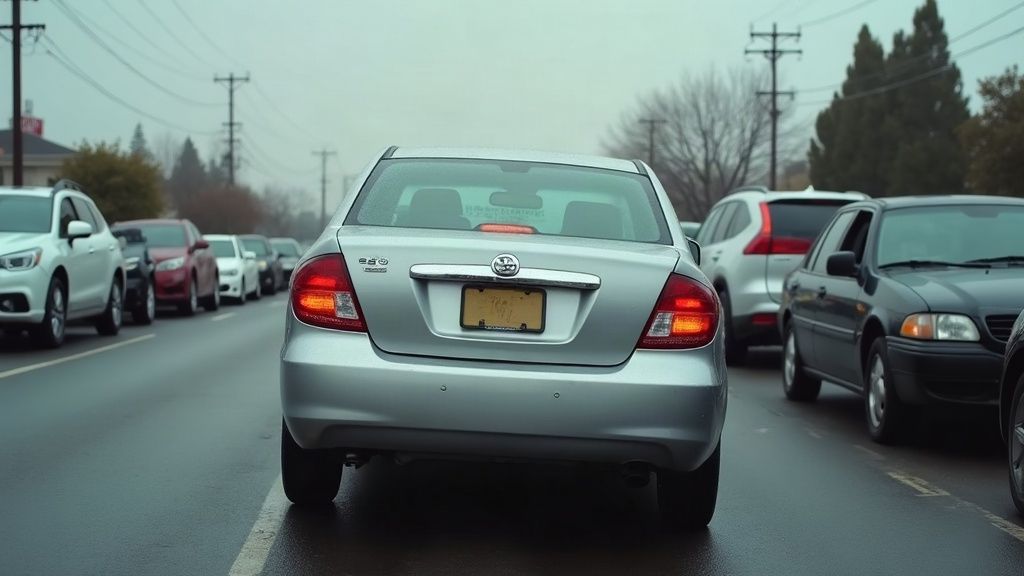
If a driver reversed into your car in a California parking lot, you already know one frustrating truth: fault is almost never as simple as "they were going backward, so it's their problem." Insurance adjusters complicate it. The other driver blames you. And when both cars were moving, the finger-pointing gets worse.
This article explains exactly how California law assigns fault in backing-up accidents, what evidence matters most, and what you should do before the insurance company closes the file.
Quick answers for skimmers:
- The driver backing out almost always has the legal duty to yield, under Cal. Veh. Code §21804.
- California's pure comparative fault rule can reduce, but not eliminate, your recovery if you shared some blame.
- You can file a claim even if your car was parked when it was hit.
- Injuries from low-speed collisions are real and documented, even when the cars look fine.
- You have two years to file a personal injury lawsuit in California under Cal. Civ. Proc. Code §335.1.
- A free consultation with our team costs you nothing. Call (818) 794-9947.
Why Reverse Accidents Are Treated Differently Than Typical Collisions
Most traffic collisions happen between two drivers moving forward, where California's rules of the road set clear right-of-way expectations. Backing up introduces a visibility problem that the law specifically addresses.
When you reverse, your field of view shrinks dramatically. Blind spots grow. Rear cameras help, but they do not replace the duty to look carefully before and during the maneuver. California courts and insurers recognize this built-in hazard, which is why the driver who was backing at the time of impact almost always bears a heavier share of fault.
That is not a blanket rule. Context matters. A driver who was speeding through a parking lot, cut the corner, or ignored a stop sign can share or even take on the majority of fault despite going forward. But as a starting point, the reversing driver faces a harder road when fault is being allocated.
California's Rules of Care for Drivers Backing Out of Spaces or Driveways
In California, any driver backing out of a parking space must yield to vehicles already traveling in the lane, under Cal. Veh. Code §21804.
Cal. Veh. Code §21804 is the core statute. It requires any driver entering a roadway from a parking lot, driveway, or similar access point to yield to traffic already on that roadway. When a parking lot aisle functions as a through lane, that rule applies. When a car is backing from a driveway into a public street, it applies even more clearly.
The practical result: if you backed out and hit a car that was already traveling in the lane, §21804 puts the initial presumption of negligence on you. The other driver still has to drive reasonably, but your legal obligation to yield was primary.
Beyond §21804, the general negligence standard applies. Every driver owes a duty of reasonable care under California common law. That means checking mirrors, moving slowly, watching for pedestrians, and not beginning a reversing maneuver when traffic is already too close to stop. Violating that standard is negligence, regardless of whether a specific statute covers the exact situation.
Driveways onto public streets: The yield duty is especially strong. Cal. Veh. Code §21804 covers this directly. A driver who backs out of a residential or commercial driveway into a public street and hits a passing vehicle will face a strong presumption that they failed to yield.
Parking garage ramps: Multi-level garage ramps are not technically "roadways" under the Vehicle Code in every context, but courts apply the same reasonable care analysis. A driver backing down a ramp without checking for oncoming traffic is almost certainly negligent.
Common Backing-Up Scenarios: Shopping Centers, Garages, Driveways, and Loading Zones
Fault analysis changes slightly depending on where and how the collision happened. Here are the most common situations we see.
One Car Backing, One Car Parked
If your car was parked and someone backed into it, your path to recovery is straightforward. The backing driver had a duty to see and avoid your stationary vehicle. A parked car is not a surprise obstacle. Fault almost always falls on the reversing driver in this scenario.
Your insurer may still open a claim and ask questions. Answer them carefully, or better yet, talk to an attorney before you give a recorded statement.
One Car Backing, One Car Moving Forward
This is the most common scenario in parking lots. You were driving down the aisle. Another driver backed out of a space without looking and hit your door or front quarter panel.
The reversing driver will almost certainly bear primary fault under §21804. However, the adjuster will ask: Were you speeding for a parking lot? Were you on your phone? Did you see the car starting to reverse and fail to brake? Any of those facts shifts a portion of fault back to you. Under California's comparative fault rule, your recovery is reduced by your percentage of fault, but not eliminated entirely.
Both Cars Reversing at the Same Time
When two cars back into each other, California courts look at which driver had the last clear chance to avoid the collision, the angle of impact, and any posted traffic controls in the lot.
This is the most contested scenario. Two drivers, backing out of facing spaces, hit each other in the middle of the aisle. Neither saw the other coming.
California does not have a specific statute that resolves this situation by formula. Courts and adjusters look at:
- Which driver started backing first.
- Which driver had the clearer line of sight.
- Whether either driver had the last clear chance to stop.
- The angle and force of impact.
- Any witnesses or camera footage that show who entered the aisle first.
Fault is often split 50/50 in these cases, but that is not a rule, and evidence can shift the split significantly.
Backing Out of a Loading Zone or Fire Lane
Drivers using spaces that are not standard parking spaces, such as loading zones, temporary stops, or fire lanes, carry additional exposure. Those spaces are not designed for extended parking, and backing out of them into active traffic is harder to justify. An adjuster will note that the driver chose a higher-risk stopping position.
How Fault Gets Split When Both Vehicles Are Moving in Reverse
California follows a pure comparative fault rule from Li v. Yellow Cab Co. (1975) 13 Cal.3d 804, so your recovery is reduced by your share of fault, but not eliminated.
California's pure comparative fault doctrine comes from the California Supreme Court's decision in Li v. Yellow Cab Co. (1975) 13 Cal.3d 804. Under that rule, a court reduces your damages by your percentage of responsibility for the accident. If you were 20 percent at fault and your total damages were $50,000, you recover $40,000.
Importantly, the rule is "pure." Even if you were 80 percent at fault, you can still recover the remaining 20 percent of your damages. No California rule cuts off your recovery entirely just because you shared some blame.
What this means practically: do not assume you cannot recover because you were also reversing. The question is the percentage, not the binary.
Who decides the percentage? If the case settles, the insurance companies negotiate it. If the case goes to trial, the jury decides. An experienced attorney can shift the percentage meaningfully by finding and presenting evidence the adjuster ignored or downplayed.
Evidence That Strengthens a Backing-Up Accident Claim
Strong evidence is what separates a quick low-ball settlement from a fair one. In parking lot accidents, the following matter most.
Surveillance footage. Retail parking lots, garages, and many apartment complexes have cameras. The footage often shows exactly who was moving, when, and at what speed. This footage is almost always overwritten quickly, sometimes within 24-72 hours. Preserving it requires a written preservation demand sent to the property owner as soon as possible.
Surveillance footage from parking lot cameras, dashcam video, and eyewitness statements are the most valuable evidence in a California backing-up accident claim.
Dashcam video. If your car was moving, your dashcam may have captured the other driver backing into your path. If the other car had a dashcam, that footage can also be requested during the claims process or through litigation discovery.
Witness statements. Other shoppers, pedestrians, or drivers who saw the collision can confirm which car was moving and at what speed. Get their names and phone numbers at the scene before they leave.
Photos of the vehicles and the scene. Photograph the damage on both vehicles, the final resting positions of the cars, skid marks or tire marks on the pavement, any painted arrows or traffic flow markings in the lot, and the sight lines from the reversing driver's position.
Police or security report. Not all parking lot accidents get a police report, but if one was written, it includes the officer's initial fault assessment. The property's security staff may also have an incident report on file.
Medical records. Prompt medical evaluation documents that your injuries are real and connected to the collision. Gaps in treatment are used by adjusters to argue your injuries were not serious or were caused by something else.
Injuries Typical to Low-Speed Reverse Collisions and Why They Still Matter
The word "parking lot" makes people think fender-bender. The cars were going slowly. Nobody looks hurt at the scene. The adjuster calls it a minor impact and offers a check that barely covers the damage to the bumper.
That framing is wrong, and it is worth understanding why.
Low-speed reverse collisions can still cause herniated discs, whiplash, and concussions, and symptoms often do not appear until days after the crash.
The human spine is not designed for sudden unexpected deceleration in any direction. A low-speed rear or side impact can produce a significant whipping motion of the neck and lower back. Research in biomechanics has documented spinal injuries at impact speeds that leave vehicles with minimal visible damage. The car's bumper absorbed energy designed to protect the car, not necessarily the people inside it.
Common injuries we see in backing-up accident cases:
- Whiplash and cervical strain. Neck stiffness, headaches, and limited range of motion. Symptoms frequently worsen over the first 24-72 hours rather than improving.
- Lumbar strain and disc herniation. Lower back pain that radiates into the legs can indicate disc involvement. This is often invisible on initial X-rays but appears clearly on MRI.
- Concussion. A sudden jolt can cause a concussion even without a direct blow to the head. Brain fog, light sensitivity, and sleep disruption are common symptoms that are not always connected to the accident by the injured person.
- Shoulder injuries. If you had your hands on the wheel or were bracing, the force transmits through the arms and into the shoulder joints.
- Psychological effects. Anxiety, driving fear, and PTSD are real consequences of collisions and are compensable under California personal injury law.
The critical point: seek medical care within 24-48 hours of the accident, even if you feel "okay." Document every symptom, however minor it seems. Insurance adjusters are trained to use delayed treatment or unreported symptoms to minimize the value of your claim.
How Insurance Adjusters Evaluate Low-Speed Parking Accident Claims
Understanding the adjuster's playbook helps you avoid the most common mistakes.
The recorded statement trap. The other driver's insurer will ask for a recorded statement "to process your claim." They are listening for anything they can use to shift fault onto you or argue your injuries were pre-existing. You are not required to give a recorded statement to the other party's insurer. Talk to an attorney before you do.
The low property-damage argument. Adjusters often argue that low vehicle repair costs prove the collision was minor and the injuries are therefore minor or fabricated. This argument is frequently wrong as a matter of biomechanics, but it is effective against unrepresented claimants who do not know how to counter it.
The quick settlement offer. An early settlement check, sometimes offered within days, is designed to close the file before you know the full extent of your injuries. Once you sign a release, the case is over. Do not accept a settlement offer before your treating physician has determined you have reached maximum medical improvement.
The DMV reporting requirement. [SPEAKABLE] You must report a California traffic collision to the DMV within 10 days if there was injury, death, or property damage over $1,000, under Cal. Veh. Code §16000. Missing this deadline can create complications with your insurance coverage. The SR-1 form is available through the DMV.
What to Do After a Backing-Up Accident in California
- Check for injuries. Call 911 if anyone is hurt.
- Document the scene. Photos of both vehicles, the surroundings, and any visible damage before vehicles are moved.
- Exchange information. Name, driver's license, insurance card, and license plate from the other driver.
- Get witness information. Names and phone numbers before witnesses leave.
- Ask for surveillance footage. Speak to store management or garage security and request that footage be preserved.
- Seek medical care within 24-48 hours. Even if you feel okay.
- File the SR-1 report with the DMV within 10 days if the damage exceeded $1,000 or there was injury or death.
- Talk to an attorney before giving a recorded statement to the other driver's insurance company.
How Nordanyan Law Handles Parking Lot Accident Claims
We handle personal injury cases across Southern California, including backing-up and reverse collision claims where fault is genuinely disputed. Our attorneys review the evidence, identify all available insurance coverage, and handle communications with adjusters so you can focus on recovering.
We have recovered over $150,000,000 for injured clients across California. No fee unless we win. Call (818) 794-9947 for a free case review, or visit our free consultation page to tell us what happened.
Frequently Asked Questions
Who is at fault when two cars back into each other in California?
When two drivers are both reversing and collide, California law does not assign automatic fault to either. Courts and insurers look at which driver entered the lane of travel first, which driver had the clearer sight line and the last clear chance to stop, the angle of impact, and any available camera or witness evidence. Fault is frequently split between both drivers, but the percentage depends on the specific facts. California's comparative fault rule, from Li v. Yellow Cab Co. (1975) 13 Cal.3d 804, allows each driver to recover damages reduced by their own percentage of fault.
Is backing up always considered negligence in California?
No. Backing up is a legal and necessary driving maneuver. It is not negligence by itself. What the law requires is that a driver exercising reasonable care before and during the reverse movement. Under Cal. Veh. Code §21804, a driver backing onto a roadway or through lane must yield to traffic already traveling in that lane. Failure to yield when traffic was present is strong evidence of negligence, but not a guarantee of it in every fact pattern.
Can you file a claim if someone backed into your parked car?
Yes. A parked car is a stationary obstacle that a reversing driver is obligated to see and avoid. If someone backed into your parked vehicle, you can file a claim against the at-fault driver's liability insurance. [SPEAKABLE] If someone backed into your parked car, you can file a claim against the at-fault driver's liability insurance even though your vehicle was stationary at the time of the collision. If the at-fault driver is uninsured, you may be able to claim through your own uninsured motorist coverage depending on your policy.
Does a parking lot accident report affect insurance rates in California?
It can. California law prohibits insurers from raising your rates for an accident in which you were not at fault, under Cal. Ins. Code §1861.02. However, if you are found partially at fault, your insurer may treat the incident as an at-fault event depending on the percentage of fault assigned to you and your policy terms. Filing a claim under your own collision coverage when the other driver was at fault should not itself raise your rates, but confirm with your agent and review your policy.
What if the accident happened in a private parking lot, not a public street?
Cal. Veh. Code §21804 and California's general negligence standard both apply in private parking lots to the extent the lot is open to general public use. California courts have consistently applied traffic law principles to private commercial parking lots such as shopping centers and apartment complexes. The fact that it is private property does not eliminate liability.
How long do I have to file a lawsuit after a parking lot accident in California?
Under Cal. Civ. Proc. Code §335.1, you have two years from the date of injury to file a personal injury lawsuit. If the accident caused only property damage and no personal injury, a three-year statute applies under Cal. Civ. Proc. Code §338. There are narrow exceptions, but do not rely on them. The deadlines are strict.
What if the at-fault driver left the scene?
A hit-and-run in a parking lot is still a hit-and-run. Under Cal. Veh. Code §20002, a driver involved in an accident causing property damage must stop and leave contact information. Leaving without doing so is a misdemeanor. If the driver fled, report the collision to police immediately, preserve any camera footage from the lot, and contact your own insurer to explore uninsured motorist coverage.
Do I need a police report for a parking lot accident in California?
You are not legally required to call police for every parking lot accident, but a police report strengthens your claim significantly. Officers document the scene objectively and may note fault observations in the report. If police do not respond, you can still file a report at a California Highway Patrol office or with local law enforcement. You must file the SR-1 form with the DMV directly if the accident resulted in injury, death, or property damage over $1,000 under Cal. Veh. Code §16000.
Reviewed by Minas Nordanyan, CA Bar No. 296806. Last updated for legal accuracy: 2026. This article is general legal information, not legal advice. Your case depends on facts specific to your situation. Call (818) 794-9947 for a free consultation.