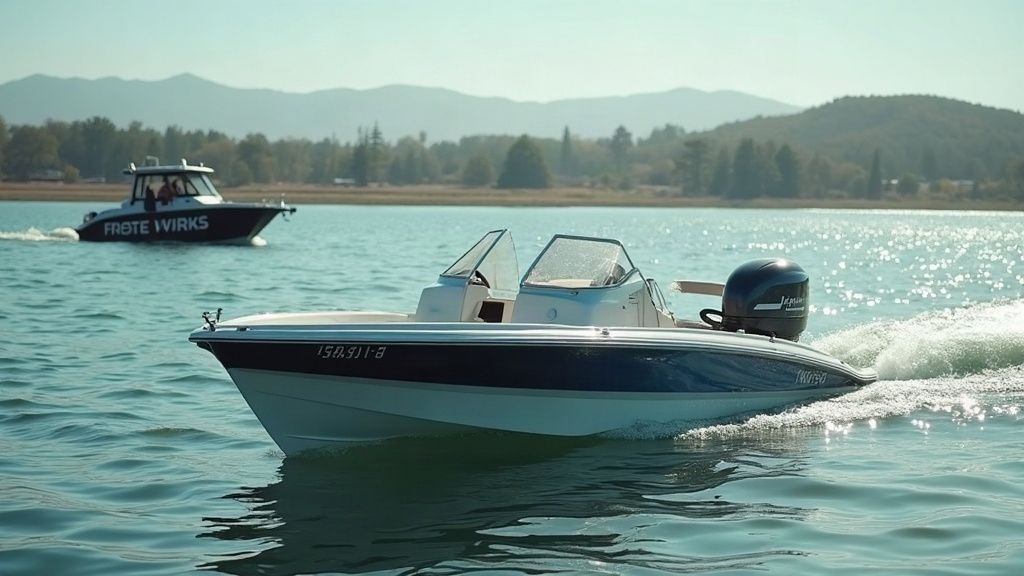
If you were hurt in a California boating or jet ski accident, you are likely dealing with confusing insurance questions, disputed liability, and pressure from other parties to settle fast. This article answers the 10 most important questions injured boaters ask, with the specific California statutes and rules you need to protect your claim.
Here is what this article covers:
- Which court and which law governs your accident
- Who can be held liable beyond the boat operator
- Why the lack of mandatory boating insurance changes your strategy
- How alcohol laws directly affect your civil case
- The 10-day reporting deadline you cannot miss
- How fault is split when multiple parties share blame
- When to stop talking to insurers and call an attorney
1. Who Has Jurisdiction Over Boating Accidents in California
California boating accidents on state waters are governed by the California Harbors and Navigation Code and enforced by California State Parks Division of Boating and Waterways, along with local sheriff's marine units. Federal jurisdiction applies on federally designated navigable waterways under U.S. Coast Guard authority, which includes portions of the Pacific Ocean, San Francisco Bay, and the Sacramento-San Joaquin Delta.
For most recreational accidents on lakes like Castaic, Havasu, or Shasta, state law controls. This matters because the applicable code determines which safety standards apply, which agency investigates, and which reporting rules trigger. If the accident occurred on a navigable waterway, federal admiralty law may also allow a separate claim, which your attorney needs to evaluate.
Takeaway: Where the accident happened determines which legal framework governs your claim. Always document the exact body of water.
2. Common Causes of Boat and Jet Ski Accidents
California State Parks data consistently shows operator inattention as the single leading cause of recreational boating accidents in the state. Other frequent causes include:
- Excessive speed for the water conditions
- Alcohol or drug use by the operator
- Equipment or mechanical failure
- Failure to maintain a proper lookout
- Reckless wake or no-wake zone violations
- Collisions with swimmers, fixed objects, or other vessels
Jet ski (personal watercraft) accidents add their own risk factors, including the high maneuverability that allows sudden direction changes, and the tendency for inexperienced renters to operate them in crowded areas. Because personal watercraft sit lower in the water, they are less visible to other operators, which contributes to collision rates.
Takeaway: Documenting which of these factors caused your accident is the foundation of your liability case. Photographs, witness statements, and the official accident report all matter.
3. Who Can Be Liable: Operator, Rental Company, or Marina
California's pure comparative fault framework means liability can be divided among multiple parties simultaneously. In a boating accident, potential defendants include:
The operator. Any person piloting a vessel has a duty to operate it safely under California Harbors and Navigation Code §655.2. Negligent operation, speeding, and BUI all expose the operator to personal liability.
The rental company. A company that rents out a vessel owes renters and the public a duty to provide a seaworthy, properly equipped vessel. If the company failed to brief the renter on operating rules, rented to an obviously incompetent operator, or sent out equipment with known mechanical defects, it can share liability.
The marina or dock operator. Marinas have a duty to maintain safe docking conditions, warn of hazards, and keep common areas free from unreasonable danger. If a dock collapse or poorly marked hazard contributed to your injury, the marina may be liable.
The vessel manufacturer. If a design defect or manufacturing flaw caused or contributed to the accident, a products liability claim against the manufacturer may run parallel to the negligence claim.
Takeaway: Never assume only the operator is responsible. A thorough investigation often reveals additional defendants with insurance coverage or assets.
4. How Boating Insurance Differs from Auto Insurance
Unlike auto insurance, watercraft liability insurance is not mandatory for most recreational boats in California. There is no California statute requiring a private boat owner to carry liability coverage before putting a vessel on state waters. This is one of the most important differences between a car accident claim and a boating accident claim.
What this means for an injured person:
- The at-fault boater may have no liability insurance at all
- Homeowners or renters insurance policies sometimes include watercraft liability for small boats (typically under 25 feet or below a specified horsepower threshold), but this coverage is often capped well below the value of a serious injury claim
- Personal watercraft are frequently excluded from homeowners policies entirely
- Some boat owners carry a separate inland marine or watercraft policy, but you will not know until you investigate
Marinas and rental companies typically carry commercial liability policies, which is one reason identifying them as defendants can make the difference between a recoverable judgment and a worthless one.
Takeaway: Before accepting any offer, your attorney needs to identify every insurance policy that may apply, because the operator's policy (if any) may not be enough.
5. Common Injuries in Watercraft Accidents
Boating accidents produce some of the most severe injuries in personal injury practice because victims are often thrown from vessels, struck by propellers, or submerged without warning. Common injuries include:
- Traumatic brain injuries (TBI): from collision impact, falls to the deck, or striking a dock
- Spinal cord injuries: from high-speed collisions or being ejected and landing at an angle
- Propeller strike lacerations: among the most catastrophic watercraft injuries, often causing deep tissue damage, bone fractures, or traumatic amputation of limbs
- Near-drowning: survival does not eliminate injury. Hypoxic brain damage and respiratory complications are documented sequelae of near-drowning events
- Broken bones and fractures: from impact with hulls, docks, or other vessels
- Lacerations and soft tissue damage: from rigging, cleats, and hull edges
Because many of these injuries are not immediately apparent, especially TBI and spinal injuries, medical evaluation immediately after the accident is both a health necessity and a legal one. Gaps in medical care are used by insurance adjusters to dispute causation.
Propeller strike injuries are among the most severe watercraft injuries, frequently causing traumatic amputation, deep tissue damage, and permanent disability.
Takeaway: See a doctor the same day, even if you feel functional. Delayed treatment creates documentation gaps that insurers exploit.
6. The Role of Alcohol and Boating-Under-the-Influence Laws
California Harbors and Navigation Code §655 makes it illegal to operate a vessel on California waters while under the influence of alcohol or drugs. The per se blood alcohol concentration limit for recreational boaters is 0.08%, the same threshold as driving under the influence.
The civil significance of a BUI charge or conviction is substantial. Under the negligence per se doctrine, violation of a safety statute is treated as automatic evidence of breach of duty. If the at-fault operator was cited for BUI, you do not need to separately prove they were operating carelessly. The statutory violation establishes it.
BUI enforcement in California is active. The California State Parks Division of Boating and Waterways, county sheriff's marine units, and the U.S. Coast Guard all conduct patrols on state waters, especially on summer weekends. Law enforcement field sobriety tests and preliminary alcohol screening for boat operators follow procedures similar to those used on roads.
If the operator was criminally convicted of BUI and your injuries arose from that same incident, the criminal court record can be introduced in your civil case. A conviction also affects the availability of punitive damages in egregious cases.
A BUI conviction in California establishes negligence per se in the civil case, meaning the injured person does not need to separately prove the operator was careless.
Takeaway: If alcohol was involved, preserve every piece of evidence: the law enforcement report, the field sobriety results, and any witness accounts of the operator's condition before getting on the water.
7. Steps to Take Immediately After a Boating Accident
What you do in the first hours after a California boating accident directly affects the strength of your claim.
- Render aid and stay at the scene. California law requires operators to render reasonable assistance to injured persons. Leaving the scene of an injury accident is a criminal offense.
- Call for emergency help. Contact the U.S. Coast Guard on VHF Channel 16 or call 911 for local law enforcement and paramedics.
- Exchange information. Get the other operator's name, address, vessel registration number, and insurance information if they carry it.
- Document the scene. Photograph vessel damage, the accident location, visible injuries, weather conditions, and any open alcohol containers.
- Identify witnesses. Collect names and contact information from anyone who saw the accident or was on board.
- Get immediate medical care. Do not delay. Even if you feel uninjured, adrenaline masks pain. Spinal injuries and TBIs are notoriously underestimated at the scene.
- Do not give a recorded statement. Insurance adjusters may contact you within hours. You are not required to give a recorded statement, and doing so before you have legal counsel routinely damages claims.
After a California boating accident, do not give a recorded statement to any insurance adjuster before consulting an attorney, because early statements are routinely used to limit injury claims.
Takeaway: Every item on this list is a building block for your case. Skipping any one of them gives the opposing insurer an argument to use against you.
8. Reporting Requirements for California Boating Accidents
California Harbors and Navigation Code §656 requires the operator of a vessel involved in a boating accident to file a written accident report with the California Division of Boating and Waterways within 10 days of the incident when:
- The accident caused the death of any person
- The accident caused bodily injury requiring medical treatment beyond first aid
- Property damage exceeded $500 to any one vessel or other property
If the operator is incapacitated, the report obligation passes to the owner of the vessel. Failure to file is a misdemeanor under California law.
The accident report becomes a public record and a foundational document in your personal injury claim. It captures the responding agency's initial findings about cause, operator conduct, and the nature of injuries while the facts are fresh. Your attorney will obtain this report early in the representation.
Note that the 10-day reporting obligation on the operator is separate from and does not extend the two-year statute of limitations on your civil injury claim.
California Harbors and Navigation Code Section 656 requires a written boating accident report within 10 days when the accident causes death, injury requiring more than first aid, or property damage over $500.
Takeaway: If you were the injured party, confirm that a report was filed. If no report exists, that gap itself is a fact worth documenting.
9. How Fault Is Determined on the Water
California applies the same pure comparative fault standard on water that it applies on land. Under California Civil Code §1431.2, each party's liability is proportional to their share of fault. An injured boater who was 20% at fault can still recover 80% of their total damages.
On the water, fault analysis draws from multiple sources:
- Navigation rules. California Harbors and Navigation Code incorporates the federal Inland Navigation Rules (COLREGS), which establish right-of-way, speed, lookout, and meeting-vessel requirements. Violation of these rules is evidence of negligence.
- Operator conduct. Speed relative to conditions, failure to keep a proper watch, and whether the operator was distracted all factor in.
- BUI evidence. As noted above, a BUI citation creates a negligence per se inference.
- Equipment condition. Were required safety items (life jackets, fire extinguisher, distress signals) present and accessible?
- Witness testimony and physical evidence. Skid marks on the hull, impact angle, and GPS track data (from chartplotters) are all admissible.
Accident reconstruction experts are often necessary in serious boating cases, particularly where vessel speed at impact is disputed.
Takeaway: Fault on the water is determined by navigation law, operator behavior, and physical evidence, not simply by who had the bigger boat or who called 911 first.
10. When to Consult a Personal Injury Attorney
You should contact a California personal injury attorney as soon as possible after a boating accident if any of the following are true:
- Anyone on either vessel was injured, regardless of apparent severity
- The cause of the accident is disputed or unclear
- An insurance company contacts you for a statement or asks you to sign a medical release
- A rental company or marina denies responsibility
- The at-fault operator has no insurance or is uncooperative
- Your injuries required hospitalization, surgery, or ongoing treatment
- You lost wages or cannot return to work
California Code of Civil Procedure §335.1 gives most personal injury plaintiffs two years from the date of injury to file a lawsuit. That sounds like a generous window, but evidence disappears quickly: vessels get repaired, witnesses move, surveillance footage is overwritten, and accident reports get harder to reconstruct. The strongest cases are built from evidence gathered in the weeks immediately after the accident.
If your injury happened while you were working, for example as a commercial fisherman, a dock worker, or a maritime crew member, your case may involve both a California workers' compensation claim and a separate civil claim. Those two tracks have different deadlines and different rules. An attorney experienced in both areas needs to evaluate which applies and how they interact.
California's personal injury statute of limitations is two years from the date of injury under Code of Civil Procedure Section 335.1, meaning a boating accident victim who delays too long may permanently lose the right to sue.
Takeaway: The consultation is free, and time works against the injured party in every boating case. Call before you sign anything.
Frequently Asked Questions
Who is liable in a boating accident in California?
Liability in a California boating accident can fall on the operator for negligent or intoxicated operation, a rental company for providing an unseaworthy vessel or failing to train the renter, a marina for negligent maintenance, or a manufacturer for a defective vessel or component. California's pure comparative fault system allows courts to divide liability among all responsible parties.
Do you need to report a boating accident in California?
Yes. Under California Harbors and Navigation Code §656, the vessel operator must file a written accident report with the California Division of Boating and Waterways within 10 days if the accident caused death, injury requiring medical treatment beyond first aid, or property damage exceeding $500. Failure to report is a misdemeanor.
Does homeowners insurance cover boating accidents in California?
Sometimes, but with significant limitations. Many homeowners policies include liability coverage for small boats under a specific length or horsepower limit. Personal watercraft like jet skis are frequently excluded entirely. Coverage caps under a homeowners policy are often well below what serious injury claims require. A separate watercraft or inland marine policy, if the boat owner carries one, is the more relevant source of recovery.
What is the BUI law in California?
California Harbors and Navigation Code §655 prohibits operating a vessel on state waters with a blood alcohol concentration of 0.08% or higher, or while under the influence of drugs or a combination of alcohol and drugs. BUI is a criminal offense and, in the civil context, constitutes negligence per se, meaning a BUI citation or conviction automatically establishes that the operator breached their duty of care to others on the water.
How long do I have to file a boating accident injury claim in California?
Most injured boaters have two years from the date of injury to file a personal injury lawsuit under California Code of Civil Procedure §335.1. Claims against a government entity, such as a publicly operated marina, require a government tort claim within six months of the incident under California Government Code §911.2. Missing either deadline typically bars the claim entirely.
Can I sue if I was partially at fault in a California boating accident?
Yes. California's pure comparative fault system allows an injured person to recover damages even if they were partly responsible for the accident. Your total damages are reduced by your percentage of fault. For example, if you are found 25% at fault, you recover 75% of your total damages. There is no threshold of fault that bars recovery entirely.
What should I do if the other boater had no insurance?
Identify every other potentially liable party, including the rental company, marina, or manufacturer, as they are more likely to carry commercial insurance. Review your own homeowners, renters, or watercraft policy for uninsured boater coverage. Document everything and consult an attorney before concluding that the claim is unrecoverable.
Can a worker injured on a boat file a workers' comp claim in California?
Yes. A worker injured on the water in the course of employment, such as a commercial fisherman, harbor worker, or charter crew member, may have both a California workers' compensation claim and a separate civil claim against a third party who caused the accident. California Labor Code §3600 covers employees injured in the course of employment regardless of where the injury occurs. An attorney needs to evaluate both tracks, because they have different deadlines and different damages rules.
If you or someone you care about was injured in a California boating or jet ski accident, every day matters. Evidence fades, vessels get repaired, and insurance carriers start building their defense immediately. We've recovered over $150,000,000 for injured people across Southern California, and we'll tell you on the first call whether you have a viable claim.
Call (818) 794-9947 for a free case review. No fee unless we win.