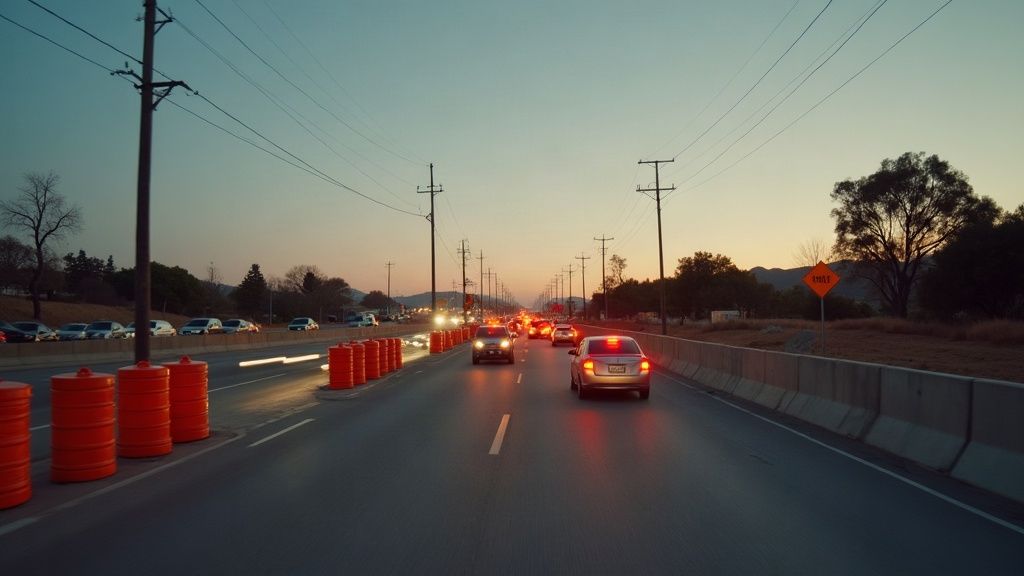
Construction zone car accidents in California are not ordinary crashes. The lane shifts, the close quarters, the mix of civilian vehicles and heavy equipment, all of it creates a different legal situation than a standard two-car collision on an open road. Liability can spread across multiple parties. Evidence disappears fast. Government claim rules add deadlines you won't find anywhere else.
If you've been hurt in a work zone crash, or you want to understand your rights before that happens, these 10 facts give you a clear picture of how these cases work under California law.
Quick summary, the 10 things to know:
- Construction zones create concentrated hazards that raise crash severity even at reduced speeds.
- Most crashes trace to lane shifts, missing signage, speed failures, and worker proximity.
- Liability can reach contractors, equipment manufacturers, and public agencies, not just the other driver.
- Government agency claims carry a strict six-month presentation deadline under California Government Code §911.2.
- Physical evidence at a work zone can vanish within 24 to 72 hours.
- Posted speed limits under California Vehicle Code §22362 directly shape how fault is assigned.
- Common injuries include whiplash, fractures, and traumatic brain injury.
- Immediate steps, 911, photos, witness info, same-day medical care, protect your claim's value.
- Multiple defendants and government timelines mean these cases often take longer to resolve.
- A specialist attorney identifies liable parties and deadlines that most injured drivers miss on their own.
1. Construction Zones Create Unique Accident Risks
Construction zones in California concentrate hazards that don't exist on open roads, narrowed lanes, abrupt speed changes, uneven pavement, and workers operating feet from live traffic.
Open highways give drivers time and space to react. Active work zones eliminate both. Lane widths shrink. The posted speed drops suddenly, sometimes by 25 miles per hour or more. Pavement transitions from smooth asphalt to loose gravel or concrete forms. And workers, equipment operators, and flag persons share the corridor with moving vehicles.
The result is a collision environment where even a momentary lapse, a distracted glance, a late brake, produces a more severe impact than the same lapse on open road. California law recognizes this by treating work zone speed violations as a distinct offense. That distinction shapes every liability and insurance conversation after a crash.
Takeaway: Work zone crashes carry higher injury severity than typical collisions at the same speed, a fact that matters when calculating damages.
2. Common Causes Include Lane Shifts, Poor Signage, and Worker Presence
Most construction zone crashes in California trace to a short list of recurring conditions: sudden lane merges without adequate warning, missing or faded temporary signage, drivers entering the zone without reducing speed, and workers or equipment moving into the path of traffic without sufficient buffer.
The California Manual on Uniform Traffic Control Devices (MUTCD) sets specific standards for how construction zones must be signed, lit, and buffered. When a contractor or public agency fails to meet those standards, a missing advance warning sign, a buffer zone that doesn't meet minimum length requirements, an unlit night zone, that failure becomes evidence of negligence in a civil claim.
Takeaway: If poor signage or inadequate lane planning contributed to your crash, that failure belongs on the table when liability is assessed.
3. Liable Parties Can Extend Far Beyond the Other Driver
Liability in a California work zone crash can reach the general contractor, subcontractors, equipment manufacturers, and the public agency that approved the traffic control plan.
Most drivers assume the other car's insurance pays. In a work zone, that picture can expand significantly. Potential defendants in a California construction zone accident include:
- The general contractor who holds the project contract and is responsible for overall site safety.
- Subcontractors who designed or installed the traffic control plan on a given day.
- Equipment manufacturers if a defective vehicle, barrier, or sign contributed to the crash.
- The public agency (Caltrans, a county, or a city) if the agency designed or approved the traffic control plan and that plan was unreasonably dangerous.
- The at-fault driver in the standard negligence lane, including potential employer liability if the driver was on the job.
California follows comparative fault rules under California Civil Code §1431.2, so each defendant's share of responsibility is assessed separately. That matters when you're negotiating settlement or preparing for trial.
Takeaway: Never assume only one party owes you compensation, contractor and government liability often go uninvestigated without a specialist.
4. Government or Contractor Liability Follows Different Rules
Claims against a California government agency for a work zone accident must be filed as a written government tort claim within six months of the incident under California Government Code §911.2.
This is the deadline most injured drivers miss, and it's fatal to a case if you miss it.
When Caltrans, a city public works department, or a county agency is a potential defendant, you cannot file a lawsuit until you first submit a written government tort claim. California Government Code §911.2 sets the presentation window at six months from the date of the incident for personal injury claims.
Once a government tort claim is submitted, the public entity has 45 days to accept or reject it under California Government Code §912.4.
Under California Government Code §912.4, the public entity must act on the claim within 45 days. If it sends a written rejection notice, you then have six months from that notice to file your lawsuit in civil court. If it takes no action and never sends a rejection notice, you have two years from when your claim arose to file suit. Miss either window and the case against the government defendant is gone, permanently.
This is entirely separate from the two-year statute of limitations that applies to private defendants under California Code of Civil Procedure §335.1. In a case with both government and private defendants, you are running two different clock systems simultaneously.
Takeaway: If a government agency had any role in the work zone where you crashed, the six-month government claim deadline under §911.2 starts running the day of the accident, not the day you decide to hire a lawyer.
5. Evidence Disappears Quickly in Active Work Zones
Physical evidence in an active work zone can vanish within 24 to 72 hours as lanes are repainted, signs are repositioned, and contractor records are updated.
Work zones are not static accident scenes. They evolve daily. Within hours of your crash:
- Temporary lane markings can be repainted or repositioned.
- Warning cones and signs are moved or removed as work progresses.
- Contractors submit daily site logs that may be overwritten or archived.
- Equipment is relocated or taken off-site.
- Witnesses, flaggers, equipment operators, survey crews, disperse.
California courts have recognized that the duty to preserve evidence (the "litigation hold" obligation) applies once a party knows or should know a claim is likely. But that obligation doesn't help you if you wait three weeks to contact an attorney. By then, the physical record of what the zone looked like at the moment of your crash may no longer exist.
Useful evidence to capture immediately: photos and video of lane markings, sign placement, buffer zones, and pavement conditions; the name and employer of any flagger on scene; dashcam footage from your vehicle or nearby vehicles; and the contract number displayed on project signage (it identifies the contractor and the overseeing agency).
Takeaway: Treat a work zone crash like any other scene where evidence has a short life, document everything before you leave or call someone who can return immediately.
6. Posted Signage and Speed Limits Directly Affect Fault
California Vehicle Code §22362 makes it a separate traffic violation to exceed the posted speed limit in an active construction zone, and that fact shapes how fault is assigned in a civil case.
Under California Vehicle Code §22362, driving over the posted speed in a construction zone is a distinct violation, separate from ordinary speeding. If the other driver was exceeding the reduced limit when your crash occurred, that violation is direct evidence of negligence in your civil claim.
The same rule cuts the other way. If investigators determine you were over the posted limit, California's comparative fault system under Civil Code §1431.2 reduces your recovery by your percentage of fault. A driver found 30% at fault because of speed receives 30% less in damages.
Investigators use multiple sources to reconstruct speed: vehicle event data recorders (black boxes), skid mark analysis, surveillance footage from roadside cameras, and posted-speed records from the contractor's traffic control plan. That traffic control plan, which specifies where each sign was placed and what limit was posted, is one of the first documents an attorney should request.
Takeaway: The posted speed in the zone is not just a traffic enforcement detail, it is a fault allocation tool that directly affects your recovery.
7. Common Injuries Include Whiplash, Broken Bones, and Head Trauma
Work zone crashes produce a recognizable injury pattern. The combination of sudden speed reductions, rear-end impacts from following drivers who don't slow in time, and debris or barrier strikes generates:
- Cervical spine sprain (whiplash): Rapid forward-backward head movement during a rear-end impact overstretches the soft tissue of the neck. Symptoms, neck pain, stiffness, headaches, limited range of motion, often appear hours after the crash.
- Traumatic brain injury (TBI): Head contact with a steering wheel, window, or deployed airbag during a high-speed impact can cause concussion or more severe brain trauma. Even a "mild" TBI can produce months of cognitive symptoms.
- Long bone fractures: Arm, leg, and rib fractures occur when occupants are thrown against vehicle structures or when construction debris penetrates the vehicle.
- Lacerations and crush injuries: Unsecured equipment, shattered glass, and barrier materials can cause deep lacerations or crush injuries in high-impact work zone collisions.
California workers who are injured inside a work zone as part of their job, construction workers, flaggers, equipment operators, may have both a workers' compensation claim under Cal. Lab. Code §3600 and a third-party personal injury claim against the at-fault driver.
Takeaway: Seek medical evaluation the same day, delayed treatment creates documentation gaps that insurers use to dispute the severity of your injuries.
8. Immediate Steps After a Work Zone Collision Matter for Your Claim
What you do in the first hour after a California work zone crash directly affects what you recover.
- Call 911. A police report documents the scene configuration, lane markings, sign placement, pavement conditions, at the time of the crash. Without it, contractors and agencies may dispute what the zone looked like.
- Photograph everything before moving your vehicle if it is safe to do so. Capture the lane layout, every visible sign, any debris, the positions of all vehicles, and any visible contractor identification (project number signs, company logos on equipment).
- Get witness information. Construction workers, flaggers, and other drivers who witnessed the crash are high-value witnesses. Collect names and phone numbers before they leave the scene.
- Identify the contractor. Project signage posted in California construction zones typically includes the contractor name and a contract number. Photograph that sign.
- Seek medical care the same day. Even if you feel only minor pain, a same-day medical record creates an unbroken chain of documentation from crash to injury to treatment.
- Preserve dashcam footage. Overwrite cycles on most dash cameras run 24 to 48 hours. Pull and save footage before it is gone.
- Do not give a recorded statement to any insurance carrier before consulting an attorney. Adjusters use recorded statements to establish facts that limit payouts.
Takeaway: The first hour determines the quality of your evidence, treat it like the most important hour of your claim.
9. These Claims Often Take Longer to Resolve
A standard two-car collision with one insurer and a clear liability picture can settle in a matter of months. A California construction zone accident case rarely does.
Multiple defendants means multiple insurers, multiple defense attorneys, and multiple sets of discovery requests. Government agency involvement adds the pre-litigation claim process under Government Code §911.2 and §912.4 before a lawsuit can even be filed. Disputes over traffic control plan adequacy often require a certified traffic engineer as an expert witness, whose schedule and deposition add months to the timeline.
California's civil courts also schedule trials well into the future in complex multi-party cases. Insurance carriers for contractors and government agencies tend to defend these cases more aggressively than personal auto carriers, because the exposure, and the precedent, can be significant.
None of this means you wait. The six-month government claim deadline runs regardless of how complex the case becomes. The work zone evidence clock starts the moment the crash happens.
Takeaway: Expect a longer timeline, and plan your medical care and financial support accordingly, a personal injury specialist helps you build a case that holds up through a longer fight.
10. A Lawyer Can Identify Liable Parties You Would Miss on Your Own
Most drivers who handle a work zone claim on their own pursue only the other driver's auto insurance. That is often the smallest pool of recovery available.
A specialist evaluating your construction zone accident claim will request the contractor's traffic control plan, the agency's project approval documents, the contractor's daily site logs, and any communications between the contractor and the public agency about known hazards. Each document can establish a defendant, and a separate insurance policy, that would not appear in a standard claims process.
We've recovered over $150,000,000 for injured workers and drivers across Southern California. Work zone cases are among the most legally complex in the personal injury space, but they are also among the cases where thorough investigation produces the largest gap between what an insurer first offers and what a prepared legal team actually recovers.
If you were hurt in a California construction zone crash, the best time to call is now, before the evidence changes, before the government claim deadline passes, and before you sign anything an adjuster puts in front of you.
Call (818) 794-9947 for a free case review. No fee unless we win.
Frequently Asked Questions
Who is liable for an accident in a construction zone in California?
Liability in a California construction zone accident can fall on the at-fault driver, the general contractor responsible for traffic control, subcontractors who installed signage or lane configurations, equipment manufacturers if a defect contributed, and the public agency (such as Caltrans or a city) that approved the traffic control plan. California's comparative fault system under Civil Code §1431.2 assigns each party a percentage of responsibility.
Are construction zone accident penalties different in California?
Yes. Under California Vehicle Code §22362, exceeding the posted speed limit in an active construction zone is a separate traffic violation from ordinary speeding. Fines are higher, and a speed violation in the zone is direct evidence of negligence in a civil claim. The at-fault driver's speed, documented through event data recorders, skid marks, and traffic control plan records, directly affects how fault is allocated.
Can a construction company be sued for a work zone accident in California?
Yes. A general contractor or subcontractor responsible for designing, installing, or maintaining a traffic control plan in a California work zone can be named as a defendant in a personal injury lawsuit if their negligence, inadequate signage, insufficient buffer zones, poorly marked lane shifts, contributed to the crash. Their commercial general liability insurance is a separate recovery source from the at-fault driver's auto policy.
What should I do after a crash in a highway work zone?
Call 911 immediately. Photograph the lane configuration, all visible signs, debris, and vehicle positions before anything moves. Collect contact information from witnesses and identify the contractor using the project number sign. Seek medical care the same day. Preserve dashcam footage within 24 hours. Do not give a recorded statement to any insurance carrier before speaking with an attorney. If a government agency may be involved, be aware that the six-month government tort claim deadline under California Government Code §911.2 starts running on the date of the crash.
What is the deadline to file a claim after a California construction zone accident?
If only private parties (the driver, a contractor) are involved, California's standard personal injury statute of limitations gives you two years from the date of the crash under California Code of Civil Procedure §335.1. If a government agency is a potential defendant, you must file a written government tort claim within six months of the incident under California Government Code §911.2, before any lawsuit can be filed. Missing the six-month deadline forfeits your claim against the government entity permanently.
What kind of evidence is most important in a work zone accident case?
The most valuable evidence includes: photographs of lane markings, sign placement, and pavement conditions taken immediately after the crash; the contractor's traffic control plan (available through a public records request or litigation discovery); the police report documenting the scene configuration; dashcam footage from your vehicle or nearby vehicles; daily site logs and inspection records from the contractor; and witness statements from flaggers, equipment operators, or other drivers. This evidence degrades or disappears within 24 to 72 hours in an active work zone, making same-day documentation critical.
Can an injured construction worker file both a workers' comp claim and a personal injury lawsuit?
Yes. A construction worker, flagger, or equipment operator injured inside a California work zone by a motorist may file a workers' compensation claim under Cal. Lab. Code §3600 for medical benefits and wage replacement, and also pursue a third-party personal injury claim against the at-fault driver. These two claims run on separate tracks and do not cancel each other out. The workers' compensation carrier may have a reimbursement right against any third-party recovery, which a specialist attorney factors into settlement negotiations.
Reviewed by Minas Nordanyan, CA Bar #296806. Last updated August 2026. This article is general legal information, not legal advice for your specific situation. For case-specific guidance, call (818) 794-9947 for a free consultation.