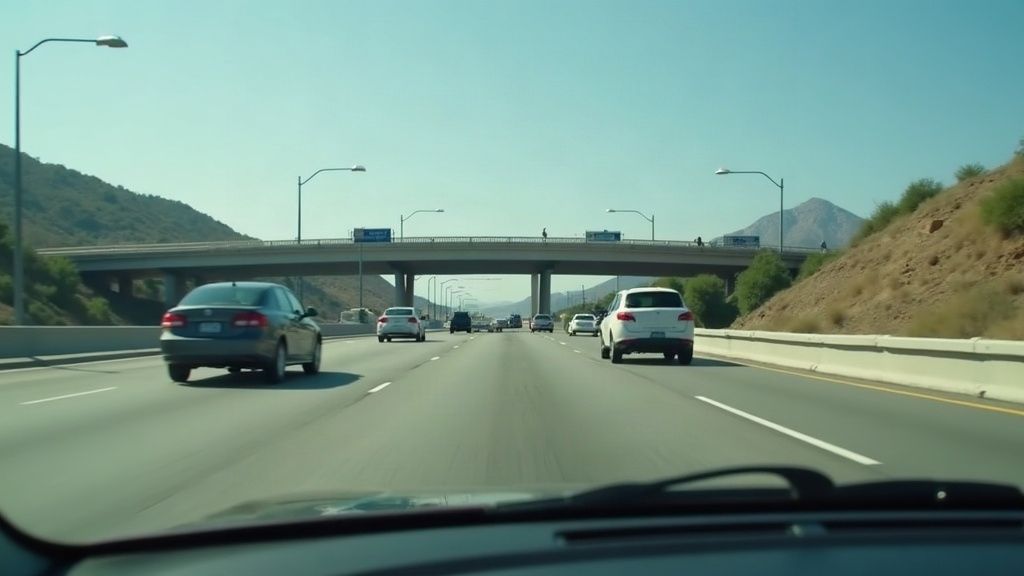
If you were hurt in a California car accident, one question comes up fast: how do you prove what actually happened? Witnesses forget details. The other driver has every incentive to bend the story. The police arrive after the crash, not before it.
A dash cam changes that equation. Footage from a properly preserved recording gives adjusters, attorneys, and courts something witness memory cannot: a real-time, timestamped account of the seconds that mattered most.
Below are 10 specific ways that footage can strengthen your personal injury claim, and a few honest limits you should know before you hand anything over to an insurer.
At a glance:
- Proves fault more clearly than witness memory
- Counters disputed liability claims under California's comparative fault rule
- Reveals hidden factors like phone use before impact
- Supports or corrects the police report
- Gives you strategic control over what each insurer sees and when
- Must be preserved immediately before the camera loops and overwrites it
- Has real limitations in angle, resolution, and evidentiary scope
- Helps law enforcement and your insurer in hit-and-run cases
- Raises California privacy considerations you need to understand
- Works best when reviewed by an attorney before you share it
1. Proving Fault More Clearly Than Witness Memory
Dash cam footage is generally admissible in California civil courts as documentary evidence of how a car accident occurred, provided the recording is authenticated.
Human memory is unreliable under stress. Studies in cognitive psychology have long documented that eyewitness recollection of fast-moving events degrades within hours, and that stress accelerates that process. A dash cam does not forget, panic, or look away.
Footage captures vehicle speeds, lane positions, traffic signals, and the point of impact, all in sequence. In a California civil case, video evidence is treated as documentary evidence and is admissible once authenticated: you or a custodian of records must be able to testify that the recording accurately reflects what it purports to show.
Practical takeaway: Save the metadata file alongside the video. Timestamp and GPS data embedded in the recording strengthen authentication and make the footage harder to challenge.
2. Countering a Disputed Liability Claim
California follows a pure comparative fault rule, meaning footage that shifts even a small percentage of fault away from you can increase the money you recover.
California applies pure comparative fault. That means your recovery is reduced by your percentage of fault, but you can still recover even if you were 99% responsible. Flipping the fault split from 50/50 to 70/30 in your favor is not a technicality; it is the difference between recovering half your damages and recovering seventy percent.
When the other driver disputes how the crash happened, footage that shows them running a red light, changing lanes without signaling, or rear-ending you while you were stopped provides visual proof that is far more persuasive than dueling accounts. Opposing insurers routinely argue shared fault to reduce their payout. Clear video makes that argument much harder to sustain.
Practical takeaway: If the other driver's insurer offers a low settlement soon after the accident, ask your attorney whether your footage, reviewed before you disclose it, changes the fault calculation entirely.
3. Revealing Hidden Factors Like Phone Use
Distracted driving is notoriously hard to prove after the fact. A driver's cell phone records can be subpoenaed, but that process takes time, court orders, and cooperation from carriers. A dash cam with a wide-angle lens may capture the seconds before impact and show a driver with their head down, drifting across a lane boundary in a pattern consistent with distraction.
That footage does not prove phone use by itself, it records observable behavior, not what a driver was doing on a device. But it gives your attorney a factual foundation to pursue the phone records that confirm it. Combined with call logs showing an outgoing text at the time of impact, video of erratic pre-crash behavior becomes powerful supporting evidence.
Practical takeaway: Do not assume footage of the road ahead is irrelevant. What happens in the 3-5 seconds before a crash often tells the entire story of how it started.
4. How Dash Cam Video Interacts with the Police Report
Officers fill out accident reports from observations made after the crash; footage of the crash itself can corroborate, clarify, or correct factual errors in that report.
Police officers respond after a collision. They document the scene, take statements, and form opinions, but they were not there when it happened. An accident report carries real weight with insurers and in civil litigation because it is an official, contemporaneous government record. When your footage matches the report, that alignment strengthens your claim. When the footage reveals a factual error, a disputed point of impact, a traffic signal state that was mismeasured, a witness account that the officer credited incorrectly, your attorney can present the video to correct the record.
Correcting a police report is not easy, but it is possible. The reporting agency can sometimes amend its report when presented with additional evidence. An attorney experienced in California car accident claims knows how to initiate that process.
Practical takeaway: Do not assume the police report is final. If your footage contradicts it, bring both to an attorney before accepting any settlement.
5. Sharing Footage with Your Insurer Versus the Other Driver's Insurer
You are not legally required to hand your footage directly to the other driver's insurer on demand; an attorney can help you share it strategically.
You have two insurer relationships after a crash: your own carrier and the other driver's carrier. The duties you owe each are different.
Under your own policy, you generally have a cooperation obligation. Failing to cooperate with your own insurer, including by withholding relevant evidence, can give the carrier grounds to disclaim coverage. That typically means you should share footage with your own insurer, but confirm the scope of that duty with your attorney first, because policies vary.
You owe no comparable duty to the other driver's insurer. An opposing adjuster may request your footage, but you are not required to hand it over on demand. Timing matters: sharing before you understand what the footage shows and how it interacts with the full evidence picture can inadvertently hurt your position. Your attorney reviews the recording, assesses what it proves and what gaps it leaves, and advises on whether, when, and in what format to disclose.
Practical takeaway: Treat a request for footage from the opposing insurer the same way you treat a recorded statement request: politely decline until you have spoken with an attorney.
6. Protecting and Preserving Footage Before It Is Overwritten
Most dash cams overwrite stored files within 24 to 72 hours, so you must copy the accident clip to external storage immediately after a crash to prevent permanent loss.
Most consumer dash cams use loop recording: when the memory card fills, the camera writes over the oldest files first. Depending on card size and video resolution, that cycle can complete in as little as one to three days. The clip you need may be gone before you think to look for it.
The moment you are safely away from the scene, take these steps:
- Remove the memory card from the camera or use the camera's built-in export function to copy the relevant file to your phone, a USB drive, or a cloud account.
- Note the filename, date, and timestamp displayed by the camera before you move the file.
- Make at least two copies on separate media, one local, one cloud.
- Do not delete or edit any portion of the original file. Selective editing can destroy the metadata that authenticates the recording and raise spoliation issues in litigation.
California courts have inherent authority to sanction parties who destroy evidence once litigation is reasonably anticipated. If you have been in a serious accident, litigation is reasonably anticipated from the moment of impact.
Practical takeaway: Preserve the footage before you call anyone else. The camera will not wait.
7. Limitations of Dash Cam Footage as Sole Evidence
Footage is powerful, but it is not a complete substitute for a full evidence strategy. Honest counsel on the limitations matters as much as knowing the strengths.
Angle and field of view: A forward-facing camera captures what happened ahead of your vehicle. It may not show a vehicle that struck you from the side or rear, a hazard in the road, or a driver's behavior that occurred outside the frame.
Resolution and lighting: Night footage, glare, or low-resolution cameras can make it impossible to read a license plate, confirm a traffic signal state, or identify a vehicle's color.
Audio limitations: California Penal Code §632 restricts recording confidential communications without consent. A recording made inside the vehicle may capture statements made by passengers or bystanders; how those recordings can be used raises separate legal questions.
Gaps in recording: Cameras that rely on motion activation may miss the moments immediately before a crash. Loop recordings sometimes stop mid-event if the crash triggers the camera's power cut-off.
Weight in court: Video is evidence, not a verdict. A jury still evaluates it alongside medical records, expert accident reconstruction testimony, police reports, and witness statements. Footage that is ambiguous or incomplete may be argued both ways.
Practical takeaway: Tell your attorney about every limitation you observe in the footage, not just its strengths. Gaps you identify first are gaps the opposing side cannot use to surprise you later.
8. How Footage Can Help in Hit-and-Run Cases
Hit-and-run accidents present a specific evidentiary problem. When the other driver flees, you may have no name, no license plate, and no witness. Two legal systems then operate simultaneously: law enforcement investigating the crime, and your own insurer evaluating your uninsured motorist (UM) claim.
On the law enforcement side, footage that captures a license plate, even partially, gives investigators a concrete lead. A partial plate combined with a vehicle color, make, and model narrows the search to a manageable number of vehicles in the DMV's registration database, increasing the odds that the driver is identified.
On the insurance side, California Insurance Code §11580.2 governs UM coverage. When a hit-and-run involved no physical contact between your vehicle and the unidentified vehicle, subdivision (b) imposes an important requirement: the claim must be corroborated by competent evidence other than your own testimony. Your account alone is not enough. Dash cam footage of the departing vehicle, a bystander's cell phone video, or a contemporaneous witness statement can each satisfy that corroboration requirement and unlock your UM coverage.
Practical takeaway: In a no-contact hit-and-run, your footage may be the only evidence that gets your UM claim paid. Preserve it immediately and share it with your attorney before filing the UM claim.
9. Privacy Considerations When Sharing Recordings
California has some of the strongest privacy protections in the country. Before you share footage, with your insurer, the opposing insurer, law enforcement, or online, understand the rules.
Recording in public: Footage of other vehicles, pedestrians, and public roadways captured from inside your vehicle generally does not implicate a reasonable expectation of privacy under California law. Roads are public spaces.
Recording conversations: California is an all-party consent state under Penal Code §632. If your dash cam's microphone captured a private conversation inside your vehicle, with a passenger, or at a drive-through window, sharing that audio without the other party's consent can create liability. Removing the audio track before disclosure, or sharing footage with counsel who can advise on redaction, is the safer approach.
Social media: Posting dash cam footage online before your case resolves is almost always a mistake. Once footage is public, the opposing insurer has it, context is lost, and you lose control of how it is used. Keep all evidence private until your attorney authorizes disclosure.
The California Consumer Privacy Act (CCPA): The CCPA imposes obligations on businesses that collect personal information, but its direct application to footage shared between private individuals in litigation is limited. Your attorney can identify whether any business entity in the chain, a dash cam manufacturer's cloud service, for example, holds your footage and what rights you have over it.
Practical takeaway: Share footage with your attorney first, law enforcement second, your own insurer third, and nobody else until your case is resolved.
10. When to Bring Footage to a Personal Injury Attorney
The single most consequential decision you make after preserving footage is who reviews it first.
An experienced California personal injury attorney does several things with your recording that you cannot easily do alone:
Assesses evidentiary value: What does the footage actually prove? What does it leave open? Where are the gaps the other side will exploit? That analysis requires someone who has presented and challenged video evidence in California civil proceedings before.
Identifies spoliation risk: If your footage captures something that might harm the opposing driver's case, you face a litigation-hold obligation once a lawsuit is reasonably anticipated. Your attorney advises you on document preservation so you are not later accused of destroying evidence.
Advises on disclosure timing: There is no universal rule that you must hand footage to any insurer immediately. Strategic timing of disclosure, particularly to the opposing insurer, can affect how negotiations proceed. An attorney who has negotiated California car accident claims knows when early disclosure helps and when it does not.
Builds the complete evidence package: Footage alone rarely closes a case. Your attorney uses it alongside your medical records, the police report, expert reconstruction if necessary, and witness statements to build the argument that wins maximum compensation.
Practical takeaway: Call (818) 794-9947 for a free consultation before you share the footage with any insurer. We review the recording with you, explain exactly what it proves, and handle every aspect of your claim from that moment forward.
If you've been injured in a California car accident and you have dash cam footage, that recording is an asset, but only if it's preserved correctly, reviewed strategically, and presented as part of a complete evidence package. We've recovered over $150,000,000 for injured workers and accident victims across Southern California. We know what California insurers respond to, and we know how to use every piece of evidence to fight for the maximum you deserve.
Call (818) 794-9947 for a free consultation. No fee unless we win.
Frequently Asked Questions
Is dash cam footage admissible in California car accident claims?
Yes. Dash cam footage is generally admissible in California civil proceedings as documentary evidence, provided it is authenticated, meaning someone who can establish that the recording accurately reflects what it shows testifies or provides a declaration to that effect. Metadata, GPS coordinates, and timestamps embedded in the file support authentication. Footage that has been altered or selectively edited may be challenged or excluded.
Do I have to share my dash cam footage with insurance?
It depends on which insurer is asking. Under most California auto policies, you owe your own carrier a cooperation duty, which may require sharing relevant footage. You owe no equivalent duty to the other driver's insurer. An attorney can review your policy language and advise on timing before you disclose anything to any party.
Can dash cam footage prove the other driver was at fault?
It can significantly support a fault determination, but footage alone is rarely the only evidence in a California personal injury case. Video that captures the sequence of events, vehicle positions, and traffic conditions at the moment of impact is highly persuasive. Combined with the police report, medical records, and witness statements, it creates a far stronger case than any single piece of evidence by itself.
How long should I keep dash cam footage after an accident?
Keep all footage until your case is fully resolved, meaning until any settlement is finalized or any judgment is satisfied, including through any appeals. California's statute of limitations for personal injury claims is generally two years from the date of injury under Cal. Code Civ. Proc. §335.1, but complex cases take longer. Never delete footage without speaking to your attorney first.
What happens if the other driver does not have a dash cam and disputes the footage?
The opposing driver can challenge authenticity, argue that the footage is incomplete, or present their own witnesses and evidence. A California jury evaluates all of it. Clear, unedited footage with intact metadata is far harder to discredit than footage that has gaps or has been copied multiple times without a documented chain of custody. Your attorney can engage an accident reconstruction expert if the opposing party mounts a serious challenge.
Can I use dash cam footage in a hit-and-run case where the driver fled?
Yes, and in some hit-and-run cases it is the most important evidence you have. Footage that captures the vehicle's plate, color, or make helps law enforcement identify the driver. For uninsured motorist claims involving no physical contact, California Insurance Code §11580.2(b) requires corroboration beyond your own testimony, dash cam footage satisfies that requirement and can be the difference between a paid claim and a denied one.