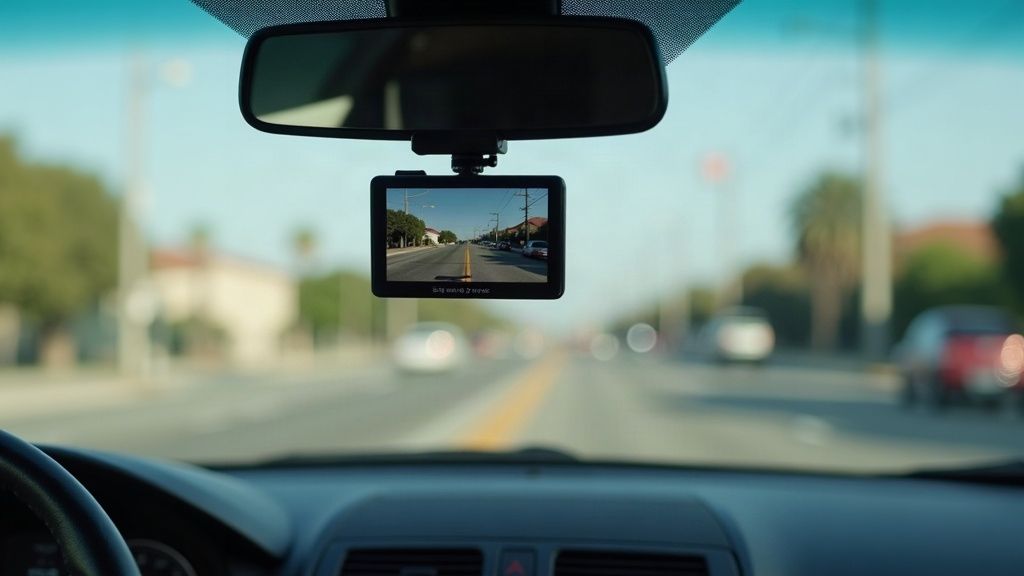
If you were in a car accident in California and your dashcam caught it on video, that footage may be the single most valuable piece of evidence you have. Insurers deny claims every day by arguing the other driver was not at fault, or that your injuries could not have been caused by the impact. A clear recording can cut through those arguments fast.
But footage does not protect itself. It can be overwritten, discarded, or challenged in court if it is not handled correctly. This guide explains how California law treats dashcam evidence, what you must do in the hours after a crash, and how video can affect the value of your claim.
If you have questions specific to your situation, call (818) 794-9947 for a free consultation. No fee unless we win.
Quick Answers: Dashcam Evidence in California
- Dashcam footage is admissible in California civil court when properly authenticated under the California Evidence Code.
- You must copy or lock the file immediately, because most cameras overwrite within 24 to 72 hours.
- You are generally not required to hand footage over to the opposing insurer without formal legal process.
- California's pure comparative negligence rule means any evidence of the other driver's fault directly increases your recovery.
- Footage from third-party cameras, businesses, traffic signals, other drivers, is often obtainable through a legal hold letter or formal discovery.
- Mounting rules apply: a dashcam cannot obstruct your view under Cal. Veh. Code §26708.
Why Dashcams Are Becoming Key Evidence in California Crash Claims
California roads are dense, fast, and contested. The Los Angeles metro, the San Fernando Valley, the Inland Empire, the 405, the 91, the 10, these are corridors where multi-vehicle collisions happen daily, and where fault is almost always disputed.
Dashcam sales have climbed steadily in recent years, and insurers have noticed. Some carriers now offer policy discounts for drivers who use them. That shift reflects a practical truth: video resolves disputes that eyewitness accounts and police reports cannot.
A police report records what officers observed after the fact. Eyewitness memories fade and conflict. But a dashcam captures speed, lane position, traffic signals, and driver behavior in real time, fractions of a second before impact.
For a California personal injury claim, that matters enormously. Under California's pure comparative negligence rule, established in Li v. Yellow Cab Co. (1975) 13 Cal.3d 804, your recovery is reduced by your own percentage of fault. If the other driver was 80 percent at fault and you were 20 percent at fault, you collect 80 percent of your damages. Footage that pushes the other driver's share higher, or confirms your own lane position was lawful, translates directly into dollars recovered.
How Insurance Adjusters and Courts Treat Dashcam Video
Dashcam footage is admissible in California civil courts when it is properly authenticated under the California Evidence Code.
Under the California Evidence Code §1400, a writing or recording is authenticated when sufficient evidence supports a finding that it is what the proponent claims it is. For dashcam footage, that means showing:
- The camera was functioning and recording at the time of the crash.
- The file has not been edited or altered.
- The timestamp, GPS data, or other metadata is consistent with the crash location and time.
In practice, most dashcam files include embedded metadata that satisfies this requirement with minimal additional foundation. Your attorney can work with a digital forensics professional if the opposing party challenges authenticity.
How adjusters use it. Insurance adjusters for both sides review dashcam footage early. Your own insurer may ask for it as part of the claim investigation. The opposing carrier will want it too. The footage may help you or hurt you, depending on what it shows, which is why you should have an attorney review it before you share it with anyone.
How courts treat it. In civil litigation, video evidence is introduced through written or oral testimony that lays the foundational record. Juries respond strongly to video, often more than to any other type of evidence. A clean, uncontested recording of another driver running a red light or rear-ending you at speed can shorten litigation significantly.
What to Do With Your Footage Immediately After a Crash
Most dashcams loop and overwrite footage within 24 to 72 hours, so you must copy or lock the file immediately after any crash.
The steps below should happen within hours, not days.
1. Lock or protect the current file. Most dashcams have a manual event-lock button, often indicated by a lock icon. Press it immediately after the crash. This prevents the camera from overwriting the clip during its normal loop.
2. Remove the SD card and copy the files. If your camera stores footage on a removable SD card, eject it carefully and copy the files to a computer and a cloud backup. Do not rely on the card alone. Cards fail.
3. Note the camera's timestamp accuracy. Many dashcams drift slightly from real time. Check whether your camera's internal clock matches the actual time of day. A discrepancy is explainable but should be documented now rather than later.
4. Do not edit or enhance the footage. Editing, cropping, or applying filters can raise authenticity objections later. Preserve the original file exactly as the camera created it.
5. Tell your attorney before you share it. Before sending footage to any insurance carrier, including your own, talk to an attorney. You are generally not required to hand footage over voluntarily without a formal discovery request or signed authorization, and sharing footage without legal guidance can affect your claim's value.
When Another Driver's or Business's Camera Footage Helps You
Your own dashcam may not be the only camera that recorded the crash. California's built environment is watched from many angles.
Traffic and intersection cameras. The California Department of Transportation (Caltrans) and local transportation agencies operate camera systems at major intersections and freeway interchanges. Footage from these systems is typically retained for a short period before being overwritten. Your attorney can send a preservation demand or public records request quickly to secure it.
Business surveillance cameras. Gas stations, parking lots, retail storefronts, and restaurants often have cameras aimed at the street. A crash that happened near a business may have been recorded from multiple angles. Businesses are not required to preserve footage indefinitely, so the same urgency applies: a legal hold letter sent within days of the crash is far more effective than one sent weeks later.
Other drivers' dashcams. Witnesses who stopped at the scene may have had their own cameras running. Get their contact information at the scene. Your attorney can follow up.
Rideshare and commercial vehicle cameras. Uber, Lyft, and commercial trucking companies are required to maintain certain records. If a rideshare or commercial vehicle was involved, those cameras may have captured the crash from a different angle.
Protecting and Preserving Footage Before It's Overwritten
Preservation is a legal concept, not just a practical one. If you have reason to believe footage exists that is relevant to your claim, and it is destroyed, the party responsible for preserving it may face adverse inference instructions in court.
For footage you control, the practical steps above apply. For footage controlled by third parties, businesses, fleet operators, government agencies, the tool is a litigation hold letter, sometimes called a spoliation letter. This is a formal written notice demanding that the recipient preserve specified evidence because litigation is anticipated.
The timing matters. Send it within days of the crash, not weeks. Most business surveillance systems overwrite footage on a 30-day or shorter cycle. Traffic cameras may overwrite in days.
Your attorney drafts and sends this letter on your behalf. It creates a record that the third party was notified. If they destroy footage after receiving it, that destruction can be argued as spoliation and used against them in court.
How Video Evidence Affects Settlement Value
California's pure comparative negligence rule, from Li v. Yellow Cab Co. (1975), means your recovery is reduced only by your own percentage of fault, so any footage showing the other driver caused the crash directly increases what you can recover.
Clear video evidence tends to move settlements in a specific direction: it reduces the insurer's ability to dispute liability, which collapses one of their primary reasons to offer less.
Insurance carriers calculate offers based on a combination of liability risk and damages. When liability is contested, they factor in the probability that a jury might assign some fault to you. If dashcam footage eliminates that dispute by showing the other driver ran a red light or crossed the center line, the carrier loses that actuarial hedge.
That does not mean video automatically produces a larger number. Other factors still apply: the severity of your injuries, your documented medical treatment, lost wages, and whether you sought care promptly. But on the liability side of the equation, clean footage is a powerful variable.
Footage can also work against you. If your dashcam shows you were following too closely, failing to signal, or distracted before the impact, the opposing carrier will use it to argue comparative fault. This is another reason to have an attorney review the footage before anyone else does.
Legal Limits: Privacy and California Recording Laws
A dashcam cannot obstruct the driver's view, and California law under Cal. Veh. Code §26708 restricts where objects may be mounted on a windshield.
There are two legal dimensions to dashcam use in California: traffic law and recording law.
Windshield mounting rules. Cal. Veh. Code §26708 limits what may be mounted on or near a windshield. A dashcam must not obstruct the driver's clear view of the road. Approved mounting zones generally include a small area in the upper center or lower corner of the windshield. If your camera is mounted in a way that arguably obstructs your view, the opposing party may raise it. Follow the manufacturer's placement instructions and stay within the legally described zones.
Recording audio in California. California is an all-party consent state for audio recordings under Cal. Penal Code §632. This means recording a private conversation without all parties' consent is generally prohibited. However, conversations in a car on a public road are not clearly "private" in the same legal sense as a phone call or a conversation in an office. The practical approach: use your dashcam for video. If your camera captures audio, note that the audio component's admissibility could be contested in some contexts. Your attorney can advise based on your specific facts.
Recording on public roads. Filming in public spaces, including public roads, is generally permissible in California. Dashcam video of another driver's behavior on a public street does not require their consent.
Government claims. If the vehicle that caused your crash was operated by a city, county, or state agency, additional rules apply. You must file a government tort claim within six months of the accident under Cal. Gov. Code §911.2 before you can file a civil lawsuit. Missing this deadline can bar your claim entirely. Dashcam footage showing a government vehicle's fault is especially valuable in these cases because government agencies actively defend their drivers.
What If the Crash Happened While You Were Working?
If you were driving as part of your job when the crash happened, you may have both a workers' compensation claim and a personal injury claim against the at-fault driver. These are separate legal tracks, and dashcam footage can support both.
The workers' compensation portion is handled through California's workers' comp system under the California Labor Code, administered by the DWC (Division of Workers' Compensation). The personal injury claim against the at-fault driver is filed in civil court, not before the WCAB (Workers' Compensation Appeals Board), which handles only workers' comp disputes.
Our firm handles both. If your crash was work-related, call (818) 794-9947 to discuss both claims in one conversation.
FAQ: Dashcam Footage and California Car Accident Claims
Is dashcam footage admissible in California court?
Yes. Dashcam footage is admissible in California civil court when it is properly authenticated under the California Evidence Code. The proponent must show the recording is what it purports to be, that it has not been altered, and that the metadata is consistent with the claimed time and location.
Can insurance companies request my dashcam footage?
California does not require you to voluntarily hand dashcam footage to the opposing insurance carrier without a formal discovery request or signed authorization.
The opposing carrier cannot simply demand your footage without legal process. In pre-litigation, you are not required to provide it voluntarily to the adverse carrier. Your own insurer's policy may contain cooperation clauses that require you to share evidence, so check your policy language. If the case goes to litigation, footage can be obtained through formal discovery. Always consult an attorney before producing footage to any insurer.
Does dashcam footage help prove fault in a car accident?
It often does. Footage that shows the other driver's lane position, speed, signal use, or traffic signal compliance at the moment of impact is direct evidence of fault. California's pure comparative negligence system, from Li v. Yellow Cab Co. (1975), means every percentage of fault matters. Video evidence that moves fault toward the other driver increases your recovery proportionally.
How long should I keep dashcam footage after a crash?
Keep the original footage for at least as long as your claim or lawsuit is open, which can be years. California's general statute of limitations for personal injury is two years from the date of injury under Cal. Code Civ. Proc. §335.1. If a government entity is involved, the six-month government claim deadline under Cal. Gov. Code §911.2 applies first. Back up footage in at least two locations and do not delete anything.
What if my dashcam was damaged in the crash?
If the camera or SD card was physically damaged, a digital forensics professional may still be able to recover footage from a damaged card. Do not attempt DIY data recovery, which can overwrite recoverable data. Preserve the damaged hardware exactly as it is and let your attorney coordinate recovery efforts.
Can the other driver access my dashcam footage without my consent?
Not without legal process. Before litigation, the opposing driver or their insurer cannot compel production of your footage. Once a lawsuit is filed, they can request it through discovery. At that point, your attorney will respond through the proper legal channels.
What if a business camera or traffic camera caught the crash but the footage was deleted?
If the business or agency received a litigation hold letter from your attorney in time and still deleted the footage, that may constitute spoliation of evidence. Courts can instruct juries to draw an adverse inference against a party who destroys relevant evidence after being put on notice to preserve it. This is an argument your attorney can raise if it applies to your facts.
Does California law require me to use a dashcam?
No. California law does not require any driver to operate a dashcam. It also does not prohibit dashcam use. The only restrictions involve placement under Cal. Veh. Code §26708 and audio recording considerations under Cal. Penal Code §632.
Talk to a California Car Accident Attorney Today
If you were in a crash and have dashcam footage, or if you are trying to obtain footage from another source, every day matters. Evidence gets overwritten. Cameras get cleared. Businesses close.
We've recovered over $150,000,000 for injured people in Southern California. We handle personal injury and workers' compensation claims, and we fight for every dollar you deserve from the moment you call us to the final resolution of your case.
Call (818) 794-9947 for a free consultation. No fee unless we win. Available in English and Spanish.
Reviewed by Minas Nordanyan, CA Bar #296806. Last reviewed for legal accuracy prior to publication. This article is educational information, not legal advice specific to your case. Contact our office to discuss your individual facts.