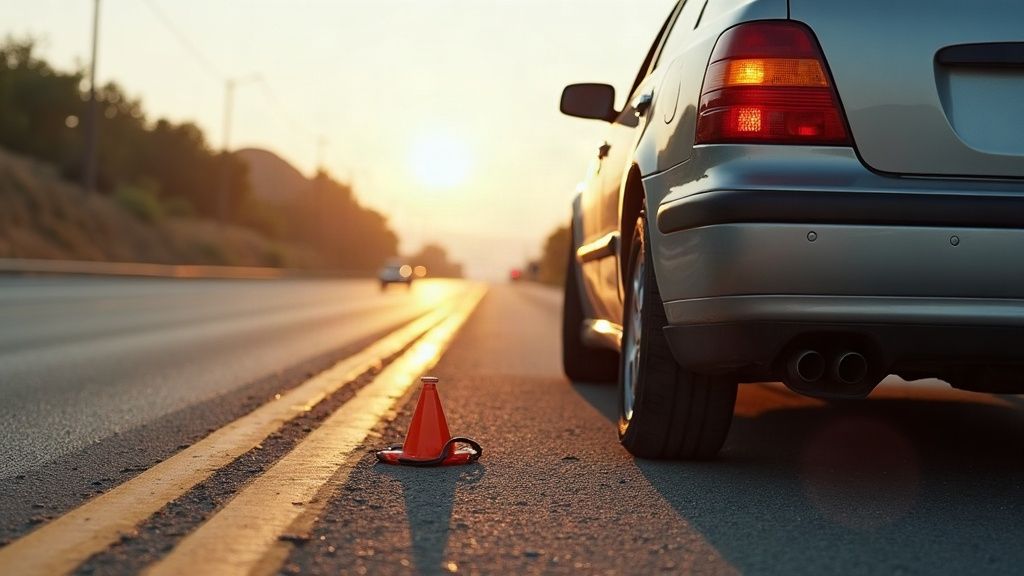
If a tire blew out without warning, a steering system failed on the freeway, or a brake component gave out before you could stop, you may be dealing with more than a car accident. You may be dealing with a defective product case, and that changes everything about who you can hold responsible.
California product liability law gives injured drivers, passengers, and pedestrians a legal path directly to the manufacturer, distributor, or retailer that put a dangerous part on the road. This guide explains how that path works, what you need to prove, and why acting quickly matters.
If you were hurt in a crash you believe was caused by a defective tire or auto part, call (818) 794-9947 for a free consultation. We handle personal injury and product liability cases in California. No fee unless we win.
Quick-Answer Summary
- California applies strict product liability, you do not need to prove the manufacturer was careless.
- Three defect types matter: design defect, manufacturing defect, and failure to warn.
- Every company in the chain, manufacturer, distributor, and retailer, can be held liable.
- The statute of limitations for personal injury product liability is two years under Cal. Code Civ. Proc. §335.1.
- Preserving the failed part and the vehicle is critical and time-sensitive.
- A recall strengthens your case but is not legally required to win it.
How Mechanical Failures and Defects Lead to Serious Crashes
A car is only as safe as the parts inside it. When one of those parts fails because it was designed wrong, assembled wrong, or sold without proper safety warnings, the consequences on a California road can be catastrophic.
Common defective-part crashes include:
- Tire blowouts caused by tread separation, faulty sidewall construction, or improper load ratings.
- Brake failure caused by defective master cylinders, contaminated fluid seals, or pads that wear out far earlier than the manufacturer's specifications.
- Steering and suspension failures that cause a driver to lose control with no warning.
- Airbag malfunctions, including airbags that fail to deploy, deploy with too much force, or (as in the Takata scandal) deploy metal shrapnel.
- Fuel system defects that cause post-collision fires.
- Accelerator or electronic throttle control failures that cause unintended acceleration.
These failures often happen at highway speeds, leaving the driver no time to react. The resulting crashes frequently cause traumatic brain injuries, spinal cord injuries, fractures, and, in the worst cases, wrongful death.
The critical legal question is not just whether a part failed. It is whether the part was defective, and that determination is what triggers product liability.
Product Liability Versus Ordinary Driver-Negligence Claims
Most car accident cases in California rest on negligence, one driver failed to act with reasonable care, and that failure caused the crash. Product liability cases are different in an important way.
In California, you do not have to prove a manufacturer was negligent to win a product liability case, you only have to prove the product was defective and that the defect caused your injury.
This is called strict liability, and California has applied it to defective products since the California Supreme Court's landmark decision in Greenman v. Yuba Power Products (1963). Strict liability means that even a manufacturer who followed every industry standard and exercised reasonable care can be held liable if the product they placed into commerce was defective.
For injured crash victims, this matters because it removes one of the hardest obstacles in an ordinary negligence case: proving what the manufacturer knew, when they knew it, and what they should have done differently. With strict liability, the focus is on the product itself.
The Three Types of Product Defects
California recognizes three types of product defects: a design defect, a manufacturing defect, and a failure to warn.
Design defect. The entire product line was built to a blueprint that made it unreasonably dangerous. Every unit off the assembly line carries the same flaw. A tire designed with a tread pattern prone to separation at normal highway temperatures is a design-defect case.
Manufacturing defect. The design was sound, but something went wrong during production for this specific unit. A properly designed brake caliper that was assembled with a substandard bolt is a manufacturing-defect case. Other units of the same model may be perfectly safe; yours was not.
Failure to warn (marketing defect). The product carried a risk that was not obvious to users, and the manufacturer or seller failed to provide adequate instructions or warnings. A tire rated for one load capacity that is regularly installed on vehicles requiring a higher capacity, without warning the consumer, can fall into this category.
A single accident can involve more than one defect type. An experienced product liability attorney will investigate all three.
Manufacturers, Distributors, and Shops That Can Be Held Responsible
One of the advantages of a California product liability claim is the breadth of who can be held accountable.
Every company in the distribution chain, the manufacturer, the distributor, and the retailer who sold the tire or part, can be held strictly liable under California law.
This includes:
- The original equipment manufacturer (OEM), the company that built the part originally installed on the vehicle.
- Aftermarket part manufacturers, companies that sell replacement parts outside the original vehicle manufacturer's supply chain.
- Tire manufacturers, separately liable when a tire defect causes a crash.
- Distributors and wholesalers that moved the product from manufacturer to market.
- Retailers, auto parts stores, and dealerships that sold the part to the consumer.
- Auto repair shops that installed a defective part, or that installed a good part incorrectly in a way that created a defect.
When a shop installs a part, it can also face a separate negligence claim even if the part itself was not defective, if the installation was done carelessly, the shop carries its own liability.
California's comparative fault rules mean all of these parties can be named, their respective shares of fault can be allocated, and you can recover from each in proportion to their responsibility.
Preserving the Vehicle and Part as Critical Evidence
Preserving the failed part and the damaged vehicle after a crash is one of the most important steps you can take to protect a product liability claim in California.
Once a defective part is repaired, discarded, or the vehicle is totaled and crushed, the physical evidence may be gone forever. Product liability cases depend heavily on expert analysis of the actual part. Without it, your attorney is arguing from photographs and records. With it, a forensic engineer can examine the fracture patterns, the material composition, the torque marks, and the assembly sequence to build a scientifically grounded opinion about what failed and why.
Steps to take immediately:
- Do not authorize the repair shop, tow yard, or insurance company to repair or dispose of the vehicle or any parts.
- Photograph every angle of the damage, with close-ups of the failed component, before anything is moved.
- If the failed part has already been removed (a shredded tire, for example), retrieve it and store it somewhere it will not be further damaged.
- Send a formal evidence preservation letter to every party that has custody of the vehicle or parts, the tow yard, the insurance carrier, the repair shop. Your attorney can do this the day you hire them.
- Preserve any maintenance records, purchase receipts, and installation records for the part in question.
In California, if a party with control over evidence destroys it after receiving notice that litigation is foreseeable, a court can instruct the jury about spoliation of evidence, and that instruction can seriously damage the responsible party's case. The flip side is that if you fail to preserve evidence that was in your control, the same principle can hurt your claim.
Recalls and How They Support (but Don't Guarantee) a Claim
A vehicle recall is powerful evidence in a product liability case because it shows the manufacturer already knew or should have known the product was dangerous.
The National Highway Traffic Safety Administration (NHTSA) maintains a public database of vehicle and tire recalls. If a recall covers your specific vehicle, model year, or tire brand and batch, and if the recall addresses the same type of failure that caused your crash, that is highly significant evidence.
Here is what a recall can do for your case:
- It proves the manufacturer identified the defect as a real safety risk, often before your accident occurred.
- It documents the manufacturer's own description of how the failure happens, which may closely match what happened to you.
- It may establish a timeline that supports your argument the manufacturer failed to act fast enough.
Here is what a recall cannot do by itself:
- It does not automatically establish that the defect caused your specific crash. You still need expert analysis linking the defect to the collision.
- It does not cap or guarantee your recovery. Case value depends on your injuries, your losses, and the facts of your specific incident.
- The absence of a recall does not mean no defect exists. Many defects are never recalled, either because the manufacturer has not yet been forced to act, or because the defect affects a small enough number of units that NHTSA has not triggered an investigation.
Your attorney can check the NHTSA database, pull the full recall history, and request the underlying complaint data that led to the recall. That complaint data sometimes contains accounts from other crash victims that closely parallel your own.
Why These Cases Need Early Expert Investigation
Product liability cases involving defective tires and auto parts are among the most expert-intensive cases in personal injury law. They require:
- Forensic engineering experts who can examine the part and render a scientific opinion about the defect and its cause.
- Accident reconstruction specialists who can connect the part failure to the sequence of the crash.
- Medical experts to document the connection between the crash and your injuries.
These experts are expensive, and their opinions take time to develop. The earlier your attorney engages them, the better, both because the evidence is fresher and because manufacturers in major product liability cases move quickly to deploy their own expert teams.
California's two-year statute of limitations for personal injury gives you time, but it does not give you unlimited time. Under Cal. Code Civ. Proc. §335.1, you have two years from the date of injury to file suit. Exceptions exist, for example, a minor's deadline does not begin running until they turn 18, but the general rule is strict.
California's product liability statute of limitations for personal injury is two years from the date of injury under Cal. Code Civ. Proc. §335.1.
There is also a practical reason not to wait: manufacturers in large product liability cases frequently have litigation holds in place and legal teams ready to move. The longer you wait, the further ahead of you those defense teams are.
The California Department of Motor Vehicles (DMV) crash report, the police report, and the scene investigation are all time-sensitive. Your attorney needs to secure all of it before it becomes harder to obtain.
What About the Driver or the Other Car?
A defective-part case does not cancel out a driver-negligence claim. The two can coexist. If another driver was also negligent, running a red light at the moment your tire blew, for example, you may have claims against both the driver and the manufacturer. California's comparative fault system, codified in Cal. Civ. Code §1431.2, allows multiple defendants to be apportioned fault, and each pays their proportionate share of your damages.
This is one reason these cases benefit from early, thorough representation. A firm that handles both personal injury auto accident claims and product liability claims can investigate every thread simultaneously and make sure nothing is missed.
What Damages Can You Recover in a California Product Liability Case?
When a defective auto part causes an injury, the injured person can seek the full range of compensatory damages available under California law, including:
- Medical expenses, past and future, including surgery, rehabilitation, and ongoing care.
- Lost wages and lost earning capacity, if the injury affects your ability to work.
- Pain and suffering, non-economic damages for physical pain and emotional distress.
- Property damage, the value of the vehicle and any personal property destroyed in the crash.
- Wrongful death damages, when a defective part causes a fatality, surviving family members may have claims under Cal. Code Civ. Proc. §377.60.
In rare cases involving especially egregious manufacturer conduct, cases where a company knowingly concealed a defect, California courts may award punitive damages under Cal. Civ. Code §3294.
We do not quote average settlement figures because there are none that are accurate or honest. Case value depends on the severity of the injury, the strength of the defect evidence, the defendant's financial resources, and dozens of other case-specific facts. What we can tell you is that product liability cases involving serious injuries and documented defects tend to be among the highest-value personal injury claims in California.
What to Do After a Crash You Suspect Involved a Defective Part
- Get medical care. Your health is first. Emergency documentation also creates the medical record your attorney will need.
- Report the crash. Call 911. A police report establishes the basic facts while they are fresh.
- Photograph everything, the vehicle, the tires, the scene, road conditions, any visible part damage.
- Do not authorize repairs yet. Tell the tow yard and the insurance company you are preserving the vehicle for a potential product liability investigation.
- Write down everything you remember, the sequence of events, any sounds or sensations before the crash, weather, speed.
- Check for a recall. Search the NHTSA database for your VIN at nhtsa.gov/recalls.
- Call a product liability attorney early. The evidence is most accessible right now.
Frequently Asked Questions
Can I sue a manufacturer for a defective car part?
Yes. Under California strict liability doctrine, a manufacturer whose defective product causes injury can be sued by the injured person. You do not need to prove the manufacturer was negligent, only that the product was defective, you were injured, and the defect caused the injury.
Who is liable for a tire blowout accident?
Liability depends on the cause of the blowout. If the tire was defectively designed or manufactured, the tire maker and the entire distribution chain can be strictly liable. If the tire was installed incorrectly by a shop, the shop may be liable for negligence. If the vehicle had a suspension defect that damaged the tire, the vehicle or parts manufacturer may be liable. Multiple parties can share liability under California's comparative fault rules.
What is product liability in a car accident?
Product liability in a car accident is a legal claim that the crash was caused by a defect in the vehicle itself or a component part, rather than (or in addition to) driver error. California applies strict liability to product defect cases, meaning the injured person must prove the product was defective and caused harm, but does not need to prove fault or carelessness on the part of the manufacturer.
How do you prove a car part was defective?
Proving a defect typically requires: (1) preservation and examination of the failed part by a forensic engineering expert; (2) accident reconstruction testimony connecting the part failure to the crash; (3) documentation from the manufacturer's own records, recall notices, or complaint databases showing the defect was known or knowable; and (4) evidence that the defect existed when the product left the manufacturer's control.
How long do I have to file a product liability lawsuit in California?
The general statute of limitations for a personal injury product liability case is two years from the date of injury under Cal. Code Civ. Proc. §335.1. Different rules may apply for claims involving a governmental entity, claims on behalf of a minor, or cases where the defect was not discovered immediately. Talk to an attorney about your specific situation as soon as possible.
Does a recall mean I automatically win my case?
No. A recall is powerful evidence, it shows the manufacturer identified the same type of defect as dangerous. But you still need to prove the recall defect caused your specific crash and injuries. A case without a recall can still succeed if expert analysis establishes the defect.
What if the other driver was also at fault?
Both claims can coexist. California's comparative fault rules allow a jury to apportion fault between the negligent driver and the defective product manufacturer. You may recover from both in proportion to their share of responsibility.
Can I bring a product liability claim if I was a passenger, not the driver?
Yes. California product liability claims are available to anyone injured by a defective product, including passengers, pedestrians, and cyclists struck by a vehicle whose defective part caused the driver to lose control.
If you were hurt in a crash and you suspect a defective tire or auto part played a role, the time to act is now. Evidence degrades. Parts get discarded. Recall timelines move forward without you.
We've recovered over $150,000,000 for injured Californians. We handle the investigation, the expert coordination, the insurance carriers, and the litigation, from the moment you call to the final resolution of your case.
Call (818) 794-9947 for a free consultation. No fee unless we win. Available in English and Spanish.
Reviewed by Minas Nordanyan, CA Bar No. 296806. Last reviewed July 2026. This article is for general informational purposes and does not constitute legal advice. Your rights depend on the specific facts of your case. Contact a licensed California attorney to evaluate your individual situation.