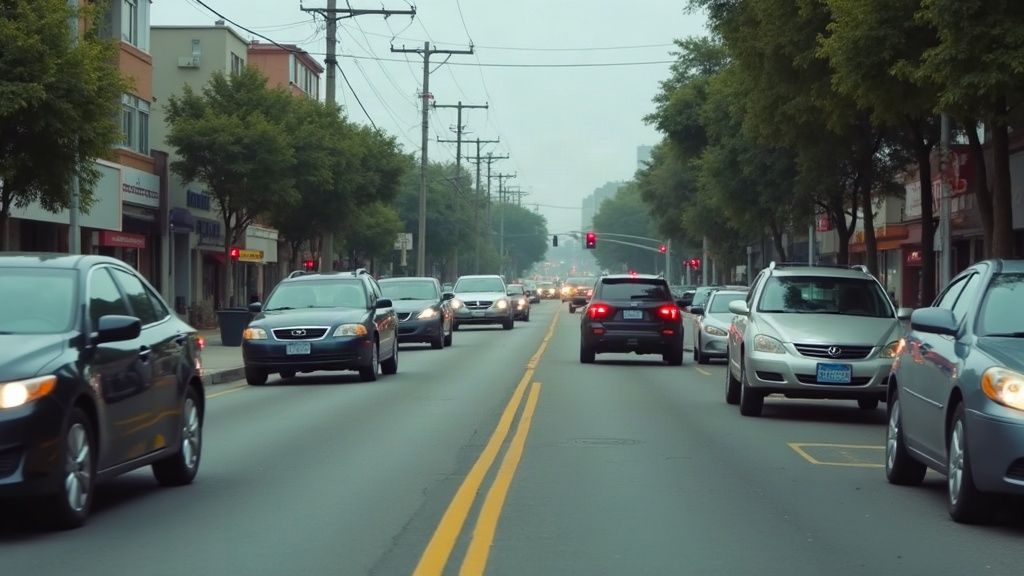
If you were in a crash involving a double-parked car in California, one question comes up fast: whose fault is this, and who pays? The answer is rarely simple. California law can split responsibility between the driver who was illegally stopped and the driver who hit them. How that split falls depends on the specific facts of your crash.
This article breaks down California's parking laws, how courts assign fault in these cases, and what steps you should take to protect your claim.
Quick answers if you're scanning:
- Double parking is illegal in California under Cal. Veh. Code §22500(h).
- Being hit while double-parked does not automatically make you the only party at fault.
- California's pure comparative fault rule (from Li v. Yellow Cab Co., 13 Cal.3d 804 (1975)) means a moving driver can still recover even if they share some blame.
- Insurance for the double-parked driver is the primary source of compensation, but your own policy may also come into play.
- Gathering evidence at the scene significantly affects how fault is assigned.
If you've been injured and need answers specific to your situation, call (818) 794-9947 for a free consultation. No fee unless we win.
Why Double-Parked Cars Create Unique Liability Questions
Most car accident cases start with a clear question: which driver made a mistake? When one car is parked and the other is moving, it might seem obvious that the moving driver is at fault for not avoiding a stationary object.
That logic breaks down with double parking.
A double-parked car is not in a legal parking spot. It is sitting in a travel lane, blocking the normal flow of traffic and forcing other drivers to swerve around it. The double-parker has already broken the law by stopping there. That illegal act is often a contributing cause of the crash.
At the same time, a moving driver who has a clear line of sight to a stopped vehicle and rear-ends it anyway shares some responsibility. California law does not let any party completely off the hook just because someone else also acted wrongly.
The result: these crashes almost always involve shared fault, and the percentage split drives who pays how much.
California Parking Laws and What Counts as Illegal Parking
Cal. Veh. Code §22500 lists the places where stopping, parking, or leaving a vehicle standing is prohibited. The subsection most relevant to double parking is §22500(h), which prohibits stopping or parking on the roadway side of any vehicle stopped or parked at the edge or curb of a street.
Plain English: you cannot park in the travel lane next to a car that is already parked at the curb. That is double parking.
Other nearby violations you will see in these crashes:
- Blocking a bike lane (Cal. Veh. Code §21211), relevant when a cyclist is forced into traffic.
- Standing in a loading zone beyond the posted time limit.
- Stopping in a no-stopping zone (common in commercial districts with red-curb markings).
- Obstructing traffic flow generally (Cal. Veh. Code §22400).
A vehicle code violation does not automatically establish civil liability, but California courts use the doctrine of negligence per se. Under negligence per se, when a driver violates a statute designed to protect other road users from the type of harm that occurred, that violation is treated as negligence as a matter of law. The double-parker's Cal. Veh. Code §22500(h) violation is almost always enough to trigger this doctrine.
How Fault Is Determined When a Moving Car Hits a Parked One
Double parking is illegal in California under Cal. Veh. Code §22500(h), which prohibits stopping on the roadway side of a vehicle already stopped at a curb.
The moving driver's duty to maintain a safe distance
California Vehicle Code §21703 requires a driver not to follow another vehicle more closely than is reasonable. A parallel obligation applies to avoiding stationary hazards: a driver must travel at a speed that allows them to stop within the distance they can see ahead (Cal. Veh. Code §22350, the basic speed law). If a double-parked car was visible and the moving driver had room to stop or safely go around it, the moving driver carries some fault.
The double-parker's role in creating the hazard
A moving driver who hits a double-parked car can still pursue a claim against the double-parker, but the moving driver's own failure to maintain a safe distance may reduce their recovery.
The double-parker created an obstacle in a live traffic lane. Their Cal. Veh. Code §22500(h) violation is a direct cause of the collision scenario. In practice, insurance adjusters and juries assign a meaningful share of fault to the illegally parked driver, often the majority of fault when the moving driver had limited warning.
Factors that shift fault percentages
Adjusters and courts look at:
- Sight distance. Was the double-parked car visible from a reasonable distance, or did it appear suddenly from behind another vehicle?
- Emergency flashers. Was the vehicle displaying hazard lights, or did it look like a moving car in traffic?
- Time of day and lighting. A double-parked car at night with no lights on is a much greater hazard.
- Speed of the moving vehicle. Excess speed reduces the moving driver's reaction time.
- Lane width. If the street was narrow and passing safely was impossible, the double-parker's fault percentage rises.
- Whether the double-parker was inside the vehicle. A driver who sees approaching traffic and does nothing to alert them compounds the negligence.
Bicycle and Motorcycle Risks Around Double-Parked Vehicles
Cyclists and motorcyclists face the greatest danger from double-parked vehicles because an opening car door or a sudden vehicle pull-out can force them directly into traffic with almost no time to react.
Cyclists and motorcyclists face outsized danger from double-parked vehicles for two reasons.
First, dooring. When a driver or passenger opens a door into the bike lane or the road edge, a cyclist traveling at normal speed has almost no time to react. Cal. Veh. Code §22517 prohibits opening a vehicle door on the side available to traffic without first checking for oncoming traffic. A dooring injury caused by a double-parked vehicle combines the §22500(h) parking violation with the §22517 door violation, giving the injured cyclist a strong negligence per se foundation.
Second, squeeze-out. A moving car trying to pass around a double-parked vehicle may drift into the bike lane or shoulder, pushing a cyclist off the road or into a collision. In that scenario, the double-parker contributed to the moving car's deviation, which then caused the cyclist's injury. Fault can attach to both the double-parker and the driver who drifted.
Motorcyclists face similar squeeze-out risks, and the consequences of being forced off a lane line tend to be severe.
If you were on a bike or motorcycle and a double-parked vehicle was part of the chain of events that caused your crash, you may have claims against multiple parties. Call (818) 794-9947 to talk through the facts with an attorney at no charge.
Gathering Evidence When the Other Car Was Illegally Stopped
The quality of your evidence is the single biggest factor controlling how fault is assigned when you cannot yet get to a courtroom. Here is what to document as quickly as possible.
At the scene:
- Photograph the double-parked vehicle from multiple angles, including its position relative to curb-parked cars, any crosswalk or loading-zone markings, and any red or yellow curb paint.
- Photograph skid marks and final rest positions of all vehicles before they are moved.
- Record the license plate of the double-parked vehicle. If the driver is present, photograph their license and insurance card.
- Get the names and phone numbers of witnesses, pedestrians, business owners, people waiting for transit. Bystanders often see events you did not.
- Request police response. A responding officer's report will note the illegal stop in the probable cause section and may cite the double-parker under Cal. Veh. Code §22500.
- Check for nearby cameras. Businesses, ATMs, traffic cameras, and Ring doorbells may have captured the entire sequence. Note which direction they face and request the footage before it is overwritten (many systems hold 24-72 hours of footage).
- Document your injuries. Photograph any visible injuries at the scene and then seek medical evaluation the same day, gaps in treatment are used by insurers to minimize injury claims.
After the scene:
- Obtain the police report number so your attorney can request the full report.
- Write down your own account of the crash while the details are fresh.
- Preserve any dashcam footage from your vehicle.
How Comparative Fault Can Apply to Both Drivers
California follows pure comparative fault, established by the California Supreme Court in Li v. Yellow Cab Co., 13 Cal.3d 804 (1975), meaning your own share of fault reduces your recovery but does not eliminate it entirely.
California follows the rule of pure comparative fault, which the California Supreme Court established in Li v. Yellow Cab Co., 13 Cal.3d 804 (1975). Under this rule, a plaintiff's recovery is reduced by their own percentage of fault, but they can still recover even if they are mostly at fault.
A concrete example: you are driving and strike a double-parked delivery truck. A jury finds the delivery driver 70% at fault for the illegal stop and you 30% at fault for not braking sooner. If your total damages are $100,000, you recover $70,000.
How Prop 51 affects multiple defendants
When more than one defendant is responsible, Cal. Civ. Code §1431.2 (passed as Proposition 51 in 1986) governs how those defendants share the bill. Under §1431.2:
- Economic damages (medical bills, lost wages, property damage, future lost earnings) remain subject to joint and several liability. Any defendant who is found liable can be required to pay the full amount of economic damages, regardless of their individual fault percentage.
- Non-economic damages (pain and suffering, emotional distress) are several only. Each defendant pays only their own proportionate share of non-economic damages.
Under Cal. Civ. Code §1431.2, defendants are severally liable for their proportionate share of non-economic damages, while economic damages remain subject to joint and several liability.
Why does this matter in a double-parking case? Suppose the double-parked driver is uninsured and a second negligent driver also contributed to your crash. You could pursue the insured second driver for their full share of your economic damages under joint and several liability, even though they were only partially at fault. For non-economic damages, you collect from each defendant only what their percentage of fault requires.
Filing a Claim When the At-Fault Party Left the Scene
A common frustration in double-parking crashes: the driver who was illegally stopped pulls away before police arrive, and you did not get their plate number.
Your options depend on your own insurance coverage.
Uninsured motorist (UM) coverage. California requires insurers to offer UM coverage, and most policies include it unless the insured specifically waives it in writing. If the double-parked driver cannot be identified, UM coverage may provide compensation for your injuries.
There is an important limitation: California's UM provisions generally require physical contact between your vehicle and the unidentified vehicle in a hit-and-run scenario. If the double-parked car drove away without actually hitting you but caused you to crash while avoiding it, the physical-contact requirement may create a hurdle. Your attorney can analyze whether your specific policy language and the facts of your case satisfy the UM trigger.
If the double-parked vehicle left the scene before you could identify it, your uninsured motorist coverage may apply, but California UM policies generally require physical contact with the unidentified vehicle.
Your own collision coverage. If you carry collision coverage, it pays for damage to your vehicle regardless of fault, subject to your deductible. Your insurer then has subrogation rights to pursue the at-fault driver.
Third-party witnesses and business records. Even if the driver fled, camera footage or a witness who noted the license plate can allow you to identify them later and file a claim directly against their liability insurance.
Working With an Attorney on a Double-Parking Claim
These cases involve overlapping issues: a traffic code violation, the comparative fault calculation, the §1431.2 economic vs. non-economic damage split, potential UM coverage questions, and insurance adjusters who will argue the moving driver should have avoided the obstacle.
We've recovered over $150,000,000 for injured people across Southern California since 2014. We handle every case as if it were going to trial, because insurance carriers settle for more when they know the other side is prepared to fight.
If you were hurt in a crash involving a double-parked car, call (818) 794-9947 for a free consultation. No fee unless we win.
FAQ: Double-Parked Car Accidents in California
Is it illegal to hit a double-parked car?
Hitting a double-parked car is not a criminal act, but it can make you civilly liable for property damage or injuries. California's comparative fault system means both the driver who was illegally parked and the driver who struck them can share responsibility. Your share of fault reduces your recovery; it does not automatically eliminate it.
Who is at fault if you hit a double-parked car?
Fault is shared in most cases. The double-parked driver violated Cal. Veh. Code §22500(h) by creating an obstacle in a travel lane. The moving driver had a duty to maintain a safe following distance and travel at a speed that allowed them to stop for visible hazards. The exact split depends on sight lines, speed, road conditions, and other facts specific to your crash.
Can you be liable for double parking and causing an accident?
Yes. A driver who double-parks in violation of Cal. Veh. Code §22500 and whose illegal stop contributes to a crash can be held civilly liable for injuries and property damage. Depending on the facts, the double-parker may bear the majority of fault.
Does insurance cover accidents with illegally parked cars?
The double-parked driver's liability insurance is the primary source of compensation for the other party's injuries and property damage. If the double-parker is uninsured or fled the scene, the injured driver's own uninsured motorist coverage and collision coverage may apply, subject to policy terms.
What if the double-parked car drove away before I got the plate?
Report the crash to police immediately. Check nearby businesses, traffic cameras, and rideshare pickup areas for surveillance footage. If you cannot identify the vehicle, file a UM claim with your own insurer. Be prepared for the insurer to raise the physical-contact requirement if the double-parked car left without actually striking yours.
Does it matter if the double-parked car had hazard lights on?
Yes, but not conclusively. Hazard lights are a warning, not permission to stop illegally. A double-parked vehicle displaying hazards may reduce its own liability slightly if a moving driver had adequate notice and still did not slow down, but the underlying Cal. Veh. Code §22500(h) violation remains and the double-parker can still be found negligent.
How does comparative fault affect my recovery amount?
Under California's pure comparative fault rule from Li v. Yellow Cab Co., 13 Cal.3d 804 (1975), your recovery is reduced by your own percentage of fault. If a jury finds you were 20% at fault and your total damages are $80,000, you recover $64,000. There is no threshold percentage that bars you from recovering.
What is the difference between economic and non-economic damages in these cases?
Economic damages cover medical bills, lost wages, property repair or replacement, and future financial losses. Non-economic damages cover pain and suffering, emotional distress, and loss of enjoyment of life. Under Cal. Civ. Code §1431.2, each defendant is liable for their proportionate share of non-economic damages. Economic damages remain subject to joint and several liability, meaning a solvent defendant can be required to pay the full economic award even if another defendant is judgment-proof.
Should I call the police after hitting a double-parked car?
Yes. A police report creates an official record of the scene, the positions of the vehicles, and the parking violation. The responding officer may cite the double-parked driver under Cal. Veh. Code §22500, which strengthens your civil claim. California law requires you to report any accident involving injury or death, and requires a report to the DMV within 10 days if the accident caused injury, death, or property damage over $1,000 (Cal. Veh. Code §16000).
Reviewed by Minas Nordanyan, CA Bar #296806. This article is for general informational purposes only and does not constitute legal advice. Every case depends on its specific facts. Call (818) 794-9947 for a free consultation about your situation.