E-bike sales in California have climbed every year since 2020, and so have e-bike crash injuries. The problem is that the law has not kept pace the way most riders assume. E-bikes occupy an unusual legal middle ground between a bicycle and a motor vehicle, and that ambiguity can cost injured riders real money if they handle a claim without understanding the rules.
If you or someone you care about was hurt in an e-bike accident in California, what follows covers the 11 things that matter most before you talk to an insurance adjuster.
Quick summary:
- California law creates three e-bike classes with different speed limits and riding rules.
- Your e-bike class affects where you can ride legally and shapes fault analysis after a crash.
- Dooring, intersection failures, and distracted drivers cause most e-bike crashes.
- A car driver's auto liability insurance is the first recovery source when a vehicle causes the crash.
- E-bike riders who injure pedestrians may face personal liability with no insurance to cover it.
- The e-bike manufacturer can be strictly liable for defective components under California law.
- Riding without a required helmet can reduce your own compensation.
- Auto, homeowner's, renter's, and specialty e-bike policies all play different roles.
- Onboard e-bike data must be preserved immediately.
- E-bike crash injuries tend to be severe because of the higher speeds involved.
- A two-year statute of limitations applies to most California e-bike injury claims.
1. How California Classifies Different E-Bike Types
California divides e-bikes into three classes under Vehicle Code §312.5: Class 1 is pedal-assist up to 20 mph, Class 2 is throttle-assist up to 20 mph, and Class 3 is pedal-assist up to 28 mph.
Class 1 bikes assist only when you pedal and stop assisting at 20 mph. Class 2 bikes have a throttle that can power the bike without pedaling, also capped at 20 mph. Class 3 bikes assist pedaling up to 28 mph and require a speedometer. All three classes are limited to a 750-watt motor output under Vehicle Code §312.5.
This classification is not just a technical detail. It determines which paths and trails you may use legally, whether you are required to wear a helmet, and what a judge or jury will consider when deciding who was responsible for a crash.
Takeaway: Before any claim is evaluated, your attorney needs to know what class your e-bike is, because the answer changes the legal analysis.
2. Why Classification Affects Fault and Insurance Coverage
A Class 3 e-bike traveling at 28 mph in a bike lane is operating at a speed that surprises many car drivers who expect slower bicycles. California Vehicle Code §21207.5 restricts Class 3 e-bikes from paths and trails that are open to Class 1 and Class 2 bikes unless a local authority specifically permits it.
If a Class 3 rider was in a restricted zone when the crash occurred, an insurance adjuster or defense attorney will argue the rider was contributorily at fault for being somewhere the law did not allow. Under California's pure comparative fault system, your compensation is reduced by your percentage of fault, even if the other party was mostly responsible.
Classification also signals to insurers what kind of vehicle was involved. Some insurers treat Class 3 bikes closer to mopeds for coverage purposes, which can affect whether a policy applies at all.
Takeaway: Confirm your e-bike's class and verify you were riding lawfully before any statement is given to an insurer.
3. Common Causes of E-Bike Crashes on California Streets
The most frequent causes of e-bike collisions in California fall into a few clear categories:
- Dooring: A driver or passenger opens a car door into a bike lane. At 20-28 mph, an e-bike rider has almost no time to stop.
- Intersection failures: Drivers failing to yield when turning across a bike lane or failing to see a rider in a crosswalk.
- Distracted driving: Drivers looking at phones or navigation screens in urban areas where e-bikes share road space.
- Road hazards: Potholes, uneven pavement, or debris that would be survivable at 12 mph on a regular bicycle but causes a serious crash at 28 mph.
- Mechanical defects: Throttle failures, brake defects, or battery fires that cause sudden loss of control.
Each cause points to a different potential defendant: the driver, the city, or the manufacturer. Identifying the correct defendant is the first strategic decision in any e-bike injury claim.
Takeaway: The cause of the crash determines who can be sued, so document conditions at the scene thoroughly before anything is moved or cleaned up.
4. What Happens When a Car Hits an E-Bike Rider
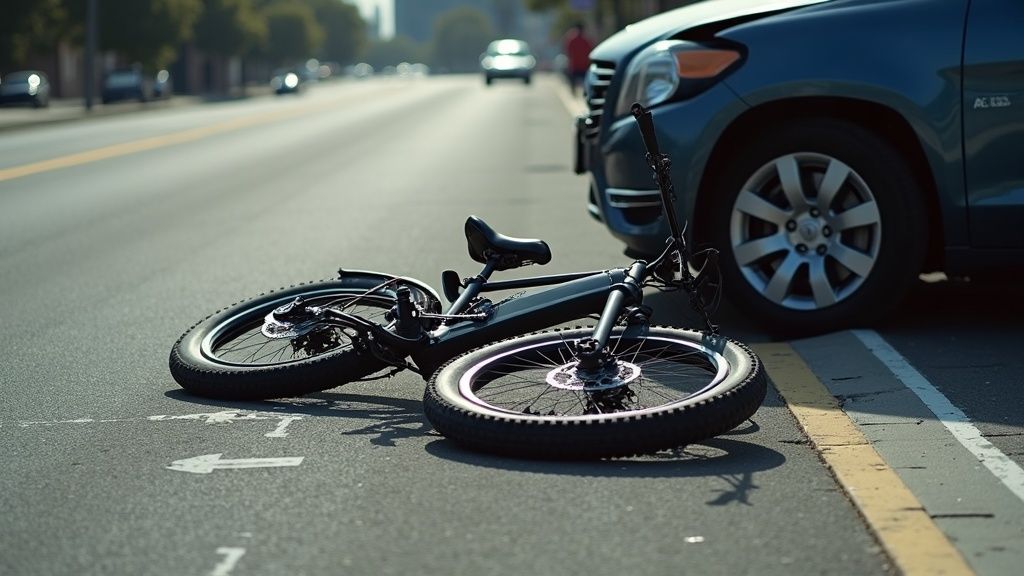
When a motor vehicle strikes an e-bike rider, the driver's automobile liability insurance is the primary source of recovery, but serious injuries often exceed policy minimums quickly.
As of policies issued or renewed on or after January 1, 2025, California's minimum bodily injury liability limits are $30,000 per person and $60,000 per accident, with $15,000 in property damage coverage (30/60/15) under the changes enacted by SB 1107. Traumatic brain injuries, spinal injuries, and multiple fractures from an e-bike crash can generate medical bills that exceed those limits within days of the crash.
This is why uninsured/underinsured motorist (UM/UIM) coverage on your own auto or specialty policy matters. If the at-fault driver carried only minimum limits and your damages are higher, UM/UIM coverage on your own policy is often the only source of additional recovery. California requires insurers to offer UM/UIM coverage, though policyholders can reject it in writing under Vehicle Code §11580.2.
Takeaway: Pull your own insurance declarations page immediately after a crash to find out what UM/UIM limits you carry, that number matters as much as the at-fault driver's policy.
5. What Happens When an E-Bike Hits a Pedestrian
When an e-bike rider causes an injury to a pedestrian, the rider becomes the defendant. Pedestrians have the right of way in marked and unmarked crosswalks under Vehicle Code §21950, and an e-bike rider who fails to yield can be found negligent under California's general duty-of-care standard in Civil Code §1714.
The significant exposure for riders in this scenario is personal financial liability. Unlike a car driver, most e-bike riders do not have a dedicated vehicle liability policy. Unless the rider has homeowner's or renter's insurance with a personal liability component, or a specialty e-bike policy with liability coverage, they may have no insurance to pay the injured pedestrian's claim.
Pedestrians injured by e-bikes have the same two-year window to bring a personal injury claim as any other plaintiff under Cal. Code Civ. Proc. §335.1.
Takeaway: If you ride an e-bike regularly, check whether your renter's or homeowner's policy includes personal liability coverage for incidents off your property.
6. Whether the E-Bike Manufacturer Could Share Fault
Under California's strict products liability doctrine, a manufacturer can be held liable if a defective e-bike component caused the crash, without the injured person needing to prove negligence.
California established strict products liability in Greenman v. Yuba Power Products (1963), which means an injured rider does not have to prove the manufacturer was careless. The rider must show: (1) the product was defective, (2) the defect existed when it left the manufacturer's control, and (3) the defect caused the injury. Common e-bike defects that generate claims include faulty throttle assemblies that accelerate unexpectedly, brake systems that fail at speed, weak frame welds that collapse under normal riding loads, and lithium battery packs that overheat or catch fire.
If a defect contributed to the crash, the manufacturer, distributor, and retailer can each be named as defendants. These cases often require a mechanical engineer as an expert witness and prompt preservation of the physical e-bike before any repairs are made.
Takeaway: Never repair or discard a damaged e-bike after a crash. It is evidence in a potential products liability claim.
7. How Helmet and Age Laws Can Affect a Claim
Riding a Class 3 e-bike without a helmet can reduce your compensation through California's comparative fault rules, because a jury may assign partial fault to the unhelmeted rider.
California Vehicle Code §21212 requires all riders under 18 to wear a bicycle helmet on any class of e-bike. Vehicle Code §21213 extends the helmet requirement to all Class 3 e-bike riders regardless of age. If you were not wearing a required helmet and you suffered a head injury, a defense attorney will argue that your failure to wear a helmet contributed to the severity of your injury, asking the jury to assign you a percentage of fault under California's comparative fault system.
Even if you were not legally required to wear a helmet, a jury may still consider the absence of a helmet when evaluating the reasonableness of your conduct. That percentage comes directly off your damages award.
Age restrictions also matter: riders under 16 may not operate a Class 3 e-bike under Vehicle Code §21213.
Takeaway: Always wear a helmet on a Class 3 e-bike, and encourage anyone under 18 to wear one on any class, both for safety and to protect the value of a future claim.
8. What Insurance Actually Applies to E-Bike Injuries
Coverage for e-bike crashes is more fragmented than most riders realize. Here is how the layers typically work in California:
- Auto liability insurance: Covers the at-fault car driver's liability to the e-bike rider. Does not cover the e-bike rider's own vehicle or injuries under most standard auto policies.
- Homeowner's or renter's insurance: May cover personal liability if the e-bike rider injures someone else. Coverage limits vary widely. Many policies exclude motorized vehicles, and some insurers treat Class 3 e-bikes as motorized.
- Specialty e-bike insurance: Standalone policies that can include collision coverage, theft, medical payments, and third-party liability. Availability has expanded with e-bike market growth.
- Workers' compensation: If the crash happened while you were working, a food delivery rider, a courier, an employee running an errand for an employer, the employer's workers' comp policy may apply under Cal. Lab. Code §3600. This does not prevent a separate personal injury claim against the at-fault driver.
- Health insurance: Covers medical treatment regardless of fault but creates subrogation rights, meaning the insurer may seek reimbursement from any personal injury settlement.
Takeaway: Map all potentially applicable coverage sources on day one of the claim. Missing a layer is a common and costly mistake.
9. Evidence Unique to E-Bike Accident Scenes
E-bikes carry onboard data, including speed and throttle input logs, that must be preserved immediately after a crash because it can corroborate or contradict witness accounts.
Many modern e-bikes record trip data: speed, distance, throttle engagement, braking events, and battery status. This data can be overwritten by subsequent rides or lost if the bike is powered down and the system is not preserved. An attorney can send a litigation hold letter to the manufacturer or retailer if the bike uses a cloud-connected app.
Beyond onboard data, collect or request:
- Police report number and the officer's name
- Photographs of both vehicles, the road surface, traffic controls, skid marks, and the e-bike's damage pattern
- Dashcam footage from the car involved or nearby vehicles
- Traffic or business security camera footage (businesses are not required to preserve footage; request it quickly)
- Witness names, phone numbers, and a brief statement while the event is fresh
- Any visible defects in the roadway, such as potholes, that may involve a public entity defendant
Claims against public entities for road defects require a government tort claim filed with the responsible agency within six months of the incident under Cal. Gov. Code §911.2, a far shorter deadline than the standard two-year personal injury statute.
Takeaway: Preserve the e-bike's data and photograph everything at the scene before anything is moved. The evidence window closes faster than most people expect.
10. Common Injuries Seen in E-Bike Crashes
Because e-bikes reach speeds up to 28 mph with no protective shell around the rider, the injuries are closer to motorcycle-crash injuries than typical bicycle injuries. Commonly treated conditions include:
- Traumatic brain injury (TBI): Even helmeted riders can sustain concussion or more severe TBI from high-speed impacts. TBIs range from brief disorientation to permanent cognitive impairment.
- Clavicle (collarbone) fractures: One of the most common e-bike injuries, caused by landing on an outstretched arm or striking the shoulder on pavement.
- Road rash: Skin abrasions from sliding on pavement can be deep enough to require skin grafting and carry a risk of serious infection.
- Wrist fractures: Instinct to brace a fall with outstretched hands often results in distal radius or wrist fractures.
- Spinal injuries: High-speed crashes can cause herniated discs, compression fractures, or in the worst cases, spinal cord damage with lasting neurological effects.
- Facial fractures: Riders who are not wearing helmets with face shields can sustain orbital fractures, nasal fractures, and dental damage.
Medical documentation from the emergency room and all follow-up care forms the foundation of the damages calculation in any personal injury claim. Never delay seeking care, and never stop treatment before your doctor clears you.
Takeaway: E-bike injuries are routinely more severe than what a standard bicycle crash produces, get full medical documentation and follow your treatment plan without gaps.
11. Steps to Take Right After an E-Bike Accident
California's personal injury statute of limitations is two years from the date of injury under Cal. Code Civ. Proc. §335.1, so injured e-bike riders must act within that window or lose the right to recover.
Follow these steps in order:
- Call 911. A police report creates an official record of the crash, the parties involved, and initial observations about fault.
- Get emergency medical care. Even if you feel able to walk away, adrenaline masks pain. Delays in seeking care are used by insurers to argue injuries were not serious.
- Photograph the scene. Both vehicles, the road surface, traffic signs, skid marks, and the damage pattern on the e-bike.
- Collect witness contact information. Names and phone numbers before anyone leaves the scene.
- Preserve the e-bike. Do not repair it. Do not delete the companion app data. It is physical evidence.
- Notify your own insurer. Report the crash but give no recorded statement about fault until you have spoken with an attorney.
- Contact a personal injury attorney. E-bike claims involve overlapping insurance layers, potential product defect issues, and possible public entity defendants. An attorney identifies all defendants and all coverage sources before the evidence window closes.
If a public entity (city, county, or state) may be responsible for a road defect, the six-month government claim deadline under Cal. Gov. Code §911.2 applies, that is one reason not to delay the call to an attorney.
Takeaway: The first 48 hours after an e-bike crash determine what evidence is preserved and what claims remain available. Move fast.
Frequently Asked Questions
Are e-bikes treated like bicycles or motor vehicles in California?
California treats e-bikes as a distinct category under Vehicle Code §312.5, separate from both traditional bicycles and motor vehicles. They are not required to be registered like cars, but they are subject to traffic laws, class-specific path restrictions, and helmet requirements that do not apply to standard bicycles. For insurance and liability purposes, how an e-bike is treated depends heavily on its class and the specific policy language involved.
Who is liable if an e-bike hits a pedestrian?
The e-bike rider can be held liable under California's negligence standard in Civil Code §1714. Pedestrians have the right of way in crosswalks under Vehicle Code §21950, and a rider who fails to yield and causes injury can face a personal injury lawsuit. If the rider lacks personal liability insurance through a homeowner's, renter's, or specialty e-bike policy, that liability may come directly out of the rider's personal assets.
Does car insurance cover e-bike accidents?
It depends on whose car insurance and what kind of coverage. If a car driver's negligence caused the crash, that driver's auto liability policy covers the e-bike rider's damages up to policy limits. The e-bike rider's own auto insurance policy generally does not cover the e-bike itself under a standard auto policy, but uninsured/underinsured motorist coverage may apply if the at-fault driver is uninsured or underinsured. Specialty e-bike insurance and homeowner's or renter's policies fill other gaps.
Can I sue if a defective e-bike caused my crash?
Yes. Under California's strict products liability doctrine established in Greenman v. Yuba Power Products (1963), you do not need to prove the manufacturer was negligent. You need to show the product had a defect, the defect existed when it left the manufacturer, and the defect caused your injury. The manufacturer, distributor, and retailer can all be named as defendants. Preserving the physical e-bike and its data is essential to this type of claim.
What is the deadline to file an e-bike accident lawsuit in California?
For a personal injury claim against a private party, California's statute of limitations is two years from the date of injury under Cal. Code Civ. Proc. §335.1. If a public entity such as a city or county may be liable for a road defect, a government tort claim must be filed within six months of the incident under Cal. Gov. Code §911.2, before any lawsuit can be brought.
Do I need a police report to file an e-bike injury claim?
You are not legally required to have one, but it is one of the most valuable pieces of evidence in your claim. A police report documents the crash location, the parties involved, and the officer's initial observations about fault. Without it, the claim often becomes a he-said/she-said dispute that is harder to resolve in the injured rider's favor.
What if I was riding my e-bike for work when the crash happened?
If you were performing work duties when the crash occurred, such as making deliveries or running an errand for your employer, you may have both a workers' compensation claim against your employer's insurer and a personal injury claim against the at-fault driver. Workers' comp covers medical treatment and a portion of lost wages under Cal. Lab. Code §3600. The personal injury claim against the driver is separate and can recover additional damages including pain and suffering.
If you or someone you care about was injured in a California e-bike accident, the window to preserve evidence and protect your legal rights is short. Call (818) 794-9947) for a free case review with a California personal injury attorney. No fee unless we win.
Reviewed by Minas Nordanyan, CA Bar #296806. Last updated August 2026.