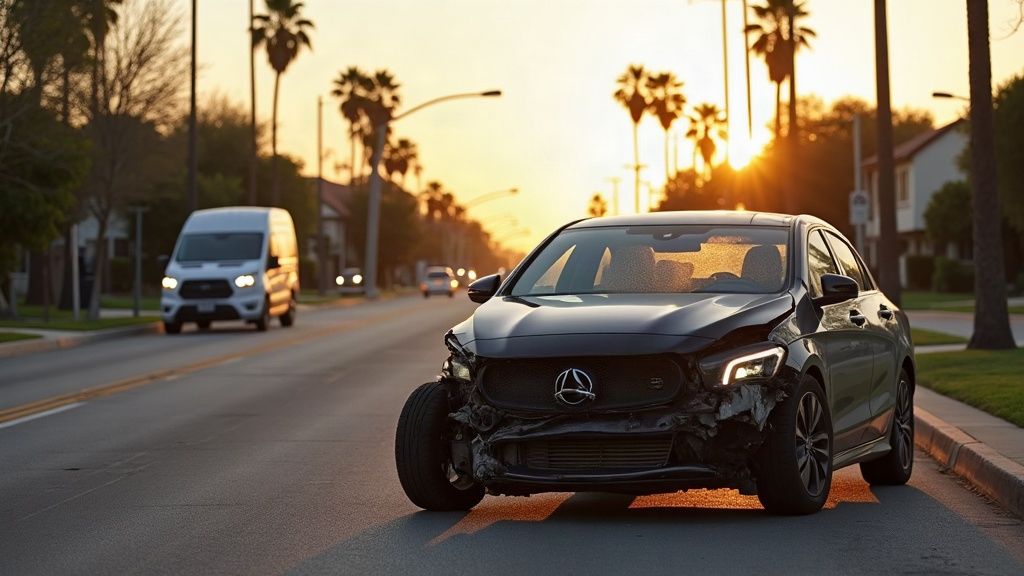
If you were seriously hurt in a crash caused by an older driver in California, the legal path forward is not always straightforward. Age does not automatically mean fault, but it can open lines of evidence that don't exist in a typical accident case, medical history, DMV renewal records, prescription drug disclosures, and even family liability. The two-year deadline under Cal. Civ. Proc. Code §335.1 means you don't have unlimited time to sort this out.
Below are the nine things that matter most when the driver who hit you was elderly.
Quick summary:
- Crash risk can increase with age due to reaction time, vision, and medical conditions.
- California requires in-person renewal and vision testing for drivers 70 and older.
- Negligence must still be proven through duty, breach, causation, and damages, age alone is not fault.
- Medical records and prescription histories can be powerful evidence in discovery.
- Any person can request a DMV reexamination of an unsafe driver under California law.
- Current minimum liability limits are $30,000 per person / $60,000 per accident for policies issued on or after January 1, 2025.
- The registered vehicle owner can be jointly liable under California's permissive use statute.
- Pedestrian and bicycle crashes carry unique evidentiary and damages considerations.
- California's personal injury statute of limitations is two years from the date of injury.
1. Why Crash Risk Can Rise with Age
Age alone does not determine fault in a California car accident; negligence must still be proven through the standard four-element test of duty, breach, causation, and damages.
Older drivers can face documented physical and cognitive changes that affect driving ability. Reaction time tends to slow, peripheral vision narrows, and conditions like cataracts or early-stage dementia can reduce the ability to process traffic information quickly. Certain medications prescribed at higher rates in older populations, including sedatives, antihistamines, and some blood pressure drugs, carry impairment warnings that parallel those attached to alcohol.
None of this means an elderly driver is automatically at fault for a crash. California law applies the same negligence standard to every driver regardless of age. What age-related impairment does is open additional evidentiary channels: medical records, prescription logs, and DMV fitness-to-drive history can all become relevant to proving that a specific driver should not have been behind the wheel on the day of your crash.
Practical takeaway: Document everything at the scene. If the at-fault driver appeared confused, drove erratically, or acknowledged a medical condition, note it in your own written account and tell your attorney as soon as possible.
2. California License Renewal Rules for Older Drivers and How They Affect a Claim
California requires drivers age 70 and older to renew their license in person and pass a vision test under Cal. Veh. Code §12814.5.
California imposes more stringent renewal requirements on older drivers than on the general population. Under Cal. Veh. Code §12814.5, drivers who are 70 years of age or older must renew in person rather than by mail or online, and they must pass a vision test at the time of renewal. The DMV also has authority to require a written or behind-the-wheel driving test if there is reason to question a driver's competence.
Why does this matter to your case? If the driver who hit you recently renewed and passed those screenings, that fact cuts one way. If records show the driver failed a vision test, was flagged for a knowledge exam, or let a license lapse and was driving without a valid license, those facts cut the other way, they go directly to whether the driver exercised reasonable care. A subpoena for the driver's DMV renewal file can surface information an insurance adjuster will never voluntarily hand over.
Practical takeaway: Ask your attorney early about preserving DMV records for the at-fault driver. These files can be obtained in civil discovery and can show whether the driver met California's minimum fitness standards before getting behind the wheel.
3. How Negligence Is Established When an Elderly Driver Causes a Crash
To win a personal injury claim in California, you must prove four elements: the driver owed you a duty of care, they breached that duty, the breach caused your injuries, and you suffered compensable damages. Every driver on a California road owes a duty of reasonable care to others under the general negligence standard. The question is always whether this specific driver breached that duty on this specific day.
Evidence of breach in an elderly-driver case can come from several sources: a police report citing a traffic violation, witness testimony about the driver's behavior before impact, the driver's own statements at the scene, dashcam or surveillance footage, and medical or pharmacy records obtained in discovery. California is a pure comparative fault state, meaning that even if you were partially at fault, you can still recover damages, reduced by your percentage of fault.
Practical takeaway: Never assume the crash was too complicated to prove because the other driver is elderly. Each of the four negligence elements can be built from physical evidence, records, and witness accounts, none of which require you to prove the driver is "bad" in a general sense, only that their conduct fell below the standard on that day.
4. Using Medical Conditions or Medications as Evidence in Your Case
Any person can request a DMV reexamination of an elderly driver by submitting a written request under Cal. Veh. Code §13803, and the request can be kept confidential.
An elderly driver's medical history can become central evidence in a negligence case when that history shows the driver knew, or should have known, that a condition or medication made them unsafe to drive. Dementia, Parkinson's disease, uncontrolled epilepsy, severe vision loss, and certain cardiac conditions are among the diagnoses that can impair driving ability. Prescriptions for benzodiazepines, opioids, muscle relaxants, and some antihistamines carry FDA warnings about operating a vehicle.
In civil litigation, your attorney can seek the driver's medical records and prescription history through discovery. A treating physician's notes stating that the patient was advised not to drive, or a pharmacy label warning against operating machinery, can be powerful evidence that the driver consciously assumed a risk that injured you. In some cases, a prescribing physician or a specialist hired as an expert witness can testify about how a particular condition or medication affects driving ability.
Practical takeaway: Tell your attorney about any observations at the scene, confusion, slurred speech, slow movements, or the driver mentioning a health condition. These details help attorneys know which medical records to target in discovery before the driver's family or insurer limits access.
5. How to Report a Potentially Unsafe Elderly Driver to the DMV
If you are concerned that an elderly driver poses an ongoing danger to the public, whether or not you were personally involved in a crash, California law gives you a formal mechanism. Under Cal. Veh. Code §13803, any person may submit a Request for Driver Reexamination to the DMV, asking the agency to evaluate whether the driver remains fit to hold a license. Physicians and law enforcement officers are also authorized to report unsafe drivers directly.
The DMV reviews the submission and may require the driver to take a written test, a vision exam, or a behind-the-wheel driving test. If the driver fails or refuses, the DMV can suspend or revoke the license. Importantly, California law allows these reports to be submitted confidentially, the driver is not told who made the request.
Reporting a driver to the DMV is separate from your civil injury claim, but a DMV action taken after your crash can become evidence that corroborates your allegation that the driver was unsafe. Timing matters: if the DMV opens a reexamination file after your crash, your attorney can subpoena those records.
Practical takeaway: If you or a family member is worried about an elderly driver's fitness before any crash occurs, submit a reexamination request through the DMV's website or a local DMV office. The process is free and can be confidential.
6. Insurance Coverage Considerations When the At-Fault Driver Is Elderly
California's current minimum auto liability limits are $30,000 per person and $60,000 per accident for policies issued or renewed on or after January 1, 2025.
California law requires all drivers to carry auto liability insurance. For policies issued or renewed on or after January 1, 2025, SB 1107 raised the minimum limits under Cal. Veh. Code §16056 to $30,000 per person, $60,000 per accident, and $15,000 for property damage. Policies issued before that date may still carry the prior lower minimums until renewal.
Serious injuries, fractures, traumatic brain injury, spinal damage, can generate medical bills and lost wages that exceed even a fully compliant policy. When that happens, your own uninsured/underinsured motorist (UM/UIM) coverage becomes the backstop. Your own policy's UM/UIM coverage steps in to cover the gap between the at-fault driver's limit and your actual damages, up to your own policy's UM/UIM limit. Reviewing your own declarations page with your attorney as soon as possible is essential.
In some cases, the elderly driver may be uninsured. California's uninsured motorist statute, Cal. Ins. Code §11580.2, requires insurers to offer UM coverage. If you accepted that coverage, it applies to crashes caused by uninsured drivers. If you declined it, your options narrow significantly, which is one of the many reasons attorney involvement early matters.
Practical takeaway: Pull out your own auto insurance declarations page and confirm your UM/UIM limits before your first attorney consultation. That number often determines how much total recovery is available to you.
7. When Family or Vehicle-Owner Liability May Come Into Play
Under Cal. Veh. Code §17150, the registered owner of a vehicle is liable for damages caused by any driver they permitted to use it.
California's permissive use doctrine, codified at Cal. Veh. Code §17150, holds that the registered owner of a vehicle is liable for any injury or property damage caused by a person who operated the vehicle with the owner's express or implied permission. This matters enormously in elderly-driver cases.
Consider the common scenario: an adult child or spouse owns the car and permits an elderly family member to drive it despite knowing the family member has cognitive or vision impairment. Under §17150, the vehicle owner can be held jointly liable. That owner may carry their own insurance policy with higher limits, providing an additional source of recovery. The owner's liability is capped at $15,000 per person and $30,000 per accident under the statute's express limits, but that ceiling does not eliminate liability claims against the owner under general negligence theories if the owner had independent knowledge of the driver's impairment and permitted the drive anyway.
Family negligent entrustment, lending a vehicle to someone you know is unfit to drive, is a separate cause of action that can reach beyond the owner-liability caps. If an adult child knew their parent had failed a DMV test, had prior crashes, or had been told by a physician not to drive, and they still handed over the keys, that adult child may face direct personal liability.
Practical takeaway: Identify who owns the vehicle in every elderly-driver crash. The registered owner's name appears on the police report. That single fact can significantly expand the pool of insurance coverage available to cover your losses.
8. Special Considerations for Pedestrian or Bicycle Crashes Involving Elderly Drivers
Pedestrians and cyclists struck by an elderly driver often sustain the most severe injuries in this category of crashes, because there is no vehicle frame protecting them from the force of impact. California law specifically addresses driver duties in these situations. Under Cal. Veh. Code §21950, drivers must yield the right of way to pedestrians within a crosswalk. Violations of that statute can constitute negligence per se, meaning the violation itself establishes the breach element of negligence without requiring further proof that the driver acted unreasonably.
For pedestrian and bicycle crash claims, damages tend to be larger, and so does the likelihood that the at-fault driver's minimum policy limits will be inadequate. Economic damages can include emergency care, surgery, rehabilitation, long-term physical therapy, lost income, and future earning capacity. Non-economic damages for pain, suffering, and loss of enjoyment of life can also be substantial.
Comparative fault arguments arise often in these cases. Insurers may argue the pedestrian was not in a marked crosswalk, crossed against the signal, or was wearing dark clothing at night. California's pure comparative fault rule means those arguments reduce your recovery, not eliminate it, but they require an experienced attorney to counter with scene reconstruction, signal timing data, and eyewitness accounts.
Practical takeaway: If you were struck as a pedestrian or cyclist, photograph every detail at the scene, crosswalk markings, traffic signals, sight lines, and skid marks. That physical evidence disappears quickly once a road crew passes through.
9. When to Consult a Lawyer About a Claim Involving an Elderly Driver
California's personal injury statute of limitations is two years from the date of injury under Cal. Civ. Proc. Code §335.1.
California's personal injury statute of limitations is two years from the date of the crash under Cal. Civ. Proc. Code §335.1. Miss that deadline and your right to recover is extinguished regardless of how strong your underlying claim would have been. Two years sounds long. It moves faster than you expect when you are focused on medical treatment, physical therapy, and returning to work.
An attorney experienced in California personal injury claims involving elderly drivers can do several things that matter before you settle on your own. They can subpoena the at-fault driver's DMV file, medical records, and prescription history before those documents become harder to access. They can identify the registered vehicle owner and investigate family negligent entrustment. They can analyze every available insurance policy, the at-fault driver's, the vehicle owner's, and your own UM/UIM coverage, to map the full pool of available recovery. And they can preserve surveillance footage, dashcam data, and black-box records before they are overwritten.
We've recovered over $150,000,000 for injured clients in Southern California. We handle every case as if it were going to trial, because insurance companies settle for more when they know the other side is prepared to fight.
Practical takeaway: Contact an attorney before you give a recorded statement to any insurance company, including your own. A recorded statement made before you understand the full extent of your injuries can limit your recovery in ways that are very difficult to undo.
Frequently Asked Questions
Can I sue an elderly driver's family after a California car accident?
Yes, in some circumstances. Under Cal. Veh. Code §17150, the registered vehicle owner is liable for crashes caused by a permitted driver. Beyond that statute, a family member who knew the elderly driver was unfit to drive and handed over the keys anyway may face a direct negligent entrustment claim under California common law. The key facts are ownership of the vehicle, permission to drive, and knowledge of the driver's impairment.
Does age affect fault in a California car accident claim?
Age alone does not establish or reduce fault. California applies the same negligence standard to all drivers. However, age-related impairments, cognitive decline, vision loss, medication effects, can be evidence of breach of the duty of care if they affected the driver's ability to operate a vehicle safely. The four-element negligence test (duty, breach, causation, damages) applies the same way regardless of the at-fault driver's age.
How do I report an unsafe elderly driver in California?
Any person can submit a Request for Driver Reexamination to the California DMV under Cal. Veh. Code §13803. You can submit the request online or at a DMV office. The report can be kept confidential. The DMV will then determine whether to require the driver to retake written, vision, or behind-the-wheel tests.
What if the elderly driver has no insurance?
If the at-fault driver is uninsured, your own uninsured motorist (UM) coverage, required to be offered under Cal. Ins. Code §11580.2, may cover your damages up to your policy's UM limits. If you declined UM coverage, recovery becomes significantly more difficult and may require pursuing a judgment directly against the uninsured driver. An attorney can evaluate whether the vehicle owner's insurance or other coverage sources might apply.
What is California's statute of limitations for a car accident injury claim?
The deadline is two years from the date of injury under Cal. Civ. Proc. Code §335.1. Claims against a government entity (such as if a public bus driver or a city vehicle was involved) carry a much shorter administrative claim deadline of six months under the California Government Claims Act. Missing either deadline bars your claim.
Can an elderly driver's medical records be used as evidence?
Yes. In civil litigation, medical records, physician notes, and prescription histories are obtainable through discovery if they are relevant to the driver's fitness to drive at the time of the crash. A treating physician's warning that the patient should not drive, or a prescription label cautioning against operating a vehicle, can directly support the negligence and causation elements of your claim.
What damages can I recover after a crash caused by an elderly driver?
California allows recovery of economic damages, medical bills, future medical care, lost wages, loss of future earning capacity, and non-economic damages such as pain and suffering and loss of enjoyment of life. In rare cases involving oppression, fraud, or malice, California Civil Code §3294 allows punitive damages, though that standard is difficult to meet in an ordinary car accident case.
If you were injured in a crash caused by an elderly driver in California, every day counts. Evidence fades, DMV records cycle, and the two-year statute of limitations moves faster than it looks. Call (818) 794-9947 for a free case review. No fee unless we win.
Reviewed by Minas Nordanyan, CA Bar #296806. Last reviewed September 2026.