If you were hurt riding an electric bike in California, you are probably dealing with real pain and a confusing mix of questions: Does the driver's insurance apply? Does your own insurance help? And can you actually sue?
The short answer is yes, you may have a strong personal injury claim. But the details depend on how California law classifies your e-bike, who was at fault, and which insurance policies are in play.
This article walks through all of it in plain terms. If you want to talk through your specific situation now, call (818) 794-9947 for a free consultation. No fee unless we win.
Quick Answers
- California divides e-bikes into three classes, and the class affects where you can ride and who bears fault.
- Drivers who cause e-bike crashes can be sued under standard negligence law.
- As of 2025, California's minimum auto liability limits increased to $30,000 per person / $60,000 per accident under SB 1107.
- Homeowners and renters policies vary, so you must check your specific declarations page.
- California's pure comparative fault rules let you recover even if you were partly responsible.
- E-bike workers injured on the job may have both a workers' comp claim and a personal injury lawsuit.
Why E-Bike Accidents Are Rising Across California Cities
E-bikes have moved from a niche product to a common sight on California streets, bike lanes, and multi-use paths. Their motor assistance lets riders travel faster and farther than on a standard bicycle. That speed advantage also raises the stakes when a crash happens.
Dooring incidents, intersection collisions, and sidewalk conflicts have all increased alongside e-bike adoption. Riders traveling at 20 to 28 miles per hour have far less reaction time than traditional cyclists, and drivers often do not anticipate that a bike lane user is moving at motor-vehicle speeds.
How California Classifies E-Bikes and Why It Matters for Your Claim
Cal. Veh. Code §312.5 divides electric bicycles into three classes:
| Class | Motor cutoff speed | Throttle allowed? | Where you can ride |
|, |, |, |, |
| Class 1 | 20 mph (pedal assist only) | No | Most bike paths and lanes |
| Class 2 | 20 mph | Yes (throttle only) | Most bike paths and lanes |
| Class 3 | 28 mph (pedal assist only) | No | Road and bike lanes; restricted from some paths |
California classifies electric bikes into three classes under Vehicle Code §312.5, and the class your bike falls into determines where you can legally ride and who bears fault when an accident happens.
Why does the class matter for your injury claim? If you were riding a Class 3 e-bike on a path that restricts them, a defendant's attorney will argue you were negligent for being there. Conversely, if you were in a designated bike lane and a driver hit you, your legal position is much stronger. The classification is the foundation of the fault analysis.
Cal. Veh. Code §21207.5 adds that Class 3 e-bikes may not be ridden on a bicycle path, trail, or bikeway that is specifically set aside for Class 1 or Class 2 bikes unless a local authority permits it. Local ordinances in cities like Los Angeles and San Francisco can further restrict or expand access, so the rules on a particular street matter.
Common E-Bike Accident Scenarios
Dooring Accidents
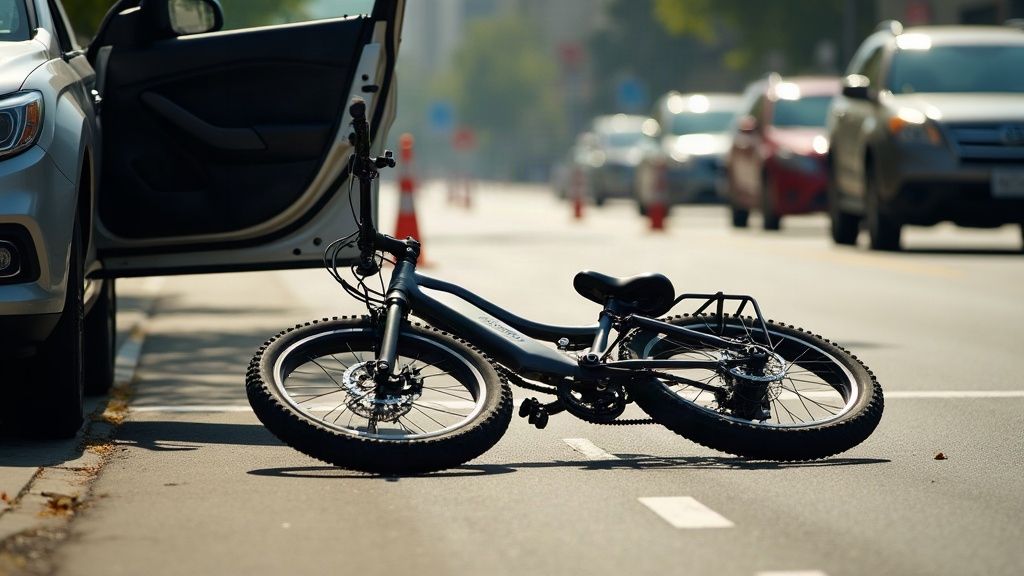
A driver or passenger opens a car door into the path of an oncoming e-bike rider. At 20-plus miles per hour, a rider has almost no time to stop. Cal. Veh. Code §22517 prohibits opening a vehicle door on the side of moving traffic unless it is safe to do so, making the door-opener presumptively at fault.
Intersection Collisions
A driver turning left fails to yield to an e-bike coming through the intersection in the bike lane. Cal. Veh. Code §21802 requires drivers to yield to traffic already in the intersection. Because an e-bike in a bike lane is traffic, the failure to yield creates a clean negligence theory.
Sidewalk Riding Conflicts
Riding an e-bike on a sidewalk is generally prohibited in California under Cal. Veh. Code §21230 and local ordinances, though rules vary by city. If a rider is on a sidewalk unlawfully and collides with a pedestrian, the rider bears significant fault. If a driver exits a driveway without stopping and strikes an e-bike rider who is riding legally, the driver is at fault.
Road Hazard Crashes
Potholes, cracked asphalt, missing pavement markings, and defective bike lane surfaces cause a significant share of solo e-bike crashes. These cases involve government liability, which requires filing a government tort claim within six months under the California Government Code before any lawsuit. Missing that window forecloses the claim entirely.
If a city or county failed to maintain a safe bike lane or road surface, a government tort claim under the California Government Code may be an additional avenue for compensation.
Determining Fault Between Riders, Drivers, and Cities
California follows pure comparative fault rules under Cal. Civ. Code §1714. That means:
- You can be 40% at fault and still recover 60% of your damages.
- The defense will look for any evidence of rider negligence: no helmet (note: helmets are required for Class 3 riders and all minors under Cal. Veh. Code §21212), riding outside a designated lane, distracted riding, or exceeding the speed appropriate for conditions.
- Multiple parties can share fault. A driver may be 60% at fault, the city may be 20% at fault for a hazardous road condition, and the rider may be 20% at fault for lane position.
California follows pure comparative fault rules, meaning you can recover compensation even if you were partly responsible for the e-bike accident, though your award is reduced by your percentage of fault.
What fault determination looks like in practice: Evidence that matters includes traffic camera footage, eyewitness statements, the physical position of the bike and vehicle after the crash, skid marks, vehicle damage patterns, and the e-bike's own data (some e-bikes log speed). Gathering that evidence early matters because footage is overwritten and witnesses' memories fade.
Any driver who negligently causes an e-bike accident can be held liable for your medical bills, lost wages, and pain and suffering under California Civil Code §1714.
Injuries Specific to E-Bike Collisions
Because e-bikes travel faster than standard bicycles, the injury profile more closely resembles motorcycle crashes than typical bicycle falls:
- Traumatic brain injury (TBI): Even with a helmet, high-speed impacts can cause concussion or more serious brain trauma. TBI claims often involve long-term cognitive and earning-capacity damages.
- Road rash: Sliding on pavement at speed removes layers of skin and can cause permanent scarring. Severe road rash may require skin grafting.
- Fractures: Wrist, clavicle, and hip fractures are common as riders instinctively brace for impact. Hip fractures in older riders carry serious rehabilitation costs.
- Spinal injuries: Disk herniations, spinal fractures, and spinal cord injuries appear in high-speed e-bike collisions with vehicles.
- Internal injuries: Blunt force from a vehicle or hard landing can cause internal bleeding, organ damage, and pneumothorax.
Medical documentation beginning on day one determines the strength of the damages portion of your claim. Every gap in treatment is an argument the defense will use.
Insurance Issues: Does Your Auto or Homeowners Policy Apply?
This is one of the most misunderstood areas of e-bike law in California.
The Driver's Auto Insurance
If a driver caused the accident, their auto liability policy is the primary source of recovery. As of January 1, 2025, California's minimum required bodily injury liability limits under SB 1107 are $30,000 per person and $60,000 per accident, with $15,000 for property damage. Many drivers carry only the state minimum.
If the driver's policy limits are too low to cover your damages, several other sources may apply: underinsured motorist (UIM) coverage on your own auto policy (if you have one), umbrella policies, or additional defendants who share fault.
As of January 1, 2025, California requires drivers to carry at least $30,000 per person and $60,000 per accident in bodily injury liability coverage under SB 1107.
Your Own Auto Insurance
If you have an auto insurance policy with uninsured or underinsured motorist coverage, that coverage can pay your damages when the at-fault driver has no insurance or not enough. Check your policy declarations page. Some policies explicitly exclude e-bike accidents; others include them if you are struck by a vehicle.
Homeowners or Renters Insurance
Standard homeowners and renters policies sometimes include personal liability coverage that applies when you injure a third party. Whether that coverage extends to e-bike accidents depends entirely on your specific policy language. Many policies exclude motorized vehicles, and insurers differ on whether an e-bike qualifies as a motorized vehicle under those exclusions. Read your declarations page carefully, or have an attorney review it.
E-Bike-Specific Insurance
Several insurers now offer dedicated e-bike policies covering bodily injury liability, theft, and collision. If you own an e-bike, this type of policy is worth considering for your own protection.
Workers' Compensation Overlap
If you were riding your e-bike as part of your job, delivering packages, riding between job sites, or performing any task for your employer, the injury may be compensable under California workers' compensation. Workers' comp covers medical treatment and a portion of lost wages regardless of fault. Critically, if a third party (the driver) caused the accident, you may be entitled to file both a workers' comp claim AND a personal injury lawsuit against the driver simultaneously.
E-bike riders who are injured while performing a work-related task may be entitled to file both a workers' compensation claim and a third-party personal injury lawsuit.
Both claims can proceed at the same time under California law, though there are lien and offset rules that apply. An attorney who handles both practice areas, the way our firm does, makes sure neither claim is sacrificed for the other. If this situation applies to you, call (818) 794-9947 so we can walk through exactly how both claims interact.
For more on the workers' compensation side of that scenario, visit our workers' compensation practice area.
What Compensation Looks Like in an E-Bike Injury Claim
California personal injury law allows recovery for both economic and non-economic damages:
Economic damages (calculable losses):
- Past and future medical expenses, including surgery, hospitalization, physical therapy, and medication
- Lost wages from time missed at work
- Reduced earning capacity if your injury affects your ability to work long-term
- Property damage to the e-bike, helmet, and gear
Non-economic damages (subjective losses):
- Pain and suffering
- Emotional distress
- Loss of enjoyment of life
- Disfigurement or permanent impairment
California does not cap non-economic damages in standard personal injury cases (the MICRA cap applies to medical malpractice claims, not vehicle accident claims).
There is no formula that honestly predicts your settlement or award amount. Outcomes depend on the severity of your injury, the clarity of the liability evidence, the defendant's insurance coverage, and many other case-specific factors. What we can tell you is that injured people who are represented by attorneys consistently recover more than those who negotiate alone.
To see examples of results we have recovered for clients, visit our results page.
Steps to Take After an E-Bike Accident in California
- Call 911 and get a police report. The report documents the scene, the parties, and any violations. Without it, liability disputes are harder to resolve.
- Photograph everything. The bike, the vehicle, your injuries, skid marks, road conditions, and any surveillance cameras nearby.
- Get medical care the same day. Adrenaline masks pain. Many serious injuries, including TBI and internal injuries, do not feel severe immediately. A same-day evaluation also connects your injury to the accident in the medical record.
- Collect witness information. Names and phone numbers from anyone who saw the crash.
- Note the e-bike's class and condition. If the e-bike has data logging, preserve it before it is overwritten.
- Do not give a recorded statement to the other driver's insurer. Their adjuster is trained to use your words to minimize your claim. Talk to an attorney first.
- Call an attorney before the statute of limitations runs. California's personal injury statute of limitations is generally two years from the date of injury under Cal. Code Civ. Proc. §335.1. Government entity claims have a six-month administrative deadline. Missing either window ends your right to recover.
FAQ: E-Bike Accident Injuries in California
Who is liable in an e-bike accident in California?
Liability depends on who was at fault. A driver who violates a traffic law and hits you bears primary liability. A government entity may share liability if a road defect contributed. If you were partly at fault, your damages are reduced proportionally under California's pure comparative fault rules.
Do e-bikes need insurance in California?
California currently does not require e-bike riders to carry liability insurance the way it requires motorcycle riders to do so. However, if you cause an accident, you may be personally liable for the other party's damages. Dedicated e-bike insurance and homeowners or renters liability coverage can fill that gap.
Can I sue a driver who hit my e-bike?
Yes. If a driver's negligence caused or contributed to your accident, you can bring a personal injury claim against them under Cal. Civ. Code §1714. Their auto liability insurance is the typical source of payment, subject to the policy limits.
Does homeowners or auto insurance cover e-bike accidents?
It depends on the specific policy. Some auto policies extend uninsured motorist coverage to e-bike accidents involving a vehicle; others exclude them. Some homeowners policies cover bodily injury liability arising from e-bike use; others exclude motorized vehicles. You need to read your declarations page or have an attorney review it.
What if the driver who hit me has no insurance?
Your own uninsured motorist (UM) coverage can pay your damages in that scenario, up to the limits of your policy. If you do not have UM coverage, you may still sue the driver directly, but collecting a judgment against an uninsured individual can be difficult.
What if a defective road caused my crash?
File a government tort claim with the responsible city or county within six months of the incident. Failure to file within that window bars your lawsuit against the government entity. An attorney can help you identify the right entity and meet the deadline.
How long do I have to file a lawsuit after an e-bike accident in California?
Generally two years from the date of injury under Cal. Code Civ. Proc. §335.1 for claims against private parties. For claims against a government entity, you must file an administrative tort claim within six months first.
What if I was riding for a delivery app when I was hit?
You likely have both a workers' compensation claim and a personal injury claim against the at-fault driver. The workers' comp claim covers medical treatment and a portion of wages regardless of fault. The personal injury claim against the driver can recover full damages including pain and suffering. Both claims can run simultaneously, subject to lien and offset rules under California law.
Talk to a California E-Bike Injury Attorney
E-bike accident claims involve overlapping traffic laws, multiple insurance policies, short government-claim deadlines, and California's comparative fault rules. Sorting through all of that while you are recovering from an injury is genuinely hard.
We have recovered over $150,000,000 for injured people across Southern California. We handle every case as if it were going to trial, because that preparation is exactly what moves insurance carriers to settle for more.
If you were hurt in an e-bike accident in California, call (818) 794-9947 for a free consultation. No fee unless we win. Available in English and Spanish.
Or start with our free case evaluation online.
Reviewed by Minas Nordanyan, CA Bar #296806. Last updated 2026-08-22. This article is for general informational purposes and does not constitute legal advice for your specific situation.