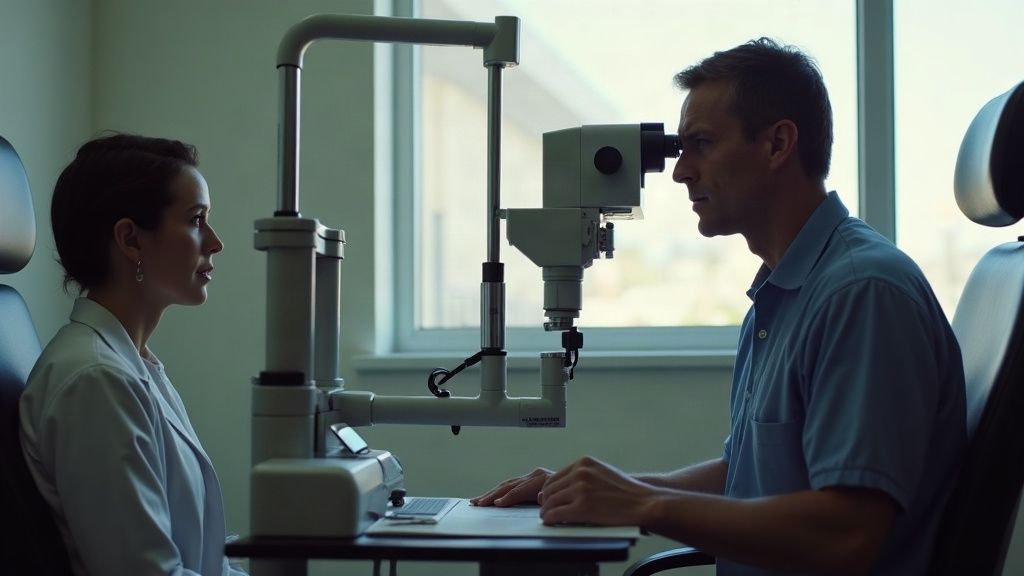
If you suffered an eye injury in a California car accident, you are dealing with one of the most frightening outcomes a crash can produce. Vision affects every part of daily life, from driving and working to reading and recognizing faces. When a collision damages your eyes, the legal stakes are just as serious as the medical ones.
This article explains the types of eye injuries that commonly result from car crashes, why some do not show up for days, and how California law lets you pursue compensation for both your medical costs and your reduced quality of life.
If you want to talk through your specific situation now, call (818) 794-9947 for a free consultation. We handle personal injury cases on a contingency basis, meaning there is no fee unless we win.
Quick-Answer Summary
- Car crashes can cause corneal abrasions, retinal detachment, lens dislocation, optic nerve damage, and traumatic hyphema, among other serious eye injuries.
- Airbag deployment, flying glass, dashboard impact, and seatbelt effects can all injure the eyes even in moderate-speed collisions.
- Some vision injuries are painless at first and only discovered through a dilated eye exam days after the crash.
- California law lets you recover economic damages (medical bills, lost income) and non-economic damages (pain, suffering, loss of enjoyment of life) under Cal. Civ. Code §3333.
- The statute of limitations for a California personal injury claim is two years from the date of injury under Cal. Civ. Code §335.1.
- Thorough medical documentation, including records from an ophthalmologist, is essential to a strong eye injury claim.
- Permanent vision loss that prevents you from returning to your occupation can significantly increase the value of your claim.
Common Ways Car Accidents Damage the Eyes
The eyes are exposed and fragile. Even with modern safety systems, several forces in a car crash can cause serious eye injuries.
Airbag deployment. An airbag deploys at speeds between 100 and 220 miles per hour. That force is enough to cause corneal abrasions, retinal detachment, traumatic hyphema (bleeding inside the eye), and lens dislocation. The chemical propellants in airbags can also cause chemical burns to the cornea and conjunctiva.
Flying debris and glass. Windshield shattering sends glass fragments and debris toward the driver and front passenger at high velocity. Even safety glass can cause deep corneal lacerations.
Direct impact. When a head strikes the steering wheel, dashboard, or side window, blunt trauma to the eye socket can fracture the orbital bones, compress the optic nerve, and cause retinal damage.
Whiplash forces. Even without direct contact, the rapid acceleration and deceleration of a rear-end collision can put enough force on the retina to cause tears or detachment, particularly in people who already have thinned retinal tissue.
Seatbelt effects. Shoulder belts ride close to the face for shorter drivers. In a severe crash, the belt's restraining force can cause injury if it contacts the face or neck area near the eye orbit.
Signs of a Serious Eye Injury You Shouldn't Ignore
Go to an emergency room or urgent care immediately if you notice any of the following after a crash:
- Visible blood in the white of the eye (subconjunctival hemorrhage) or behind the pupil (hyphema)
- Eye pain, pressure, or a sensation that something is in the eye
- Sudden blurred vision, double vision, or loss of part of your visual field
- Sensitivity to light that was not present before the crash
- Floaters, flashing lights, or a dark "curtain" moving across your vision
- Swelling, bruising, or deformity around the eye socket
- Inability to move the eye normally in all directions
Even if you feel no discomfort at the scene, tell the responding paramedics or emergency room staff about any vision changes, however minor. Getting that complaint into the medical record on day one protects your claim.
Why Some Vision Problems Don't Show Up Until Days Later
Some serious eye injuries, including retinal tears and vitreous hemorrhage, produce little or no pain immediately after a car crash, which is why a dilated eye exam is critical even when your eyes feel fine.
This is one of the most common reasons eye injury claims run into problems: the injured person assumes their eyes are fine because nothing hurts, then develops symptoms a week later, and the insurance carrier argues the condition is unrelated to the crash.
Here is why delayed presentation happens:
Retinal tears. The retina can be torn by the shock wave of impact. Initially, the tear may not bleed and may not cause symptoms. Fluid gradually seeps under the retina over days, causing it to detach. When detachment is complete, vision loss can be sudden and severe.
Vitreous hemorrhage. A bleed into the vitreous gel of the eye may be small at first. As red blood cells disperse through the gel over 24 to 48 hours, the person sees increasing floaters and cloudiness.
Traumatic iritis. Inflammation of the iris can develop hours to days after blunt trauma, presenting as light sensitivity, eye ache, and blurred vision.
Optic nerve contusion. When the optic nerve is bruised rather than severed, vision may be initially normal. Swelling develops over hours, and vision can deteriorate significantly before stabilizing.
The documentation gap. If you wait a week to see a doctor, the insurance adjuster will argue the injury is from something else. A dilated eye exam within 48 to 72 hours of the crash, even with a normal result, creates a baseline record. An abnormal result documented that close to the collision date is very strong evidence of causation.
Documenting Vision Loss for Your Insurance Claim
Thorough documentation is the difference between a well-supported claim and a disputed one. Here is what you need to gather and preserve.
Emergency room records. The ER report should note any eye complaints. If the ER doctor did not perform a detailed eye exam, that is fine, but your complaint of visual symptoms must appear in the record. Ask for copies of all records and imaging studies before you leave or within a few days.
Ophthalmology evaluation. An emergency room physician is not an eye specialist. You need a referral to an ophthalmologist (a medical doctor who specializes in eye diseases and surgery) as soon as possible. An optometrist can perform some baseline testing, but an ophthalmologist can diagnose and treat structural damage, order imaging, and is better qualified to write the causation opinion your attorney needs.
Imaging studies. CT scans of the orbit and skull can reveal fractures and foreign bodies. Optical coherence tomography (OCT) can image the retinal layers. Visual field testing documents exactly where and how much field has been lost.
A written causation letter. Ask your treating ophthalmologist to prepare a letter or report stating, in their medical opinion, that the injuries you have are consistent with the mechanism of a car crash and were not present before the accident. This is sometimes called a "causation opinion" and it is essential if the insurer disputes that the crash caused the vision loss.
Photographs. Photograph any visible external injury: redness, swelling, bruising around the eye orbit, chemical rash from airbag propellants.
A personal journal. Write brief daily notes about how your vision problems affect your life: difficulty reading, inability to drive, headaches, light sensitivity, emotional distress, tasks you can no longer perform. These entries are admissible as evidence of your non-economic damages.
Documenting an eye injury thoroughly, including ophthalmology records, imaging results, and a written statement from your treating doctor linking the injury to the crash, is one of the most important steps you can take to protect your claim.
Valuing an Eye Injury Claim: Medical Costs and Quality of Life
Cal. Civ. Code §3333 sets the baseline for personal injury damages in California. It allows a plaintiff to recover the full measure of the loss caused by the defendant's wrong. In practice, that breaks down into two categories.
Economic damages. These are your out-of-pocket, calculable losses:
- Emergency room, urgent care, and ambulance costs
- Ophthalmology consultations, surgical procedures, and follow-up care
- Prescription medications, eye drops, and corrective lenses
- Future medical care, including anticipated surgeries or long-term treatment
- Lost wages for days missed from work during treatment and recovery
- Reduced earning capacity if vision loss limits the jobs you can perform going forward
- Home modification costs if vision loss requires adaptive equipment or assistance
Non-economic damages. These compensate for losses that do not come with a receipt:
- Physical pain and discomfort from the injury and treatment
- Emotional distress, anxiety, and depression related to vision loss
- Loss of enjoyment of life, including hobbies, activities, and relationships affected by reduced vision
- Loss of consortium, if the injury affects your relationship with your spouse or domestic partner
There is no formula written into California law that tells a jury exactly how to calculate non-economic damages. Juries weigh the severity of the injury, the credibility of the evidence, and the effect on the person's specific life. This is why documentation of how the injury changes your daily existence matters so much.
California does not cap non-economic damages in personal injury cases between private parties. (Note: different rules apply in medical malpractice cases under MICRA, which is not at issue in a typical car accident claim.)
We do not publish settlement averages for eye injury cases because every case is different. What we can tell you is that we have recovered over $150,000,000 for our clients, and we evaluate every case individually to pursue the full value of what you've lost. You can review some of those results at /results.
When Vision Loss Qualifies as a Permanent Disability
If vision loss after a car accident prevents you from returning to your occupation, it may qualify as a permanent disability that significantly increases the value of your California civil claim.
Not all eye injuries heal completely. Some conditions that can result in permanent or long-term vision impairment include:
- Complete or partial retinal detachment with residual field loss after surgical repair
- Optic nerve damage resulting in permanent reduced visual acuity or color vision loss
- Traumatic cataracts that develop weeks or months after blunt eye trauma
- Chemical corneal burns causing scarring and chronic vision disturbance
- Severe hyphema leading to secondary glaucoma and ongoing pressure management
When a physician documents permanent impairment, two things happen to your claim. First, the future medical expense calculation grows substantially, because you will need ongoing care. Second, the non-economic damages calculation grows because the loss of enjoyment of life is not temporary.
If your job requires specific vision acuity, such as a commercial driver, surgeon, electrician, or machinist, permanent vision loss may end that career. The lost earning capacity from a career change or early retirement is an economic damage that a forensic economist can calculate and present in litigation.
California courts look at vision loss as a whole-person impairment. An ophthalmologist or neuro-ophthalmologist can assign a percentage of whole-person impairment, which a judge or jury can use as a framework for the non-economic damages award.
Working With Eye Specialists to Strengthen Your Case
A strong eye injury claim generally involves more than one treating provider. Here is who typically matters in these cases and why.
Ophthalmologist (treating physician). The primary specialist who diagnoses, treats, and documents your injury. Their treatment records are the backbone of your damages case.
Neuro-ophthalmologist. If the crash caused optic nerve or brain-related vision problems, a neuro-ophthalmologist connects the visual symptoms to the neurological injury. This is particularly important in cases where a traumatic brain injury and eye injury overlap.
Retinal specialist. For retinal tears, detachments, and vitreous hemorrhage, a retinal specialist performs the surgical repair and documents the extent of damage before and after intervention.
Forensic expert or expert witness. In contested cases, your attorney may retain an independent ophthalmologist who reviews all records and provides an expert opinion for litigation. This expert can contradict a defense-hired doctor who disputes causation.
Vocational rehabilitation expert. If vision loss affects your ability to work, a vocational expert can document your pre-injury earning capacity, identify the occupations you can no longer perform, and calculate the wage loss.
The insurance carrier's adjuster will review all of these records. An adjuster's job is to pay as little as possible. Having a complete, consistent, and well-documented medical picture makes it much harder for them to argue your injuries are minor or unrelated.
An airbag deploys at speeds between 100 and 220 miles per hour, and that force alone can cause corneal abrasions, lens dislocation, and retinal detachment.
The California Filing Deadline You Cannot Afford to Miss
California's statute of limitations for a personal injury claim after a car accident is two years from the date of injury under Cal. Civ. Code §335.1.
Missing that deadline almost always means losing your right to compensation, regardless of how strong your case is. There are narrow exceptions, such as when the injured person is a minor or when a government entity is involved (in which case a claim must typically be filed with the agency within six months under Cal. Gov. Code §911.2). But do not count on an exception applying to your situation.
Two years may sound like a long time, but ophthalmology treatment records, accident scene evidence, and witness memories all deteriorate. Insurance carriers also begin closing their investigation files. The sooner you have an attorney reviewing your case, the better your position.
If your eye injury happened at work, for example in a commercial vehicle crash or a delivery vehicle accident, you may have both a California workers' compensation claim and a third-party personal injury claim against the at-fault driver. Those two paths have different deadlines and different procedures. The DWC handles workers' compensation; your civil personal injury case goes through the court system. We handle both at /practice-areas/workers-compensation and /practice-areas/personal-injury.
FAQ
Can a car accident cause permanent vision loss?
Yes. Retinal detachment, optic nerve damage, traumatic cataracts, and severe corneal injury can all result in permanent, partial, or complete vision loss. The likelihood of permanent damage depends on the severity of the injury, how quickly it was treated, and the individual's underlying eye health. Prompt diagnosis and treatment by an ophthalmologist give the best chance of preserving vision.
How much compensation can you get for an eye injury from a car accident?
There is no fixed amount. Compensation depends on your actual economic losses (medical bills, lost wages, future care costs) and your non-economic losses (pain, suffering, loss of enjoyment of life). California law under Cal. Civ. Code §3333 does not cap non-economic damages in personal injury cases between private parties. Cases involving permanent vision loss or career-ending disability involve substantially higher damages calculations than cases involving temporary injuries. We evaluate each case individually.
What are common causes of eye injuries in car crashes?
The most common causes are airbag deployment (which generates forces up to 220 miles per hour), flying glass from a shattered windshield, blunt impact to the face from the steering wheel or dashboard, whiplash forces sufficient to stress the retina, and chemical burns from airbag propellants.
Do I need an ophthalmologist after a car accident?
If you have any visual symptoms after a car accident, including blurred vision, floaters, light sensitivity, eye pain, or redness, yes, you need an ophthalmologist, not just an emergency room physician or a general practitioner. An ophthalmologist can examine the internal structures of the eye, diagnose retinal tears or other structural damage before symptoms worsen, and document injuries in a way that is medically and legally meaningful.
What if my eye symptoms started a few days after the crash?
Delayed presentation is common with retinal tears, vitreous hemorrhage, and traumatic iritis. See an ophthalmologist immediately and tell them the date of the crash. The physician can document the clinical findings and offer an opinion on whether they are consistent with the crash mechanism. Delayed symptoms do not disqualify your claim, but the insurance carrier may dispute causation, which is why the doctor's written causation opinion becomes critical.
What if the airbag injured my eyes even though I was wearing my seatbelt?
Seatbelts and airbags together are safety systems, but airbag deployment can still injure the eyes of properly restrained occupants, particularly shorter drivers who sit closer to the steering wheel. Wearing a seatbelt does not eliminate your claim or reduce your damages under California law. Comparative fault analysis would look at the at-fault driver's negligence, not your use of a safety system that was working as intended.
Can I file a claim if I had a pre-existing eye condition?
Yes. California follows the "eggshell plaintiff" doctrine, which holds a defendant liable for the full extent of harm caused to a plaintiff even if that plaintiff was more vulnerable than an average person due to a pre-existing condition. If the crash worsened your pre-existing condition or accelerated its progression, that worsening is a compensable harm. The defense may argue apportionment between pre-existing and crash-caused damage, which is why a detailed ophthalmology examination both before (if records exist) and after the crash helps establish the baseline.
How long do I have to file an eye injury claim in California?
The general statute of limitations for a personal injury claim in California is two years from the date of injury under Cal. Civ. Code §335.1. If a government entity, such as a city or county vehicle, was involved, you typically have only six months to file an administrative claim under Cal. Gov. Code §911.2. If you were a minor at the time of the crash, a different limitations period applies. Do not rely on memory of the deadline. Call an attorney to confirm which deadline applies to your case.
Talk to a California Car Accident Attorney Today
Eye injuries are among the most life-altering outcomes of a car crash. They affect your ability to work, drive, read, and engage with the people and activities that matter to you. California law gives you the right to pursue full compensation for what you've lost, but that right has a deadline and it depends on documentation gathered now.
We've recovered over $150,000,000 for injured Californians. We handle personal injury cases from the day of the first call through the final resolution, and we never charge a fee unless we win.
Call (818) 794-9947 for a free consultation. Available in English and Spanish. No fee unless we win.