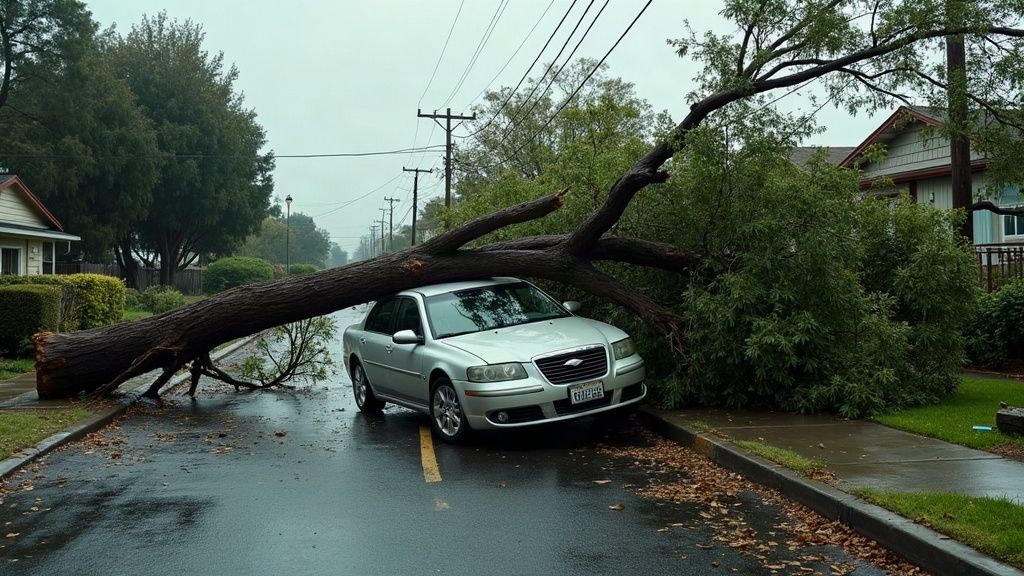
If a tree or utility pole just fell on your car or injured you in California, you may already be dealing with medical bills, a damaged vehicle, and an insurance company that is slow to explain who is responsible. The answer depends on who owned the tree or pole, whether they knew it was dangerous, and what kind of storm, if any, caused it to fall.
This article walks you through how California law assigns liability in these cases, what defenses you will likely hear from the other side, and what evidence your attorney will need to build your claim.
Quick answers if you are skimming:
- A private property owner who ignored a known hazard tree can be sued under California negligence law.
- A city or county can be liable but you have only six months to file a government claim.
- Utility companies have their own liability rules under the California Public Utilities Code.
- The "act of God" defense is narrower than insurers imply.
- Comprehensive auto coverage handles your vehicle, but you need a separate injury claim for medical costs and lost wages.
- If you were hurt at work, you may have both a workers' comp claim and a third-party injury claim.
Common Causes: Storm Damage, Neglected Trees, and Aging Infrastructure
Falling trees and utility poles rarely injure people without some contributing factor that could have been prevented. The most common scenarios we see include:
- Storm-toppled trees where the tree was already weakened by root rot, disease, or prior storm damage that the owner never addressed.
- Overgrown or dead trees on private property that lean over a public road, sidewalk, or neighboring lot.
- Street trees maintained by a city or county that received prior complaints but were never inspected or trimmed.
- Aging wooden utility poles that a utility company failed to inspect on its required maintenance cycle.
- Vehicle collisions that knock a utility pole into oncoming traffic or onto a parked car.
- Construction activity that destabilizes tree roots or soil around a pole's foundation.
Each cause points to a different defendant. Identifying who owned the tree or pole and what they knew before it fell is the foundation of every claim.
Determining Who Owned or Was Responsible for the Tree or Pole
California does not have a single "falling tree" statute. Liability is built on the general negligence standard in Cal. Civ. Code §1714, which holds every person responsible for their own negligent acts and the injuries those acts cause to others.
That means you must identify the responsible party before you can build a claim.
Private property owners. If a tree stands on private land and falls into the street, onto a neighboring driveway, or onto your car parked at the curb, the owner of that land is the first place to look. Under California negligence law, ownership alone is not enough to create liability. You must show the owner knew or should have known the tree was dangerous and failed to act. Evidence of prior complaints, visible disease or decay, previous partial failures, or arborist reports that the owner ignored are all relevant.
City or county government. Street trees planted in the public right-of-way are typically maintained by the city or county. When a municipality's tree falls and injures someone, the claim goes through the Government Tort Claims Act rather than a standard lawsuit.
Homeowners associations. In a planned community or condominium complex, the HOA may own the tree or be contractually responsible for its maintenance. The HOA's CC&Rs and maintenance records are important early-discovery targets.
Utility companies. Southern California Edison, Pacific Gas and Electric, San Diego Gas and Electric, and municipal utilities own thousands of wood and steel poles across California. Each company is responsible for inspecting and maintaining its own poles under rules set by the California Public Utilities Commission (CPUC).
When a City, County, or Utility Company Can Be Held Liable
Government Liability: The Six-Month Trap
If a city or county tree falls and hurts you, California's Government Claims Act applies. Under Cal. Gov. Code §911.2, you must file a written tort claim with the responsible public entity within six months of the date of your injury. This is not an optional step you can skip and cure later.
Government agencies such as a city or county can be sued for a tree-related injury, but California Government Code §911.2 requires you to file a government tort claim within six months of the incident, not the standard two-year civil deadline.
If the agency rejects your claim or ignores it for 45 days, you then have six months to file a lawsuit. Missing the initial six-month window almost always ends the case. Talk to an attorney as soon as possible after any injury involving a public tree.
To win against a public entity, you must also show the agency had actual or constructive notice of the dangerous condition. Cal. Gov. Code §835 requires proof that the public entity either created the dangerous condition, or knew about it long enough that it should have fixed it. Prior service requests, work orders, 311 complaints, or inspector reports are the best way to establish notice.
Utility Company Liability: CPUC Safety Rules
If a utility company's pole falls and causes injury, the company may be liable under California Public Utilities Code §2106, which allows private lawsuits against utilities that violate safety rules set by the California Public Utilities Commission.
The CPUC requires utility companies to inspect poles on a set schedule and to prioritize replacement of poles that show corrosion, insect damage, ground-line decay, or structural compromise. When a utility fails to follow those inspection and replacement rules and a pole falls as a result, the company can face a private lawsuit under Cal. Pub. Util. Code §2106.
Utility companies also carry significant insurance and have dedicated legal teams who will argue the pole was in reasonable condition before the storm. Getting the utility's pole inspection logs, maintenance records, and prior complaint history early is critical. Those records can disappear or become harder to obtain after litigation begins.
A second theory against utilities involves inverse condemnation when a utility's equipment causes property damage or physical injury. California courts have applied inverse condemnation principles to utility-caused fires and infrastructure failures, though the law in this area has evolved significantly following major wildfire litigation. If the pole failure involved electrical arcing or a fire, the analysis may extend beyond ordinary negligence.
The "Act of God" Defense and When It Does or Doesn't Apply
You will almost certainly hear the phrase "act of God" from an insurance adjuster or defense attorney after any storm-related falling-tree claim. The defense, when it applies, means the event was caused by a natural force so extraordinary and unforeseeable that no reasonable precaution could have prevented the harm.
The "act of God" defense can defeat a falling-tree claim only when the storm was truly unforeseeable and the tree showed no prior signs of decay or danger, if any maintenance warning existed, the defense typically fails.
California courts have consistently narrowed this defense. It fails when:
- The tree was already compromised. A dead limb, visible fungal growth, a hollow trunk, or root heave near the base are all signs a reasonable owner should have addressed. If those warning signs existed before the storm, the storm becomes a contributing cause, not the sole cause.
- The storm was foreseeable. A strong Santa Ana wind event, a typical Southern California winter rainstorm, or even an above-average windstorm that was forecast days in advance is not an unforeseeable catastrophe. Courts expect property owners and utilities to take precautions when severe weather is predicted for their region.
- Prior complaints existed. A neighbor who complained about a leaning tree three months before it fell is powerful evidence that the owner had notice. The same applies to 311 service requests logged against a city tree.
The act of God defense has the best chance of success when a genuinely extraordinary event, such as an exceptionally powerful earthquake-driven landslide or a 100-year wind event, fells a tree that showed no prior warning signs at all. Even then, California courts look hard at whether a reasonable inspection program would have caught something.
Evidence That Matters: Maintenance Records, Prior Complaints, and Weather Reports
The strength of a falling-tree or utility-pole claim turns on documentation. Here is what your attorney will seek to preserve and obtain:
Photographs and video. Take pictures of the fallen tree or pole, the ground where it was rooted or anchored, visible decay on the root ball or base, any prior cuts or repairs on the trunk or pole, and your vehicle or property damage. If the scene is on a public street, it may be cleared by a city crew within hours.
Arborist or structural inspection records. A property owner who hired an arborist and received a report recommending removal of a hazard tree has actual notice. That report is a key piece of evidence if the owner ignored it.
311 and service-request logs. California cities and counties keep electronic records of complaints and service requests tied to specific addresses or GPS coordinates. A prior complaint about the same tree is strong notice evidence.
Utility inspection and maintenance logs. Under DWC guidelines and CPUC rules, utilities must retain inspection records for their poles. A subpoena or early discovery request for those logs should happen quickly.
Weather data. The National Weather Service and local airports maintain historical wind speed, rainfall, and storm-track data. Your attorney will use this to characterize the storm as foreseeable or extraordinary and to rebut an act-of-God defense.
Prior incident reports. If another tree on the same property fell, or if the same utility pole had been struck or repaired previously, those incidents may be discoverable through public records requests or litigation discovery.
HOA meeting minutes. Boards of directors often discuss deferred maintenance and known hazard trees in meeting minutes. Those minutes can establish notice even years before the incident.
Coordinating Auto Insurance, Homeowner's Insurance, and Third-Party Claims
After a falling-tree incident, multiple insurance policies may be in play at the same time. Here is how they typically interact in California.
Your comprehensive auto coverage. If a tree falls on your car, your comprehensive auto policy covers the vehicle damage regardless of who was at fault. Comprehensive coverage applies to falling objects, storm damage, and vandalism. You pay your deductible and your carrier pays the rest. Your insurer may then subrogate against the responsible party's insurance to recover what it paid.
If a tree falls on your car during a storm, your own comprehensive auto insurance covers the vehicle damage regardless of fault, but a separate third-party personal injury claim is needed to recover medical bills, lost wages, and pain and suffering.
The responsible party's homeowner's or commercial liability insurance. If a private property owner's negligence caused the tree to fall, their homeowner's or business liability policy is the target for your personal injury claim. Those policies typically cover bodily injury and property damage caused by the insured's negligence. The insurer will investigate whether the owner had notice of the hazard.
Government self-insurance funds. Cities and counties in California are either self-insured or participate in a joint powers authority risk pool. After your government claim is filed, the entity's risk management department handles the investigation. Having an attorney present a documented notice-and-failure case to that department often results in settlement without filing a lawsuit.
Umbrella and excess policies. If your injuries are serious and the primary policy limits are insufficient, your attorney will investigate whether the property owner carries an umbrella policy.
What comprehensive does NOT cover. Your auto policy's comprehensive coverage pays for the vehicle only. It does not pay your medical bills, your lost wages while you recover, or the pain and suffering that comes with a serious injury. Those damages come from a third-party claim against the responsible party.
Injuries Commonly Seen in Falling-Object Collisions
Falling trees and utility poles generate enormous force. When they strike an occupied vehicle or a person on foot, the injuries are often severe.
- Traumatic brain injury (TBI). A roof crush or sudden impact to the head, even with an airbag deployed, can cause concussion, intracranial bleeding, or more serious brain damage.
- Spinal cord injuries. Compression of the spine from a roof collapse or blunt impact can result in herniated discs, fractured vertebrae, or partial or complete paralysis.
- Crush injuries to the limbs. When a large limb or pole traps an arm or leg inside a vehicle, crush syndrome and compartment syndrome can develop quickly.
- Lacerations and penetrating injuries. Shattered glass and broken branches can cause deep cuts, puncture wounds, and nerve damage.
- Electrocution and burns. When a utility pole falls and the lines remain energized, anyone who contacts the wire or stands on ground near a downed line faces electrocution risk. Electrical burns can be deceptive, with significant internal damage that is not visible at the surface.
- Psychological injury. A severe collision involving a sudden falling object can produce post-traumatic stress disorder, anxiety disorders, and sleep disruption that persist long after the physical injuries heal.
The severity of these injuries matters for your claim because California allows recovery for medical expenses, lost earnings, future medical care, and non-economic damages such as pain, suffering, and loss of enjoyment of life. Under Cal. Civ. Code §3333, a plaintiff may recover all damages proximately caused by the defendant's negligence.
If You Were Hurt at Work: A Second Claim May Be Available
If you were working when the tree or pole fell on you, your situation involves two separate legal systems at the same time.
Workers injured when a tree or utility pole falls on them while on the job may have both a workers' compensation claim and a third-party personal injury claim against the responsible property owner or utility.
Under the California Labor Code, nearly every employee in California is entitled to workers' compensation benefits for any injury arising out of and in the course of employment, regardless of fault. Cal. Lab. Code §3600 sets out the basic coverage rule. Workers' comp will pay medical treatment and a portion of your lost wages while you recover.
At the same time, if a third party, such as a property owner who was not your employer, was responsible for the falling tree, you can pursue a personal injury claim against them in civil court. That claim can recover damages that workers' comp does not cover, including full lost wages, non-economic damages, and future care costs beyond what the workers' comp system provides.
Your workers' compensation attorney and your personal injury attorney need to coordinate these claims carefully because the workers' comp insurer has a lien right against any third-party recovery under Cal. Lab. Code §3856.
FAQ
Who is responsible if a tree falls on my car in California?
Responsibility depends on who owned the tree and what they knew before it fell. If the tree was on private property and the owner had reason to know it was diseased or structurally weak, the owner can be held liable under California negligence law. If it was a city street tree, the government may be liable under the Government Claims Act, but you must file within six months of the injury. If a utility pole fell instead of a tree, the utility company may be liable under Cal. Pub. Util. Code §2106.
Can I sue the utility company if a downed power pole causes a crash?
Yes, in many cases. California law allows private lawsuits against utility companies that violate safety rules established by the California Public Utilities Commission. If the utility failed to inspect or replace a deteriorated pole on its required schedule and the pole falls as a result, Cal. Pub. Util. Code §2106 creates a cause of action. You will need the company's inspection and maintenance records to prove it had notice of the condition.
Does homeowner's insurance cover a tree that fell on my vehicle?
Your own comprehensive auto insurance policy is usually the first source of coverage for vehicle damage when a tree falls on your car, subject to your deductible. The neighboring property owner's homeowner's insurance may also be responsible if their negligence caused the tree to fall. However, if the tree was healthy and fell purely because of an unforeseeable storm, the neighbor's homeowner's carrier may deny the claim on act-of-God grounds.
Is a falling-tree accident treated as an act of God in California?
Not automatically. California courts require the defendant to prove the event was caused by a natural force so extraordinary and unforeseeable that no reasonable precaution could have prevented it. If the tree showed any signs of decay, disease, or structural failure before the storm, or if the storm itself was foreseeable from weather forecasts, the act-of-God defense typically fails. The more evidence there is of prior knowledge of the hazard, the weaker the defense becomes.
What is the deadline to sue after a falling-tree injury in California?
For a claim against a private party, California's standard personal injury statute of limitations under Cal. Code Civ. Proc. §335.1 gives you two years from the date of injury to file a lawsuit. For a claim against a city, county, or other public entity, the Government Claims Act requires a written claim to be filed with the agency within six months of the incident. Missing the six-month deadline can permanently bar your claim against the government, so act quickly.
What evidence should I collect at the scene?
Photograph the fallen tree or pole from multiple angles, including the base, root ball, and any visible decay. Document every point of contact with your vehicle. Capture the surrounding weather conditions. Get the names and contact information of any witnesses. If the tree was on private property, photograph the entire property. File a police report and request a copy. All of this helps establish the condition of the tree or pole before it fell.
Can I still recover damages if I was partly at fault?
California follows a pure comparative fault rule under Cal. Civ. Code §1714. That means you can recover damages even if you were partly responsible for your own injuries, but your recovery will be reduced by your percentage of fault. For example, if a jury finds you were 20 percent at fault and your total damages are $100,000, you recover $80,000. This rule applies in falling-tree cases the same as any other personal injury claim.
What damages can I recover in a falling-tree injury claim?
Under Cal. Civ. Code §3333, California allows recovery for all damages proximately caused by the defendant's negligence. This includes past and future medical expenses, lost wages and future earning capacity, property damage, and non-economic damages such as pain, suffering, disfigurement, and loss of enjoyment of life. In rare cases involving egregious conduct, punitive damages may also be available.
Talk to an Attorney Before the Evidence Disappears
Fallen trees are cleared quickly. Utility poles are replaced within days. Inspection records are not automatically preserved once litigation is not on the horizon. The window to gather the evidence that makes or breaks these claims is short.
If you or someone you care about was hurt when a tree or utility pole fell in California, the team at Nordanyan Law will review your facts, identify every potentially liable party, and explain what your claim may be worth. We handle personal injury cases on a contingency basis: no fee unless we win.
Call (818) 794-9947 for a free consultation. Available in English and Spanish.
Reviewed by Minas Nordanyan, CA Bar No. 296806. Last legal review: 2026. This article is for general informational purposes and does not constitute legal advice for any specific case. Laws change; consult a licensed California attorney for guidance on your situation.