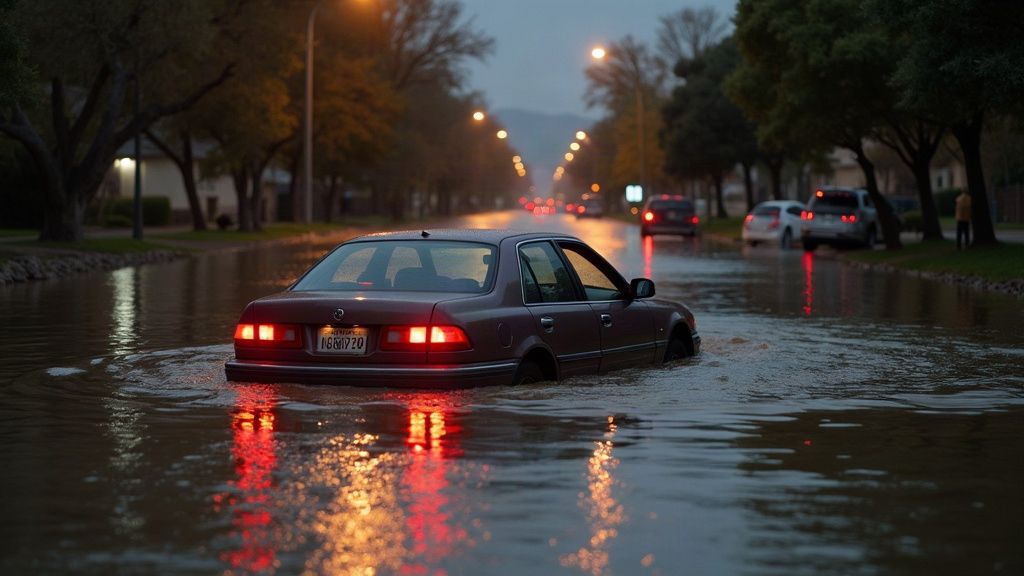
Car Accidents on Flooded California Roads: Liability, Total Loss, and Injury Claims
California's rainy season arrives quietly and then all at once. Roads that were dry yesterday fill with runoff overnight. Intersections flood before the city posts a single warning sign. Drivers misjudge depth, engines stall, and crashes happen in seconds.
If you were hurt in a flood-related car accident, or your vehicle was damaged by rising water while you drove through a storm, you are likely asking at least three questions: Who is responsible? Will insurance pay? Do I have a legal claim?
This article answers all three, specifically for California law.
If you want to talk through your situation now, call (818) 794-9947 for a free consultation. We've recovered over $150,000,000 for injured Californians, and there is no fee unless we win.
Quick Answers (TL;DR)
- Fault for a flooded-road accident can fall on the driver, on a government agency that allowed a known drainage hazard to persist, or on both, split by percentage.
- You must file a government tort claim within six months of the incident before you can sue a city or county for poor drainage under Cal. Gov. Code §911.2.
- Flood vehicle damage is a comprehensive coverage claim, not a collision claim. Liability-only drivers have no vehicle damage claim with their own insurer.
- A flooded car with water in the engine or electronics is often a total loss.
- Injuries in flood-related crashes range from standard collision trauma to near-drowning and are fully compensable in a personal injury claim.
- California's pure comparative fault rule, from Li v. Yellow Cab Co. (1975) 13 Cal.3d 804, reduces your recovery by your own percentage of fault, but does not bar it entirely.
Why California's Rainy Season Turns Ordinary Roads Into Hazards
California sees less rainfall than most states, which creates a specific and underappreciated danger: roads accumulate months of oil, rubber, and debris between storms. When rain finally arrives, that buildup mixes with water and forms a slick surface layer that dramatically reduces tire grip, even in light rain.
Add to that the state's aging stormwater infrastructure. The California Department of Transportation (Caltrans) and local agencies maintain tens of thousands of drainage structures. Many were built to handle precipitation levels from decades ago. As storms intensify, chronic flooding hot spots appear at underpasses, low-lying intersections, and areas near clogged storm drains.
Drivers unfamiliar with a route often have no way to know a particular intersection floods regularly. A stretch of road that looks passable at six inches of standing water can be impassable or life-threatening at twelve. Without adequate warning signage or road closures, the scene is set for a serious crash.
How Flooded Roads Cause Crashes
Most people picture hydroplaning when they think of wet-road accidents. Hydroplaning is one mechanism, but flood-related crashes happen in several distinct ways.
Stalled engines and loss of control. A car driven into standing water deeper than the air intake can inhale water into the engine, causing an immediate stall. The driver loses power steering and power brakes. If a second vehicle strikes the stalled car or the driver opens the door and is swept by current, injuries follow quickly.
Misjudged water depth. Moving water that reaches eight to twelve inches is enough to float most passenger cars. Drivers frequently misjudge depth because the road surface is invisible. Once the vehicle begins to float, steering becomes ineffective.
Debris collisions. Floodwater carries branches, trash, displaced road debris, and occasionally larger objects. A driver swerving to avoid debris can cross lanes and strike another vehicle.
Rear-end and multi-vehicle pileups. A vehicle that stalls or stops abruptly in a flooded lane can trigger a chain-reaction collision from following traffic.
Reduced visibility. Heavy rain reduces a driver's sight distance significantly. Combined with poorly lit roads and missing or submerged lane markings, the conditions create real collision risk even for cautious drivers.
Determining Fault: Driver Error, Poor Signage, and Government Drainage Failures
Fault in a California flooded-road accident is rarely a single-party question. It is often shared among the driver, other drivers, and, in some cases, a government agency.
Driver Negligence
A driver has a duty to operate their vehicle safely given the actual road conditions. Cal. Veh. Code §22350 is California's basic speed law: no person shall drive at a speed greater than is reasonable or prudent for weather and road conditions, regardless of the posted speed limit. Driving into a visibly flooded roadway, ignoring barricades, or traveling at freeway speed in a blinding downpour can each support a finding of driver negligence.
Comparative Fault
California uses a pure comparative fault rule established by the California Supreme Court in Li v. Yellow Cab Co. (1975) 13 Cal.3d 804. Under that rule, your recovery is reduced by your own percentage of fault, but you are not barred from recovering even if you are mostly at fault. If a jury finds you 40 percent responsible for driving into a flooded road and awards $100,000 in damages, you recover $60,000.
This matters enormously in flood cases. An insurance adjuster may argue that you "should have seen the water" and try to assign you 100 percent of the fault. A personal injury attorney's job is to push back on that characterization with weather reports, photos, witness testimony about the absence of warning signs, and any evidence that the flooding was a recurring, reported problem that should have triggered a road closure.
Government Liability for Drainage Failures
When a flood hazard on a public road exists because a government agency failed to maintain drainage infrastructure, repair a clogged storm drain, or post adequate warning signs, the agency can be held liable under the California Government Claims Act.
Liability typically rests on one of two theories:
- Dangerous condition of public property. Under Cal. Gov. Code §835, a public entity is liable for injury caused by a dangerous condition of its property if the entity had actual or constructive notice of the condition and failed to take protective action within a reasonable time.
- Negligent maintenance. A clogged storm drain that floods the same intersection every rainy season is a foreseeable hazard. If a city received prior complaints or repair requests about that drain and ignored them, constructive notice is easier to establish.
Government liability cases are difficult and require a strict pre-lawsuit process described below.
When a Flooded Vehicle Becomes a Total Loss
Vehicle damage from flood water is typically covered under the comprehensive portion of an auto insurance policy, not the collision portion. Comprehensive coverage addresses non-collision losses: flood, fire, theft, falling objects, and similar events.
If you carry only liability coverage, your own insurer owes you nothing for vehicle damage. You would need to pursue the at-fault driver's property damage liability coverage if another driver caused the accident, or the responsible government entity's claim process if a drainage failure was the cause.
What Makes a Flooded Car a Total Loss?
An insurer declares a total loss when the estimated cost to repair the vehicle exceeds a threshold percentage of the car's actual cash value (ACV). California does not cap that threshold by statute, so insurers apply their own percentages, commonly in the range of 70 to 80 percent of ACV.
Flood damage is particularly destructive because water intrudes into components that are expensive to replace:
- Engine and transmission. Water in the combustion chamber causes hydraulic lock, which can bend connecting rods or crack cylinder heads. Even partial intrusion warrants a full rebuild or replacement.
- Electrical systems. Modern vehicles have dozens of control modules. Corrosion from flood water can render them inoperable in ways that appear weeks or months after the initial exposure.
- Safety systems. Airbag sensors, seatbelt pretensioners, and anti-lock brake components can all be compromised without visible external damage.
- Interior and mold. Saturated upholstery and carpeting quickly develop mold, which is a health hazard and adds to remediation costs.
A vehicle that absorbed standing water above the floor pan level is a candidate for total loss designation, even if it appears superficially intact.
Disputing a Low ACV Offer
If your insurer declares a total loss, it owes you the ACV of your vehicle immediately before the loss. Adjusters sometimes use comparable-vehicle databases that undervalue your car. You have the right to challenge the valuation using independent comparable sales data from your geographic area. An attorney can assist with this negotiation or connect you with an independent appraiser.
Injuries Linked to Flood-Related Collisions
The injuries in a flooded-road accident depend on how the crash unfolded. A rear-end collision caused by reduced visibility produces the same trauma as any rear-end impact: whiplash, soft tissue injuries of the cervical and lumbar spine, concussion, and, in high-speed impacts, fractures.
But flood-specific injuries add a second category:
- Near-drowning and submersion trauma. A driver or passenger trapped in a vehicle as it fills with water can suffer hypoxia, aspiration pneumonia, and neurological damage even after a successful rescue.
- Cold water exposure. California floodwater in winter is cold. Prolonged exposure causes hypothermia, which compounds any trauma injury.
- Secondary infection. Floodwater contains bacteria, sewage, and agricultural runoff. Open wounds or abrasions from the accident can become infected from contact with contaminated water.
- Psychological injury. Near-drowning and entrapment are traumatic events. Post-traumatic stress disorder is a recognized and compensable injury under California personal injury law.
All of these injuries are documented in your medical record and form the basis of your damages claim. Keep every diagnosis, every treatment note, and every receipt.
Holding Caltrans or a City Accountable for Chronic Flooding Hazards
Suing a government agency in California requires following a specific pre-lawsuit process under the Government Claims Act. Skipping any step can permanently bar your claim.
Step 1: File a Government Tort Claim Within Six Months
Before filing a lawsuit, you must submit a written claim to the responsible public entity, describing the incident, your injuries, and the damages you seek. Under Cal. Gov. Code §911.2, this claim must be filed within six months of the date of the incident for personal injury and property damage claims.
Miss this deadline and your lawsuit is almost certainly barred, regardless of how clear the agency's negligence was.
Step 2: The Agency Responds (or Does Not)
Once you file, the public entity has 45 days to accept, reject, or request an extension. Under Cal. Gov. Code §913 and §945.6:
- If the entity mails a written rejection notice: you have six months from the date of that notice to file your lawsuit in court.
- If the entity never sends a proper written rejection: the deadline to file suit extends and you may have up to two years from the date the claim accrued to file, under Cal. Gov. Code §945.6.
If a public agency mails you a written rejection of your government tort claim, you have six months from that notice to file your lawsuit under California Government Code §945.6.
If a public agency never sends a written rejection notice after your government tort claim, the deadline to file suit can extend to two years from the date the claim accrued under California Government Code §945.6.
What You Must Prove
To hold a public entity liable for a dangerous condition under Cal. Gov. Code §835, you generally need to show:
- The property was in a dangerous condition at the time of the injury.
- The injury was proximately caused by the dangerous condition.
- The dangerous condition created a reasonably foreseeable risk of the kind of injury that occurred.
- The public entity had actual or constructive notice of the condition a sufficient time before the injury to have taken protective measures.
"Constructive notice" means the condition existed long enough that the agency should have discovered it through reasonable inspection. A storm drain that has flooded the same street in prior rainy seasons, generated prior public complaints, or appeared in prior repair requests is strong evidence of constructive notice.
Government defendants often invoke design immunity under Cal. Gov. Code §830.6, arguing the drainage system was built to an approved design. That immunity erodes when the entity knew the design was no longer adequate and failed to warn.
Protecting Your Claim: Evidence That Matters
Evidence degrades quickly after a flood event. Floodwater recedes, roads dry, and the scene normalizes. Here is what to collect as soon as it is safe to do so.
At the scene:
- Photographs and video of the standing water, road markings (or the absence of them), any warning signs or barricades, damage to your vehicle, and any visible injuries.
- Note the water depth relative to your tires or door panels in photographs.
- Identify and photograph any nearby storm drains, particularly if they appear clogged or are overflowing.
- Collect names and contact information for witnesses.
After the scene:
- Obtain official weather records. The National Weather Service and local weather stations maintain historical precipitation data that can corroborate conditions.
- Request 911 dispatch logs and first-responder reports. These records often include officers' observations about road conditions and visibility.
- Search public records for prior complaints or maintenance requests about the same roadway. Many California agencies accept public records requests under the California Public Records Act.
- Preserve all repair estimates and total-loss documentation from your insurer.
- Keep a journal of your symptoms, medical appointments, work missed, and daily limitations.
Why this matters: Insurance adjusters and government lawyers will argue the flooding was not as severe as you describe, that warning signs were present, or that you should have turned around. Documentary evidence collected close in time to the event is your answer to those arguments.
FAQ
Who is liable for an accident caused by a flooded road in California?
Liability can fall on the driver, another driver, a government agency, or a combination of all three. A driver who enters a flooded road unreasonably can be at fault under Cal. Veh. Code §22350. A city or county that allowed a known drainage failure to persist without adequate warning may share liability under Cal. Gov. Code §835. California's pure comparative fault rule (Li v. Yellow Cab Co., 1975) allows courts to assign a percentage of fault to each party and reduce each party's recovery accordingly.
Does car insurance cover flood damage from driving through water?
Flood damage to a vehicle is covered by the comprehensive portion of an auto policy, not the collision portion. If you carry only liability coverage, your own insurer does not cover your vehicle. If another driver was at fault, you could file a property damage claim against their liability policy. If a government agency's drainage failure contributed, you may be able to seek compensation through the Government Claims Act process.
Can I sue the city for poor drainage that caused my accident?
Yes, but only if you first comply with the Government Claims Act. You must file a written claim with the responsible public entity within six months of the incident under Cal. Gov. Code §911.2. If the agency sends a written rejection, you then have six months from that notice to file suit. Missing the pre-lawsuit claim deadline almost always bars the case.
What should I do if my car stalls in a flooded intersection?
If it is safe to stay inside, remain in the vehicle with your seatbelt on and call 911. If water is rising rapidly and threatens to submerge the vehicle, exit as soon as possible, moving to higher ground. Do not attempt to drive through deepening water. Once safe, document the scene with photographs, seek medical attention even if you feel uninjured, and contact an attorney before giving a recorded statement to any insurance adjuster.
How long do I have to file a personal injury claim against another driver?
Under Cal. Code Civ. Proc. §335.1, the statute of limitations for a personal injury claim against a private party in California is two years from the date of injury. Claims against government entities require the additional pre-lawsuit tort claim step described above, with its own six-month initial filing window.
My insurer declared my flooded car a total loss but the offer seems low. What can I do?
You have the right to dispute the actual cash value calculation. Request the comparable vehicles the adjuster used to reach their valuation, then locate independent comparable sales in your area through public dealer listings. If the gap is significant, consider retaining an independent auto appraiser. An attorney can also assist with this negotiation.
What if I was injured and the accident was partly my fault?
California's pure comparative fault rule (Li v. Yellow Cab Co., 1975) means partial fault does not bar your recovery. Your damages are reduced by your percentage of fault. If you were 30 percent at fault and your damages are $200,000, you recover $140,000. An insurance adjuster may try to overstate your fault to reduce their payout. An attorney's job is to counter that with evidence.
Are near-drowning injuries from a flooded car accident compensable?
Yes. Near-drowning, hypoxia, aspiration pneumonia, neurological effects, hypothermia, and psychological trauma including post-traumatic stress disorder are all recognized and compensable injuries under California personal injury law. Document every diagnosis, treatment, and symptom from the start.
Call (818) 794-9947 for a Free Case Review
In California, a driver who enters a clearly flooded road and causes a crash can be found partially or fully at fault under the state's pure comparative fault rule, which traces to Li v. Yellow Cab Co. (1975) 13 Cal.3d 804.
Before you can sue a California city or county for a drainage failure that caused your accident, you must first file a government tort claim within six months of the incident under California Government Code §911.2.
Flood damage to a vehicle is generally covered under the comprehensive portion of an auto policy, not the collision portion, so drivers with liability-only coverage typically have no vehicle damage claim with their own insurer.
A flooded car that has water intrusion into the engine, transmission, or electrical system is often declared a total loss because repair costs exceed the vehicle's actual cash value.
Flood-related car accident claims in California involve overlapping deadlines, competing insurance arguments, and, in government cases, a pre-lawsuit process that has no margin for error. Missing the six-month government tort claim deadline or accepting an insurance company's first offer without independent analysis can cost you a significant portion of what you are owed.
We handle personal injury claims involving vehicle accidents, including those caused by flooded roads and defective government infrastructure. If you were hurt or your vehicle was totaled in a flood-related crash, call (818) 794-9947 for a free consultation. No fee unless we win.
You can also learn more about how we handle vehicle accident cases at our personal injury practice page or review past results at our results page.
Reviewed by Minas Nordanyan, CA Bar #296806. Last updated for legal accuracy prior to publication. This article is general legal information for California readers and does not constitute legal advice for any specific case.