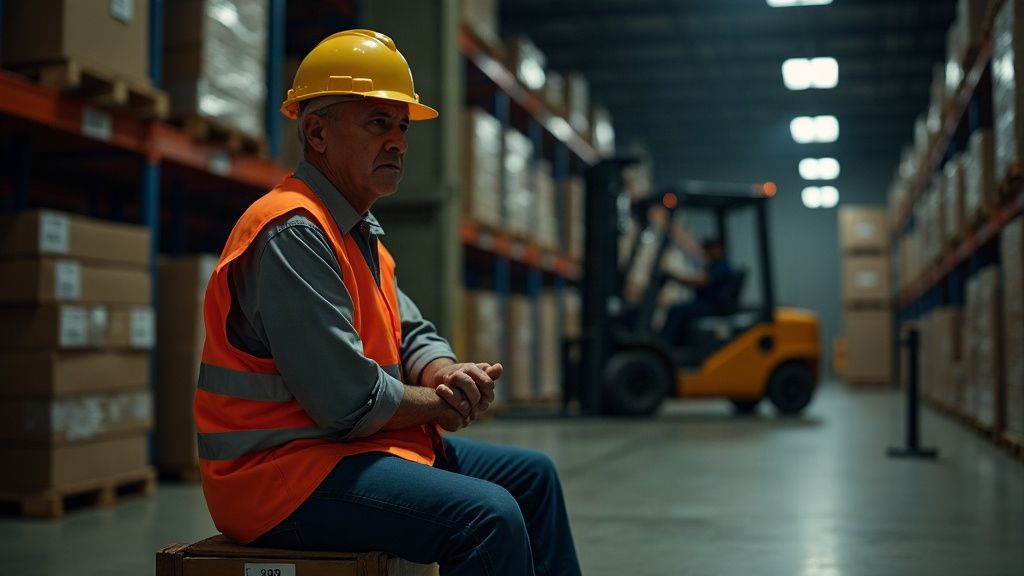
If you were hurt in a forklift accident or a warehouse injury in California, you are probably dealing with pain, mounting medical bills, and a lot of unanswered questions about what you are owed. The good news is that California law gives injured warehouse workers real options. Workers' compensation covers your medical care and lost wages. In some situations, a third party, such as a forklift manufacturer or a staffing agency, may owe you additional compensation outside the workers' comp system entirely.
This article walks through both paths in plain terms.
Quick answers:
- You must tell your employer about the injury within 30 days and file your workers' comp claim within one year of the injury date.
- Workers' comp pays your medical bills and two-thirds of your average weekly wages while you cannot work.
- If a defective machine or a non-employer third party caused the accident, you may also have a civil lawsuit.
- Employer retaliation for filing a workers' comp claim is illegal under California law.
- Repetitive warehouse injuries, not just single traumatic accidents, are covered.
- Call (818) 794-9947 for a free consultation. No fee unless we win.
Why Warehouses Report Some of the Highest Injury Rates in California
Warehouses are among the most physically demanding and hazardous workplaces in the state. Forklifts, conveyor systems, heavy pallets, loading docks, and speed-driven productivity quotas all exist in the same space as human beings who are often tired, working long shifts, and under pressure to move fast.
The California Division of Workers' Compensation (DWC) and the state's Department of Industrial Relations (DIR) track injury data showing that warehousing and transportation occupations consistently generate among the highest workers' compensation claim volumes in Southern California. Large fulfillment centers, cold-storage facilities, manufacturing distribution hubs, and third-party logistics operations all fall into this category.
The combination of heavy equipment, high throughput, and physical repetition creates risk from two directions. Some injuries happen in a single moment, a forklift tip-over, a falling pallet, a crush at a loading dock. Others develop slowly over months of repeated lifting, twisting, and gripping until the body gives out.
Both types are covered under California workers' compensation.
Typical Forklift and Warehouse Injuries: Crush, Fall, and Overexertion
Understanding what injuries are most common helps you recognize whether your situation qualifies.
Forklift-specific injuries:
- Crush injuries when a forklift pins a worker against a rack, wall, or another vehicle
- Pedestrian strike injuries, when a forklift hits a worker on foot in a shared aisle
- Tip-over accidents, particularly on uneven surfaces or with improperly loaded forks
- Falling loads from elevated forks striking workers below
- Carbon monoxide poisoning in enclosed facilities running propane or gas-powered forklifts
General warehouse injuries:
- Traumatic brain injuries from falling objects or falls from elevated surfaces
- Spinal fractures and disc injuries from falls off loading docks or mezzanines
- Shoulder, knee, and back injuries from repetitive lifting and overexertion
- Lacerations and amputations from conveyor systems and powered equipment
- Carpal tunnel syndrome and tendinitis from sustained repetitive tasks
Under Cal. Lab. Code §3208, a "compensable injury" includes any injury or illness that arises out of, or in the course of, employment. That language is broad by design. A back that breaks down after six months of pallet-pulling is just as covered as a shoulder broken when a load falls on you.
Repetitive lifting injuries and overexertion injuries in a warehouse qualify as work injuries under California Labor Code §3208 and are fully covered by workers' compensation.
Filing Your Workers' Comp Claim: What's Different in a Fast-Paced Facility
The workers' compensation process in California starts with two deadlines you cannot miss.
Step 1: Report the injury to your employer within 30 days.
Cal. Lab. Code §5400 requires you to give your employer written notice of a workplace injury within 30 days. In a warehouse or distribution setting, that means telling a supervisor or HR representative, not just a coworker. Get it in writing, even a text or email, so there is a timestamp.
In California, you must report a workplace injury to your employer within 30 days and file your workers' compensation claim within one year of the date of injury.
Step 2: File a DWC-1 claim form.
Once you report, your employer is required to give you a DWC-1 claim form within one working day under Cal. Lab. Code §5401. Fill it out and return it. Your employer then has 90 days to accept or deny the claim. If they do not act within 90 days, the injury is presumed compensable under Cal. Lab. Code §5402.
What workers' comp pays:
- Medical treatment: All reasonable and necessary medical care related to the injury, with no out-of-pocket costs to you, under Cal. Lab. Code §4600.
- Temporary disability (TD): While you cannot work, two-thirds of your average weekly wages, subject to state minimums and maximums that adjust annually, under Cal. Lab. Code §4653.
- Permanent disability (PD): If the injury leaves you with a lasting impairment, a separate PD benefit calculated from a rating system under Cal. Lab. Code §4658.
- Supplemental Job Displacement Benefit (SJDB): A voucher for retraining if you cannot return to your prior job.
- Death benefits: For surviving dependents if a warehouse injury proves fatal.
What's different about high-volume warehouse facilities:
Large employers, including major fulfillment centers and third-party logistics operators, often have managed care networks and aggressive return-to-work programs. The insurer's Medical Provider Network (MPN) controls who treats you, which can limit your choices. If the facility's MPN doctor clears you for light duty before you actually feel ready, you have the right to request a second opinion within the MPN or, in some circumstances, to see a QME (qualified medical evaluator) appointed through the DWC.
Do not let the pace or culture of a high-throughput facility pressure you into skipping a doctor visit or understating your symptoms. Your medical record is the foundation of your claim.
When a Third Party (Equipment Maker, Staffing Agency, Contractor) May Also Be Liable
Workers' comp is the exclusive remedy against your direct employer in California. Under Cal. Lab. Code §3602, you generally cannot sue your employer in civil court for a workplace injury. That exclusivity rule is strong, but it only covers your employer.
If someone other than your employer caused or contributed to your injury, you may have a separate civil claim. In warehouses and distribution facilities, three categories of third parties come up most often.
Forklift and Equipment Manufacturers
California products liability law, grounded in civil tort doctrine, allows an injured worker to pursue a defective-product claim against the manufacturer, distributor, or retailer of a piece of equipment that caused the injury. If a forklift had a defective braking system, a faulty horn, or a design flaw that contributed to a tip-over or pedestrian strike, the manufacturer can be held liable under a strict liability theory, meaning you do not have to prove they were negligent, only that the product was defective and caused your harm.
This matters in warehouse settings because forklifts, conveyor systems, pallet jacks, and other powered industrial vehicles are manufactured by companies entirely separate from your employer. Their failure to build a safe product is not covered by workers' comp exclusivity.
Staffing Agencies and Labor Contractors
A large number of warehouse workers in California are placed by staffing agencies and work on-site at a host employer's facility. When that happens, the question of which entity is the "employer" for workers' comp purposes gets complicated.
California law recognizes the concept of a "dual employer," and under Cal. Lab. Code §3602, the workers' comp bar applies to employers, but staffing agencies and host employers each bear different exposure depending on the facts. In some configurations, a staffing agency that supplies the worker and a host employer that controls the work environment create conditions where the worker can bring a civil claim against one of them as a third party.
This is fact-specific analysis. If you were placed by a staffing agency at a warehouse where you were injured, document both the agency and the host employer by name before you do anything else.
General Contractors and On-Site Subcontractors
In warehouse construction, retrofit, or maintenance scenarios, multiple contractors often share the same floor. If a subcontractor's crew, someone who did not employ you and did not share your workers' comp coverage, caused the forklift accident or dropped a load on you, they can be sued in civil court.
If a third party, such as a forklift manufacturer or a staffing agency, caused or contributed to your warehouse injury, you can file a civil lawsuit against them in addition to your workers' comp claim.
A civil lawsuit against a third party can recover damages that workers' comp does not pay at all: pain and suffering, full lost earnings without a two-thirds cap, and, in egregious cases, punitive damages. The trade-off is that your workers' comp insurer will have a lien on any third-party recovery for the amounts it already paid on your behalf.
Visit our personal injury practice area page for more on how third-party civil claims work alongside workers' comp, and our workers' compensation page for a full breakdown of the benefits system.
Productivity Quotas and Injury Reporting Pressure: Know Your Rights
In high-throughput warehouse operations, informal pressure not to report injuries is common. Workers describe being told their downtime affects team metrics, that reporting "too many" injuries draws attention, or that missing a shift for treatment means falling behind on piece-rate counts. Some workers delay treatment and work through pain rather than risk losing income or standing.
California law draws a hard line here.
Cal. Lab. Code §132a makes it a misdemeanor for an employer to discharge, threaten, or otherwise discriminate or retaliate against an employee who files a workers' comp claim or testifies in a workers' comp proceeding. The remedy includes reinstatement, reimbursement of lost wages, and additional compensation for the retaliation itself.
California law under Cal. Lab. Code §132a makes it a misdemeanor for an employer to retaliate against a worker for reporting a workplace injury or filing a workers' compensation claim.
Productivity quotas are a separate legal issue. California's Senate Bill 1162 and prior legislation have imposed reporting and transparency requirements on large warehouse employers, and Cal/OSHA separately enforces ergonomic and safety standards at warehouses of all sizes. If a quota drove the conditions that led to your injury, or if your employer is pressing you to return to quota-level work before you are medically released to do so, those facts matter for your claim.
Document everything. Save texts from supervisors. Keep a log of any verbal pressure not to file or to return early. That documentation can support a §132a retaliation claim if one becomes necessary.
Coordinating Workers' Comp With a Separate Claim Against a Non-Employer
Running a workers' comp claim and a civil lawsuit at the same time is common in warehouse and forklift cases with a third-party component. Here is how the coordination works in practice.
Your workers' comp claim runs first for medical and wage benefits. The insurer starts paying for your treatment and temporary disability right away, regardless of the civil case.
Your civil lawsuit runs in parallel in state or federal court. The standard of proof, the timeline, and the damages available are all different from the workers' comp system.
The workers' comp insurer holds a lien on your civil recovery. Under Cal. Lab. Code §3856, when you recover money from a third-party lawsuit, the workers' comp insurer has the right to recover what it paid from that fund. The lien is negotiable, but it must be accounted for in any settlement.
You still receive a net benefit from the civil case. Even after the lien is satisfied, a successful civil claim against a forklift manufacturer or a negligent third-party contractor typically exceeds what workers' comp pays alone. Pain and suffering damages, which workers' comp does not pay at all, are often the largest component of a civil recovery.
A workers' compensation claim and a third-party personal injury lawsuit can run at the same time in California, and any third-party recovery may be subject to a lien by the workers' comp insurer.
Getting both claims right requires attorneys who handle both practice areas and understand how the lien and offset rules interact. Nordanyan Law handles both workers' compensation and personal injury specifically for this reason. We've recovered over $150,000,000 for injured workers and their families across Southern California.
If you want to understand the value of your specific situation, our free case evaluation is the right place to start.
What to Do Right Now If You Were Hurt in a Warehouse or Forklift Accident
Acting quickly protects your rights on both the workers' comp and the civil side.
- Get medical attention immediately. Go to the emergency room or urgent care, even if the injury seems manageable. The medical record created that day is your most important piece of evidence.
- Report the injury to your employer in writing within 30 days. A text, an email, or a written form all work. Date it, keep a copy.
- Fill out and return the DWC-1 form your employer is required to give you.
- Photograph the scene if you can do so safely. Forklift position, aisle markings, load, lighting conditions, safety signage, missing guards. This evidence disappears fast in active facilities.
- Identify witnesses. Coworkers who saw the accident or who have noticed the same unsafe condition are valuable. Get names before shift changes scatter them.
- Do not give a recorded statement to the insurance adjuster before you speak with an attorney. The adjuster works for the insurer, not for you.
- Call Nordanyan Law at (818) 794-9947. We will review your workers' comp and third-party options together, at no cost. No fee unless we win.
FAQ: Forklift and Warehouse Injuries in California
What should I do after a forklift accident at work?
Report the injury to your employer in writing within 30 days, get medical care right away, fill out the DWC-1 claim form your employer provides, photograph the scene if possible, and speak with a workers' comp attorney before giving any recorded statement to the insurance company. The first 72 hours after a forklift accident set the foundation for your claim.
Can I sue if a forklift injury was caused by a coworker?
Generally, no. California's workers' compensation system is the exclusive remedy against your employer and your coworkers acting in the course of their employment. Under Cal. Lab. Code §3601, an employee cannot sue a fellow employee for a work injury in most circumstances. However, if the forklift was defective, or if a contractor or staffing agency (not your direct employer) played a role, a civil lawsuit against those parties may still be possible.
Does workers' comp cover warehouse repetitive lifting injuries?
Yes. Under Cal. Lab. Code §3208, a compensable injury includes cumulative trauma, meaning conditions that develop gradually from repetitive work activity. Back injuries, herniated discs, rotator cuff tears, and carpal tunnel syndrome caused by sustained warehouse work are all recognized as compensable injuries in California.
Can I file a claim against the forklift manufacturer?
Yes, if the forklift had a design defect, a manufacturing defect, or an inadequate warning that contributed to your injury. California's strict products liability doctrine means you do not need to prove the manufacturer was careless, only that the product was defective and caused your harm. This claim runs separately from workers' comp and can recover damages workers' comp does not pay, including pain and suffering.
What if my employer is pressuring me not to file a workers' comp claim?
That pressure is illegal. Cal. Lab. Code §132a prohibits employers from retaliating against workers who file, or even intend to file, a workers' comp claim. Document any threats or pressure in writing, note the date and who said what, and contact an attorney. A §132a retaliation claim can result in reinstatement, back pay, and additional compensation on top of your underlying injury claim.
How long does a warehouse workers' comp case take in California?
It depends on the severity of the injury, whether the claim is disputed, and whether permanent disability needs to be evaluated. Straightforward accepted claims with clear medical evidence may resolve in six to twelve months. Cases involving denied claims, disputed permanent disability ratings, or parallel civil litigation typically take longer. An attorney can give you a realistic timeline based on your specific facts.
What if I was placed at the warehouse by a staffing agency?
Your workers' comp coverage typically flows from the staffing agency, the direct employer, rather than the host facility. Whether the host employer also owes you a duty of care as a third party depends on the specific contract between the agency and the facility and on who controlled your day-to-day work. This is one of the more complex fact patterns in warehouse injury cases, and it is worth having an attorney review the staffing agreement before you accept a settlement.
Is there a deadline to file a third-party lawsuit for a forklift accident in California?
For a personal injury lawsuit against a third party, such as a forklift manufacturer, the general statute of limitations under California law is two years from the date of injury. However, if the third party is a government entity, such as a public port or a state-operated facility, the Government Claims Act sets a six-month deadline for filing an administrative claim before you can sue. Missing either deadline permanently bars your civil claim. Talk to an attorney as soon as possible.
What damages can I recover in a third-party lawsuit on top of workers' comp?
Workers' comp pays medical bills and a portion of lost wages. A civil lawsuit against a third party can also recover the full amount of your lost earning capacity without the two-thirds cap, compensation for pain and suffering, compensation for loss of enjoyment of life, and, in cases of intentional or reckless conduct, punitive damages. The workers' comp insurer will hold a lien on the civil recovery for what it paid, but the net benefit to you is typically higher than workers' comp alone.
How do I know if I need an attorney for a warehouse workers' comp claim?
If your claim was denied, if the insurer is disputing your injury's extent, if you are being pressured to return to work before you are medically ready, if there is a potential third-party claim against a manufacturer or contractor, or if your employer is retaliating against you, you need an attorney. For straightforward accepted claims with no disputes, an attorney can still help you avoid common mistakes that reduce your final settlement. Nordanyan Law offers free consultations at (818) 794-9947, so there is no cost to asking the question.
Warehouse and forklift injuries can upend your life quickly. The workers' compensation system is there to protect you, but navigating it alongside a potential third-party claim, a retaliation situation, or a dispute over your permanent disability rating is not something you should do alone.
We fight for injured workers across Southern California. We've recovered over $150,000,000 for clients in situations exactly like yours. Every injured worker deserves the same quality of legal representation as any corporation. That is the principle this firm was built on.
Call (818) 794-9947 for a free consultation. No fee unless we win.
Reviewed by Minas Nordanyan, CA Bar #296806. Last reviewed for legal accuracy prior to publication.