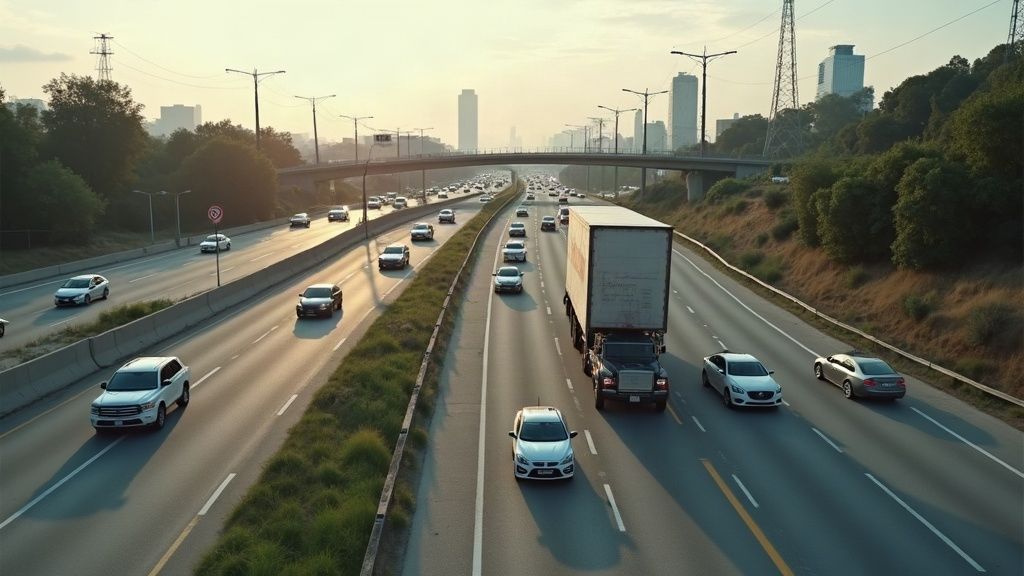
If you were involved in a freeway merging accident in California, you already know how fast everything happened. One moment traffic was moving; the next, two vehicles were fighting for the same lane at highway speed. What happens next, who pays, how fault is split, whether your claim survives, depends on a set of California-specific rules most drivers have never read.
We've recovered over $150,000,000 for injured Californians across Southern California. Here are the eight things that matter most if you're dealing with a multi-lane freeway merge crash.
Quick summary:
- California law requires lane changes to be safe before a driver moves over.
- Fault is almost always disputed, evidence collection decides the case.
- Merge crashes follow common, identifiable patterns.
- Video footage disappears fast; preserving it is urgent.
- Witness accounts are often the deciding factor.
- California's comparative fault rule lets you recover even if you were partly to blame.
- HOV lane entries add a separate layer of potential negligence.
- The steps you take in the first 48 hours shape your entire claim.
1. How California's Unsafe Lane Change Rules Work
California Vehicle Code Section 21658(a) requires every driver to stay within a marked lane and move out of it only when the movement can be made safely.
California Vehicle Code §21658(a) is the cornerstone statute for every freeway merge crash claim. It states that a vehicle must be driven, as nearly as practical, within a single marked lane and must not be moved from that lane until the driver has first determined that the movement can be made with safety. A second statute, California Vehicle Code §22107, adds that no driver shall turn a vehicle from a direct course until the movement can be made with reasonable safety and, if another vehicle may be affected by the movement, until a signal is given.
These two statutes work together. A driver who merged without checking their blind spot, failed to signal, or moved over while a vehicle was already occupying that lane has violated both provisions. That violation is not automatically a finding of civil liability, but it is strong evidence of negligence under California's negligence per se doctrine, which allows a jury to treat a statutory violation as evidence that the defendant failed to act as a reasonably careful person.
Practical takeaway: If the other driver violated §21658(a) or §22107, document it in your police report. The statutory violation supports your claim at every stage.
2. Why Merging Accidents Often Involve Disputed Fault
Disputed fault is the defining feature of freeway merge crashes, and understanding why helps you prepare for what the insurance company will do next.
At freeway speeds, a lane-change collision takes roughly one second from first contact to rest. Neither driver has a clear mental film of exactly where each vehicle was when the contact began. Both typically believe the other car moved into their lane. There is rarely a single pedestrian witness standing on the shoulder. The result is that two drivers give two genuinely different accounts to the investigating officer, and the insurer for the other driver uses that ambiguity to either deny your claim or push fault onto you.
California law does not require you to prove the other driver was 100 percent at fault. But it does require you to prove they were at least partially at fault, and to quantify the damage their negligence caused you. When both drivers give conflicting accounts, the physical evidence, paint transfer, point of impact on each vehicle, tire marks, and especially video, is what breaks the tie.
Practical takeaway: Never assume the police report alone is enough. Disputed fault cases require layered evidence, and the insurer will exploit every gap.
3. Common Patterns That Cause Freeway Merge Collisions
Fault in a freeway merge crash is often disputed because both drivers believe the other vehicle moved first, which is why independent witness statements carry so much weight.
Most freeway merge crashes fit one of four fact patterns, each with its own liability profile.
Blind-spot failure: The merging driver checks their mirrors but not their blind spot, and the adjacent vehicle is already alongside them. This is the most common pattern and almost always places primary fault on the merging driver under §21658(a).
On-ramp speed mismatch: A vehicle entering the freeway from an on-ramp fails to accelerate to freeway speed before merging, forcing the lane-change to occur at a speed differential. California Vehicle Code §21654 requires slower vehicles to use the right-hand lanes and yield to faster traffic. Fault often falls on the entering driver.
Multi-lane cut: A driver attempts to cross two or more lanes in a single movement without separate verification of each lane. Each lane boundary is a separate §21658(a) obligation; cutting across two lanes multiplies the exposure.
Distracted or impaired driving: A driver drifts across a line because they are looking at a phone, fatigued, or under the influence. These cases often support punitive damages in addition to compensatory damages under California Civil Code §3294 when the conduct rises to the level of conscious disregard for the safety of others.
Practical takeaway: Identify which pattern your crash fits. It points directly to the statute and the evidence you need most.
4. How Traffic Camera and Dashcam Footage Gets Used
Traffic camera footage from Caltrans and local agencies is typically overwritten within 30 days, so sending a preservation demand immediately after a freeway crash is critical.
Video is the single most powerful evidence in a disputed merge crash because it removes the credibility contest between the two drivers.
Caltrans operates a statewide network of freeway surveillance cameras, and local agencies such as the Los Angeles Department of Transportation operate additional systems. The retention period for most traffic camera footage is 30 days or less; some systems overwrite footage in as little as 72 hours. An attorney can send a written evidence-preservation letter to the agency within days of the crash, legally obligating them to retain the footage while the civil matter is pending.
Dashcam footage from your own vehicle or from nearby vehicles is equally valuable. Footage that shows the lane markings, the relative positions of both cars, and the moment of first contact resolves most disputes about which driver crossed the line first. If a commercial truck was nearby, federal regulations under 49 C.F.R. §395.8 require trucking companies to retain driver logs; many also retain forward-facing dashcam footage for longer periods.
Practical takeaway: If there is any chance a camera captured your crash, the preservation letter must go out within 72 hours. This is something an attorney can do for you immediately.
5. Why Witness Statements Matter More in These Crashes
Independent witnesses are more important in freeway merge cases than in almost any other type of collision, for one reason: the drivers cannot agree on what happened, and the physical evidence is often ambiguous.
A motorist who was traveling parallel to both vehicles when the crash occurred has no financial stake in the outcome and no reason to favor either driver. Juries and adjusters treat their account as the most credible version of events. Commercial truck drivers are particularly valuable witnesses because their elevated cab height gives them a panoramic view of adjacent lanes that passenger car drivers do not have. Many large trucks also run forward and side cameras continuously.
Collecting witness information at the scene is entirely within your rights, and it costs nothing. California does not restrict the collection of witness contact information after a crash. Get names, phone numbers, and, if possible, a brief written or recorded statement while the driver's memory is fresh. Memories fade within days at the level of detail that matters in a lane-change case.
Practical takeaway: Before you move your vehicle or exchange insurance cards, ask anyone who stopped or pulled over whether they saw the crash and take their number. That 30-second conversation can be the most valuable thing you do at the scene.
6. How Comparative Fault Can Split Responsibility
California follows a pure comparative fault rule from Li v. Yellow Cab Co., meaning you can still recover compensation even if you share some of the blame for a merging accident.
California applies a pure comparative fault rule, established by the California Supreme Court in Li v. Yellow Cab Co. (1975) 13 Cal.3d 804. Under this rule, a plaintiff's damages are reduced by the percentage of fault attributed to them, but they are not barred from recovery even if they are found more than 50 percent at fault. If a jury finds that you suffered $200,000 in damages but were 30 percent at fault for the crash, you recover $140,000.
In freeway merge crashes, fault is frequently split. Driver A may have failed to signal before merging under §22107 while Driver B was traveling slightly above the speed limit, creating the conditions for the collision. Both failures contribute to the crash. The jury assigns percentages; the award is reduced accordingly.
California Civil Code §1431.2 addresses how non-economic damages are apportioned among multiple defendants in civil actions, requiring each defendant to pay only their proportionate share of those damages. This becomes relevant when more than two parties are responsible for a crash, such as when a third vehicle forced both drivers into the collision.
Practical takeaway: Do not assume that sharing some fault ends your claim. Pure comparative fault means partial fault equals a reduced recovery, not no recovery. Get your percentage documented accurately.
7. What Makes Carpool and HOV Lane Crashes Unique
A driver who enters an HOV lane without the required number of occupants under California Vehicle Code Section 21655.5 can face that violation as evidence of negligence in a civil claim.
High-occupancy vehicle (HOV) lanes on California freeways operate under California Vehicle Code §21655.5, which restricts access to vehicles carrying the required number of occupants, or to qualifying clean-air vehicles displaying the proper California Department of Motor Vehicles decal. Entry and exit from HOV lanes are restricted to designated on- and off-ramp points marked by broken lines; solid double yellow lines prohibit entry or exit entirely.
Two additional liability factors appear in HOV lane crashes that do not appear in general-purpose lane crashes. First, a driver who entered the HOV lane at an unauthorized solid-line segment has violated §21655.5 regardless of whether they had enough occupants. That statutory violation can be used as evidence of negligence per se in the civil case. Second, HOV lanes on California freeways are often separated from general-purpose lanes by a narrow buffer that leaves almost no room for error. Merge distances are shorter, and the consequences of misjudgment are greater.
If a crash occurred because one driver improperly crossed a solid double-yellow HOV buffer line, the investigation should focus on that crossing point, the visible markings at that location, and any available camera footage from the overhead gantries that monitor HOV lane compliance.
Practical takeaway: If the crash involved an HOV lane, note whether the other driver entered or exited through a solid-line segment and whether they had the required occupancy. Both facts affect liability.
8. Steps to Strengthen Your Claim After a Merging Accident
The actions you take in the 48 hours after a freeway merge crash have more impact on your recovery than almost anything that happens later. Here is what matters most.
At the scene: Call 911 and request a police report, even for crashes that seem minor. Photograph the final resting positions of both vehicles, any skid or yaw marks on the pavement, lane markings, and any visible damage before the vehicles are moved. Collect witness names and phone numbers. Do not discuss fault with the other driver beyond exchanging insurance and license information.
Within 24 hours: Seek medical evaluation for any pain, headache, dizziness, or restricted movement. California requires that medical treatment be documented to support a personal injury claim. Delay in seeking treatment gives insurers grounds to argue the injury was unrelated to the crash.
Within 72 hours: Contact an attorney to send an evidence-preservation letter to Caltrans, the local traffic authority, and any commercial trucking company whose vehicles were present. The letter creates a legal obligation to retain footage and data.
Before speaking to the other driver's insurer: Consult with a personal injury attorney. Insurance adjusters are trained to gather statements that minimize the insurer's exposure. A recorded statement made without legal guidance can lock you into a version of events before the full picture is clear.
Our firm handles freeway accident cases across Southern California on a contingency basis, no fee unless we win. To schedule a free case review, call (818) 794-9947.
Frequently Asked Questions
Who is at fault in a lane-change accident in California?
The driver who moved out of their lane without first confirming the movement was safe is typically the at-fault party under California Vehicle Code §21658(a). However, fault is frequently shared when both drivers contributed to the collision, for example, when the merging driver failed to signal and the adjacent driver was speeding. California's pure comparative fault rule allows both drivers to share fault in different proportions.
What is the unsafe lane change law in California?
California Vehicle Code §21658(a) requires every driver to remain within a single marked lane and to move from that lane only when the movement can be made safely. California Vehicle Code §22107 adds the requirement to signal when the movement may affect another vehicle. Violations of either statute can be used as evidence of negligence in a civil claim.
How do multi-car freeway accidents get investigated?
Multi-vehicle freeway crashes are typically investigated by the California Highway Patrol (CHP), which collects physical evidence, takes driver and witness statements, and produces a collision report. Civil attorneys supplement this with independent evidence such as traffic camera footage from Caltrans, dashcam recordings, black-box data from vehicles, and accident reconstruction experts who analyze speed and impact angles.
Can more than one driver be at fault in a merging accident?
Yes. California's pure comparative fault rule, established in Li v. Yellow Cab Co. (1975) 13 Cal.3d 804, allows fault to be apportioned among multiple drivers. Each driver's damages are reduced by their own percentage of fault. In multi-car freeway pileups, a third vehicle that forced two others into each other can also bear a portion of liability, and California Civil Code §1431.2 governs how non-economic damages are allocated among multiple defendants.
Does it matter if the crash happened in an HOV lane?
Yes. Entry and exit restrictions under California Vehicle Code §21655.5 mean that a driver who crossed a solid double-yellow HOV buffer line committed a statutory violation independent of the lane-change itself. That violation is admissible as evidence of negligence in the civil case. HOV lane geometry also tends to leave narrower margins, which courts and juries consider when evaluating whether a driver acted reasonably.
How long do I have to file a personal injury claim after a freeway accident in California?
California Code of Civil Procedure §335.1 sets a two-year statute of limitations for personal injury claims from the date of the accident. If a government entity, such as Caltrans or a city, is involved, a government tort claim under California Government Code §911.2 must be filed within six months of the incident. Missing either deadline generally bars the claim entirely.
What evidence should I collect at the freeway crash scene?
Photograph both vehicles' positions, lane markings, skid marks, and any visible damage before the vehicles are moved. Collect the name, phone number, and insurer information of the other driver. Get the badge number of the responding CHP or police officer. Take the contact information of any witnesses. Note the location of any visible traffic cameras mounted on overhead gantries or light poles, your attorney can use those locations to request footage before it is overwritten.
What if the other driver's insurer says I was at fault?
An insurer's initial fault determination is not final. Under California's pure comparative fault rule, even a driver found partially at fault can recover a proportionate share of their damages. An attorney can challenge the insurer's determination using traffic camera footage, witness statements, accident reconstruction analysis, and statutory violation evidence. Do not accept a denial or a reduced settlement offer without an independent legal review of the evidence.
If you were hurt in a freeway merging accident anywhere in Southern California, every day of delay makes the evidence harder to recover. Call (818) 794-9947 for a free consultation. No fee unless we win.
Reviewed by Minas Nordanyan, CA Bar #296806. Nordanyan Law represents injured workers and accident victims across Southern California. This article is for general informational purposes and does not constitute legal advice for any specific case.