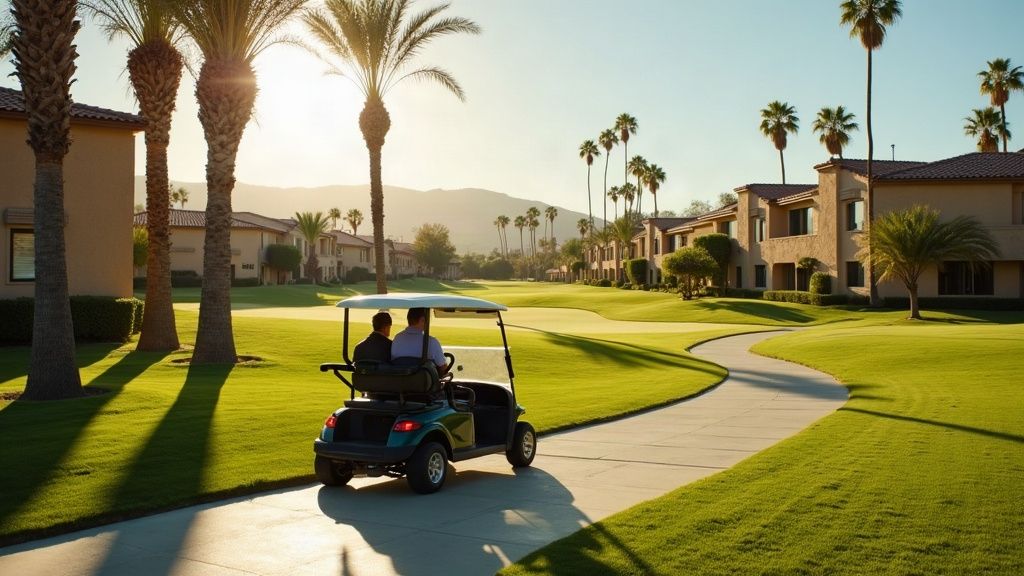
Golf carts look harmless. They top out at 15 to 25 miles per hour, they are quiet, and they are everywhere, on golf courses, inside gated retirement communities, across resort properties, and along the streets of places like Palm Desert and Avalon on Catalina Island. That low-speed, low-stakes appearance is exactly what makes them dangerous. There are no doors, no standard seatbelts on most models, and no crumple zone. When a golf cart hits something, or rolls over, the people inside and around it absorb the full impact.
If you or someone you care about was hurt in a golf cart crash in California, here are nine things that determine what your claim is worth and how to protect it.
Quick summary:
- California law treats golf carts as motor vehicles on public roads, opening standard negligence claims.
- Crashes happen most often at resorts, retirement communities, HOAs, and campuses.
- Liability can fall on the driver, the property owner, or the cart manufacturer.
- Standard auto insurance usually excludes golf carts, coverage gaps are common.
- Injuries include traumatic brain injuries, spinal fractures, and broken bones.
- Impaired driving and passenger overloading are frequent contributing factors.
- California's pure comparative fault rule lets you recover even if you share some blame.
- Preserve evidence immediately: photos, witnesses, incident reports.
- The filing deadline is generally two years from the crash date.
1. What Counts as a Golf Cart Accident Under California Law
In California, golf carts operated on public roads are treated as motor vehicles under the Vehicle Code, which means a crash victim can file a personal injury claim under the same negligence rules that apply to car accidents.
The California Vehicle Code defines a "motor vehicle" broadly, and when a golf cart travels on a public street or highway, it falls inside that definition. Cal. Veh. Code §21115 permits local authorities to allow golf carts on certain roadways under specific conditions, and many Southern California cities, particularly in the Coachella Valley and on Catalina Island, have done exactly that.
When the accident happens on private property, a golf course fairway, a resort pathway, or inside a gated community, the applicable legal framework shifts to premises liability and general negligence law rather than the Vehicle Code. The core question stays the same: did someone's carelessness cause your injury?
Practical takeaway: Whether your crash was on a public road or private land shapes which legal theory applies, but it does not eliminate your right to recover.
2. Common Places These Crashes Happen
Golf cart accidents in California cluster in predictable locations where carts and people share close quarters. Knowing where they happen helps identify who owned or controlled the property, a critical piece of the liability puzzle.
The most frequent settings include:
- Golf courses and country clubs, errant carts on cart paths and fairways, often involving multiple passengers leaning or shifting weight on slopes.
- Resort and hotel properties, carts used to shuttle guests between buildings, frequently operated by hotel employees.
- Retirement communities and 55-plus HOAs, Palm Springs, Sun City Palm Desert, Leisure World Seal Beach, and similar communities allow street-legal carts on community roads.
- College and university campuses, facilities and grounds staff use carts extensively; pedestrian-heavy environments increase risk.
- Airport tarmacs and industrial facilities, where workers can be struck by carts and may have both a workers' compensation claim under Cal. Lab. Code §3600 and a third-party personal injury claim.
- Amusement parks and sports stadiums, guest transport and maintenance carts move through crowded public areas.
Practical takeaway: The physical location of your crash directly determines which property owner, employer, or operator may share liability alongside the driver.
3. Who Can Be Held Responsible: Driver, Property Owner, or Manufacturer
California's pure comparative fault rule means you can still recover compensation even if you were partly responsible for the golf cart accident, your damages are simply reduced by your share of fault.
Actually, that sentence belongs in item 7, let's cover the three responsible parties here.
Liability for a California golf cart accident frequently touches more than one defendant:
The driver. The operator of the cart owes a duty of reasonable care to passengers, bystanders, and other vehicles. Speeding on a slope, texting, carrying too many passengers, or driving while impaired are all forms of negligence.
The property owner. Under California premises liability law, a property owner has a duty to maintain safe conditions for people on the premises. Cal. Civ. Code §1714 imposes a general duty of care. An HOA, resort, or golf course that provides carts, permits their use, or fails to maintain safe pathways can be held liable under a negligent entrustment or premises liability theory.
The manufacturer. If the cart itself was defective, a brake failure, a missing or inadequate seatbelt system, a roof or rollover protection structure that failed, the manufacturer can face a products liability claim. California follows strict liability for defective products under the rule from Greenman v. Yuba Power Products (1963), meaning you do not need to prove the manufacturer was careless, only that the product was defective and caused your injury.
Practical takeaway: Identify every party who controlled, owned, or designed the cart and the property, a thorough claim names all of them.
4. How Insurance Coverage Works for Golf Carts
Standard auto insurance policies in California typically do not cover golf carts unless the policyholder added a specific endorsement, so victims often need to look to homeowner's insurance or the property owner's general liability policy.
Coverage gaps are one of the most frustrating parts of a golf cart injury claim. Here is how the layers typically stack:
- Personal auto policy: Most standard policies exclude vehicles not designed for public road use. If the cart is street-legal and registered, some coverage may apply, but you cannot assume it.
- Homeowner's or renter's policy: Many policies extend liability coverage to golf carts operated on a golf course or on private property. This varies significantly by insurer and policy language.
- Standalone golf cart policy: Available from specialty insurers. Provides both liability and physical damage coverage and is the cleanest solution for frequent users.
- Property owner's commercial general liability (CGL) policy: When the cart belongs to a resort, HOA, or golf course, their CGL policy is usually the primary source of recovery. These limits are generally much higher than personal policies.
- Employer's workers' comp carrier: If you were injured in a golf cart crash while working, your employer's workers' compensation insurer covers your medical bills and lost wages under Cal. Lab. Code §3700, and a separate third-party PI claim against the negligent driver or property owner may also be available.
Practical takeaway: Never assume coverage exists. An attorney can identify every applicable policy before you accept a single settlement offer.
5. Common Injuries Seen in Golf Cart Crashes
Golf carts offer almost no protection in a collision or rollover. Most models have no doors, no crumple zone, and no standard seatbelts. At 15 miles per hour, a passenger can be ejected several feet onto pavement or turf.
The injuries we see most often include:
- Traumatic brain injuries (TBI), from head contact with the ground, a post, or another vehicle during ejection or rollover. TBI ranges from concussion to severe brain damage.
- Spinal cord injuries, compression or fracture of the vertebrae, with outcomes ranging from chronic pain to permanent paralysis.
- Broken bones, wrists and arms from bracing during a fall; ankles and hips from being pinned under a cart; ribs from lateral impact.
- Lacerations and road rash, from contact with pavement or vegetation after ejection.
- Crush injuries, when a cart tips onto a passenger or bystander, particularly dangerous for older adults in retirement communities.
- Soft tissue injuries, whiplash-type neck and back injuries even at low impact speeds.
Older adults sustain disproportionately severe injuries from golf cart crashes because of reduced bone density and balance. The DIR and occupational safety data consistently identify golf cart incidents as a meaningful source of serious workplace injury in hospitality and grounds-maintenance sectors.
Practical takeaway: Seek medical attention immediately after any golf cart crash, even if you feel "fine", symptoms of TBI and spinal injury can appear hours or days later, and a documented medical record ties your injuries to the crash.
6. Special Risks: Impaired Driving and Passenger Overloading
Two factors show up repeatedly in serious golf cart accidents and significantly affect both how the crash happened and the strength of your legal claim.
Impaired operation. [SPEAKABLE] California Vehicle Code section 23152 makes it illegal to operate a golf cart on a public road while impaired, and a DUI conviction against the driver is powerful evidence in your injury lawsuit. In resort and country-club settings, alcohol and golf are culturally intertwined, which means DUI is a genuine risk factor even on private property, where a negligence theory (rather than the Vehicle Code) still applies. A driver's blood-alcohol content above 0.08% is strong evidence of negligence and may support a claim for punitive damages under Cal. Civ. Code §3294.
Passenger overloading. Almost every golf cart has a posted passenger capacity, typically two or four people. Exceeding that number raises the center of gravity and dramatically increases rollover risk on even modest slopes. Overloading is a clear form of negligent operation by the driver, and if the property owner permitted or encouraged overloading (for example, to move larger groups faster), the owner shares that liability.
Practical takeaway: Impaired driving and overloading both raise the value of a claim by establishing clearer negligence and potentially opening the door to punitive damages.
7. How Comparative Fault Can Apply
California follows a pure comparative fault system. Under Cal. Civ. Code §1714 and the framework established in Li v. Yellow Cab Co. (1975), a plaintiff's recovery is reduced by their own percentage of fault, but not eliminated, no matter how high that percentage is.
In golf cart cases, comparative fault arguments commonly arise when:
- A passenger chose to ride in an overloaded cart and could have declined.
- A pedestrian entered a cart path without looking.
- A passenger grabbed the wheel or distracted the driver.
- Someone rode on the running board or stepped off a moving cart voluntarily.
An insurance adjuster will almost always argue that you bear some share of responsibility. That is a negotiating tactic, not a legal conclusion. The actual apportionment of fault is determined by a jury, or by the parties in settlement, based on the specific facts.
Even if an insurer argues you were 30% at fault, you are still entitled to recover 70% of your total damages: medical bills, lost wages, pain and suffering, and future care costs.
Practical takeaway: Do not let a comparative fault argument discourage you from filing, your percentage of fault reduces your recovery, it does not eliminate it.
8. Steps to Take Right After a Golf Cart Accident
What you do in the hours and days after a golf cart crash can protect your claim or quietly undermine it. Follow these steps in order:
- Call 911. Even on private property, a police or security report creates an official record of the crash, the parties involved, and any observed impairment.
- Get medical attention immediately. Go to an emergency room or urgent care the same day, even if you feel only mild discomfort. The medical record establishes the link between the crash and your injury.
- Photograph everything. The cart, the scene, the roadway or path, any signage, and your visible injuries. Do this before anything is moved or cleaned up.
- Collect witness information. Names and phone numbers of anyone who saw the crash, including other golfers, resort guests, or bystanders.
- File an incident report with the property owner. Request a copy before you leave. If they refuse, document that refusal.
- Do not give a recorded statement to any insurance adjuster. Adjusters are trained to elicit statements that minimize your claim. Politely decline and speak with an attorney first.
- Preserve the evidence. If you own or rented the cart, do not allow it to be repaired or returned until it has been inspected. A defective brake or missing restraint is physical evidence.
- Contact a personal injury attorney. Many pieces of evidence, surveillance video, maintenance logs, incident records, are routinely deleted within 30 to 90 days. Early legal action can preserve them with a litigation hold letter.
Practical takeaway: The first 48 hours after a golf cart crash are the most important for evidence preservation, act quickly.
9. When It Is Time to Talk to a Personal Injury Attorney
The statute of limitations for a golf cart injury lawsuit in California is generally two years from the date of the accident under Code of Civil Procedure section 335.1, missing that deadline can end your right to recover anything.
Two years sounds like a long time. It is not. Here is why you should call sooner rather than later:
- Surveillance footage is deleted. Golf courses, resorts, and HOAs overwrite security camera footage on 30- to 90-day loops. Once it is gone, it is gone.
- Witnesses' memories fade. The sooner a statement is taken, the more accurate it is.
- Insurance companies move fast. An adjuster may call you within 24 to 48 hours of the crash with an early settlement offer. That offer is almost always far below the actual value of the claim.
- Special deadlines apply in some cases. If a government entity owns the property or the cart, a public university, a city-owned golf course, a transit authority, you may have as little as six months to file a government tort claim under the California Government Claims Act before suing.
- Medical costs compound. A spinal cord injury or TBI can require surgery, rehabilitation, and long-term care. Settling before the full scope of your damages is known locks you in to an inadequate number permanently.
You do not need to have all the answers before you call. A free case review costs you nothing and gives you a clear picture of what your claim is actually worth and what the deadline is for your specific facts.
We've recovered over $150,000,000 for injured workers and accident victims across Southern California. No fee unless we win. Call (818) 794-9947 for a free consultation.
Frequently Asked Questions
Do you need a license to drive a golf cart in California?
On private property such as a golf course or resort, California does not require a driver's license to operate a golf cart. On public roads, the requirements depend on local ordinance. In communities where golf carts are permitted on public streets under Cal. Veh. Code §21115, the driver generally must be at least 16 years old and hold a valid driver's license. Always check the specific rules for the city or county where you are operating.
Is a golf cart accident covered by car insurance in California?
Not automatically. Standard California auto insurance policies typically exclude golf carts because they are not designed primarily for public road use. Coverage may exist if the policyholder added a golf cart endorsement, if the cart is registered and street-legal, or through a homeowner's or renter's policy for on-course or private property incidents. If the cart belonged to a business or property, their commercial general liability policy is usually the applicable source of recovery.
Can you sue an HOA for a golf cart accident in California?
Yes. An HOA that owns carts, maintains cart paths, permits cart use on community roads, or entrusts carts to residents can be held liable under premises liability and negligent entrustment theories if its carelessness contributed to the accident. HOAs are also subject to Cal. Civ. Code §1714, the general negligence standard. The HOA's commercial general liability policy is typically the source of recovery.
What happens if a golf cart accident involves a minor in California?
If a minor was driving the cart, their parents or legal guardians can be held vicariously liable under Cal. Veh. Code §17707 for injuries the minor causes while operating a motor vehicle. If a minor was the one injured, the two-year statute of limitations under Code of Civil Procedure section 335.1 generally does not begin to run until the minor turns 18, giving additional time to file, but acting early still preserves evidence that would otherwise be lost.
What if I was injured in a golf cart accident while working?
If a golf cart crash happened in the course and scope of your employment, you have a workers' compensation claim under Cal. Lab. Code §3600 covering medical bills and lost wages. If a third party, a vendor, another company's employee, or a property owner separate from your employer, was also at fault, you may also have a personal injury lawsuit against that third party. Both claims can run simultaneously, and recovering on one does not forfeit the other. See our workers' compensation practice area for more on how the two claims interact.
How much is a golf cart accident claim worth in California?
The value depends on the severity of your injuries, who was at fault, available insurance coverage, and how your long-term care needs shake out. Damages in a California personal injury claim can include past and future medical expenses, lost wages and earning capacity, pain and suffering, and, where the conduct was egregious, punitive damages. There is no formula. The best way to get an accurate number for your specific facts is to speak with an attorney before accepting any offer. Visit our results page to see examples of what we've recovered for clients with serious injuries.
Reviewed by Minas Nordanyan, CA Bar No. 296806. Last updated September 2026. This article is for general informational purposes only and does not constitute legal advice. Every case turns on its specific facts. Call (818) 794-9947 or visit our free consultation page to discuss your situation with a California personal injury attorney. No fee unless we win.