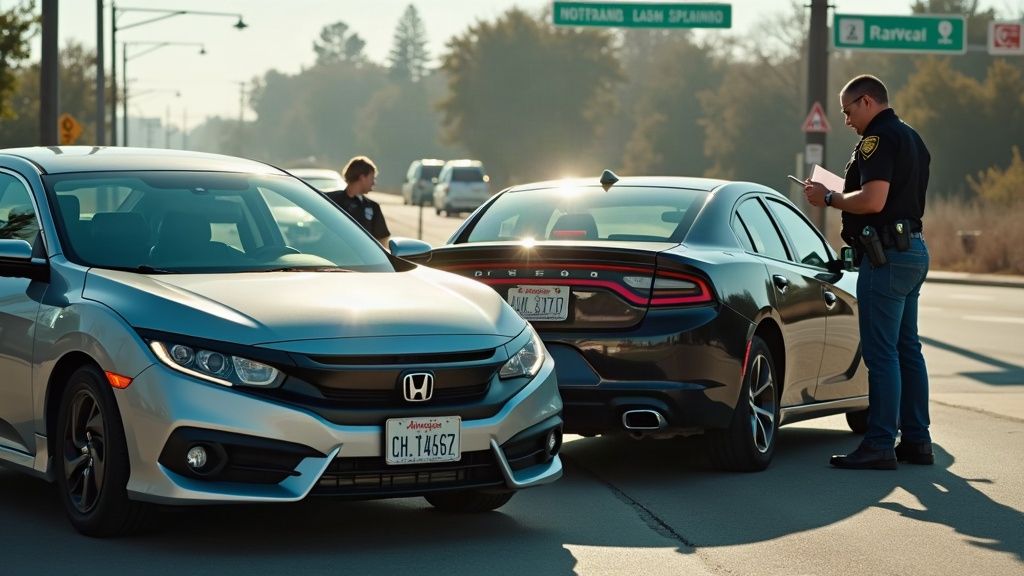
If you were just hit by a driver with out-of-state plates, you are already dealing with pain, shock, and a pile of questions. Add a driver who lives 2,000 miles away, an insurer you have never heard of, and coverage rules that vary by state, and the situation gets complicated fast.
The good news: California has strong protections for injured drivers, and those protections apply to you whether the person who hit you was from Nevada, Texas, or anywhere else in the country. Here is what you need to know.
Quick summary:
- California law governs the crash, full stop.
- You must still exchange insurance information at the scene under Cal. Veh. Code §16025.
- Out-of-state policies must meet California's 2025 minimum liability limits if the driver operated here.
- You file your claim in California, but collecting a judgment may require additional steps.
- Rental cars create extra insurance layers under the federal Graves Amendment.
- Your deadline to file suit is two years from the date of injury under Cal. Code Civ. Proc. §335.1.
- A California attorney can serve out-of-state defendants through the Secretary of State.
- Act in the first 72 hours to preserve evidence before the other driver leaves the state.
- Local legal help is not optional in multi-state crashes. It is the difference between collecting and not.
1. Why Accidents with Out-of-State Drivers Get Complicated
California law governs any car accident that happens within its borders, even if the driver who hit you is from another state.
When an in-state driver hits you, everything lives in one jurisdiction. The same is rarely true when the at-fault driver holds an out-of-state license. You may be dealing with an insurer that has no California office, an adjuster who is unfamiliar with California's fault rules, and a defendant who can drive home and become harder to reach within hours of the crash.
The complications stack up quickly. The other driver's home-state policy may carry lower minimum limits than California requires. Their insurer may dispute whether California or the driver's home state controls how benefits are calculated. If you need to file a lawsuit, serving the defendant across state lines requires a specific legal mechanism. And if you ultimately win a judgment, collecting it may require separate proceedings in the defendant's home state.
None of these hurdles make your claim impossible. They do make preparation and experienced legal representation more important than they would be in a routine local accident.
2. How California Law Still Applies to the Crash
The rule here is straightforward. Where the accident happens determines which state's law governs liability and damages. Because your crash occurred in California, California's tort law and traffic statutes control the case, regardless of where the other driver is from or where their insurer is based.
That means California's pure comparative fault system applies. Under California's comparative fault doctrine, your compensation is reduced by your own percentage of fault, but you can still recover even if you were partly responsible. The other driver cannot argue that their home state's contributory negligence rules, which in some states would bar your recovery entirely, apply here.
California's rules on damages, including compensation for medical bills, lost wages, pain and suffering, and future care costs, also apply. The at-fault driver and their insurer cannot import friendlier limits from another state's damage caps simply because the driver is from there.
Practical takeaway: The crash happened on California soil. California law is your law here, and it is one of the most plaintiff-favorable in the country.
3. Tracking Down the Other Driver's Insurance Information
California Vehicle Code §16025 requires every driver in a crash to exchange name, driver's license number, and insurance information at the scene.
Specifically, Cal. Veh. Code §16025 requires each driver to provide their name, address, driver's license number, vehicle registration, and the name and address of their automobile insurer, along with their policy number, at the scene. If the other driver refuses or cannot provide that information, note their license plate number and call law enforcement immediately.
Once you have the plate number, the police report will typically capture the registered owner's information. You can also contact the California Department of Motor Vehicles for registered-owner data if you have a legitimate legal purpose, which an injured party does.
After the crash, contact the insurer listed on the other driver's proof of insurance card and open a third-party claim. If the adjuster assigned to your claim is based in another state and seems unfamiliar with California rules on medical payments, rental reimbursement, or pain-and-suffering damages, that is not unusual, and it is one reason early legal representation helps.
Practical takeaway: Get the other driver's insurance card and photograph it on the spot. That single step can save weeks of hunting later.
4. What If the Driver's Home-State Insurer Isn't Licensed in California
Some smaller regional insurers are licensed only in their home state. That does not mean you cannot collect.
Under Cal. Ins. Code §11580.1, any automobile liability policy that covers a vehicle or driver operating in California must provide certain minimum protections. Effective January 1, 2025, California's minimum liability limits increased to $30,000 per person, $60,000 per accident, and $15,000 for property damage under SB 1107. An out-of-state policy that covers a driver operating in California must meet those California minimums, even if the driver's home state sets lower floors.
As of January 1, 2025, California's minimum auto liability limits are $30,000 per person and $60,000 per accident for policies issued or renewed on or after that date.
If the other driver is uninsured or their insurer becomes insolvent and cannot pay, your own uninsured or underinsured motorist (UM/UIM) coverage becomes critical. California requires insurers to offer UM/UIM coverage to every policyholder, though you can decline it in writing. If you have it, notify your own insurer of the crash promptly.
Practical takeaway: Your own UM/UIM policy is a safety net when the other driver's out-of-state coverage falls short or disappears.
5. Filing a Claim That Crosses State Lines
You file your bodily-injury claim where the crash occurred: California. That is the correct venue, and you generally want to keep it there. California courts are familiar with California comparative fault rules and California damages law. Moving to another state's court would surrender those advantages.
When the out-of-state driver will not voluntarily participate in litigation, California's nonresident motorist statute allows your attorney to serve process on the California Secretary of State as the defendant's agent. The California DMV and the relevant court rules govern the specifics of that procedure. Once served, the defendant must respond in California court or face a default judgment.
Collecting on that judgment is a separate step. If the defendant has no bank accounts, real estate, or other assets in California, you may need to register the California judgment in their home state under that state's version of the Uniform Enforcement of Foreign Judgments Act. Most states have adopted it, which means a valid California judgment can become a valid judgment in the other state without re-litigating the entire case.
Practical takeaway: Keep your lawsuit in California and use the nonresident motorist statute to reach the defendant wherever they live.
6. Special Issues with Tourists and Rental Cars
If the at-fault driver rented the car they were driving, the rental company is usually shielded from direct liability under the federal Graves Amendment, but the renter's own insurance or credit card coverage may still apply.
The federal Graves Amendment, codified at 49 U.S.C. §30106, bars state tort claims against rental car companies for harm caused by their renters, as long as the company was in the business of renting vehicles and was not independently negligent, such as by renting a car with known mechanical defects.
That means if a tourist rented a car and hit you, you generally cannot sue the rental company for the driver's negligence. But you are not out of options. Coverage may exist through:
- The renter's personal auto policy, which often extends to rental vehicles.
- A credit card the renter used to pay for the rental, because many premium cards include collision and liability benefits for rentals charged to the card.
- An optional collision damage waiver or supplemental liability protection the renter purchased from the rental company.
- Your own UM/UIM policy if none of the above applies or is sufficient.
If the rental company was independently at fault, for example, by renting a vehicle with brake problems they knew about, the Graves Amendment shield may not apply and you may have a direct claim against them.
Practical takeaway: Ask at the scene whether the other driver rented the vehicle and from which company. That information shapes your entire coverage analysis.
7. Statute of Limitations Considerations to Keep in Mind
In California, you generally have two years from the date of your injury to file a personal-injury lawsuit under Cal. Code Civ. Proc. §335.1.
Cal. Code Civ. Proc. §335.1 sets a two-year deadline for personal-injury claims in California. That deadline runs from the date of the crash, regardless of where the defendant now lives. If you let it pass, a California court will almost certainly dismiss your case.
A few wrinkles to watch:
- Government vehicles. If the at-fault driver was operating a government vehicle from another state, a shorter claim period may apply under the Government Claims Act or federal law. Get legal advice immediately if a government vehicle was involved.
- Minors. If the injured person is a minor, the two-year clock generally does not start until they turn 18, under Cal. Code Civ. Proc. §352.
- Delayed discovery. In rare cases where an injury is not immediately apparent, the clock may begin when the injury is discovered or reasonably should have been. An attorney can advise whether this applies to your situation.
Do not assume that because the defendant lives far away the deadline is somehow extended or that you have more time to decide. You do not.
Practical takeaway: Mark two years from the crash date on your calendar now, and consult an attorney well before that deadline, not the week before.
8. Steps to Protect Your Claim in the First Few Days
Out-of-state drivers can be on a plane home within 24 hours. That makes the first 72 hours after the crash the most important window for evidence preservation.
At the scene:
- Photograph the damage to both vehicles from every angle, including the other driver's out-of-state license plate.
- Photograph the other driver's license, registration, and insurance card. Do not rely on memory or a written note.
- Get names and contact information for every witness.
- Call 911 and wait for a police report. The report creates an official record of the driver's identity and out-of-state origin that you cannot easily re-create later.
In the days that follow:
- Seek medical treatment the same day or the next morning, even if you feel only mild soreness. Soft tissue injuries and traumatic brain injuries sometimes do not peak in symptoms until 24 to 72 hours after impact.
- Notify your own insurer of the crash, even if you plan to pursue the other driver's policy. Delay in notification can affect your own coverage.
- Preserve all records. Keep every medical bill, prescription receipt, physical therapy note, and pay stub showing time missed from work.
- Do not post about the crash on social media. Defense adjusters and their attorneys monitor public posts.
Practical takeaway: Evidence that an out-of-state driver exists and caused your injury must be locked down before they leave California. Do it at the scene.
9. Why Local Legal Help Matters in Multi-State Crashes
Multi-state car accident claims are not simply bigger versions of a standard local claim. They involve procedural rules, insurance statutes, and collection strategies that a California attorney handles routinely but that an injured person navigating the process alone will find genuinely difficult.
A California-licensed attorney who handles personal injury cases can:
- Serve an out-of-state defendant through the California Secretary of State under the nonresident motorist statute, keeping your case in a California court.
- Negotiate with an out-of-state insurer whose adjuster may be applying their home state's damage framework instead of California's.
- Identify all layers of coverage, including the other driver's policy, rental coverage, your own UM/UIM, and any employer policy if the other driver was on the job.
- Calculate the full value of your claim under California law, including future medical costs, long-term lost earning capacity, and non-economic damages that some out-of-state adjusters routinely undervalue.
- Domesticate a California judgment in the defendant's home state if collection requires it.
A California-licensed attorney can serve an out-of-state defendant through the Secretary of State using the state's nonresident motorist statute, keeping your case in a California court.
We've recovered over $150,000,000 for injured Californians, and we handle every case as if it were going to trial, because that preparation is exactly why insurers, including out-of-state ones, settle for more. If you've been hurt in a crash with an out-of-state driver, call (818) 794-9947 for a free consultation. No fee unless we win.
Frequently Asked Questions
What happens if an out-of-state driver hits me in California?
California law governs the crash because it occurred here. You have the right to pursue a bodily-injury claim against the at-fault driver and their insurer under California's tort rules, which include pure comparative fault and full damages for medical bills, lost wages, and pain and suffering. The driver's out-of-state residence does not change your rights; it does add procedural steps, including potentially serving them through the California Secretary of State if they refuse to participate in litigation.
Can I sue an out-of-state driver in a California court?
Yes. California courts have jurisdiction over any defendant who causes injury within the state. If the out-of-state driver will not voluntarily appear, California's nonresident motorist statute allows your attorney to serve process on the California Secretary of State as the driver's designated agent. The defendant must then respond in California court or risk a default judgment being entered against them.
How do I find insurance information for an out-of-state driver?
Cal. Veh. Code §16025 requires the other driver to give you their insurer's name, address, and policy number at the scene. If they refuse or leave, the police report will typically capture that information from their registration. Your own insurer and a personal-injury attorney can also help locate coverage through the other driver's license plate and DMV records.
Does California law apply to accidents caused by tourists?
Yes. California's traffic laws and civil liability rules apply to every driver operating within the state, including tourists, business travelers, and visitors. A tourist cannot invoke their home state's more favorable fault or damage rules. California's pure comparative fault doctrine and California's damages framework both apply to your claim.
What if the tourist was driving a rental car?
The federal Graves Amendment generally protects rental car companies from liability for a renter's negligence. However, the renter's personal auto policy, credit card rental benefits, or optional coverage purchased from the rental company may still provide compensation. Your own uninsured or underinsured motorist coverage is a backstop if those sources are insufficient.
What is the deadline to file a claim against an out-of-state driver in California?
The personal-injury statute of limitations in California is two years from the date of injury under Cal. Code Civ. Proc. §335.1. That deadline applies regardless of where the at-fault driver lives. Exceptions exist for minor plaintiffs and cases involving government vehicles, but absent a specific exception, missing the two-year window will bar your claim.
What if the other driver's insurer is not licensed in California?
Under Cal. Ins. Code §11580.1, any auto liability policy covering a driver operating in California must meet California's minimum liability limits, currently $30,000 per person and $60,000 per accident for policies issued or renewed on or after January 1, 2025. If the out-of-state insurer fails to honor that requirement, your attorney can pursue the claim through California's insurance regulatory framework, and your own UM/UIM coverage may provide an additional source of recovery.
Should I accept the out-of-state insurer's first settlement offer?
No. First offers from any insurer, including out-of-state ones, rarely reflect the full value of a California personal-injury claim. Adjusters working from out-of-state offices may apply their home state's lower damage norms by default. A California attorney can calculate the full value of your claim under California law and negotiate accordingly.
Reviewed by Minas Nordanyan, CA Bar #296806. This article is for general informational purposes and does not constitute legal advice. Every case turns on its specific facts. Call (818) 794-9947 for a free consultation specific to your situation.