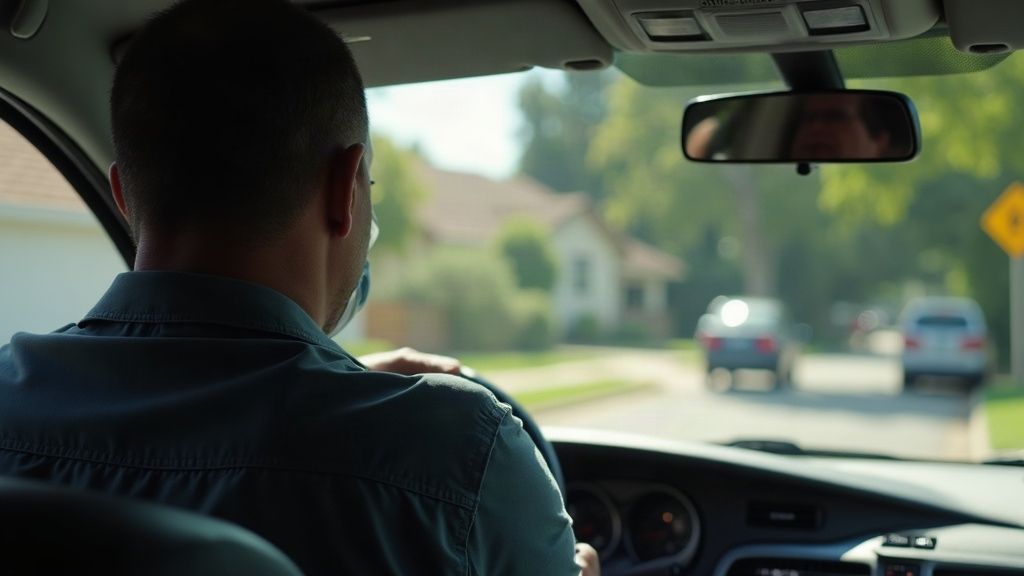
If you've filed a workers' compensation or personal injury claim in California, there is a real chance the insurance company has already hired someone to watch you. It sounds extreme. It is also completely legal, and it happens far more often than most injured workers realize.
Insurance carriers pay private investigators to gather video evidence they can use to challenge the extent of your injuries. A single clip of you carrying groceries, walking without a limp, or swinging a golf club can be presented to the WCAB or a civil jury to suggest your injuries are not as serious as you reported.
Knowing the signs of surveillance protects you from being blindsided. Below are nine things to watch for, what each one means legally, and what to do about it.
Quick summary: the 9 signs at a glance
- Insurers use surveillance legally and frequently on California injury claimants.
- Unfamiliar vehicles parked near your home on multiple days are a red flag.
- Sudden unknown social media followers or friend requests are a digital surveillance tactic.
- Unusually specific questions from your adjuster about a particular day signal existing footage.
- Investigators follow claimants to medical appointments and physical therapy.
- Surveillance video can reduce your disability rating or end your claim.
- You can do anything your doctor has cleared, consistently, in public.
- Set social media to private and report your limitations accurately to your doctor.
- Tell your attorney the moment you suspect surveillance so they can use discovery.
1. Why Insurance Companies Use Surveillance on Injury Claimants
California insurance companies are legally allowed to hire private investigators to film injured claimants in public places, and that footage can be used to dispute your claim.
Insurance carriers are businesses. Every dollar they pay on a claim is a dollar they did not keep. When a claim involves significant benefits, including temporary disability, permanent disability, or a large personal injury settlement, the carrier's financial incentive to challenge that claim is substantial.
Surveillance is one of their primary tools. Private investigators are hired to document claimants performing activities that appear inconsistent with reported limitations. The legal basis is straightforward: California law gives anyone the right to observe and record activities that occur in a public place. There is no legal expectation of privacy on a public sidewalk, in a parking lot, at a shopping center, or even in the front yard of your home.
Under Cal. Lab. Code §5402, a workers' compensation claim is presumed compensable if the insurer does not accept or deny it within 90 days. Surveillance is most aggressive in the window before that deadline and in the period leading up to a deposition or trial. The goal is not just to deny the claim outright; it is to reduce your permanent disability rating, challenge your treating physician's restrictions, and lower the settlement value.
Takeaway: Surveillance is legal, it is common, and it is aimed directly at reducing what you receive.
2. Unusual Cars or People Appearing Near Your Home Repeatedly
A vehicle parked near your home on multiple days, often with someone sitting inside, is one of the clearest signs that a private investigator is watching you during your California injury claim.
Private investigators conducting physical surveillance need to be close enough to film you. That usually means a vehicle parked on a public street with a clear line of sight to your front door, driveway, or yard.
Watch for vehicles that are new to your block and appear on more than one day. Investigators rotate vehicles and sometimes work in pairs to avoid detection, but certain patterns are hard to hide: a van or SUV with slightly tinted windows, a car with a person who does not get out for extended periods, or a vehicle that pulls away shortly after you leave.
Investigators are permitted to be on public streets. They cannot enter your private property, peer through your windows using special equipment from a private vantage point, or follow you in a manner that constitutes harassment under California law.
Takeaway: Trust your instincts. If you notice an unfamiliar vehicle outside your home on multiple occasions, note the date, time, make, color, and license plate, then contact your attorney.
3. Sudden Friend Requests or New Followers on Social Media
Social media posts are treated as public evidence in California injury cases, even on accounts set to private, because investigators can access them through fake profiles or mutual connections.
Digital surveillance is now standard in California injury claims. Investigators search for your name on every major platform, including Facebook, Instagram, TikTok, YouTube, and LinkedIn. They are looking for photos, videos, and posts that show you doing something physically active that contradicts your reported limitations.
A spike in unknown friend requests or follow requests from people you do not recognize is a recognized tactic. Investigators create or borrow profiles that appear legitimate, accept the request, and then download everything on your account. Courts in California have allowed social media content to be admitted as evidence in both workers' comp proceedings before the WCAB and civil personal injury trials.
Even posts by friends and family that tag you or name you can surface in litigation. A tagged photo of you at a birthday party, a comment from a relative about a trip you took, or a check-in at a hiking trail can all create problems.
Takeaway: Set every social media account to private immediately after filing a claim, decline unknown requests, and ask close friends and family not to tag you in anything physical.
4. Questions from Your Insurer That Reference Your Daily Activities
If your insurance adjuster suddenly asks very specific questions about where you went on a particular day, it is a strong indicator that surveillance footage of that day already exists.
Insurance adjusters follow a script during routine calls. When the questions shift from standard claim-processing language to very specific inquiries about a particular Tuesday afternoon, a specific shopping center, or a particular physical task you performed on a given date, that specificity is not coincidental.
Adjusters ask these targeted questions for one reason: to get your recorded statement to match or contradict footage they already have. If you say you cannot lift anything above your shoulder and the investigator filmed you loading boxes into a truck on October 14th, a recorded statement from you taken after that date becomes a comparison exhibit.
You are not legally required to give a recorded statement to a workers' compensation insurance carrier in California. Under Cal. Lab. Code §4600, you have rights regarding medical treatment and communication with the carrier, but routine recorded statements are voluntary. Your attorney should be present for, or should advise you on, any recorded statement.
Takeaway: If an adjuster's questions suddenly become very specific about dates and activities, stop the conversation, tell them you will call them back, and contact your attorney before saying anything further.
5. Private Investigators at Medical Appointments or Physical Therapy
Investigators do not only sit outside your home. They follow claimants to medical appointments, physical therapy sessions, pharmacies, and specialist offices. These locations are especially valuable to the insurance company because they allow investigators to document how you move immediately before you enter the office and immediately after you leave, comparing that behavior to what you report to the doctor inside.
A common tactic is to film a claimant walking quickly through a parking lot to get to an appointment, then present that footage as evidence the claimant has more functional capacity than the treating physician documented. A treating physician under Cal. Lab. Code §4600 evaluates you during the appointment itself; the investigator captures the moments the doctor never sees.
Investigators can legally be present in any public area, including parking lots, sidewalks adjacent to medical buildings, and waiting areas that are accessible to the public. They cannot follow you into private examination rooms or record conversations protected under California privacy law.
Takeaway: Walk and move consistently in parking lots and public areas the same way you move at home. Do not push through pain or rush because you are running late.
6. How Surveillance Footage Can Be Used Against You
Surveillance video is evidence. In a California workers' compensation case, it can be submitted to the WCAB at a formal hearing. In a personal injury case, it can be shown to a jury. In both contexts, the goal is to challenge the credibility of your reported limitations.
The most damaging scenarios involve footage of an activity specifically restricted by your treating physician. If your doctor's work restrictions state no lifting over ten pounds and an investigator films you carrying a child, moving furniture, or swinging a hammer, that footage creates a direct contradiction. A workers' compensation judge evaluating your permanent disability rating can weigh that footage against the medical reports from your doctor and a QME (qualified medical evaluator), and the footage often wins.
Even footage that does not show an outright violation can reduce the value of your case. Video of you walking at a normal pace or appearing comfortable in a parking lot, without visible pain behavior, is framed by defense attorneys as evidence that your functional limitations are exaggerated, even when pain is real and internal.
Critically, the insurer does not have to show you the footage before using it in depositions or hearings unless your attorney requests it through the formal discovery process. Under the California Code of Civil Procedure, your attorney can compel production of all surveillance evidence before trial.
Takeaway: Ask your attorney to send a discovery demand for all surveillance material as early as possible in your case so there are no surprises at deposition or trial.
7. What Activities Are Safe to Do During an Open Claim
A common fear among injured workers is that they cannot do anything while their claim is open without it being used against them. That fear is understandable but inaccurate, and living in complete restriction when your physician has not ordered it creates its own problems.
The rule is straightforward: do what your treating physician has actually cleared you to do, do it consistently, and do not push through significant pain to appear capable in public. If your doctor says you may walk for up to twenty minutes at a flat pace, you may walk for up to twenty minutes at a flat pace, every day if you choose. If your restrictions allow light household tasks, you may perform light household tasks.
What gets claimants into trouble is the gap between what they tell the doctor and what they do in public. If you report to your treating physician that you cannot stand for more than five minutes but an investigator films you standing at a farmers market for forty minutes, that gap is a credibility problem, not a legal technicality.
The DWC and WCAB evaluate your functional capacity based on the totality of medical and factual evidence. Living within your actual medical restrictions, and reporting your actual symptoms honestly to your doctor, is both legally correct and medically appropriate.
Takeaway: Follow your physician's actual instructions, report your real symptoms honestly, and do not perform activities outside your medical restrictions regardless of whether you think anyone is watching.
8. How to Protect Yourself Without Changing Your Life
Protecting yourself during a surveillance investigation does not mean becoming a shut-in. It means being consistent, honest, and deliberate about your digital footprint.
Be consistent with your medical restrictions. Your behavior in public should match what you tell your doctor. If you have a bad day and push through pain to carry something heavy, that moment on film is the only moment the jury sees.
Set social media to private immediately. Every platform should be set to the most restrictive privacy setting available. Remove location data from photos you have already posted. Do not post anything physical, anything that shows travel, or anything that could be interpreted as inconsistent with your injury.
Do not discuss your claim online. Posts in public forums, Facebook groups, or community pages about your injury, your case, your attorney, or your limitations can all surface in litigation.
Inform your treating doctor of all your symptoms. Incomplete symptom reporting is one of the most common ways surveillance damages claims. If you tell your doctor your pain is a four out of ten on a good day but your doctor only records that number, video of you on a good day looks like a full contradiction of your injury.
Report suspected surveillance to your attorney. Under the California Code of Civil Procedure, your attorney can serve a demand on the insurance carrier for all surveillance evidence gathered to date. Getting that demand out early preserves your ability to review the footage before it is used against you in a deposition. For questions about your specific claim, call your attorney at (818) 794-9947.
Takeaway: Honesty with your doctor, privacy on social media, and early communication with your attorney are the three actions that protect your claim most effectively.
9. When to Tell Your Attorney About Suspected Surveillance
Telling your attorney about suspected surveillance as soon as possible allows them to request all footage through the discovery process under the California Code of Civil Procedure before it is used against you at trial.
The short answer is: tell your attorney immediately. Not after the next appointment. Not after you confirm your suspicion. The moment you notice something that feels like surveillance, make the call.
Here is why timing matters. Insurance carriers are not required to proactively disclose surveillance footage to you or your attorney. They can hold it until a deposition or hearing and then deploy it in a way that maximizes its impact on your credibility. Once your attorney sends a formal discovery demand, the carrier must produce all surveillance footage and reports gathered to that point. Any footage gathered after the demand is served is still discoverable, but the early demand prevents a large, pre-deposition ambush.
Your attorney can also evaluate what the footage actually shows in the context of your medical records. Footage that looks damaging in isolation may be entirely consistent with your physician's documented restrictions when placed next to the medical record. An experienced workers' compensation attorney knows how to frame that comparison in front of a WCAB judge. You can review your workers' compensation options and get a case evaluation at no cost by calling (818) 794-9947.
Additionally, if you believe the surveillance crossed a legal line, such as a photographer entering private property, recording through a residential window, or engaging in conduct that rises to the level of harassment under California Penal Code §647, your attorney can evaluate a separate legal response.
Takeaway: Call your attorney the same day you suspect surveillance. Early discovery demands force the insurer to produce footage before depositions, removing the element of surprise.
Frequently Asked Questions
Can insurance companies legally have you followed in California?
Yes. Insurance companies can legally hire private investigators to follow and film claimants in California in any public location, including streets, parking lots, shopping centers, and parks. There is no legal expectation of privacy in a public place under California law. Investigators cannot enter private property, record inside your home through windows, or engage in conduct that constitutes criminal stalking or harassment.
What can insurance investigators film during a claim?
Investigators can film anything that occurs in a public space. That includes how you walk to and from your car, how you carry items at a store, how you move at a medical appointment, and any physical activity you perform outdoors. They can also capture and preserve your social media posts. They cannot record private conversations, enter private property, or access accounts without authorization.
Does surveillance mean my claim is being denied?
Not necessarily. Surveillance means the insurance company is looking for evidence to dispute the extent of your injuries. [SPEAKABLE] Surveillance does not automatically mean your claim will be denied; it means the insurance company is actively looking for evidence to reduce the value of your case. Many claims that are surveilled still result in a recovery for the injured worker, particularly when the claimant is behaving consistently with their medical restrictions.
How do I protect my privacy during an injury claim?
Set all social media accounts to the most restrictive privacy settings, decline unknown connection requests, and ask family and friends not to tag you in photos or posts. Move consistently with your actual medical restrictions at all times in public. Report any suspected surveillance to your attorney so a discovery demand can be served immediately.
Can surveillance footage be excluded from my case?
In limited circumstances, yes. If the footage was obtained illegally, such as by trespassing on private property or through unauthorized access to a private account, your attorney can move to exclude it. Footage obtained legally in public spaces is generally admissible. Your attorney can also challenge the context, argue the footage is incomplete, or present medical evidence that explains the activity shown.
What happens if the surveillance footage shows me doing something my doctor restricted?
This is a serious evidentiary problem. It can be used to impeach your credibility at a WCAB hearing or trial, reduce your permanent disability rating, or support a carrier's argument that your reported limitations are overstated. The best response is to discuss the footage with your attorney immediately so they can evaluate how to contextualize it against your full medical record.
Does the insurance company have to tell me they are investigating me?
No. Insurance carriers in California are not required to disclose that a surveillance investigation is underway. However, once your attorney serves a discovery demand, the carrier must produce all surveillance materials gathered to that point. Under the California Code of Civil Procedure, this production is mandatory and must occur within the statutory response period.
If you have noticed any of the signs described in this article, or if you simply want to understand your rights during a California workers' compensation or personal injury claim, call (818) 794-9947 for a free consultation. No fee unless we win.
Reviewed by Minas Nordanyan, CA Bar #296806. Last updated 2026.