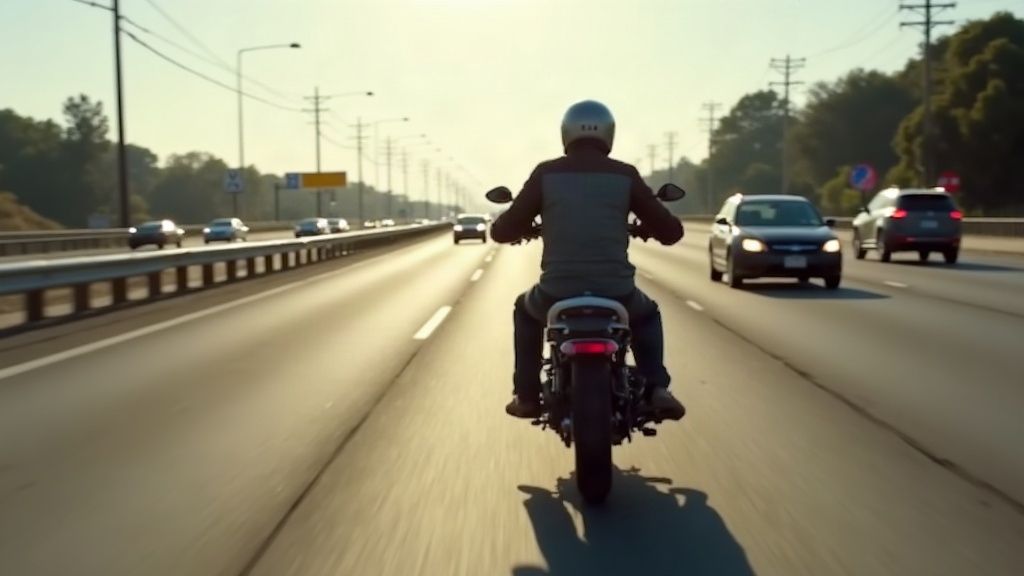
If you ride a motorcycle in California and have been involved in a lane-splitting crash, you are likely dealing with an insurer that assumes you were the problem. That assumption is wrong as a matter of law, and it is beatable with the right evidence and the right legal strategy.
California is unique. The state formally permits lane splitting by statute, and a rider who was splitting lanes lawfully when a crash occurred has a real claim, even against a car that changed lanes without warning. But these cases have specific rules, and the details matter far more than most riders realize.
Here is what you need to know before you give a statement, sign a release, or accept a settlement offer.
Quick summary: the 9 things that determine your lane-splitting claim
- California is one of the few states that formally allows lane splitting by statute.
- Legal lane splitting does not automatically mean the rider is at fault.
- Speed differential between your motorcycle and traffic is the key factual dispute.
- Insurers start with a default assumption that the rider caused the crash.
- Dashcam and helmet-cam footage is often the strongest available evidence.
- Witness statements carry unusual weight in these cases.
- CHP safety guidelines function as a practical standard of care in disputes.
- Comparative fault can reduce your recovery even when the car driver was also wrong.
- Road conditions and lane width are part of the reasonableness analysis.
1. California Is One of the Few States That Formally Allows Lane Splitting
California Vehicle Code §21658.1, which took effect January 1, 2017, made California the first U.S. state to formally legalize lane splitting by statute. Before that law passed, lane splitting occupied a legal gray area, tolerated but not codified. Today it is expressly permitted, and the California Highway Patrol (CHP) is directed to develop educational guidelines on safe lane-splitting practices.
Most other states either prohibit lane splitting outright or treat it as a gray-area violation. California's legal status is the foundation of every lane-splitting claim here, because it means the baseline conduct, riding between lanes of slower or stopped traffic, is not negligent per se.
Practical takeaway: The fact that you were splitting lanes is not, by itself, evidence that you did something wrong. That is the starting point for your claim.
2. Legal Lane Splitting Doesn't Automatically Mean the Rider Is at Fault
Permitted conduct is not automatically reasonable conduct, and reasonable conduct is what fault analysis actually measures. But the leap from "you were lane splitting" to "you caused the crash" is one that California law does not permit without more.
California follows a pure comparative fault rule established by the California Supreme Court in Li v. Yellow Cab Co. (1975) 13 Cal.3d 804. Under that doctrine, a jury or adjuster evaluates the specific conduct of each party, not the category of activity each was engaged in. A car driver who drifted into a motorcycle's path without signaling can be assigned the majority of fault even if the motorcycle was between lanes at the time.
A motorcycle rider who was lane splitting at the time of a crash is not automatically at fault under California law.
Practical takeaway: Your claim does not fail because you were splitting lanes. It rises or falls on whether your specific speed, lane choice, and reaction were reasonable under the conditions that existed at that moment.
3. Speed Differential Between the Motorcycle and Traffic Often Matters Most
When insurers and attorneys evaluate a lane-splitting claim, the first factual question is almost always about speed: how fast was the motorcycle moving relative to surrounding traffic?
The CHP's lane-splitting safety guidelines, issued under the authority of Vehicle Code §21658.1, identify a large speed differential as the primary risk factor in lane-splitting collisions. The guidelines specifically flag riding more than 10 mph faster than surrounding traffic as a significant safety concern. Courts and adjusters treat that threshold as a practical benchmark when assessing whether a rider's conduct was reasonable.
The California Highway Patrol's lane-splitting safety guidance treats a speed differential of more than 10 mph above surrounding traffic as a significant risk factor that adjusters and courts use as a benchmark.
If you were traveling 40 mph in traffic moving at 35 mph, that differential is well within the guidelines. If you were traveling 65 mph in traffic moving at 30 mph, your claim becomes substantially harder to win, and an insurer will use that gap to argue you were primarily responsible for what happened.
Practical takeaway: Know what the traffic was doing and what your speed was before you speak with anyone. Your own account of the speed differential will shape every conversation that follows.
4. Insurers Frequently Assume the Motorcyclist Caused the Crash by Default
California legalized lane splitting under Vehicle Code §21658.1, effective January 1, 2017, making it the first U.S. state to formally permit the practice by statute.
Despite that legal foundation, insurance adjusters routinely open lane-splitting claims with the working assumption that the rider was at fault. This reflects a broader pattern in motorcycle claims, where bias against riders is documented and well-known in personal injury litigation.
The danger for riders is the recorded statement. An adjuster may call you within hours of a crash, while you are still in pain, still processing what happened, and before you have gathered any evidence. Anything you say about your speed, your lane position, or your reaction time can be used to support the default assumption.
California does not require you to give a recorded statement to the opposing party's insurer. You are required to cooperate with your own insurer under most standard policy terms, but that is a different obligation with different rules.
Practical takeaway: Do not give a recorded statement to the other driver's insurer without first speaking with an attorney. A single phrase about your speed can permanently damage an otherwise strong claim. Call (818) 794-9947 for a free case review before that call happens.
5. Dashcam and Helmet-Cam Footage Can Be Critical Evidence
In a typical rear-end collision, the physics of the impact often tell most of the story. In a lane-splitting collision, the critical question is almost always about what happened in the two to three seconds before impact, and that is almost never captured by physical evidence alone.
Video changes that calculus entirely. A helmet-mounted camera that recorded the car drifting left without a turn signal, a dashcam mounted in the car behind you that captured the sequence of events, or even a security camera from a business on the overpass can provide direct, timeline-stamped proof of who moved first and how fast each vehicle was traveling.
Helmet-cam and dashcam footage captured in the seconds before impact is often the most powerful evidence in a lane-splitting insurance dispute.
Footage must be preserved immediately. Video stored on a device may be overwritten in as little as 24 to 48 hours. An attorney can send a preservation letter to third-party sources, such as businesses with exterior cameras or fleet vehicles with dashcams, to prevent that data from being destroyed before litigation.
Practical takeaway: Pull your helmet-cam footage off the device today. Identify every vehicle near the crash site that might have had a dashcam. That footage is often the difference between the insurer's version of events and yours.
6. Witness Statements Matter More in Lane-Splitting Cases Than Typical Crashes
In a standard rear-end collision, the damage pattern on the vehicles and the point of impact usually tell a clear story. In a lane-splitting collision, the most contested facts, including which vehicle moved first and how much warning the rider had, are almost never preserved in physical evidence.
That gap is filled by witnesses. A driver in the adjacent lane, a passenger in the car that struck you, or a pedestrian on the overpass who watched the crash unfold can provide a first-hand account of whether the car made a sudden lane change without signaling, which is a violation of California Vehicle Code §22107.
Vehicle Code §22107 prohibits any lane change that is not made safely and without adequate signal. When a witness confirms the car moved without warning, that testimony directly supports a finding that the driver, not the rider, initiated the sequence that caused the crash.
Practical takeaway: Get witness contact information at the scene if you are physically able. If you cannot, ask anyone present to stay until law enforcement arrives. Your attorney can follow up with witnesses before their memories fade.
7. CHP Guidelines on Safe Lane Splitting Can Support or Hurt a Claim
Vehicle Code §21658.1 authorized the CHP to develop educational guidelines on safe lane splitting. Those guidelines do not carry the force of law in the same way that a statute does, but courts and adjusters treat them as evidence of what a reasonable, safety-conscious motorcyclist would do under ordinary conditions.
The guidelines identify several behaviors that increase crash risk: traveling at speeds above 30 mph when traffic is stopped, exceeding a 10-mph differential over surrounding traffic, lane splitting near on-ramps and off-ramps where traffic merges unpredictably, and splitting lanes on curves where sightlines are limited.
If you were following those guidelines at the time of the crash, your attorney can point to that compliance as affirmative evidence that your conduct was reasonable. If you were not following them, the defense will use the deviation as its primary argument that you were at fault.
Practical takeaway: Be honest with your attorney about your speed and conditions. The guidelines are already in the record, and the defense will compare your account against them. Surprises at that stage are far more damaging than an early, accurate assessment.
8. Comparative Fault Can Still Apply Even If a Car Changed Lanes Unsafely
Even when a car driver violated Vehicle Code §22107 by changing lanes without a safe gap, a motorcyclist can still be assigned partial fault if the rider's speed or position contributed to the collision.
California's pure comparative fault rule, established in Li v. Yellow Cab Co. (1975) 13 Cal.3d 804, means a jury can assign fault percentages to every party whose conduct contributed to the crash. If the car driver is found 80 percent at fault and the motorcyclist 20 percent at fault, the rider's damages are reduced by 20 percent, but the rider still recovers the remaining 80 percent.
This is actually one of the most rider-friendly aspects of California law. States that use contributory negligence bar recovery entirely if the plaintiff is even 1 percent at fault. California does not do that. A motorcyclist who was partially responsible for the crash, because of speed, lane choice, or reaction time, still has a real claim.
What this means practically is that your attorney's job is not to prove you were blameless. It is to argue that the other party's fault percentage is as high as the evidence supports, and to push back on any attempt to inflate your share beyond what the facts justify.
Practical takeaway: Do not assume a partial-fault analysis kills your claim. Under California's comparative fault system, a rider who is found 30 percent at fault still recovers 70 percent of their damages. The goal is minimizing your assigned percentage, not eliminating it entirely.
9. Documenting Road Conditions and Lane Width Helps Establish Reasonableness
The CHP guidelines and the courts both treat lane splitting as a context-specific activity. The same speed and lane position that is clearly reasonable on a wide, straight freeway with slow-moving traffic may be unreasonable on a narrow, winding surface street. Road conditions, lane dimensions, traffic density, lighting, and pavement quality all factor into whether a rider's choices were objectively reasonable.
This documentation is perishable. Lane markings fade, potholes get filled, and construction configurations change. A rider or attorney who returns to the scene within days of the crash can photograph lane widths, sight-line obstructions, surface conditions, and posted speed limits. In some cases, a traffic engineer can provide an expert opinion on whether the lane configuration made the rider's speed reasonable under the conditions at the time.
Practical takeaway: Return to the scene as soon as you are physically able, or send someone on your behalf. Photograph the lane widths, the road surface, and any sight-line obstructions. Those photographs become part of the "reasonableness" argument the attorney builds around your speed and position.
How a Lane-Splitting Injury Claim Works With a Workers' Compensation Claim
One scenario that California riders frequently overlook: if you were lane splitting while on the job, such as a delivery rider, a courier, a sales representative, or any other worker who uses a motorcycle for work duties, you may have both a workers' compensation claim and a third-party personal injury claim against the car driver.
The workers' comp claim covers your medical bills and a portion of your lost wages regardless of fault, under Cal. Lab. Code §3600. The third-party personal injury claim against the negligent driver can recover damages that workers' comp does not cover, including pain and suffering and full lost earning capacity. Pursuing both is permitted under California law, though the employer or insurer may have a lien against the third-party recovery for benefits already paid.
These dual-claim situations are among the most complex cases in California injury law. Getting both claims right from the start, rather than pursuing one and inadvertently undermining the other, requires a firm that handles both practice areas.
We've recovered over $150,000,000 for injured clients across California. If you or someone you know was hurt in a lane-splitting crash, call (818) 794-9947 for a free case review. No fee unless we win.
Frequently Asked Questions
Is lane splitting legal in California?
Yes. California Vehicle Code §21658.1, which took effect January 1, 2017, formally legalized lane splitting, making California the first U.S. state to permit the practice by statute. The law also directed the California Highway Patrol to develop educational guidelines on how to do it safely.
Who is at fault in a lane-splitting motorcycle accident?
Fault is determined by each party's specific conduct, not by the fact that a motorcycle was between lanes. Under California's pure comparative fault rule from Li v. Yellow Cab Co. (1975) 13 Cal.3d 804, a jury evaluates the speed, lane position, signaling, and reaction time of both the rider and the driver and assigns a percentage of fault to each. Either party, or both, can be found at fault depending on the evidence.
Does lane splitting automatically make a motorcyclist liable?
No. Because lane splitting is a lawful activity under Vehicle Code §21658.1, the act of splitting lanes is not evidence of negligence on its own. Liability is based on whether the rider's specific speed and conduct were reasonable under the conditions, not on the fact that the rider was between lanes.
How is speed a factor in lane-splitting accident claims?
Speed is typically the central factual dispute. The CHP's lane-splitting safety guidelines flag a differential of more than 10 mph above surrounding traffic as a significant risk factor. Insurance adjusters and courts treat that threshold as a benchmark when evaluating whether a rider's conduct was reasonable. A rider within that differential has a much stronger argument for reasonableness than a rider who was traveling far faster than surrounding traffic.
What evidence is most useful in a lane-splitting accident claim?
The three most useful categories of evidence are: video footage from a helmet cam, dashcam, or nearby security camera that captured the crash sequence; independent witness statements describing which vehicle moved first; and photographs of lane width, road surface, and sight-line conditions taken at the scene shortly after the crash. Physical damage patterns alone rarely resolve the key factual disputes in lane-splitting cases.
Can I recover compensation if I was partially at fault for a lane-splitting crash?
Yes. California's pure comparative fault system, established in Li v. Yellow Cab Co. (1975), reduces your recovery by your assigned percentage of fault but does not bar it. A rider found 25 percent at fault still recovers 75 percent of proven damages. The goal of legal representation is to minimize your assigned fault percentage and maximize the recovery on the remaining portion.
Should I give a recorded statement to the other driver's insurer after a lane-splitting crash?
No. You are not required to give a recorded statement to the opposing party's insurer. Adjusters ask for recorded statements early in the process because admissions about speed, lane position, or reaction time are difficult to walk back later. Speak with an attorney before giving any statement. Call (818) 794-9947 for a free consultation before that call happens.
Reviewed by Minas Nordanyan, CA Bar #296806. This article is provided for general informational purposes only and does not constitute legal advice. For advice specific to your situation, contact Nordanyan Law at (818) 794-9947.