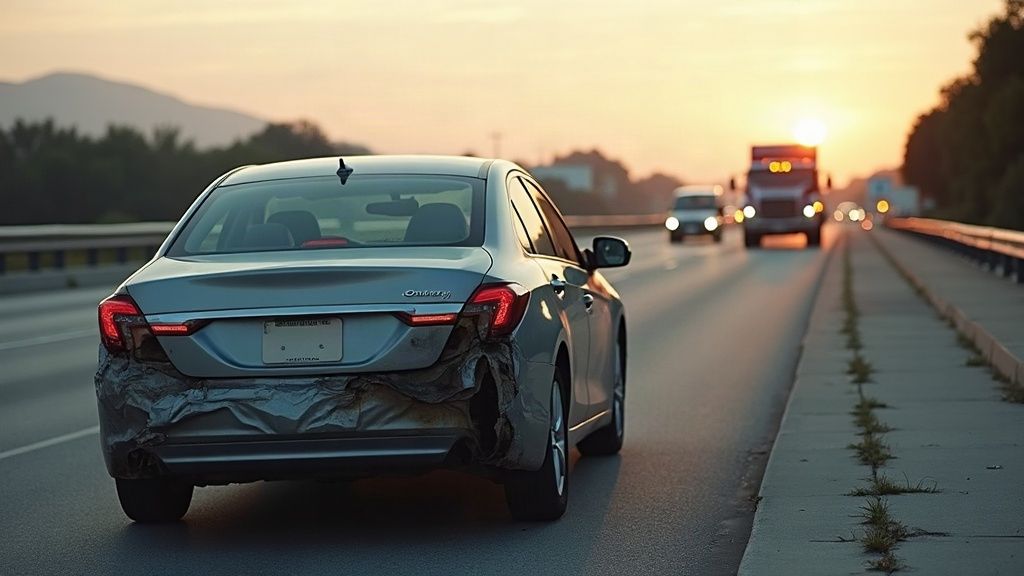
If you were injured in a leased vehicle accident in California, you are dealing with a situation that is more legally layered than a crash in a car you own outright. There is the leasing company's title interest, specific insurance requirements written into your lease, a potential gap between the insurance payout and what you still owe, and, depending on how the accident happened, possibly a workers' compensation claim running alongside your personal injury case.
The nine questions below cover the mechanics that matter most. Each one gives you a self-contained answer you can use today, whether you are still at the scene or sitting across from an insurance adjuster three weeks later.
Quick-scan summary:
- The leasing company holds title and must be notified quickly after a crash.
- Lease agreements typically require liability limits above California's current statutory minimums.
- California's vicarious-liability statute applies to vehicle owners, but the federal Graves Amendment limits leasing company exposure.
- A totaled leased car means the insurance check goes to the lessor, not to you.
- Early termination fees and remaining lease payments may need to be covered by a settlement.
- GAP coverage closes the gap between the payout and your remaining balance.
- Common disputes involve who gets the check and whether the lessee still owes money after the payout.
- Missing the lease's notice deadline can breach the contract and hurt your claim.
- A leased-vehicle crash may involve a personal injury claim, a property dispute, and a workers' comp claim simultaneously.
1. Who Technically Owns a Leased Car and Why That Matters After a Crash
The leasing company, not the driver, holds legal title to a leased vehicle for the entire lease term, which means the lessor is named in your insurance requirements and may be a party to your accident claim.
When you lease a car, you are paying for the right to use it. The leasing company (called the lessor) owns the vehicle throughout the lease, which is why every lease agreement names the lessor as a loss payee on your insurance policy. After a crash, that ownership relationship controls three things:
- Where the insurance settlement check goes (to the lessor, as lienholder).
- Who must be notified and by when.
- Which parties a personal injury attorney will name when investigating liability.
Practical takeaway: Pull your lease agreement out of your glove box or log into your lessor's portal. The first page identifies the lessor's legal entity name and the notice requirements you must meet after an accident.
2. How the Leasing Company's Insurance Requirements Affect Your Claim
California's current minimum auto liability limits, effective January 1, 2025, are $30,000 per person and $60,000 per accident for bodily injury, plus $15,000 for property damage.
California raised its mandatory minimum auto liability limits effective January 1, 2025, under SB 1107, amending California Vehicle Code Section 16056. The new floor is $30,000 per person and $60,000 per accident for bodily injury liability, plus $15,000 for property damage (commonly written as 30/60/15).
Leasing companies routinely require limits higher than the statutory floor. A typical lease agreement specifies $100,000 per person and $300,000 per accident for bodily injury, plus $50,000 or more in property damage coverage. The lessor is named as an additional insured or loss payee on your collision and comprehensive coverage, ensuring their ownership interest is protected.
If your policy lapsed or carried limits below what the lease required at the time of the accident, the leasing company may have claims against you beyond the collision damage itself, and your ability to negotiate a clean release on the vehicle is compromised.
Practical takeaway: Confirm that your current policy meets both California's 30/60/15 statutory floor and whatever higher limits your specific lease requires. If they do not match, call your insurer before the next renewal date.
3. Liability Differences Between Leased and Owned Vehicles in California
The key statute here is California Vehicle Code Section 17150, which imposes vicarious liability on the owner of a vehicle for injuries caused by anyone driving it with the owner's permission. Because the lessor holds title, that statute has historically applied to leasing companies.
However, federal law significantly limits that exposure. The Graves Amendment (49 U.S.C. Section 30106), enacted in 2005, preempts state vicarious-liability laws as applied to commercial vehicle lessors. Under the Graves Amendment, a leasing company cannot be held vicariously liable for a lessee's negligent driving, as long as the leasing company was not itself independently negligent, for example by leasing a vehicle it knew had a safety defect.
The federal Graves Amendment generally protects commercial leasing companies from being held vicariously liable for a lessee's driving, as long as the leasing company itself was not negligent.
What this means in practice: if you were injured by a driver in a leased car, your claim runs primarily against that driver, not against the leasing company, unless you can show the lessor was independently at fault. Your attorney will investigate whether an independent negligence theory, such as a known mechanical defect the lessor failed to address, is viable.
Practical takeaway: Do not assume the leasing company is an automatic defendant. The Graves Amendment makes that path narrow. The at-fault driver and their insurer remain your primary targets.
4. What Happens If the Leased Car Is Declared a Total Loss
When a leased car is totaled, the insurance payout goes to the leasing company as the lienholder, not to the person who was driving it, and you may still owe money on the lease after that payment.
A leased vehicle is declared a total loss when the cost to repair it exceeds its actual cash value (ACV), a threshold California insurers typically apply around 70-80% of ACV depending on the carrier's formula. Once a total loss determination is made:
- The at-fault driver's property damage liability coverage, or your own collision coverage, pays ACV to the leasing company as the titled owner and lienholder.
- The leasing company applies that payout against the remaining lease obligation.
- If the ACV payout is less than what you still owe on the lease, you are responsible for the difference.
Under California Insurance Code Section 1871.1 and related DIR regulations, insurers must provide a written total loss valuation, and you have the right to dispute the ACV calculation with supporting market comparables.
Practical takeaway: Request the insurer's written total loss valuation in writing. If you believe the ACV is understated, gather comparable vehicle listings from your market area and formally dispute the number before the check is issued.
5. Early Termination Fees and How a Settlement May Need to Cover Them
A total loss declaration does not simply end the lease with a handshake. Most lease agreements define a total loss as an "early termination event," which triggers a specific early termination calculation that may include:
- All remaining monthly lease payments through the scheduled end of the lease.
- A disposition fee or early termination fee stated in the lease.
- Excess mileage charges already accrued at the time of the accident.
- Any applicable taxes or registration amounts still outstanding.
These amounts are separate from your personal injury damages. A bodily injury settlement compensates you for your medical expenses, lost income, and pain and suffering. It does not automatically cover your remaining lease obligation unless your attorney specifically structures the demand to include those documented economic losses.
Under California personal injury law, documented economic losses are recoverable as special damages. If the accident was caused by another party's negligence, those lease-related costs are legitimate components of your total damages claim.
Practical takeaway: Request a written early termination payoff statement from your leasing company immediately after a total loss determination. Give that document to your attorney so it is included in the demand calculation, not discovered after a settlement is already signed.
6. Notifying the Leasing Company After a Crash
If you were driving a leased vehicle for work when the accident happened, you may have both a personal injury claim against the at-fault driver and a workers' compensation claim under California Labor Code Section 3600.
Most lease agreements require the lessee to provide prompt written notice to the lessor after any accident, regardless of fault or severity. That window is typically 24 to 72 hours, though some agreements require notice "as soon as practicable." Failing to provide timely notice can:
- Constitute a breach of the lease contract.
- Give the leasing company grounds to pursue collection of damages directly against you rather than through insurance.
- Complicate your insurer's subrogation rights if the leasing company later claims it was not informed in time to protect its interest.
Notice requirements are distinct from the obligation to report the accident to the DMV and law enforcement. California law requires a written report to the DMV within 10 days if the accident caused injury, death, or property damage over $1,000 (California Vehicle Code Section 16000). Both requirements must be met independently.
Practical takeaway: Read the "Accident Notification" section of your lease agreement tonight. Send the required notice in writing (email to the lessor's documented contact is usually sufficient) and keep a timestamped copy.
7. How GAP-Style Coverage Often Ties Into Leased Vehicle Accidents
GAP, which stands for Guaranteed Asset Protection, is a product designed specifically to address the situation described in item four: the gap between an insurer's ACV payout and the remaining lease or loan balance on a vehicle.
On a leased vehicle, depreciation and lease structuring often mean the ACV of the car at any point during the lease is lower than the sum of remaining payments and termination fees still owed. GAP coverage pays that difference so the lessee does not owe money on a vehicle they can no longer drive.
GAP coverage for leased vehicles can come from three sources:
- Built into the lease by the manufacturer's captive finance company. Many factory-affiliated lessors include GAP protection as a standard lease feature. Check your lease documents for language about "GAP waiver" or "GAP protection."
- Added as an endorsement to your auto insurance policy. Some California auto insurers offer GAP endorsements for lessees.
- Purchased separately from the dealership at signing. This is sometimes sold as a standalone product for an additional monthly fee.
GAP coverage does not typically cover items like past-due payments, mileage penalties already charged, or the deductible on your primary auto policy. Read the GAP agreement carefully to understand exactly what is and is not waived.
Practical takeaway: Locate your GAP coverage documentation now, before you receive the ACV payout. The GAP claim must usually be filed within a specific window after the total loss determination, and missing it can mean the benefit is forfeited.
8. Common Disputes Between Lessees and Leasing Companies
After a leased-vehicle accident, the relationship between the lessee and the lessor can become adversarial quickly. The most common dispute categories are:
Who receives the settlement check. Because the leasing company is a loss payee, some insurers send the total loss check directly to the lessor. Lessees sometimes expect to receive the check personally and use it to cover the remaining balance themselves. Understanding your lease and your insurer's standard process in advance prevents this from becoming a crisis.
Diminished value claims. Even if a leased vehicle is repaired rather than totaled, it may have reduced market value due to accident history. The leasing company may assert a diminished value charge at lease end. Under California law, diminished value is a recoverable damage element in a third-party claim against an at-fault driver, but lessees sometimes do not realize they can pursue this amount.
Lease-end condition charges. If the vehicle is repaired and the lessee returns it at normal lease end, the lessor may assess charges for damage that predates or relates to the accident. Documenting the repair with photographs and repair orders is essential to defending against spurious charges.
Whether GAP fully eliminates the residual balance. As noted above, GAP coverage excludes certain charges. Lessees sometimes assume GAP is a complete wipe of all obligations and are surprised by a remaining balance bill.
Practical takeaway: Keep a complete paper trail: repair estimates, adjuster correspondence, GAP claim submissions, and all written communications with the leasing company. This documentation is your defense in any lease-end dispute.
9. When to Loop In an Attorney for a Leased-Vehicle Claim
A leased-vehicle accident is not a simple two-party claim. It typically involves at least three distinct legal and financial tracks running simultaneously:
Track 1: Your personal injury claim. If another driver caused the accident, you have a potential claim for medical expenses, lost wages, and pain and suffering against that driver and their insurer. California follows a pure comparative fault standard, and under California Civil Code Section 1431.2 each defendant is liable only for its own share of non-economic damages, so even partial fault on your part does not eliminate your right to recover. You recover in proportion to the other party's fault percentage.
Track 2: The property damage and lease-payoff dispute. As detailed above, the ACV determination, GAP claim, early termination fees, and any diminished value recovery all require separate attention. Settling your personal injury claim without addressing the lease financial obligations can leave you liable for thousands of dollars the settlement could have covered.
Track 3: A potential workers' compensation claim. If the crash occurred while you were driving the leased vehicle for work, you may have a compensable injury under California Labor Code Section 3600. California workers' compensation covers medical treatment and partial wage replacement regardless of fault. Critically, accepting a workers' comp settlement can affect your third-party personal injury claim through subrogation rights, and the reverse is also true. Both tracks need to be coordinated.
An experienced attorney evaluates all three tracks before any single claim is resolved, because settling one prematurely can compromise your rights on the others. We've recovered over $150,000,000 for injured workers and accident victims across Southern California. Every injured worker deserves the same quality of legal representation as any corporation. That is the principle this firm was built on.
Practical takeaway: If you were injured in a leased-vehicle accident, do not accept any settlement offer, on any track, before speaking with an attorney who has reviewed all three potential claims. A call costs nothing and the free consultation at (818) 794-9947 takes less time than reading the insurance company's release form.
Frequently Asked Questions
Who is liable if I crash a leased car in California?
The at-fault driver is primarily liable for injuries and property damage under California's fault-based system. If you were driving the leased vehicle and caused the crash, your liability insurance policy covers damages up to your policy limits. The leasing company generally cannot be held vicariously liable for your negligent driving under the federal Graves Amendment (49 U.S.C. Section 30106), unless the leasing company was independently negligent, for example by renting a vehicle with a known safety defect.
Do I still owe lease payments if my leased car is totaled?
Yes, until the total loss settlement is finalized and the lease is formally terminated. The insurer pays the actual cash value to the leasing company. If that payout is less than your remaining lease obligation, you owe the difference unless GAP coverage bridges it. Continue making lease payments during the gap period to avoid a default notation on your credit.
Does the leasing company get involved in my accident claim?
Yes. The leasing company is a named loss payee on your policy, so the insurer notifies them when a claim is filed involving the leased vehicle. The lessor has a financial interest in the insurance proceeds and may communicate directly with your insurer. Your lease agreement also likely requires you to notify the leasing company separately and promptly after the accident.
Is my insurance different for a leased car than an owned car?
The types of coverage required are largely the same, but a lease agreement adds requirements that a financed or owned vehicle may not impose. You must typically carry higher liability limits than California's statutory floor, and you must carry collision and comprehensive coverage naming the lessor as a loss payee. Some lessors also require rental reimbursement coverage or specific deductible caps.
What is GAP coverage and do I need it for a leased vehicle?
GAP coverage pays the difference between the insurer's actual cash value payout and the remaining lease balance if the vehicle is totaled or stolen. Many factory-affiliated lessors include a GAP waiver in the lease itself. If your lease does not include it, ask your auto insurer whether they offer a GAP endorsement, or review any standalone GAP product you purchased at signing. Without GAP, a significant depreciation gap can leave you owing thousands on a vehicle you no longer have.
Can I recover the early termination fees in an accident settlement?
Yes, if another party's negligence caused the accident. Early termination fees and remaining lease obligations are documented economic losses, recoverable as special damages in a California personal injury claim. Request a written payoff statement from your lessor and give it to your attorney so it is included in the demand.
What notice do I have to give my leasing company after a crash?
Most lease agreements require written notice within 24 to 72 hours. The specific requirement is in your lease contract. Send the notice in writing, keep a timestamped copy, and follow up in writing if the lessor does not acknowledge receipt within a day or two.
What if I was driving the leased vehicle for work when the accident happened?
A crash during work-related driving may trigger both a personal injury claim against the at-fault driver and a California workers' compensation claim under California Labor Code Section 3600. The two claims run on separate tracks but interact through subrogation rules. Do not settle either claim without coordinating both. Call (818) 794-9947 to talk through how both tracks apply to your specific facts.
How does California's comparative fault rule affect my leased-vehicle accident claim?
California follows pure comparative fault. Even if you were partially at fault for the accident, you can still recover damages from the other at-fault parties, reduced by your percentage of fault. For example, if you are found 20% at fault and your total damages are $100,000, you can recover $80,000 from the other party. This rule applies equally whether the vehicle was leased or owned.
If you were injured in a leased-vehicle accident in California, every day matters. The notice deadline in your lease, the window to dispute a total loss valuation, and the two-year statute of limitations for a personal injury claim under California Code of Civil Procedure Section 335.1 all run simultaneously. Call (818) 794-9947 for a free consultation. No fee unless we win.
Reviewed by Minas Nordanyan, CA Bar No. 296806. For informational purposes only, not legal advice for any specific case.