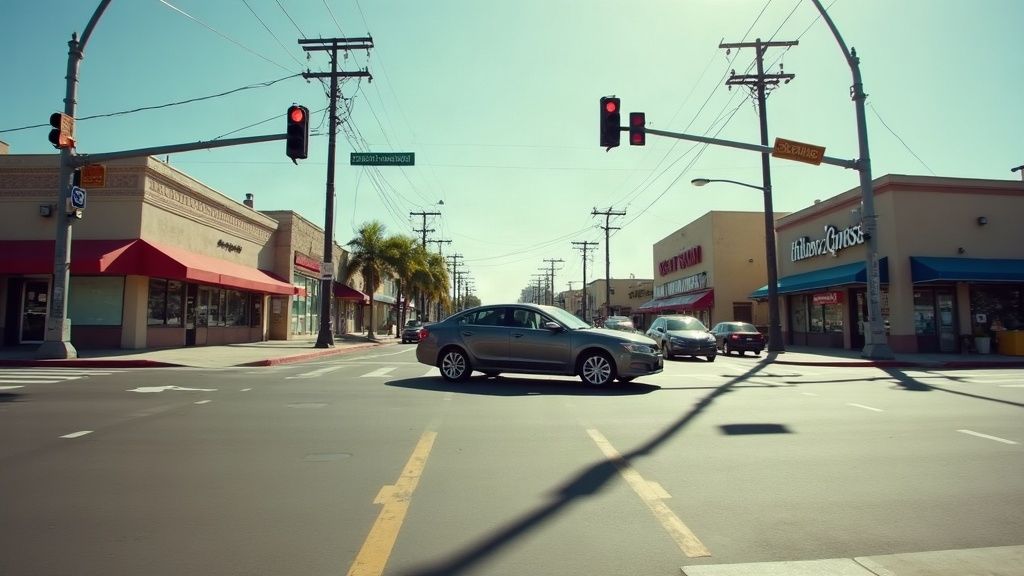
If you were hurt in a left-turn collision in California, you already know the crash was sudden and the damage was real. What you may not know is how California law decides who pays, how fault gets split, and what evidence can protect your claim.
Here are eight facts every injured driver in California should know before talking to any insurance adjuster.
Quick-reference summary:
- Left turns require crossing oncoming traffic, making them one of the riskiest intersection maneuvers.
- California law presumes the turning driver must yield under Cal. Veh. Code §21801(a).
- The oncoming driver can share fault if they were speeding, ran a red, or were impaired.
- "Unprotected" turns carry a heavier yield burden than turns made on a green arrow.
- Traffic signal type, green ball vs. green arrow, changes who legally owned the intersection.
- T-bone impacts cause some of the most severe injuries seen in car accidents.
- Physical evidence such as dashcam footage and electronic data recorder data can shift fault percentages.
- California's injury lawsuit deadline is two years from the crash date under Cal. Code Civ. Proc. §335.1.
1. Why Left Turns Are One of the Riskiest Maneuvers on the Road
Under California Vehicle Code §21801(a), a driver making a left turn must yield to all oncoming vehicles that are close enough to be a hazard.
A left turn forces a driver to cross one or more lanes of oncoming traffic while also watching for pedestrians, cyclists, and vehicles approaching from the rear. That combination of competing hazards makes the left turn one of the most demanding moves at any intersection.
Federal crash research conducted by the National Highway Traffic Safety Administration (NHTSA) has consistently identified left turns as a leading contributing maneuver in intersection collisions. Intersections already account for a large share of serious crashes in California, and left turns concentrate risk because the driver must judge the speed and distance of multiple oncoming vehicles simultaneously, often under time pressure from queued traffic behind them.
The consequences of a misjudged gap are almost always a T-bone or near-head-on impact at the front quarter of one vehicle against the side of another, which is one of the most injurious crash geometries on the road.
Practical takeaway: Even a momentary misjudgment of oncoming vehicle speed can close a "safe" gap faster than expected. Speed differentials matter.
2. The General Presumption of Fault for Turning Drivers
California law places a clear legal obligation on the driver making the left turn. Cal. Veh. Code §21801(a) states that a driver intending to turn left must yield the right-of-way to all oncoming vehicles close enough to pose a hazard, and must continue to yield until the turn can be made safely.
That statute creates a strong presumption of fault against the turning driver when a collision occurs. Insurance adjusters know it. Defense attorneys know it. The presumption does not mean fault is automatic, but it does mean the turning driver starts from a disadvantaged position and must produce evidence to rebut it.
The California DWC (Division of Workers' Compensation) and civil courts both apply this framework when a work-related driving injury triggers overlapping claims.
California follows a pure comparative fault rule established in Li v. Yellow Cab Co. (1975), meaning each party's damages are reduced by their own percentage of fault.
Practical takeaway: If you were the turning driver and the crash happened, expect the insurer's first move to be assigning you the majority of fault. Rebuttal evidence is essential.
3. Situations Where the Oncoming Driver May Share Blame
The presumption of fault against the turning driver is not absolute. California follows a pure comparative fault rule established in Li v. Yellow Cab Co. (1975) 13 Cal.3d 804, which allows a court or insurer to divide fault among all parties based on their actual contribution to the crash. Each party's damages are then reduced by their own percentage of fault.
The oncoming driver may carry a share of fault when:
- Speeding. If the oncoming driver was traveling significantly above the posted limit, a gap that appeared safe for the turn may have closed faster than a reasonable driver could anticipate. Speed above the legal limit is a violation of Cal. Veh. Code §22350, the basic speed law, and contributes to comparative fault.
- Running a red light or stop sign. An oncoming driver who entered the intersection on a red signal was there unlawfully. That violation can substantially increase their share of fault.
- Driving under the influence. Impairment slows reaction time and impairs judgment. Evidence of DUI can support a significant fault allocation to the oncoming driver.
- Distracted driving. Cell phone records or witness testimony showing the oncoming driver was not watching the road at the moment of impact supports a comparative fault argument.
Practical takeaway: Even if you turned left and the crash happened, you may not be fully at fault. The oncoming driver's conduct matters and must be investigated.
4. What 'Unprotected' Left Turns Mean for Liability
An unprotected left turn is one made during a green ball signal rather than a dedicated green arrow, and the turning driver bears the full yield obligation.
An "unprotected" left turn is a turn made when a standard green ball signal is illuminated rather than a dedicated green left-turn arrow. The word "unprotected" reflects a legal reality: no signal command has cleared your path. You are turning through live oncoming traffic that has every right to proceed.
Because no signal has legally granted you the intersection, the full yield obligation under Cal. Veh. Code §21801(a) remains with you. You must find a safe gap in oncoming traffic and take it, or wait. If you move too early and a collision occurs, the absence of a green arrow makes it significantly harder to argue the intersection was legally yours.
California intersections with high left-turn volumes in cities like Los Angeles, Burbank, and Van Nuys often experience unprotected left-turn crashes during peak commute hours, when impatient gap-judging under traffic pressure is most common.
Practical takeaway: If your crash happened on an unprotected left turn, your attorney needs to know the exact signal phase and timing to evaluate whether the oncoming driver's speed contributed to the gap closing unexpectedly.
5. How Traffic Signals and Arrows Affect Fault Determinations
A dedicated green left-turn arrow legally protects the intersection clearance and shifts the yield obligation to oncoming traffic.
The type of signal controlling your left turn at the moment of the crash is one of the most important factual questions in a California left-turn claim.
Green ball signal: Oncoming traffic has the right to proceed. You must yield. The full weight of Cal. Veh. Code §21801(a) applies.
Dedicated green left-turn arrow: The intersection signal system has specifically cleared your path. Oncoming traffic should have stopped. If oncoming traffic ran the signal while you had a green arrow and a crash occurred, the fault calculus shifts substantially toward the oncoming driver. Their failure to stop for a red or a red-and-green-arrow combination is a separate Vehicle Code violation.
Yellow or red signal: Entering the intersection to complete a turn already in progress may be legally defensible under Cal. Veh. Code §21451, but turning on a red without prior authorization is not.
Intersection signal timing data and traffic camera records can often confirm which signal phase was active at the precise second of impact. This evidence is time-sensitive: traffic camera footage is often overwritten within 30 to 72 hours.
Practical takeaway: The signal type controls the legal framework for your whole claim. Preserving signal-phase evidence quickly is critical.
6. Common Injuries from T-Bone-Style Left-Turn Impacts
Left-turn crashes almost always produce T-bone geometry: the front of the turning vehicle strikes the side of the oncoming vehicle, or vice versa. The side of a vehicle offers far less structural protection than the front or rear, placing occupants directly in the path of intrusion forces.
Common injuries in these crashes include:
- Traumatic brain injury (TBI). Lateral head movement during a side impact can cause the brain to strike the interior of the skull, resulting in concussion, contusion, or diffuse axonal injury.
- Cervical whiplash. Rapid lateral forces snap the neck in a way similar to, and sometimes worse than, rear-end impacts, causing disc herniations and ligament tears.
- Rib and sternum fractures. The seatbelt and door panel both transfer force directly to the chest wall during a T-bone.
- Pelvic fractures. Door intrusion in a side impact transmits high energy directly to the hip and pelvic ring, sometimes requiring surgical fixation.
- Internal organ damage. The spleen, liver, and kidneys sit near the side of the body and are vulnerable to blunt trauma from door intrusion.
- Shoulder injuries. The shoulder on the impact side absorbs direct door contact and seatbelt loading simultaneously.
Workers who drive as part of their job duties, delivery drivers, construction crew transport, utility field workers, may have both a workers' compensation claim through our workers' compensation practice and a separate personal injury claim against the at-fault driver. These two claims run in parallel and require careful coordination.
Practical takeaway: Document every symptom immediately. Some TBI and internal injury symptoms do not peak for 24 to 72 hours after the crash.
7. Evidence That Can Shift Fault Away from the Turning Driver
If you were the turning driver, your claim lives or dies on evidence. The presumption of fault under Cal. Veh. Code §21801(a) can be rebutted, but only with credible, documented proof that the oncoming driver contributed to the crash.
The most powerful evidence categories include:
Traffic and intersection cameras. Red-light cameras, city-operated intersection cameras, and nearby business security cameras may have captured the actual signal phase, vehicle speeds, and point of impact. These recordings are often overwritten within days. A legal hold letter sent immediately can preserve them.
Electronic data recorders (EDRs). Most vehicles manufactured after 2000 contain an EDR, sometimes called a "black box," that records speed, throttle position, braking, and airbag deployment in the seconds before a crash. If the oncoming driver's EDR shows speed well above the posted limit, that data can be decisive. Access to the other vehicle's EDR typically requires a court order or cooperation agreement, which is another reason early legal action matters.
Skid-mark and road evidence. Tire marks, gouge patterns, and final vehicle resting positions are documented by police at the scene. An accident reconstruction expert can use this physical evidence to calculate vehicle speeds and directions at the moment of impact.
Witness statements. Independent witnesses who saw the crash, or who saw the oncoming driver speeding or on a phone before impact, can provide statements that adjusters must weigh.
Cell phone records. A subpoena of the oncoming driver's cell records can establish whether they were texting or on a call at the moment of impact, supporting a distracted-driving fault allocation.
Police report notations. If the responding officer cited the oncoming driver or noted observed skid marks consistent with excessive speed, those notations carry significant weight with adjusters and juries.
Visit our results page to see how evidence-centered case preparation has shaped outcomes for our clients.
Practical takeaway: Evidence preservation begins the day of the crash. The longer you wait, the more of it disappears.
8. When to Get Legal Help with a Left-Turn Claim
California's statute of limitations for car accident injury claims is two years from the date of the crash under Cal. Code Civ. Proc. §335.1.
You should speak with a personal injury attorney before giving any recorded statement to an insurance company, yours or the other driver's. Insurers are trained to use early recorded statements to establish a favorable fault percentage before any investigation has been completed. A statement made in the first 48 hours, when you are in pain and may not yet know the full extent of your injuries, can follow your case all the way through trial.
California's statute of limitations for personal injury claims from a car accident is two years from the date of the collision under Cal. Code Civ. Proc. §335.1. Miss that deadline and the right to sue is gone, regardless of how strong the evidence is.
If you were injured while driving for work, the deadline calculus becomes more complex. A workers' compensation claim runs on a separate timeline: you must report the injury to your employer within 30 days under Cal. Lab. Code §5400 and file the workers' comp claim within one year. Those deadlines run concurrently with, not instead of, the two-year civil deadline.
We handle every case as if it were going to trial, because insurance companies settle for more when they know the other side is prepared to fight. A free case review with our team costs you nothing and starts the evidence-preservation clock immediately.
Practical takeaway: Do not give a recorded statement. Preserve your evidence. Know your deadlines. Call before either of those windows closes.
Frequently Asked Questions
Who is usually at fault in a left-turn accident?
In most California left-turn accidents, the turning driver carries the primary fault because Cal. Veh. Code §21801(a) requires them to yield to all oncoming traffic before turning. However, fault is not automatic. If the oncoming driver was speeding, ran a red light, or was impaired or distracted, they can be assigned a share of fault under California's comparative fault doctrine from Li v. Yellow Cab Co. (1975).
Is a left-turn accident always the turning driver's fault?
No. California's pure comparative fault rule, established in Li v. Yellow Cab Co. (1975) 13 Cal.3d 804, allows fault to be divided among all parties based on their individual contribution to the crash. If the oncoming driver was breaking the law, speeding, running a red, driving impaired, that conduct can reduce or eliminate the turning driver's fault percentage.
What is an unprotected left turn in California?
An unprotected left turn is a left turn made when a standard green ball signal is displayed rather than a dedicated green left-turn arrow. Because no signal command has cleared the path, the turning driver retains the full yield obligation under Cal. Veh. Code §21801(a) and must find a safe gap in oncoming traffic before turning.
How do insurance companies decide fault in left-turn crashes?
Insurers typically start with the police report, then review damage patterns, vehicle positions, and any available camera or witness evidence. They apply the presumption of fault against the turning driver under Cal. Veh. Code §21801(a) and look for evidence, such as EDR speed data, cell phone records, or traffic camera footage, that might shift a percentage of fault to the oncoming driver. Their initial fault assignment often favors the insured party, which is why an attorney reviewing the same evidence frequently reaches a different conclusion.
What evidence is most important in a California left-turn accident claim?
The most powerful evidence is traffic or intersection camera footage showing the signal phase and vehicle speeds, EDR data from the vehicles involved, independent witness statements, skid-mark analysis, and cell phone records. Much of this evidence is time-sensitive and must be preserved through legal hold requests or formal discovery within days of the crash.
How long do I have to file a lawsuit after a left-turn accident in California?
You have two years from the date of the collision to file a personal injury lawsuit under Cal. Code Civ. Proc. §335.1. If the at-fault driver was a government employee operating a government vehicle, a separate government tort claim under the California Tort Claims Act must be filed within six months. If your injury occurred while you were driving for work, a workers' compensation claim must be reported within 30 days and filed within one year under Cal. Lab. Code §5400.
Should I give a recorded statement to the insurance company after a left-turn accident?
No. You are not legally required to give a recorded statement to the other driver's insurer, and doing so before a full investigation is complete can lock in a low fault percentage that hurts your claim. Speak with a personal injury attorney before agreeing to any recorded statement.
If you were hurt in a left-turn accident in California, every day that passes puts evidence at risk. Call (818) 794-9947 for a free case review with our team. No fee unless we win.