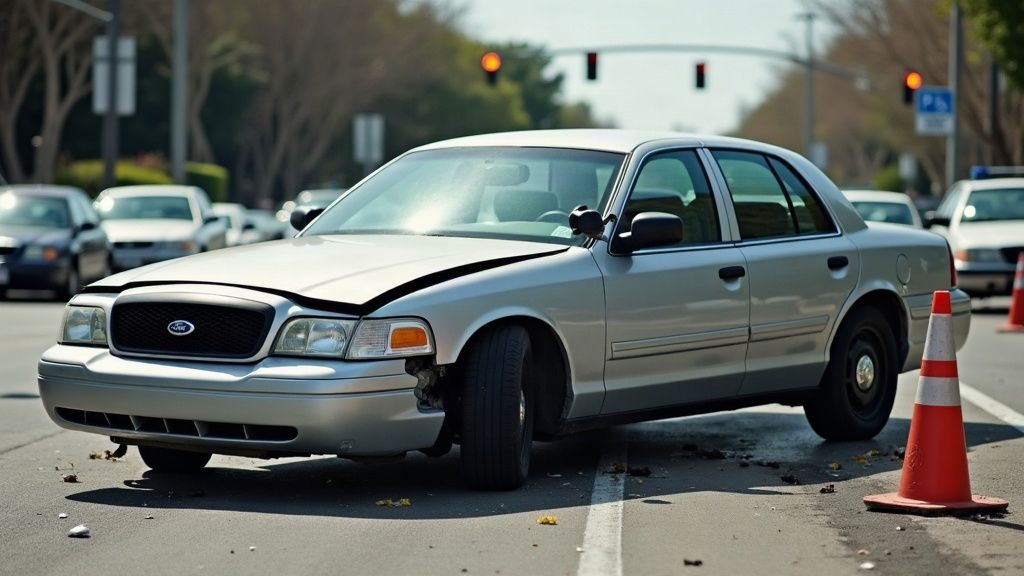
If you were hurt in a left-turn accident in California, one of the first questions you will face is: who is legally responsible? The answer is rarely as simple as "the turning driver is always at fault." California law is more nuanced than that, and understanding how fault actually works can mean the difference between recovering full compensation and walking away with far less than you deserve.
This article explains California's right-of-way rules for turning vehicles, when fault can shift to the oncoming driver, what evidence wins these cases, and exactly what to do to protect your claim.
Quick-answer summary:
- California law requires the left-turning driver to yield to oncoming traffic (Cal. Veh. Code §21801(a)).
- The turning driver is NOT automatically 100% at fault if the other driver was speeding, ran a red light, or was distracted.
- California's pure comparative fault rule lets you recover compensation even if you share some responsibility.
- Evidence from traffic cameras, black boxes, and witnesses is critical to proving who had the right of way.
- You have two years from the date of the crash to file a personal injury claim in most cases (Cal. Code Civ. Proc. §335.1).
- A free consultation with a California personal injury attorney costs you nothing upfront.
Why Left-Turn Intersections Are High-Risk in California
Left turns are among the most dangerous maneuvers a driver can make. Unlike a right turn, a left turn requires crossing one or more lanes of oncoming traffic. The turning driver must judge the speed and distance of approaching vehicles, the status of the traffic signal, and the behavior of pedestrians and cyclists all at the same time.
California roads add extra pressure. High posted speed limits on arterial roads, aggressive driving habits in dense urban areas, and intersections without dedicated left-turn signal phases all increase crash risk. An unprotected left turn is one where no dedicated green arrow protects the turning driver. The driver must wait for a gap in oncoming traffic and judge whether that gap is large enough. Misjudge it, and the result is a direct side impact at closing speeds that can be severe.
The WCAB and California courts see the consequences of these crashes regularly, including cases where workers are injured in left-turn collisions while on the job, potentially triggering both a personal injury claim and a workers' compensation claim simultaneously.
California's Right-of-Way Rules for Turning Vehicles
Cal. Veh. Code §21801(a) is the governing statute. It states that the driver of a vehicle intending to turn left must yield the right of way to all vehicles approaching from the opposite direction which are close enough to constitute a hazard at any time during the turning movement.
In California, a driver making a left turn must yield to oncoming traffic and may not turn until the turn can be completed safely, under Cal. Veh. Code §21801(a).
A few points that matter for your claim:
- The duty to yield applies throughout the entire turning movement, not just when the driver first enters the intersection.
- "Close enough to constitute a hazard" is not defined by a fixed distance. It depends on speed, road conditions, and the time needed to complete the turn.
- The statute does not say the oncoming driver's conduct is irrelevant. If the oncoming vehicle was behaving unlawfully, fault analysis shifts.
Cal. Veh. Code §21451 governs driver behavior at signalized intersections. A driver facing a solid green signal may proceed, but only with caution. A driver facing a solid red signal must stop. If the oncoming driver ran a red light, that violation is a direct factor in the fault analysis.
When Speeding, Red Lights, or Distraction Shift Fault to the Oncoming Driver
This is where many people get the law wrong. It is common to hear that the turning driver is always at fault. California law does not say that.
The left-turning driver is not always at fault in California, if the oncoming driver ran a red light, was speeding excessively, or was driving distracted, fault can shift fully or partially to that driver.
Here are the scenarios where the oncoming driver may carry significant or primary fault:
The oncoming driver ran a red light. If the signal turned red before the oncoming driver entered the intersection and they proceeded anyway, they violated Cal. Veh. Code §21453(a). That violation substantially changes the fault picture. A turning driver who entered the intersection on a green signal and was hit by a red-light runner has a strong argument that the oncoming driver bears primary fault.
The oncoming driver was significantly over the speed limit. If an oncoming driver was traveling at 60 mph in a 35 mph zone, the turning driver's judgment about a "safe gap" was based on a reasonable assumption about lawful speed. An approaching vehicle traveling at an unlawful speed closes a gap far faster than any reasonable driver could anticipate. California courts and juries take this into account.
The oncoming driver was driving distracted. A driver who was texting, adjusting a phone, or otherwise distracted may have been slower to react or may have drifted, contributing to the impact. Evidence of distraction includes phone records, witness accounts, and sometimes dashcam footage.
The oncoming driver made a sudden, illegal lane change. If an approaching driver switched lanes without signaling and struck a turning vehicle as a result, that lane change is itself a violation of Cal. Veh. Code §22107.
In each of these situations, the turning driver did not bear 100% of the fault. Under California's comparative fault system, the jury or insurance adjuster apportions a percentage of fault to each party, and compensation adjusts accordingly.
Common Injuries From Left-Turn and T-Bone-Style Impacts
Left-turn collisions frequently result in side impacts, sometimes called T-bone crashes. The side of a vehicle offers significantly less structural protection than the front or rear. There is less crumple zone between an occupant and the point of impact, which means the force transfers more directly to the person inside.
Left-turn and T-bone collisions frequently cause traumatic brain injury, spinal fractures, and broken bones because the side door provides far less crash protection than the front or rear of a vehicle.
Common injuries in these crashes include:
- Traumatic brain injury (TBI). Even a moderate lateral impact can cause the brain to strike the inside of the skull. TBI can range from concussion with temporary symptoms to severe, permanent cognitive impairment.
- Spinal fractures and disc injuries. The sudden side-force on the spine can fracture vertebrae or herniate discs, causing chronic pain or nerve damage.
- Broken ribs and pelvic fractures. The door and seatbelt can transmit force directly to the ribcage and pelvis in a side-impact crash.
- Shoulder and arm injuries. Drivers and front-seat passengers often instinctively brace during a crash, resulting in shoulder dislocations or wrist fractures.
- Knee and lower-leg injuries. The door panel can collapse inward, crushing the knee against the console or door.
- Soft-tissue injuries and whiplash. Even lower-speed impacts produce significant muscle, tendon, and ligament injuries that can take weeks or months to resolve.
The severity of your injuries directly affects the value of your claim. Full documentation of every injury, every medical visit, every missed workday, and every limitation on your daily life builds the foundation of a strong case.
Evidence That Establishes Who Had the Right of Way
In a left-turn accident claim, you win or lose on evidence. Insurance adjusters will default to blaming the turning driver unless you give them a reason to look harder. Here is what actually moves the needle.
Traffic and surveillance camera footage. Many California intersections have red-light cameras or traffic-monitoring cameras operated by the city or county. Nearby businesses often have security cameras that capture the roadway. This footage is often overwritten within 30 to 72 hours. Preservation demands must go out immediately.
Event data recorder (EDR) readings. Most modern vehicles have an event data recorder, often called a black box, that captures speed, braking input, throttle position, and seatbelt status in the seconds before a crash. An attorney can subpoena this data from both vehicles.
Evidence that matters most in a left-turn accident claim includes traffic camera footage, event data recorder readings, skid-mark measurements, and statements from independent witnesses.
Skid marks and physical evidence. A crash reconstruction specialist can measure skid marks to estimate how fast a vehicle was traveling before braking. The final resting positions of the vehicles, debris fields, and gouge marks on the pavement all tell a story about the sequence of events.
The official police report. Officers who respond to the scene document their observations, diagram the crash, note any citations issued, and may record statements from drivers and witnesses. A citation issued to the other driver for speeding or running a red light is strong supporting evidence, though it is not legally binding in a civil case.
Witness statements. Independent witnesses, meaning people who have no relationship to either driver, carry significant weight. Get contact information from any bystander who saw the crash.
Phone records. If distracted driving is suspected, an attorney can subpoena the other driver's cell phone records to determine whether a call or text was active at the time of impact.
Medical records tied directly to the crash. Gaps in treatment, delayed diagnosis, or pre-existing conditions the other side tries to exploit are all issues your attorney will address, but a clean chain of medical records from the date of the crash forward is your strongest proof of injury and damages.
How Shared Fault Affects Your Compensation
California follows the pure comparative fault rule. This means that even if you were partially at fault for the crash, you can still recover compensation. Your total damages are reduced by your percentage of fault.
California uses a pure comparative fault rule, which means your compensation is reduced by your percentage of fault, but you can still recover even if you were partly responsible for the crash.
For example: a jury finds your total damages to be $200,000. The jury also finds you were 20% at fault because you misjudged the gap in traffic. Under Cal. Civ. Code §1431.2, your recovery is reduced by 20%, and you receive $160,000.
This is why the insurance company for the other driver will almost always argue that you share some fault. Raising your percentage of fault reduces what they owe. It is a standard tactic, not a reflection of the truth of what happened.
An experienced personal injury attorney builds the evidentiary case that keeps your fault percentage as low as the facts honestly allow, and fights back when the adjuster assigns you more fault than the evidence supports.
Steps to Protect Your Claim After a Left-Turn Crash
The actions you take in the hours and days after a left-turn accident directly affect the strength of your claim. Follow these steps.
Call 911 and get an official police report. Even if injuries do not seem serious at the scene, a police report creates an official record of the crash, the parties involved, and the officer's initial observations. Do not skip this step.
Seek medical attention immediately. Adrenaline can mask pain. Some serious injuries, including TBI and internal bleeding, may not produce obvious symptoms for hours. Go to an emergency room or urgent care the same day. Getting examined creates a medical record that ties your injuries to the crash.
Document the scene before you leave if you can do so safely. Photograph both vehicles, the intersection, any skid marks, traffic signals, and your own visible injuries. Video is even better.
Exchange information. Get the other driver's name, address, phone number, driver's license number, license plate, vehicle make and model, and insurance company name and policy number.
Get contact information from witnesses. If anyone stopped or was standing nearby, ask for their name and phone number before they leave.
Do not give a recorded statement to the other driver's insurance company without speaking to an attorney first. Adjusters are trained to ask questions in ways that produce answers they can use to reduce your compensation. You are not required to give a recorded statement to the other side.
Send a preservation demand immediately. If there is any chance of surveillance footage or EDR data, an attorney can send a legal preservation letter within 24 to 48 hours, which creates an obligation for the other party and businesses to retain that evidence.
Contact a California personal injury attorney. The two-year statute of limitations under Cal. Code Civ. Proc. §335.1 feels like a long time, but evidence disappears quickly. Camera footage gets overwritten. Witnesses move. An attorney who gets involved early preserves evidence and positions your case correctly from day one.
If your crash happened while you were working, for example as a delivery driver or a sales rep traveling between clients, you may have both a personal injury claim against the at-fault driver and a workers' compensation claim through your employer. Our workers' compensation practice handles both types of claims and can help you understand which path applies, or whether both apply at the same time.
FAQ
Is the left-turning driver always at fault in California?
No. California law places the initial duty to yield on the left-turning driver under Cal. Veh. Code §21801(a), but the left-turning driver is not automatically 100% at fault. If the oncoming driver was speeding substantially, ran a red light, or was driving distracted, fault can shift partially or fully to that driver under California's comparative fault system.
What is an unprotected left turn accident?
An unprotected left turn is one made at an intersection where there is no dedicated green arrow signal protecting the turning driver. The driver must yield to a gap in oncoming traffic and judge whether that gap is safe to use. If no safe gap exists and the driver turns anyway, or if the driver misjudges the gap, a collision can occur. These crashes are common at intersections with long oncoming traffic flows and no left-turn signal phase.
Can the oncoming driver ever share fault in a left-turn crash?
Yes. If the oncoming driver ran a red light, was traveling significantly over the speed limit, was driving distracted, or made an illegal lane change just before impact, that driver can bear a portion or even the majority of the fault. California's pure comparative fault rule allows fault to be divided between any number of parties based on the evidence.
How does a police report affect a left-turn accident claim?
A police report is important supporting evidence. It records the officer's observations, the diagram of the crash scene, and any citations issued. A citation to the other driver for speeding or running a red light strengthens your claim, though in a civil case it is evidence rather than a definitive determination of liability. Insurance adjusters and courts both consider police reports in evaluating fault.
What happens if both drivers share fault in a California left-turn accident?
Under California's pure comparative fault rule (Cal. Civ. Code §1431.2), your compensation is reduced by your percentage of fault. If you are found 25% at fault and the total damages are $100,000, you recover $75,000. Unlike some states that bar recovery when a plaintiff is 50% or more at fault, California allows recovery at any fault percentage.
How long do I have to file a claim after a left-turn accident in California?
In most California personal injury cases, you have two years from the date of the accident to file a lawsuit, under Cal. Code Civ. Proc. §335.1. If the crash involved a government vehicle or occurred on government property, you may have as little as six months to file a government tort claim under Cal. Gov. Code §911.2. Missing either deadline typically bars your claim entirely.
What damages can I recover in a California left-turn accident case?
You may be able to recover medical expenses (past and future), lost wages, reduced future earning capacity, pain and suffering, emotional distress, and property damage. The specific amounts depend on the severity of your injuries, the strength of the evidence, and the applicable insurance policy limits.
Should I accept the first settlement offer from the insurance company?
You should not accept any settlement offer before consulting with an attorney. Initial offers from insurance carriers are almost always lower than what a represented claimant can recover. Once you sign a release and accept a settlement, you give up your right to pursue additional compensation even if your injuries turn out to be more serious than initially understood.
Talk to a California Left-Turn Accident Attorney Today
Left-turn accident cases are winnable, but they require quick action to preserve the evidence that proves who actually had the right of way. If you or someone you care about was hurt in a left-turn or T-bone crash in California, you deserve to know exactly where you stand.
We've recovered over $150,000,000 for injured clients across Southern California. Our personal injury practice handles these cases on a contingency basis, which means you pay nothing unless we recover for you.
Call (818) 794-9947 for a free consultation. No fee unless we win. Available in English and Spanish.
Reviewed by Minas Nordanyan, CA Bar #296806. Last reviewed August 2026. This article is for general informational purposes and does not constitute legal advice for your specific situation. For advice about your case, call (818) 794-9947.