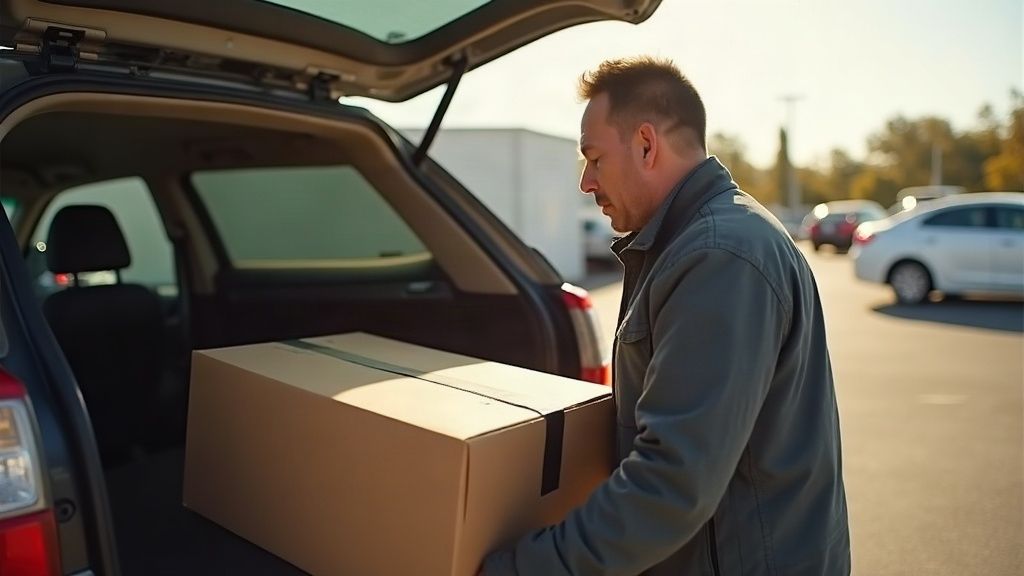
If you were hurt lifting boxes into your trunk, unloading tools from your truck bed, or getting struck while standing next to your open car door, you may be wondering whether any insurance policy covers what happened to you. The honest answer is: it depends on the specific circumstances, and several different bodies of law can apply in California.
This article walks through the main coverage theories, explains how California law treats loading and unloading, and tells you exactly what documentation you need to protect your claim.
If you've been injured in a situation like this and want to talk through the specifics, call (818) 794-9947 for a free case review. No fee unless we win.
Quick-Answer Summary
- Many California auto policies treat loading and unloading as part of "vehicle use," which can trigger liability or uninsured motorist coverage.
- As of January 1, 2025, California's mandatory minimum auto liability limits increased to $30,000 per person and $60,000 per accident (Veh. Code §16056, as amended by SB 1107).
- If another driver hit you while you were standing outside your car, their liability insurance is usually the primary source of recovery.
- California's pure comparative fault rule, established in Li v. Yellow Cab Co. (1975) 13 Cal.3d 804, lets you recover even if you were partly at fault, but your award is reduced by your percentage of fault.
- Workers who are injured loading or unloading a vehicle as part of their job duties are covered by California workers' compensation under Cal. Lab. Code §3600.
- Documentation of timing and location is critical. Insurers routinely dispute whether an injury happened during loading, before it, or after it finished.
Why "Use of a Vehicle" Can Include Loading and Unloading
California auto insurance policies are required to provide liability coverage for bodily injury "arising out of the ownership, maintenance, or use of the motor vehicle." Whether a specific injury "arises out of use" when the car's engine is off and the doors are open depends on policy language and the particular facts.
California courts have interpreted "use" broadly in many contexts. The key question is whether the vehicle was an active instrument in producing the injury, not simply a backdrop. Loading and unloading cargo is generally treated as part of the use of the vehicle rather than an activity completely separate from it. This means if you are pulling a heavy toolbox out of your truck bed and your back gives out, or if a piece of equipment you are loading falls and crushes your hand, the auto policy may respond, even though the engine was never running.
This principle matters most in three situations:
- You are the vehicle owner and you are hurt loading or unloading your own car. Your own auto policy's medical payments (MedPay) coverage may apply, and if a defect in the vehicle contributed (for example, a hatch that fell), a property coverage or product liability theory may also apply.
- Another driver's vehicle was involved in loading or unloading, and that driver's liability coverage is in play.
- You are an employee using a company vehicle, in which case the employer's commercial auto policy is the likely primary coverage.
The loading-and-unloading clause is not universal. Some policies exclude self-loading injuries, and others narrow the definition of "use." Reading the actual policy language matters, which is one reason talking to an attorney before you accept a coverage denial is worth your time.
Common Scenarios: Groceries, Strollers, Wheelchairs, Moving Boxes, Work Equipment
The range of injuries that happen during loading and unloading is wider than most people expect. Some of the most common situations we see in California personal-injury and workers' comp cases include:
Grocery and everyday cargo loading. Back strain, herniated discs, and shoulder tears are common when someone lifts heavy bags at an awkward angle from a cart into a low trunk. These injuries often happen in parking lots and are frequently dismissed as "not a car accident." Under many auto policies, they are.
Strollers and mobility equipment. Parents folding heavy strollers into a car, or family members loading a wheelchair, can suffer pinched fingers, shoulder injuries, or falls. When a parking lot is poorly maintained, a premises liability claim against the lot owner may also be available.
Moving boxes and furniture. Rental truck loading injuries are particularly common. Whether the claim falls under the rental company's liability coverage, your own auto policy, or a homeowner's policy depends on the rental agreement and policy stacking rules.
Work equipment and tools. Trade workers, delivery drivers, and service technicians routinely lift heavy materials in and out of work vehicles. These injuries are treated as workers' compensation claims in California when they occur in the course of employment. A third-party claim may also exist if a separate driver or property owner contributed to the injury.
Struck by a passing vehicle. Being hit by a car while standing at your open trunk is one of the most serious loading-and-unloading scenarios. These cases are treated as motor vehicle accidents even though the injured person was not a driver or passenger at the time of impact.
When Another Driver Strikes You or Your Open Door
Being struck by a passing car while loading or unloading is a distinct category of injury. You are pedestrian-adjacent in this situation, even though your vehicle is present. The at-fault driver's bodily injury liability coverage is the primary source of compensation. If that driver is uninsured or underinsured, your own uninsured/underinsured motorist (UM/UIM) coverage may apply.
As of policies issued or renewed on or after January 1, 2025, California drivers are required to carry at least $30,000 per person and $60,000 per accident in bodily injury liability coverage under Veh. Code §16056, as amended by SB 1107. Many drivers carry only the minimum, so UM/UIM coverage on your own policy can be critical to fully compensating a serious injury.
As of policies issued or renewed on or after January 1, 2025, California requires drivers to carry at least $30,000 per person and $60,000 per accident in bodily injury liability coverage under Vehicle Code Section 16056.
What about the open-door ("dooring") scenario? If you opened your car door into traffic and a passing driver swerved and struck you while you were stepping out to begin unloading, fault may be shared. California's pure comparative fault rule, established in Li v. Yellow Cab Co. (1975) 13 Cal.3d 804, means your damages are reduced by whatever percentage of fault is assigned to you. For example, if a jury finds you 20 percent at fault for opening your door without checking traffic, your total award is reduced by 20 percent, but you still recover the remaining 80 percent.
California follows a pure comparative fault rule established in Li v. Yellow Cab Co. (1975), meaning an injured person can recover damages even if they were partly at fault, but their total recovery is reduced by their own percentage of fault.
Fault in these cases often turns on:
- Whether the street or parking lot had adequate lighting.
- Whether the striking driver was speeding or distracted.
- How far your door was open when the impact occurred.
- Whether there was a marked loading zone or traffic-control device in place.
Gather witness contact information, call the police so there is an official report, and photograph the scene from multiple angles before the vehicles are moved.
Coverage Differences Between Auto Policies and General Liability Claims
Not every loading-and-unloading injury belongs under an auto policy. Understanding how different coverage types interact helps you identify every source of recovery.
| Coverage type | When it applies | Key California consideration |
|, |, |, |
| Auto liability (third-party) | Another driver causes the injury | Minimum 30/60/15 as of 2025 per Veh. Code §16056 |
| Auto MedPay (first-party) | Injury arises from use of your own vehicle; no fault required | Optional coverage in California; check your policy |
| UM/UIM | At-fault driver is uninsured or underinsured | Required to be offered under Ins. Code §11580.2; you may have waived it in writing |
| Premises liability | Dangerous condition of parking lot or property contributed | Property owner may owe a duty of care under Cal. Civ. Code §1714 |
| Commercial general liability | Business invited you to load/unload on their property | Applies when the hazard is a property defect, not a moving vehicle |
| Workers' compensation | Injury in course and scope of employment | No fault required; exclusive remedy against employer (Cal. Lab. Code §3602) |
When a parking lot pothole causes you to fall while carrying a heavy load, for example, the lot owner's general liability policy may be the right target, not the auto insurer. If you were on the job when it happened, workers' comp runs parallel.
How This Overlaps With a Work-Related Injury for Delivery or Trade Workers
Delivery drivers, plumbers, electricians, HVAC technicians, construction material haulers, and other workers who spend part of their workday loading or unloading a vehicle are some of the most frequent victims of loading-and-unloading injuries in California.
Employees injured while loading or unloading a vehicle in the course of their job are entitled to California workers' compensation benefits under Labor Code Section 3600, regardless of who was at fault.
Under Cal. Lab. Code §3600, workers' compensation applies to injuries that arise out of and in the course of employment. Loading or unloading a company vehicle, a delivery truck, or even a personal vehicle used for work purposes almost always qualifies. Workers' comp covers:
- Medical treatment (no out-of-pocket cost to the worker).
- Temporary disability payments while you are unable to work.
- Permanent disability benefits if the injury leaves lasting impairment.
- Supplemental job displacement benefits if you cannot return to your previous job.
Workers' compensation is an exclusive remedy against your employer under Cal. Lab. Code §3602. That means you generally cannot sue your employer in civil court for a work injury. But if a third party caused or contributed to the injury, such as another driver who hit you while you were unloading, you can pursue both a workers' comp claim and a personal injury claim against that third party simultaneously.
This combination of claims is often where the most significant total recovery is possible. The workers' comp claim covers your medical bills and wage loss quickly, while the third-party claim pursues the full range of damages that workers' comp does not provide, including pain and suffering. We handle both types of claims, and we structure them together so the workers' comp lien against your personal injury recovery is minimized where the law allows.
If you are a delivery driver or trade worker who was hurt loading or unloading, call (818) 794-9947. Our attorneys handle both workers' comp and personal injury, which is not true of every firm.
Proving the Injury Happened During Loading, Not an Unrelated Incident
Insurers and defense attorneys will often argue that your back pain, shoulder tear, or crush injury did not happen during loading or unloading at all, but rather before you reached the vehicle or after you had already finished and walked away. This is not a hypothetical risk. Timing disputes are one of the most common defenses in loading-and-unloading claims.
Proving that your injury happened specifically during the loading or unloading process, rather than before you reached the vehicle or after you finished, can determine which coverage applies and whether your claim succeeds or fails.
Evidence that establishes the timing and connection to the vehicle includes:
- Surveillance video. Parking lot cameras and traffic cameras capture the moment of injury with time stamps. Preserve this footage immediately. Video is often overwritten within 24 to 72 hours.
- Witness statements. A bystander who watched you lift the heavy box and heard you cry out is far more credible than a written account from weeks later.
- Police or incident reports. If another vehicle was involved, a police report documents the time and location. If the injury happened on commercial property, ask the manager to file an incident report that day.
- Same-day medical records. Seeking treatment the same day creates a contemporaneous record that links your injury to the incident. Waiting days or weeks to see a doctor gives the insurer an opening to argue the injury happened elsewhere.
- Purchase receipts or delivery records. A grocery receipt time-stamped five minutes before your injury connects you to the physical act of loading.
- Photos of the cargo and vehicle. Photographs of the items you were loading, the position of the trunk or tailgate, and any relevant property conditions document the physical setup.
- Your employer's GPS and dispatch logs (for work injuries). Commercial fleet vehicles often generate detailed location and activity records that can pinpoint exactly when and where a loading activity occurred.
Typical Injuries: Back Strains, Pinched Fingers, Being Struck by Traffic
Loading-and-unloading injuries span a wide range of severity. Some are acute traumatic injuries. Others develop over time into serious medical conditions.
Back and spine injuries are the most common. Lumbar strains, herniated discs, and sacroiliac joint problems result from repetitive heavy lifting or from a single overexertion event. Treatment ranges from physical therapy to epidural injections to surgery, and the cost can reach tens of thousands of dollars even before accounting for lost wages.
Shoulder injuries including rotator cuff tears and labrum tears are common when a person lifts awkwardly above shoulder height or catches a falling object. Rotator cuff repairs often require surgery and months of rehabilitation.
Crush injuries to hands and fingers happen when cargo shifts, a tailgate drops, or a car door closes on a hand. These can result in fractures, nerve damage, or amputation in severe cases.
Being struck by a passing vehicle while standing outside your car is the most dangerous scenario. These impacts can cause traumatic brain injury, spinal cord injury, broken bones, and internal bleeding. Victims who survive face long recoveries and significant permanent impairment.
Knee injuries from stepping off a truck bed or trailer, falling in a parking lot, or twisting under a heavy load are also common, particularly among older workers.
Call (818) 794-9947 for a Free Case Review
Loading and unloading injuries fall into a complicated intersection of auto insurance law, premises liability, and workers' compensation. The coverage that applies, the fault rules that govern your claim, and the deadlines you face all depend on the specific facts of your situation.
We've recovered over $150,000,000 for injured workers and accident victims across Southern California. Our attorneys handle both personal injury and workers' compensation, which means we can identify every source of recovery and coordinate both claims to maximize your total result.
Call (818) 794-9947 for a free case review. No fee unless we win.
Frequently Asked Questions
Am I covered by auto insurance if I am hurt loading groceries into my car?
Possibly. Many auto policies extend to injuries that arise out of the "use" of the vehicle, and California courts have interpreted "use" to include loading and unloading in a number of contexts. Whether your specific policy covers a self-loading injury depends on the policy language. Medical payments (MedPay) coverage, if you purchased it, applies to injuries arising from vehicle use regardless of fault. Review your policy declarations page and call an attorney if you receive a coverage denial.
What if another driver hits me while I am getting into my parked car?
That driver's bodily injury liability insurance is the primary source of recovery. As of policies issued or renewed on or after January 1, 2025, the minimum is $30,000 per person and $60,000 per accident under Vehicle Code §16056. If the at-fault driver is uninsured or carries insufficient coverage, your own UM/UIM coverage may close the gap. Call the police, document the scene, and seek medical care the same day.
Can I file a claim if I am hurt loading cargo for work?
Yes. California workers' compensation covers employees who are injured in the course and scope of employment, including while loading or unloading a work vehicle, under Cal. Lab. Code §3600. Workers' comp pays for medical treatment and a portion of lost wages with no requirement to prove fault. If a third party, such as another driver, contributed to the injury, a separate personal injury claim can run alongside the workers' comp claim.
Does it count as a car accident if I am not actually driving?
For purposes of the at-fault driver's liability coverage, yes. If you are struck by a moving vehicle while you are standing next to your car, the incident is treated as a motor vehicle accident and the striking driver's auto liability coverage applies. For purposes of your own auto policy's MedPay or UM/UIM coverage, whether the injury counts as arising from "use of a motor vehicle" depends on the specific policy language and how directly the vehicle was connected to the injury.
What if I was partly at fault for the loading accident?
California follows pure comparative fault as established in Li v. Yellow Cab Co. (1975) 13 Cal.3d 804. You can recover damages even if you were partly responsible. Your total award is reduced only by the percentage of fault assigned to you. If you are found 25 percent at fault, you recover 75 percent of your proven damages.
How long do I have to file a personal injury claim in California?
The general statute of limitations for personal injury claims in California is two years from the date of injury under Cal. Code Civ. Proc. §335.1. For workers' compensation claims, you must report the injury to your employer within 30 days under Cal. Lab. Code §5400 and file a claim within one year under Cal. Lab. Code §5405. Missing either deadline can bar your claim entirely. Act quickly.
What if the injury happened in a poorly maintained parking lot?
If a hazardous condition on the property, such as a pothole, broken pavement, or inadequate lighting, contributed to your fall while loading or unloading, the property owner may owe you a duty of care under Cal. Civ. Code §1714. A premises liability claim against the lot owner can exist alongside or instead of an auto insurance claim, depending on the facts.
Do I need a lawyer for a loading or unloading injury claim?
You are not required to hire an attorney. But loading and unloading injury claims routinely involve disputes over which coverage applies, whether the injury is work-related, how fault is allocated across multiple parties, and whether a UM/UIM claim needs to be stacked on top of a liability claim. Claimants who handle these disputes without legal representation consistently recover less than those who do not. Our firm handles these cases on a contingency basis, meaning there is no fee unless we win. Call (818) 794-9947 to talk through your situation at no cost.
What evidence should I collect right after a loading injury?
Collect surveillance footage before it is overwritten (often within 24 to 72 hours), get contact information from any witnesses, call police if a vehicle was involved, file an incident report if the injury happened on commercial property, photograph the cargo, the vehicle, and the surrounding area, keep your purchase or delivery receipts, and seek medical treatment the same day. The more contemporaneous documentation you have, the harder it is for an insurer to argue the injury happened elsewhere or at a different time.
Can I claim both workers' compensation and a personal injury settlement at the same time?
Yes, when a third party caused or contributed to your injury. Workers' comp covers your medical bills and a portion of lost wages right away. A personal injury claim against the at-fault third party can pursue the full value of your damages, including pain and suffering, which workers' comp does not cover. Your employer's workers' comp insurer holds a lien on part of any third-party recovery, but an experienced attorney can structure the resolution to minimize that lien within the limits the law allows. Call (818) 794-9947 to discuss how both claims work together in your specific situation.
Reviewed by Minas Nordanyan, CA Bar #296806. This article is for general educational purposes and does not constitute legal advice. Every case turns on its specific facts and applicable policy language. Contact our office for a case-specific evaluation.