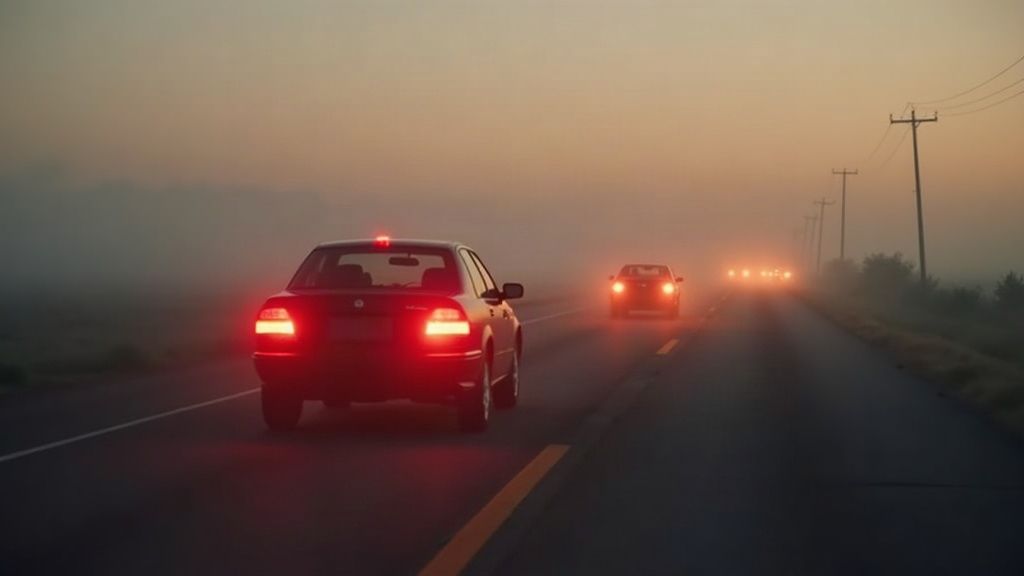
If you've been hurt in a fog-related crash in California, you already know how fast everything can go wrong. Visibility drops in seconds, brake lights appear out of nowhere, and suddenly you're in the middle of a multi-car pileup with no clear picture of what happened or who is responsible.
California's unique geography and weather patterns make fog crashes more common here than in most other states. And the legal questions that follow them are far more complicated than a straightforward two-car rear-end collision.
Here are eight things every driver should understand about fog-related accidents in California, how fault gets assigned, and what you can do to protect your claim.
Quick summary:
- The Central Valley's tule fog creates near-zero visibility and multi-car pileups with serious injuries.
- California's comparative fault rules mean multiple drivers share liability.
- Following distance violations are powerful evidence of negligence in fog crash claims.
- Chain-reaction crash investigations assign each driver a separate fault percentage.
- Critical evidence, including EDR data and camera footage, disappears within days.
- Multiple insurance policies may apply to a single crash.
- "Act of God" defenses rarely succeed in California fog cases.
- Calling 911, documenting the scene, and preserving your vehicle's data are the first steps to protecting your claim.
1. Why California's Central Valley Sees Severe Fog-Related Pileups
California's tule fog can reduce visibility to zero feet, making highways in the Central Valley some of the deadliest roads in the country during winter months.
Tule fog is a dense ground-level radiation fog that forms in California's Central Valley, typically between November and March. Unlike coastal fog that burns off by midmorning, tule fog can persist for days and blanket stretches of Highway 99, Interstate 5, and Highway 46 with visibility measured in feet, not miles.
The conditions are especially dangerous because the Valley's flat terrain gives drivers a false sense of security. At highway speeds, a driver who cannot see beyond 30 feet has no realistic stopping distance. When one vehicle brakes suddenly, the chain reaction can pull in dozens of cars and commercial trucks before anyone can react.
These pileups are not rare events. The DWC and California Highway Patrol data consistently show the Central Valley among the state's most dangerous regions for weather-related fatalities. If you were injured on a Central Valley highway in winter fog, your crash happened in one of the most legally complex environments in California personal injury law.
Practical takeaway: If your crash occurred on a Central Valley highway in fog season, expect a multi-vehicle investigation, multiple at-fault parties, and a claim that requires specialist handling from the start.
2. How Fault Gets Determined When Visibility Is Near Zero
Under California Civil Code §1431.2, each driver in a multi-car fog pileup is assigned a separate percentage of fault, so you can still recover damages even if you were partly responsible.
California follows a pure comparative fault rule under Cal. Civ. Code §1431.2. This means that in a five-car pileup, each driver can be assigned a different percentage of fault, and an injured driver can still recover damages proportional to the other drivers' share.
The baseline legal standard for driving in fog comes from Cal. Veh. Code §22350, California's basic speed law. It requires every driver to travel at a speed no greater than what is reasonable and prudent under the conditions. In dense fog with near-zero visibility, driving at the posted speed limit can itself be a violation of §22350 if that speed makes it impossible to stop within the visible range ahead.
This is the legal doctrine known as "driving within the range of your headlights." If you cannot see far enough to stop safely, you are going too fast for conditions, period. That rule applies whether the posted limit is 25 mph or 70 mph.
Practical takeaway: Speed is the first question investigators ask after a fog crash. If any driver was traveling faster than conditions allowed, that alone can establish a significant share of fault.
3. Why Following Distance Matters More in Fog Claims
California Vehicle Code §21703 requires every driver to maintain a safe following distance at all times, and violating that rule in fog is strong evidence of negligence.
Cal. Veh. Code §21703 prohibits following another vehicle more closely than is reasonable and prudent, accounting for speed and road conditions. In ordinary traffic, a two-second following gap is a commonly cited safe minimum. In dense fog, that gap needs to be considerably longer, because stopping distances do not shrink when visibility does.
In personal injury litigation, following distance becomes critical evidence. Reconstruction experts measure skid marks to calculate pre-impact speed and the distance at which a driver first applied the brakes. If that distance is shorter than the physics of stopping require at the driver's speed, the data supports a finding that the driver was following too closely.
Dashcam footage is particularly powerful here. A camera recording shows exactly how much of the road was visible and how much space existed between vehicles in the seconds before impact. Attorneys and insurance adjusters on both sides of a fog crash claim request this footage immediately.
Practical takeaway: If you had a dashcam running, preserve that footage right now. If the other driver had one, an attorney can issue a preservation demand before that data is overwritten.
4. The Role of Chain-Reaction Crash Investigations
Event data recorder data, traffic camera footage, and official visibility logs can be overwritten or lost within days of a fog crash, so preserving them quickly is critical.
A chain-reaction pileup is not investigated as a single crash. It is reconstructed as a sequence of separate impacts, each with its own set of responsible parties. The California Highway Patrol, along with private accident reconstruction experts retained by each insurer, works to assign a fault percentage to each vehicle.
The investigation uses several sources. Electronic data recorders (EDRs), also called black boxes, are installed in most vehicles manufactured after 2012. They record speed, braking force, and steering input in the seconds before impact. Investigators compare EDR data across multiple vehicles to sequence the collision timeline.
Physical evidence also matters. Debris fields, paint transfer patterns, and the positions of vehicles after impact all help reconstructors identify which car hit which, and at what speed. Witness statements, including from other drivers, passengers, and any bystanders, fill in gaps the physical evidence cannot resolve.
In a multi-car pileup, you may receive a primary collision report that initially misidentifies your role. That report is not final. An attorney can challenge the reconstruction and submit independent expert analysis.
Practical takeaway: Never accept the first fault determination in a chain-reaction fog crash as the final word. The investigation continues long after the highway reopens.
5. What Evidence Disappears Quickly After a Fog Crash
The fog lifts. The tow trucks clear the highway. And within hours, some of the most important evidence in your case is gone.
Skid marks are worn away by traffic within hours of the collision. Roadway debris is swept up by CHP cleanup crews. The fog itself, by definition, disappears. And if a driver's dashcam records on a loop, the footage can overwrite itself before anyone requests a copy.
The evidence that tends to survive longest, but still requires a formal preservation demand, includes:
- EDR data from each vehicle. Most EDRs overwrite on impact events, but a download can be ordered quickly if the vehicle is not repaired or scrapped first. An attorney can send a spoliation letter to the vehicle owner and the insurer within days of the crash.
- Traffic and CalTrans camera footage. Intersections and highway on-ramps throughout the Central Valley are monitored by cameras that typically overwrite every 30 to 72 hours. A records request must go out fast.
- CHP and Caltrans weather-visibility logs. When the California Highway Patrol or Caltrans issues a Dense Fog Advisory, they maintain logs of advisory times and affected road segments. Those logs are official records of the conditions at the time of your crash.
- Weather data from NOAA and airport observation stations. Visibility measurements taken at the nearest automated weather station, recorded by the hour, can document exactly how severe the fog was.
Practical takeaway: Call an attorney as quickly as possible after a fog crash. Preservation demands need to go out within 24 to 72 hours to have any chance of capturing this evidence before it disappears.
6. Why Multiple Insurers May Be Involved at Once
A fog crash with three, five, or ten vehicles does not produce one clean insurance claim. It produces a tangle of overlapping policies, and knowing how to navigate that tangle can determine how much you ultimately recover.
Here is how the layers typically stack:
Each driver's liability policy covers bodily injury and property damage that driver causes to others. In a ten-car pileup, you may have claims against five or six separate liability policies simultaneously.
Your own uninsured or underinsured motorist (UM/UIM) coverage steps in when another driver's liability limits are too low to cover your damages, or when a driver who hit you carries no insurance at all. Cal. Ins. Code §11580.2 governs UM/UIM coverage in California and gives you the right to stack your own policy on top of what you recover from at-fault drivers.
Commercial carrier policies apply when one of the vehicles in the pileup was a commercial truck, delivery van, or company vehicle. Commercial fleet policies often carry significantly higher limits than personal auto policies, and they bring an additional layer of corporate defendants, including the employer who put the driver on the road.
MedPay or PIP coverage on your own policy pays medical bills regardless of fault and without waiting for liability to be sorted out. Activating this coverage early keeps treatment bills from going unpaid during the months an investigation can take.
Practical takeaway: A multi-vehicle fog crash requires someone to track every policy, every limit, and every deadline across multiple insurers. That coordination is one of the primary services a personal injury attorney provides from day one.
7. How Weather Conditions Affect Settlement Negotiations
Insurance carriers sometimes argue that fog was an act of God, but California courts have consistently held that foreseeable weather conditions do not eliminate a driver's duty to adjust speed and following distance.
One of the most common insurer tactics after a fog crash is the "act of God" or "sudden emergency" argument. The carrier argues that the fog appeared without warning, that no driver could have anticipated it, and therefore that the drivers who caused the pileup were not negligent.
California law gives this defense very little room. The sudden emergency doctrine requires both that the emergency was truly unforeseeable and that the driver did not contribute to creating it. Tule fog in the Central Valley in January is not an unforeseeable emergency. It is a documented, predictable seasonal hazard. Caltrans signs warn drivers of it. CHP issues advisories about it. Drivers who live and work in the Valley know it occurs.
When a road has a documented history of fog-related crashes, that history becomes evidence that every driver on that road should have anticipated reduced visibility and adjusted their behavior accordingly. Courts have consistently held that failing to reduce speed in foreseeable fog is negligence, not an excusable response to a sudden emergency.
A strong settlement position in a fog case includes gathering Caltrans records of prior fog-related crash reports on the same highway segment, fog advisory histories from CHP, and news coverage of previous pileups on the same road. That evidence demonstrates the road's known danger and undermines the "no one could have seen it coming" defense.
Practical takeaway: Do not let an insurer's "act of God" argument go unchallenged. California law and the documented history of Central Valley tule fog give you strong grounds to push back.
8. Steps to Protect Your Claim After a Low-Visibility Crash
Your actions in the minutes, hours, and days after a fog crash directly affect the value of your claim. Here is what to do:
At the scene:
- Call 911 immediately. A police report is essential in any multi-vehicle crash.
- Move to safety if you can do so without crossing active lanes. Turn on your hazard lights and, if you have road flares or reflective triangles, place them behind your vehicle.
- Do not step out of your vehicle onto an active freeway lane in dense fog. Secondary crashes in fog are common and deadly.
- Photograph everything you safely can, including the position of your vehicle, the road, visibility conditions, and any other vehicles.
Within 24 hours:
- Seek medical attention even if you feel fine. Whiplash, traumatic brain injury, and internal injuries often present symptoms hours or days after impact. Delaying treatment gives insurers grounds to argue your injuries were not caused by the crash.
- Notify your own insurance carrier that the crash occurred. Do not give a recorded statement to any insurer, including your own, without an attorney present.
- Write down everything you remember about conditions before and during the crash while the details are still fresh.
Within 48 to 72 hours:
- Contact an attorney who handles multi-vehicle crashes. Preservation demands for EDR data, camera footage, and CHP visibility logs need to go out fast.
- Do not authorize any major repairs to your vehicle until an attorney can have the EDR downloaded. Repairs can erase or compromise the data.
Ongoing:
- Keep copies of every medical bill, prescription, and lost-wage record. Economic damages in a fog crash claim must be documented to the dollar.
- Follow your treatment plan. Gaps in treatment are used by insurers to argue that your injuries were not serious.
California's statute of limitations for personal injury lawsuits is two years from the date of the crash under Cal. Code Civ. Proc. §335.1. That deadline sounds distant, but investigation, preservation demands, and insurer negotiations take months. Starting early protects every option.
Practical takeaway: The actions you take in the first 72 hours after a fog crash can determine whether critical evidence survives and whether your claim holds its full value.
Frequently Asked Questions
Is it illegal to drive in dense fog in California?
There is no California law that flatly prohibits driving in fog. However, Cal. Veh. Code §22350, the basic speed law, requires every driver to travel at a speed that is reasonable and prudent for the conditions. In dense fog, that often means slowing to a speed well below the posted limit. A driver who continues at the speed limit when visibility is near zero can be cited under §22350 and held civilly liable for any crash that results.
Who is at fault in a multi-car fog accident?
California uses a pure comparative fault system under Cal. Civ. Code §1431.2. Each driver in a multi-car pileup can be assigned a separate percentage of fault based on their speed, following distance, and actions before impact. An injured driver who is found 20% at fault can still recover 80% of their total damages from the other at-fault parties.
What should I do if I'm caught in sudden fog while driving?
Slow down immediately and increase your following distance. Turn on your low-beam headlights, not your high beams, because high beams reflect off the fog and reduce visibility further. Turn on your hazard lights if you are slowing significantly below the traffic flow. If visibility becomes too low to drive safely, exit the highway at the nearest off-ramp and wait for conditions to improve. Pulling onto the shoulder of an active freeway in dense fog is extremely dangerous because other drivers cannot see you until they are already close.
Are fog-related pileups treated differently in injury claims?
Yes, in several important ways. The chain-reaction nature of multi-car fog pileups means that fault is distributed across multiple parties rather than assigned to one driver. Multiple insurance policies are often involved. The "act of God" defense is commonly raised by insurers and must be specifically countered. And evidence preservation is more urgent because fog, skid marks, and camera footage all disappear quickly. An attorney with experience in multi-vehicle crashes handles fog pileup claims differently from a standard two-car accident from the very first day.
How long do I have to file a personal injury claim after a fog crash in California?
You have two years from the date of the crash to file a personal injury lawsuit under Cal. Code Civ. Proc. §335.1. If the crash involved a government entity, such as a state-owned vehicle or a claim that Caltrans negligently maintained the road, a government tort claim must be filed within six months under Cal. Gov. Code §911.2. Missing either deadline typically bars your claim entirely.
Can I still recover if I was partly at fault for the fog crash?
Yes. California's pure comparative fault rule allows you to recover damages reduced by your own percentage of fault. If a jury finds you 25% at fault and awards $200,000 in total damages, you receive $150,000. There is no threshold percentage above which you lose the right to recover, unlike in some other states. Your own negligence reduces your recovery but does not eliminate it.
Fog crashes in California are among the most legally complex personal injury cases we handle. Multiple drivers, multiple insurers, disappearing evidence, and insurer tactics designed to shift blame onto the weather all make the difference between a fair recovery and a fraction of what you deserve.
We've recovered more than $150,000,000 for injured Californians, and we know what it takes to build a fog crash claim from the ground up. If you or someone you know was hurt in a low-visibility crash anywhere in California, call us for a free case review. No fee unless we win.
Call (818) 794-9947. We're available in English and Spanish.