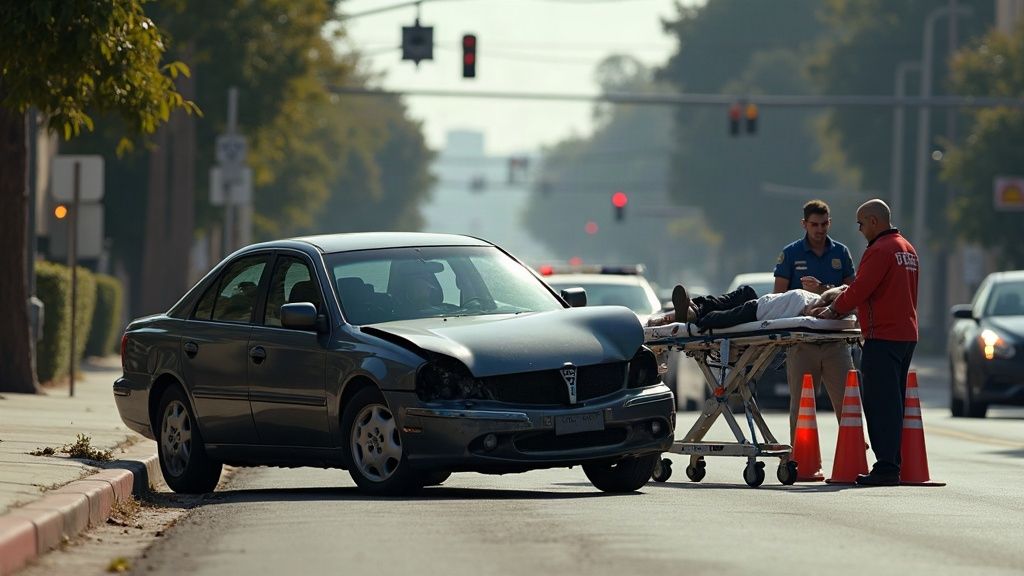
If a driver had a heart attack, seizure, or blackout before hitting you, your first question is probably: can I still get compensation? The short answer is yes, in most cases. But the driver's attorney or their insurance carrier will likely raise California's sudden emergency doctrine as a defense, and you need to understand exactly what that means before you accept any offer or give any recorded statement.
This article explains how California courts handle these cases, when that doctrine applies, and what evidence you need to push back against a "medical emergency" excuse.
Quick-answer summary for skimmers:
- A driver who had a sudden, unforeseeable medical emergency may have a valid defense to negligence under California's sudden emergency doctrine.
- That defense fails if the driver had prior knowledge of a condition that could cause sudden incapacitation.
- California's pure comparative fault rule still lets you recover even if fault is disputed.
- Medical records, prescription history, and DMV reporting records are the core evidence categories.
- Insurance companies use this defense routinely; an attorney can challenge it with the right documentation.
- Call (818) 794-9947 for a free review of your case. No fee unless we win.
Why Sudden Medical Emergencies Complicate Fault
Most car accident liability in California rests on a simple negligence standard. Under Cal. Civ. Code §1714, every person is responsible for injury caused by a want of ordinary care or skill. When a driver runs a red light or follows too closely, proving negligence is relatively straightforward.
A sudden medical emergency scrambles that analysis. The defense argument goes like this: the driver was not being careless. They were operating normally, then a physiological event outside their control took over. How can you call that negligence?
This is not a hypothetical. Courts across the country, including in California, have grappled with cases involving drivers who lost consciousness due to heart attacks, diabetic episodes, seizures, strokes, and other sudden events. The outcomes depend heavily on what the driver knew, and when they knew it.
The key distinction that California law draws is between a truly unforeseeable medical emergency and a foreseeable one the driver chose to ignore.
California's Sudden Emergency Doctrine Explained
California recognizes the sudden emergency doctrine as a jury instruction. The California Civil Jury Instructions include CACI 452, the "Sudden Emergency" instruction. It tells jurors, in substance, that a person who is suddenly confronted with an emergency not of their own making is not expected to exercise the same level of judgment they could exercise under ordinary circumstances.
California's sudden emergency doctrine may shield a driver from liability if they were suddenly and unexpectedly incapacitated by a medical event they had no prior reason to anticipate.
For the doctrine to apply in a medical emergency context, the driver must show two things:
- The medical event was sudden and unexpected, they had no advance warning that it was about to happen.
- The driver was not negligent before the emergency arose, meaning they were not already driving impaired or otherwise in violation of their duty of care.
If both elements hold up, a jury could find the driver was not negligent. That does not mean you lose your right to compensation, there may be other parties with liability, but it does make the path to recovery against that specific driver harder.
The doctrine is not automatic. The driver or their insurance carrier must affirmatively raise it and produce evidence supporting it. Courts scrutinize these claims carefully, particularly because the driver who raises this defense is almost always the only witness to their own pre-crash state of mind.
When a Driver Knew (or Should Have Known) About Their Condition
This is where most "sudden emergency" defenses fall apart.
If a driver knew about a medical condition that could cause sudden loss of consciousness and chose to drive anyway, that decision is itself an act of negligence under California law.
The negligence does not happen at the moment of the medical event. It happens earlier, when the driver got behind the wheel despite knowing their condition posed a danger to others. California courts have recognized this principle: a driver who has been diagnosed with epilepsy, told by a physician to stop driving, or prescribed medication for a condition known to impair consciousness cannot later claim the resulting crash was an unforeseeable emergency.
Examples where prior knowledge destroys the sudden emergency defense:
- A driver with a documented seizure disorder who had a seizure within the past year and was advised not to drive.
- A diabetic driver who had experienced prior episodes of hypoglycemic loss of consciousness and drove without eating or monitoring blood sugar.
- A driver who had complained to their doctor of syncope (fainting spells) or cardiac arrhythmia and received a warning about driving.
- A driver prescribed a medication with a known risk of drowsiness or impaired consciousness who took that medication before driving.
In each of these situations, the act of driving is the negligence. The crash is the foreseeable consequence.
Proving Negligence Despite a Medical Excuse
Insurance adjusters know exactly how the sudden emergency doctrine works. They will often raise it in their very first communication after a claim involving a driver who became incapacitated. Their goal is to close your file quickly and cheaply, using the medical event as a reason to deny or minimize your claim.
To push back, you need to build a factual record that challenges the "unforeseeable" element. That means answering the question: what did this driver know before they got in the car?
The evidence categories that matter most:
Medical records from before the crash. Diagnosis dates, specialist referrals, treatment notes from the driver's primary care physician, neurologist, cardiologist, or endocrinologist can establish when the driver was first told they had a condition that could impair driving.
Prescription records. If the driver was prescribed medication for a condition known to affect consciousness, those records exist at the pharmacy. They establish knowledge and timeline.
DMV records. The California DMV has authority to require medical reports from drivers with conditions that may impair their ability to drive safely. If the driver was under a medical evaluation order or had previously disclosed a condition to the DMV, that disclosure is a direct statement of knowledge.
The California DMV has authority to require medical reports from drivers with conditions that may impair driving, and a driver's failure to disclose such a condition can support a negligence claim.
Communications with physicians. Text messages, patient portal messages, or letters from a treating physician recommending that the driver stop driving, if discoverable in litigation, are powerful evidence.
Witness statements. Family members, coworkers, or others who knew the driver sometimes have direct knowledge that the driver had experienced episodes before the crash.
The driver's own statements. At the scene, emergency responders, and later in any recorded statement, the driver may make admissions about prior episodes, diagnoses, or medication.
The Role of Medical Records and Prior History
Once a lawsuit is filed, medical records become the central battleground. Your attorney will seek them through discovery. The driver's attorneys will try to limit disclosure using medical privacy arguments, but the driver's medical history is directly relevant to their duty of care and is generally discoverable when they have placed their medical condition at issue in the litigation.
The timeline matters enormously. A driver who was diagnosed six years ago and has been stable on medication is in a very different position from a driver who was hospitalized two months before the crash for a cardiac event and told to follow up with a cardiologist before resuming normal activities.
Do not assume the driver's insurance company has already gathered this information. They likely have not, or they are holding it in reserve. An experienced personal injury attorney will send preservation letters early in the case to prevent the destruction of relevant medical records.
Insurance Company Tactics in These Unusual Claims
Insurance companies frequently raise the sudden emergency doctrine early in these claims to reduce or deny payment, an experienced attorney can challenge that defense with the driver's prior medical history.
Here is what you should expect if the at-fault driver's insurer learns a medical event was involved:
Early denial or reservation of rights. The insurer may deny the claim outright or issue a reservation of rights letter suggesting they are not yet certain they owe coverage. This is not a final answer. It is a negotiating position.
Requests for your recorded statement. The insurer's adjuster may call you quickly, while you are still recovering, and ask for a recorded statement about what you saw and what the driver said. You are not required to give a recorded statement to the other driver's insurer. Politely decline and consult an attorney first.
Lowball early offers. If you press the claim, the insurer may offer a settlement amount that is a fraction of your actual damages, reasoning that the medical emergency defense creates enough uncertainty to justify a lower number. That uncertainty is the very thing a skilled attorney can reduce through investigation.
Dispute of causation. Even if you establish the driver's prior knowledge, the insurer may argue the medical event would have happened regardless, and that a competent driver would not have prevented the crash. This requires expert testimony to rebut.
How These Cases Are Investigated and Litigated
A medical-emergency accident case is more complex than a standard rear-end collision. It typically requires:
Accident reconstruction. An expert who can analyze the crash data, tire marks, airbag sensor data, event data recorder output, to determine the speed, steering inputs, and braking behavior in the seconds before impact. This evidence can show whether the driver was already losing control before the impact, which undercuts the "everything was normal until the emergency" narrative.
Medical expert review. A physician familiar with the driver's diagnosed condition can testify about whether it was the type of condition that comes on suddenly without warning, or whether standard medical literature identifies recognized prodromal symptoms (warning signs) that the driver should have experienced before full incapacitation.
Deposition of the driver and their treating physicians. The driver's personal knowledge of their condition is established through sworn testimony. Physicians can be deposed, within the limits of privilege and relevance rulings, about what they told the driver.
Comparative fault analysis. California follows a pure comparative fault rule established in Li v. Yellow Cab Co. (1975) 13 Cal.3d 804. [SPEAKABLE] California follows pure comparative fault, established in Li v. Yellow Cab Co. (1975) 13 Cal.3d 804, so an injured victim can still recover even when a driver raises a medical emergency defense. Under this rule, the jury assigns a percentage of fault to each party. Even if the driver's prior knowledge is disputed, you can still recover a portion of your damages proportional to the driver's share of fault.
Other potential defendants. If the driver was on the job at the time of the crash, their employer may have liability for negligent entrustment if the employer knew or should have known about the driver's condition. A physician who cleared the driver to drive despite a known risky condition may have liability in certain circumstances. Investigating all potential defendants matters for maximizing recovery.
What to Do If You Were Hit by a Driver Who Claims a Medical Emergency
Do these things as early as possible:
- Seek medical care and document your injuries thoroughly. Your own medical records are the foundation of your damages claim.
- Do not give a recorded statement to the at-fault driver's insurance company before speaking with an attorney.
- Preserve any photos or video from the scene, including the driver's behavior and condition immediately after the crash.
- Get the names of any witnesses, especially bystanders who may have spoken with the driver before emergency responders arrived.
- Write down everything the driver said at the scene, as soon as you can. Admissions made immediately after a crash are often the most useful evidence.
- Contact a personal injury attorney early, before evidence is lost and before the insurance carrier has shaped the narrative.
If you were injured on the job when this happened, you may have both a workers' compensation claim and a personal injury claim against the driver. Our workers' compensation team handles both, and the interaction between those claims matters for your final recovery.
FAQ
Is a driver liable if they have a heart attack and cause an accident in California?
It depends on what they knew before the crash. If the heart attack was a sudden, unforeseeable medical event with no prior warning signs, California's sudden emergency doctrine may reduce or eliminate liability. But if the driver had a prior cardiac diagnosis, recent cardiac event, or physician's warning to avoid driving, getting behind the wheel despite that knowledge is itself negligence. In those situations, the driver can still be held liable.
What is the sudden emergency doctrine in California?
The sudden emergency doctrine is a legal principle reflected in California Civil Jury Instructions (CACI 452). It recognizes that a person who is suddenly confronted with an emergency not of their own making may not be held to the same standard of care as someone acting under ordinary conditions. In medical emergency car accident cases, the driver must show the event was sudden and they were not already negligent before it began.
Can you sue a driver who had a seizure while driving in California?
Yes. Whether you can recover depends on whether the driver knew about their seizure disorder. A driver with a documented history of seizures who chose to drive is not protected by the sudden emergency doctrine because the seizure was foreseeable. California law places the negligence at the moment they got in the car with knowledge of that risk.
Does a driver's medical condition affect my injury claim in California?
Yes, significantly. If the driver raises a sudden emergency defense, your attorney must challenge it through the driver's medical history. The critical question is whether the driver knew or should have known that their condition could cause sudden incapacitation while driving. That question is answered with medical records, prescriptions, DMV reporting history, and expert testimony.
What if there is no evidence the driver knew about their condition?
If the driver genuinely had no prior diagnosis, no symptoms, and no reason to know a medical event was coming, the sudden emergency doctrine may apply and liability against that driver may be limited. In that situation, your attorney should investigate other potential defendants: the employer, vehicle owner, or others who may have had a duty of care regarding that driver. California's pure comparative fault rule still lets you recover from any party who shares in the fault.
How does California's comparative fault rule apply in these cases?
California follows pure comparative fault established in Li v. Yellow Cab Co. (1975) 13 Cal.3d 804. A jury assigns a percentage of fault to each responsible party. If the driver is found 70% at fault and you are found 0% at fault, you recover 70% of your total damages from the driver. Even if fault is disputed, you do not lose your right to recover entirely unless a court finds the driver 0% at fault.
What evidence is most important in a medical emergency car accident case?
The driver's medical records before the crash, prescription history for any condition that can impair consciousness, DMV medical evaluation records, accident reconstruction data, and any statements the driver made at the scene. The goal is to establish a timeline that shows the driver had prior knowledge of a condition that created a foreseeable risk of incapacitation while driving.
How long do I have to file a personal injury lawsuit in California?
Under Cal. Code Civ. Proc. §335.1, the statute of limitations for a personal injury claim in California is two years from the date of injury. There are narrow exceptions, but two years is the standard deadline. Waiting too long can bar your claim permanently, even if the evidence is strong.
Should I accept the insurance company's settlement offer in a medical emergency case?
Not before consulting an attorney. Insurance carriers in these cases often make early offers that account for the uncertainty the sudden emergency defense creates, but that uncertainty can be reduced significantly through investigation. Once you accept a settlement, you typically release all future claims. Our team reviews these offers in a free consultation.
How can Nordanyan Law help with a medical emergency car accident case?
We handle personal injury cases involving complex liability disputes, including cases where the at-fault driver claims a sudden medical emergency. We investigate the driver's prior medical history, work with accident reconstruction and medical experts, and challenge sudden emergency defenses through discovery and litigation. If you were hurt on the job when the crash happened, we handle the workers' comp side too. See our results for examples of what we've recovered for clients in disputed-liability cases.
If a driver is claiming a medical emergency to avoid paying for your injuries, do not assume that defense will hold. In most of the cases we see, the driver had some prior awareness of their condition. Proving that awareness is the work, and it is the work we do.
Call (818) 794-9947 for a free consultation. No fee unless we win.
Reviewed by Minas Nordanyan, CA Bar #296806. Last reviewed September 2026. This article is for general informational purposes only and does not constitute legal advice. Contact us to discuss the specific facts of your case.