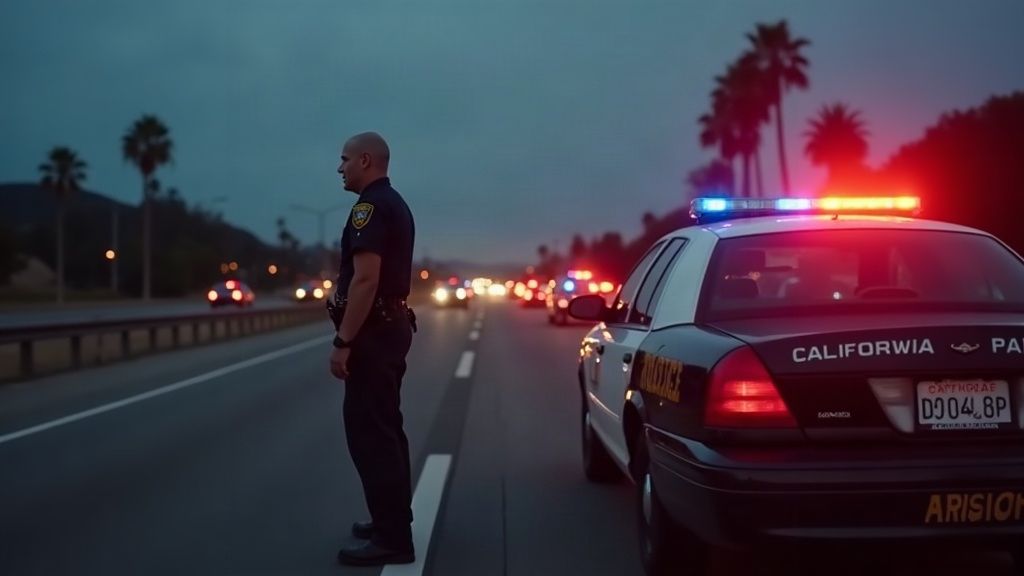
If you've been hit while stopped on the side of a California freeway, or if a passing driver blew past your stranded car without slowing down, you're not alone, and you're not without rights. California's Move Over law exists specifically to protect people in your position, and a driver who ignores it can be held legally responsible for every injury they cause.
Below are 9 concrete facts about how California's Move Over law works, how liability is established, and what steps protect your claim from the moment the collision happens.
Quick summary:
- California Vehicle Code §21809 requires drivers to move over or slow down for stopped vehicles with flashing lights on the shoulder.
- Violating the law is negligence per se under Evidence Code §669, the citation itself is evidence of fault.
- Roadside impacts often occur at freeway speed, producing catastrophic injuries.
- Pure comparative fault (from Li v. Yellow Cab Co., 1975) means partial fault on your part reduces, but does not eliminate, your recovery.
- Tow truck drivers and roadside workers can file both a workers' comp and a third-party personal injury claim.
- Dashcam footage, police reports, and witness statements are your most valuable evidence.
- You have two years from the date of injury to file a California personal injury lawsuit under Cal. Code Civ. Proc. §335.1.
- Never give a recorded statement to the at-fault driver's insurer before speaking with an attorney.
- Call (818) 794-9947 for a free review, no fee unless we win.
1. What the Move Over Law Requires Drivers to Do
California Vehicle Code §21809 requires every driver approaching a stopped emergency, tow, or maintenance vehicle with flashing lights to move one lane away or, if that is not possible, slow to a speed safe for the conditions and below the posted speed limit.
The statute was first enacted to protect law enforcement officers conducting roadside stops and has since been expanded to cover a broader category of stopped vehicles. Under the current version of Vehicle Code §21809, the move-over requirement applies to:
- Any police, fire, or emergency vehicle displaying amber, red, or blue warning lights.
- Tow trucks and roadside assistance vehicles displaying amber flashing lights.
- Caltrans maintenance and construction vehicles on the shoulder.
- Any vehicle using hazard flashers or flares on the roadside, in certain conditions.
Takeaway: A passing driver who does neither, does not move over AND does not slow down, has violated a specific California statute, which has significant consequences for your injury claim.
2. Common Situations Where the Law Applies
If you are hit while legally stopped on the shoulder of a California freeway, you have the right to file a personal injury claim against the driver who failed to comply with Vehicle Code §21809.
Vehicle Code §21809 is broader than most people realize. The law is not limited to police traffic stops. It applies in everyday situations that any California driver could encounter:
- CHP traffic stops: An officer who has pulled a vehicle over is working in the shoulder zone. All passing traffic must move over.
- Tow truck hookups: A tow truck with amber lights actively hooking or towing a disabled vehicle triggers the move-over requirement for every driver who passes.
- Caltrans lane closures: Work vehicles with flashing amber lights parked on the shoulder qualify, this includes pothole crews, sign maintenance workers, and bridge inspection vehicles.
- Stalled motorists: A car stopped on the shoulder with hazard lights activated may qualify, depending on whether a law enforcement or emergency vehicle is also present.
- AAA and commercial roadside assistance: Private roadside assistance trucks with flashing amber warning lights fall within the law's scope.
Takeaway: If a vehicle with flashing lights was stopped on the shoulder and a driver failed to move over before hitting you, Vehicle Code §21809 almost certainly applies to your situation.
3. Why Roadside Accidents Often Involve High-Speed Impacts
Freeway shoulders sit within feet of lanes where traffic travels at 65-80 miles per hour. When a driver who fails to move over strikes a stopped person or vehicle, the physics are brutal. Even a glancing blow at that speed can flip a car, propel a pedestrian dozens of feet, or crush a worker between two vehicles.
This matters for your personal injury claim for several reasons:
- Severity of injury: Traumatic brain injuries, spinal cord injuries, crushed limbs, and wrongful death are all documented outcomes of roadside freeway impacts. The severity of your injuries directly affects the value of your claim for medical expenses, lost wages, and pain and suffering.
- Property damage scale: A high-speed impact often totals not just the stopped vehicle but the tow truck or emergency vehicle alongside it.
- Insurance limits: Serious injuries from high-speed impacts often exceed a single driver's insurance policy limits, which is why an attorney needs to investigate whether additional coverage, umbrella policies, employer coverage, or government liability, applies.
Takeaway: Roadside freeway accidents tend to produce serious injuries. Document every symptom and seek emergency care the same day, because delayed medical treatment is the first argument an insurance carrier will use to dispute the severity of your claim.
4. How Liability Is Determined When a Driver Fails to Move Over
A driver who violates California's Move Over law is negligent per se under Evidence Code §669, which means the violation itself establishes their duty and breach of duty in a personal injury lawsuit.
Under California Evidence Code §669, a person who violates a statute is presumed negligent if the violation caused an injury of the type the statute was designed to prevent, to a person in the class the statute was designed to protect. Vehicle Code §21809 was enacted specifically to protect stopped motorists, workers, and officers from being struck by passing traffic. That alignment is nearly perfect.
What negligence per se means in practice:
- You do not need to prove the driver was distracted, drunk, or reckless. The violation is enough.
- The at-fault driver must affirmatively show why their violation was excused, which is a heavy burden.
- A citation issued at the scene under Vehicle Code §21809 becomes a powerful piece of evidence in your civil claim.
You still need to prove causation (the violation caused your injuries) and damages (your injuries caused real, documented losses). But the negligence per se doctrine removes the most contested element of a standard negligence case, whether the driver acted unreasonably.
Takeaway: A police report showing a Vehicle Code §21809 citation is worth pursuing aggressively. It converts a contested negligence case into a causation-and-damages dispute, which is a significantly stronger position for the injured party.
5. What Happens If You're Hit While Legally Stopped on the Shoulder
If you were legally stopped on the shoulder because of a breakdown, a flat tire, a CHP traffic stop, or any other lawful reason, you have the right to pursue a personal injury claim against the driver who failed to move over. Your legal stop does not bar your recovery.
California personal injury claims for Move Over violations typically seek compensation for:
- Medical expenses: Emergency room, surgery, hospitalization, physical therapy, and ongoing specialist care.
- Lost wages: Time missed from work during recovery, plus diminished earning capacity if the injury is permanent.
- Pain and suffering: Non-economic damages for the physical pain, emotional distress, and reduced quality of life caused by the collision.
- Property damage: Repair or replacement of your vehicle.
The statute of limitations for a personal injury lawsuit in California is two years from the date of injury under Cal. Code Civ. Proc. §335.1. If a government employee, such as a CHP officer or Caltrans worker, was the at-fault driver operating a government vehicle, a government tort claim under the California Government Claims Act must be filed within six months of the incident. Miss that window and your right to sue the government entity is permanently barred.
Takeaway: Most roadside accident victims have a two-year window, but that shrinks to six months if a government driver is at fault. Contact an attorney as soon as possible to identify every potentially liable party.
6. Special Risks for Tow Truck Drivers and Roadside Assistance Workers
Tow truck drivers and roadside assistance workers injured by a passing driver may have both a workers' compensation claim and a third-party personal injury claim against the driver who failed to move over.
For tow truck operators, roadside mechanics, and Caltrans workers, a Move Over violation is not just a civil matter, it is a workplace injury. California law gives these workers two overlapping legal claims:
Workers' compensation claim: Any injury that occurs in the course of employment triggers coverage under California's workers' comp system, administered by the DWC. Workers' comp pays for all reasonable medical treatment and a portion of lost wages (typically two-thirds of average weekly earnings, up to a statutory cap) regardless of who was at fault. The employer's workers' comp insurer pays these benefits.
Third-party personal injury claim: Because the injury was caused by a third-party driver, not the employer, the injured worker can also file a personal injury lawsuit directly against the at-fault driver. This claim can recover the full range of damages that workers' comp does not cover: pain and suffering, the remaining one-third of lost wages, and any damages beyond the workers' comp caps.
These two claims run simultaneously and are not mutually exclusive. The workers' comp insurer will likely assert a lien against any personal injury recovery to recoup the benefits it paid, but the net result for the worker is typically higher than either claim alone.
Takeaway: If you are a tow truck driver or roadside worker injured on the job, do not accept only a workers' comp settlement without first consulting a workers' compensation attorney about the third-party claim. Settling only one of the two available claims leaves money on the table.
7. How Comparative Fault Can Apply to Roadside Accidents
California follows the pure comparative fault rule from Li v. Yellow Cab Co. (1975) 13 Cal.3d 804, so a roadside accident victim can still recover compensation even if they were partly at fault, with their award reduced by their percentage of responsibility.
Insurance carriers defending a Move Over claim routinely try to shift some fault onto the stopped motorist or worker. Common arguments include:
- The stopped vehicle was partially in the travel lane, not fully on the shoulder.
- The driver failed to activate hazard lights or deploy warning triangles.
- The vehicle stopped in a location where visibility was poor and no alternative was available.
California's pure comparative fault rule, established by the California Supreme Court in Li v. Yellow Cab Co. (1975) 13 Cal.3d 804, means these arguments reduce your recovery rather than eliminate it. If a jury finds you were 20% at fault and your damages total $200,000, you recover $160,000. You can be found 50% at fault and still recover half of your proven damages.
A separate statute, Civil Code §1431.2, addresses how non-economic damages are allocated among multiple defendants on a several-liability basis. That is a different concept from comparative fault between a plaintiff and defendant, but it can affect how much each of several at-fault parties pays when more than one driver contributed to the collision.
Takeaway: Do not let an insurance adjuster convince you that any fault on your part ends your claim. Under California law, partial fault reduces recovery, it does not eliminate it. Document every precaution you took (hazard lights, warning triangles, pulling fully onto the shoulder) to minimize any fault allocation against you.
8. Evidence That Helps Prove a Move Over Violation
The strength of a Move Over accident claim rises and falls on evidence gathered in the hours and days after the collision. The at-fault driver's insurer will challenge everything it can. These are the evidence categories that matter most:
- Police report and citation: A Vehicle Code §21809 citation issued by the responding officer is the single most powerful piece of evidence. Request the full report and any supplemental materials.
- Dashcam footage: Your vehicle's dashcam, the tow truck's dashcam, or a following driver's dashcam can show the at-fault driver's lane position and speed.
- Traffic and surveillance cameras: Caltrans operates an extensive camera network on California freeways. Your attorney can send a preservation letter to Caltrans immediately, this footage is typically overwritten within days.
- Witness statements: Drivers who stopped or who witnessed the collision from adjacent lanes can confirm that the at-fault driver did not move over. Get names and phone numbers at the scene.
- Electronic data: Modern vehicles record pre-crash speed, braking, and steering data in an event data recorder (EDR, often called a "black box"). A court order or preservation letter can secure this data before the vehicle is repaired or scrapped.
- Skid-mark and scene analysis: A reconstruction expert can use physical evidence on the roadway, skid marks, gouge marks, debris fields, to calculate the at-fault driver's speed and lane position at the moment of impact.
Takeaway: Freeway camera footage is overwritten on a short cycle. If dashcam or Caltrans camera evidence exists, a preservation letter must go out within 24-48 hours. This is one of the first things an attorney should do after being retained.
9. Steps to Take After Being Hit While Stopped on the Roadside
If you are struck or nearly struck while stopped on a California freeway shoulder, the actions you take in the first hours directly affect the strength of your injury claim.
- Stay behind the guardrail or as far from traffic as possible. A second strike by a passing vehicle is a real danger. Do not stand in or near the travel lanes to survey the damage.
- Call 911 immediately. A police report documenting the scene, the positions of vehicles, and any citation under Vehicle Code §21809 is essential to your claim.
- Photograph everything before the scene changes. Capture your vehicle's position relative to the shoulder line, the at-fault vehicle, skid marks, debris, and any visible injuries, before tow trucks or other responders move anything.
- Collect witness information. Ask bystanders and stopped drivers for their name, phone number, and a brief description of what they saw.
- Seek medical care the same day. Even if you feel able to walk, adrenaline masks injury. A same-day emergency room or urgent care visit creates a medical record that ties your injuries directly to the collision. Gaps between the accident and your first medical visit are a standard insurance defense argument.
- Do not give a recorded statement to the at-fault driver's insurance carrier. You are not legally required to, and recorded statements are routinely used to minimize or deny claims.
- Contact a California personal injury attorney before accepting any settlement offer. A first offer from an insurer is almost never the full value of the claim. An attorney can evaluate liability, identify all available insurance coverage, and negotiate from a position of documented strength.
Takeaway: The 72 hours after a roadside collision are critical for evidence preservation and medical documentation. Both are significantly harder to reconstruct after the fact.
Frequently Asked Questions
What is California's Move Over law?
California Vehicle Code §21809 requires drivers approaching a stopped emergency, law enforcement, tow, or maintenance vehicle displaying flashing lights on the shoulder to move one lane away from that vehicle. If changing lanes is not safe or possible, drivers must slow to a speed below the posted speed limit that is safe for road conditions.
What happens if someone doesn't move over and hits me?
If a driver violates Vehicle Code §21809 and injures you, they can be held liable for your medical expenses, lost wages, pain and suffering, and property damage in a California personal injury lawsuit. Under Evidence Code §669, the statutory violation establishes their negligence per se, making it easier to prove the breach of duty element of your claim.
Do I have a claim if I'm hit while parked on the shoulder?
Yes. Being legally stopped on the shoulder does not bar your personal injury claim. California's pure comparative fault rule, established in Li v. Yellow Cab Co. (1975) 13 Cal.3d 804, allows you to recover damages even if you bear partial fault for the collision, your recovery is reduced by your percentage of fault, not eliminated.
Does the Move Over law apply to all vehicles?
California Vehicle Code §21809 covers law enforcement, fire, emergency medical, tow, and Caltrans maintenance vehicles, as well as any other vehicle displaying amber warning lights on the shoulder. Private roadside assistance trucks (such as AAA service vehicles) with flashing amber lights are included. The law does not require every stopped civilian car with hazard lights on to trigger the same duty, but other statutes requiring safe speed and reasonable care still apply.
How long do I have to file a claim after a Move Over accident?
The standard California personal injury statute of limitations is two years from the date of injury under Cal. Code Civ. Proc. §335.1. However, if the at-fault driver was a government employee operating a government vehicle, a government tort claim must be filed within six months of the incident. Missing the government claim deadline permanently bars your lawsuit against the public entity.
Can a tow truck driver injured on the job sue the driver who hit them?
Yes. A tow truck driver injured by a passing driver who failed to move over has two separate claims: a California workers' compensation claim against their employer's insurer for medical bills and partial lost wages, and a third-party personal injury lawsuit against the at-fault driver for the full range of damages workers' comp does not cover, including pain and suffering. Both claims can proceed at the same time.
If you or someone you know was hit while stopped on a California freeway shoulder, the evidence window is short and the insurance carrier's first call will not be in your favor. We've recovered over $150,000,000 for injured workers and accident victims across Southern California, and we handle every case as if it were going to trial, because that's the leverage that produces real results.
Call (818) 794-9947 for a free case review. No fee unless we win.
Reviewed by Minas Nordanyan, CA Bar No. 296806. Last updated September 2026.