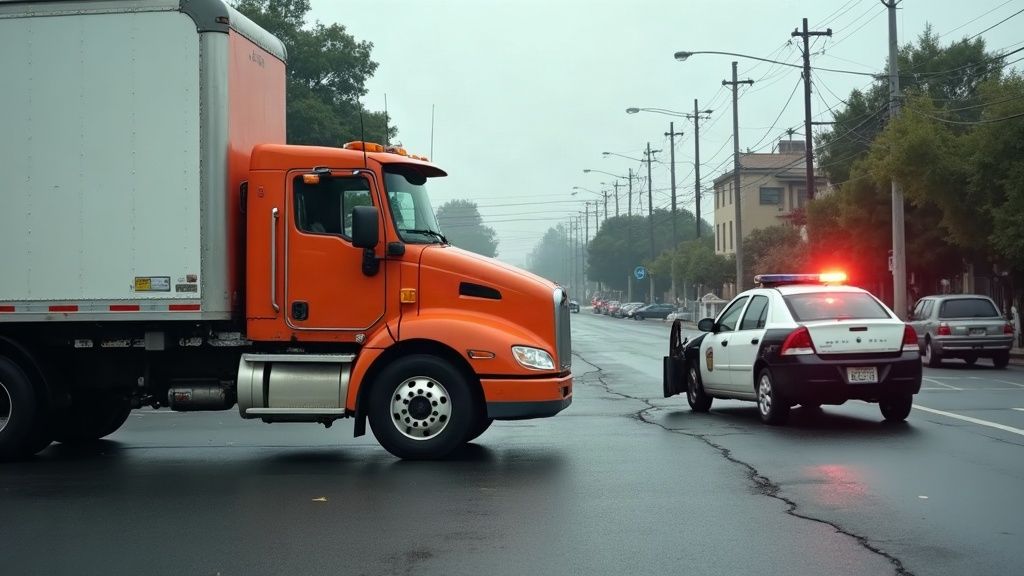
If you were hurt in a moving truck accident in California, the first question your mind goes to is simple: who is going to pay for this?
The answer is not always obvious. Moving truck crashes create a tangle of overlapping parties, insurance policies, and legal rules that a standard two-car fender-bender never raises. The renter may be liable. The rental company may share responsibility. A hired moving crew that loaded the truck may factor in. And California's comparative fault rules mean more than one party can owe you money at the same time.
This guide explains exactly how liability works, what insurance covers, and what steps protect your right to full compensation after a moving truck collision in California.
If you or someone close to you was injured in a moving truck accident, call (818) 794-9947 for a free case review. No fee unless we win.
Quick-Answer Summary
- The renter is usually the primary liable party for crashes caused by their own negligent driving.
- The federal Graves Amendment generally shields rental companies from vicarious liability, but NOT from their own independent negligence.
- U-Haul's optional coverage products are not the same as traditional insurance, and the gap matters.
- Improper cargo loading can make a third party, such as a moving company, liable regardless of who was driving.
- California pure comparative fault lets you recover even if you were partly at fault, but your award is reduced by your percentage.
- You generally have two years to file a personal injury lawsuit under Cal. Code Civ. Proc. §335.1.
- Call (818) 794-9947 to talk through your specific facts with a California personal injury attorney, at no cost.
Why Moving Truck Accidents Raise Unique Liability Questions
A standard car accident involves two drivers and their auto insurance carriers. A moving truck collision can involve the renter who drove the truck, the rental company that owned it, a professional moving crew that loaded it, employers of any of those parties, third-party drivers, and multiple insurance or coverage products that may or may not overlap.
Each of those parties potentially owes a duty of care under California negligence law. Figuring out which one, and in what proportions, is the central challenge in these cases.
The size and weight of moving trucks adds another layer. A loaded 26-foot box truck can weigh more than 26,000 pounds. Stopping distances are longer. Blind spots are larger. Turning radius is wider. Drivers who have never operated a large vehicle before step into these trucks at rental lots every weekend. That inexperience is often a direct cause of the crash.
Common Causes: Unfamiliar Vehicles, Overloaded Cargo, Blind Spots
Understanding what caused the collision matters because it directly shapes who is responsible.
Driver inexperience and handling errors are the most frequent cause. A person comfortable in a sedan or SUV may not account for the extra height when passing under a low bridge, or the extra stopping distance when approaching a red light on a downhill grade.
Overloaded or improperly distributed weight changes how a truck handles. A top-heavy load raises the center of gravity and increases rollover risk, especially on freeway on-ramps and curved roads that are common throughout Southern California.
Unsecured cargo shifting during transit can cause sudden instability. If cargo breaks through a cab wall or shifts dramatically in a turn, the driver loses control with no warning.
Blind spots on large rental trucks are significantly larger than on passenger vehicles. Rear cameras are increasingly standard, but mirrors on both sides must be properly adjusted, and many rental customers never check them.
Mechanical defects on the truck itself, such as worn brake components, faulty tie-rods, or underinflated tires, can cause or contribute to a crash through no fault of the driver.
Each of these causes points toward a different defendant. Driver error points toward the renter. A mechanical defect points toward the rental company. Improperly loaded cargo points toward whoever packed the truck.
Who Can Be Liable: The Renter, the Rental Company, or a Third Party
In California, the driver who rented the moving truck is usually the first financially responsible party, because the rental agreement places responsibility for safe operation on the renter.
The Renter
When someone signs a U-Haul or Penske rental agreement, they accept responsibility for operating the vehicle safely and in compliance with California traffic law. If the renter drives distracted, ignores traffic signals, or loses control due to inexperience, their personal auto insurance policy, and any supplemental coverage they purchased at the rental counter, are the first line of financial recovery for people they injure.
The Rental Company
Under the federal Graves Amendment, commercial rental companies like U-Haul generally cannot be held vicariously liable for a renter's negligent driving unless the company was independently negligent.
The Graves Amendment, codified at 49 U.S.C. §30106, was enacted specifically to protect rental and leasing companies from automatic liability simply because they own the vehicle involved in a crash. As long as the company was not itself negligent and is engaged in the trade or business of renting or leasing motor vehicles, vicarious liability does not attach.
That said, the Graves Amendment does NOT protect a rental company from its own direct negligence. If U-Haul rented out a truck with brake pads it knew were dangerously worn, or failed to maintain its fleet to safe operating standards, it can be held directly liable for the resulting harm. These are the cases that require a thorough inspection of maintenance records, rental-lot inspection logs, and prior complaint histories for that specific vehicle.
Third Parties: Moving Companies and Others
If you hired a moving company to load the truck, and the crew packed boxes incorrectly, stacked weight unevenly, or failed to secure furniture with straps, that moving company may carry liability for any accident attributable to cargo instability. Moving company employees act in the scope of their employment when loading, which means the company itself can be sued directly for their negligence.
Other third parties who can be liable include:
- Other drivers whose negligent actions forced the renter into a crash
- Government entities if defective road design or a missing warning sign contributed
- Mechanics or maintenance vendors if negligent service caused a mechanical failure
Understanding Rental Truck Insurance and Waiver Coverage
This is one of the most misunderstood pieces of a moving truck accident claim.
When a customer stands at the U-Haul counter, they are offered products with names like Safemove and Safemove Plus. These are not traditional insurance policies in the sense that they are filed with and regulated by the California Department of Insurance in the same way auto policies are. They are contractual protections sold as part of the rental agreement.
What they typically cover:
- Collision damage to the rental truck itself
- Cargo protection for items being transported (subject to exclusions)
- Medical and life coverage for the renter and listed drivers
What they often do NOT cover:
- Damage to the other party's vehicle or property
- Injuries to third parties hurt in the accident
- Incidents occurring when the truck was used in a way that violates the rental agreement
The renter's personal auto insurance may provide some coverage. Many personal auto policies extend to rental vehicles, but most have exclusions for vehicles above a certain weight or length, which many moving trucks easily exceed. This is a critical gap that must be verified before any assumption is made about coverage.
Commercial auto coverage applies if the renter was driving the truck in the course of their business. For example, a contractor renting a truck to move equipment for a job site would typically look to a commercial policy.
The bottom line: coverage in moving truck accidents is often patchwork. An experienced personal injury attorney can identify every applicable policy and make sure no source of compensation is overlooked.
Injuries Common in Moving Truck Collisions
The size of moving trucks means the injuries they cause tend to be serious. Common injury types seen in these crashes include:
- Traumatic brain injuries (TBI), ranging from concussion to severe intracranial hemorrhage, caused by violent impact or a vehicle rollover
- Spinal cord injuries that can result in partial or complete paralysis
- Broken bones and fractures, especially in the extremities, pelvis, and ribs
- Soft tissue injuries to the neck, back, and shoulders, which can become chronic conditions
- Internal organ injuries caused by seatbelt force or direct impact
- Lacerations and burns from shattered glass, metal, or post-crash fires
Injuries from large-vehicle crashes frequently require extended hospitalization, multiple surgeries, long-term physical therapy, and in serious cases, lifetime care. These costs add up in ways that a first-offer settlement from an insurance carrier will rarely reflect.
Steps to Take After a Moving Truck Accident in California
What you do in the hours and days after the crash has a direct effect on the strength of your claim. Here is what matters most.
1. Call 911 immediately. Any crash involving injury requires law enforcement at the scene. Cal. Veh. Code §20008 requires the driver of any vehicle involved in an accident that caused injury or death to report it to local police, the California Highway Patrol, or the county sheriff. Get a copy of the official report.
2. File an SR-1 report with the DMV if required. Separate from the police report, Cal. Veh. Code §16000 requires any driver involved in an accident that caused injury, death, or property damage exceeding $750 to file an SR-1 report with the DMV within 10 days. This is a distinct obligation from notifying law enforcement.
3. Document the scene thoroughly. Photograph every angle of both vehicles, the road, skid marks, cargo spill, traffic controls, and any visible injuries. Video is even better.
4. Collect information. Get the renter's full name, driver's license number, rental agreement number, and the name of the rental company. Collect names and contact information from all witnesses.
5. Seek medical care immediately. Even if you feel fine, adrenaline masks pain. Many serious injuries, including spinal injuries and internal bleeding, do not produce obvious symptoms right away. A same-day medical evaluation creates the documentation that links your injuries to the crash.
6. Do not give recorded statements to any insurance carrier without speaking to an attorney first. Anything you say can and will be used to reduce or deny your claim.
7. Preserve evidence. If possible, note the truck's license plate, rental unit number, and any visible condition issues such as worn tires or cracked mirrors. Ask your attorney to send a preservation letter to the rental company to secure maintenance records before they are destroyed.
8. Call an attorney before accepting any settlement offer. First offers from insurance carriers are typically well below the actual value of a serious injury claim.
How Comparative Fault Applies When Cargo or Loading Is at Issue
California follows a pure comparative fault rule from Li v. Yellow Cab Co., which means an injured person can still recover even if they were partly at fault, but their award is reduced by their percentage of fault.
In moving truck cases, comparative fault questions arise most often around cargo. If an injured person helped load the truck before the trip, a defense attorney may argue they share responsibility for how that cargo was packed. If the person riding in the moving truck failed to wear a seatbelt, that may reduce their recovery for injuries the seatbelt would have prevented.
Under the pure comparative fault system established in Li v. Yellow Cab Co., 13 Cal.3d 804 (1975), multiple defendants can each be assigned a percentage of fault. Each defendant is fully (jointly and severally) liable for economic damages such as medical bills and lost wages. For non-economic damages such as pain and suffering, each defendant is only responsible for their own proportionate share, under Cal. Civ. Code §1431.2, which California voters enacted as Proposition 51 in 1986.
This matters practically because if one defendant is insolvent or judgment-proof, the victim may not be able to collect that defendant's share of non-economic damages from the other defendants.
The Statute of Limitations: Do Not Wait
You generally have two years from the date of injury to file a personal injury lawsuit in California under Cal. Code Civ. Proc. §335.1.
Two years sounds like a long time. It is not, in practice. Building a moving truck accident case requires gathering maintenance records, rental agreements, cargo loading documentation, witness statements, and expert opinions on vehicle mechanics or load distribution. That investigation takes time, and evidence disappears.
If the crash involves a government vehicle or a road defect caused by a public entity, the timeline is even shorter. A claim against a California government entity must typically be filed within six months of the incident under Cal. Gov. Code §911.2.
Call (818) 794-9947 as soon as possible. We'll identify every deadline that applies to your situation and make sure none of them are missed.
How Nordanyan Law Handles Moving Truck Accident Cases
We've recovered over $150,000,000 for injured Californians since 2014. Moving truck and large-vehicle cases are part of our personal injury practice, which sits alongside our core workers' compensation specialty.
Every injured worker deserves the same quality of legal representation as any corporation. That principle applies just as directly to someone hit by a U-Haul on a Los Angeles surface street as it does to a warehouse employee hurt on the job.
When you call us, here is what happens:
- A free, confidential case review with a member of our legal team
- We identify every party who may owe you compensation and every applicable insurance policy
- We handle all communication with carriers so you do not have to
- We work on contingency, meaning $0 upfront and no fee unless we win
For help with a personal injury claim, visit our personal injury practice area page or contact us to get started.
If your moving truck accident happened while you were on the job, you may have both a workers' compensation claim and a third-party personal injury claim running at the same time. Visit our workers' compensation practice area page for more information on how those claims interact.
FAQ: Moving Truck Accident Liability in California
Who is liable in a U-Haul accident in California?
Liability depends on the cause of the crash. If the renter drove negligently, the renter is primarily liable. If a mechanical defect caused the crash, the rental company may be directly liable. If improperly loaded cargo caused the accident, the party who loaded the truck, whether that was the renter, a friend, or a hired moving crew, may share liability. California allows multiple parties to be found liable in different proportions.
Does U-Haul insurance cover accident injuries?
U-Haul's optional coverage products, such as Safemove and Safemove Plus, provide some medical coverage for the renter and listed drivers, and some cargo protection. They do not typically cover injuries to third parties hurt in the accident. Third-party claims generally go through the renter's personal auto insurance, a commercial policy if applicable, or directly against the at-fault party. If you were injured as a third party, your own uninsured/underinsured motorist coverage may also apply.
What if a moving truck's cargo caused the accident?
If cargo that fell or shifted caused the crash, liability analysis focuses on who was responsible for loading and securing the cargo. If a professional moving company loaded the truck, that company and its employees may be liable. If the renter loaded the truck themselves, the renter is responsible. California law requires that loads on vehicles not be transported in a manner that creates a hazard under Cal. Veh. Code §23114, which covers spilling, dropping, or releasing material onto the roadway.
Can I sue the truck rental company after a crash?
You can sue the rental company if you have evidence that the company's own negligence contributed to the crash, such as a failure to maintain the truck in roadworthy condition. The federal Graves Amendment generally prevents suing the rental company solely because it owned the vehicle. That said, the Graves Amendment does not apply to independent acts of negligence by the company itself.
Does it matter if I was partly at fault for the accident?
No, it does not bar your claim. California uses a pure comparative fault system from Li v. Yellow Cab Co. You can recover damages even if you were 99 percent at fault, though your recovery is reduced by your percentage of responsibility. The more important question is how fault is apportioned among all parties involved.
What evidence is most important in a moving truck accident case?
Maintenance records for the rental truck, the rental agreement, cargo loading documentation, photos and video from the scene, witness statements, the official police report, and any communications between the renter and the rental company before or after the crash. In cases involving cargo, loading instructions or inventory lists are also valuable. Secure this evidence early, as rental companies have their own document retention timelines.
How long do I have to file a personal injury lawsuit in California?
Generally two years from the date of injury under Cal. Code Civ. Proc. §335.1. If a government entity is involved, that window may be as short as six months. Call an attorney promptly, because building the case takes time and evidence disappears.
What should I do if the rental truck driver had no insurance?
If the at-fault party has no applicable insurance or insufficient coverage, check your own auto policy for uninsured or underinsured motorist (UM/UIM) coverage under Cal. Ins. Code §11580.2. UM/UIM coverage is required to be offered to California policyholders and can fill the gap when the at-fault driver cannot pay. An attorney can identify every available source of recovery.
Call (818) 794-9947 for a Free Case Review
If you were injured in a moving truck accident in California, every day that passes is a day evidence ages, witnesses become harder to find, and deadlines move closer.
We've recovered over $150,000,000 for injured Californians. We work on contingency, so there is $0 upfront and no fee unless we win. Call (818) 794-9947 today for a free, confidential case review in English or Spanish.
You can also start your free consultation online or visit our results page to see what we've recovered for clients.
Reviewed by Minas Nordanyan, CA Bar #296806. This article is for general informational purposes and does not constitute legal advice. Every case turns on its specific facts. Contact a licensed California attorney to evaluate your situation.