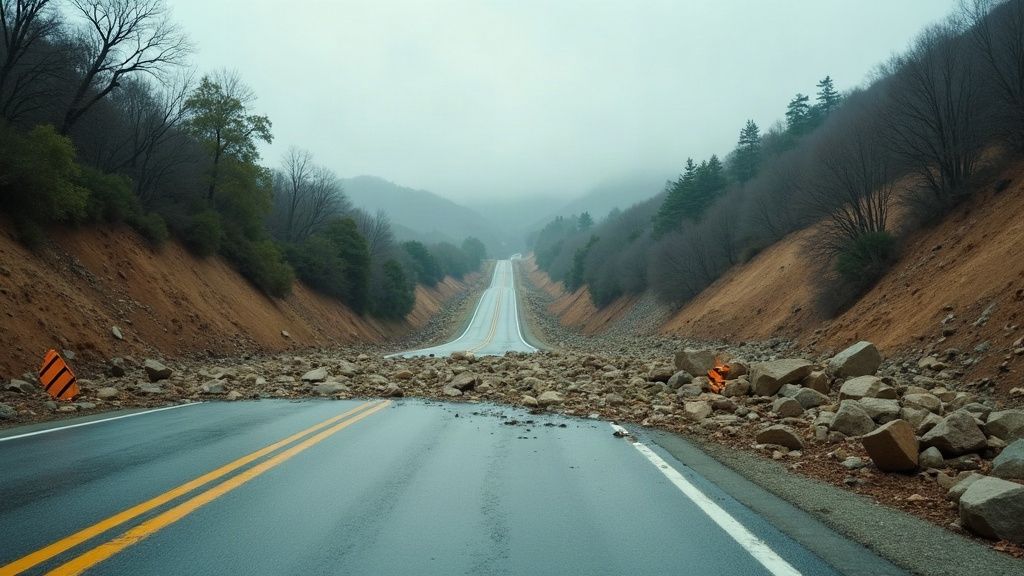
If you were driving a California highway when rocks or mud suddenly buried the road, you already know how fast everything can go wrong. One second the lane is clear; the next, you are swerving into debris you cannot avoid. If you or a passenger were injured, you have a legal path to compensation, but the rules for mudslide and rockslide accident claims in California are specific, and the deadlines are unforgiving.
This article explains who can be held liable, how the government claims process works, what your insurance covers, and what evidence you need to build a strong case.
If you've been injured in a slide-related road accident in California, call (818) 794-9947 for a free consultation. No fee unless we win.
Quick Answers (TL;DR)
- Caltrans or a local agency can be liable when it had prior notice of a slide hazard and failed to warn or repair.
- Private landowners can be liable when their unstable hillside sheds debris onto the road.
- You must file a Government Tort Claim within six months of your injury before suing any public agency.
- Comprehensive auto coverage, not collision, is what typically pays for slide-related vehicle damage.
- California pure comparative fault means your recovery is reduced by your share of fault, but not eliminated.
- Evidence from slide zones disappears fast, so acting quickly matters.
Where and Why Mudslide and Rockslide Crashes Happen Most in California
California's geography makes it one of the most slide-prone states in the country. Steep coastal bluffs, decomposed granite hillsides, fire-scarred slopes, and heavy winter atmospheric rivers create ideal conditions for debris to reach the road.
The stretches of highway with the highest historical risk include:
- Pacific Coast Highway (SR-1) between Malibu and Santa Barbara, where the Santa Monica Mountains meet the ocean.
- Highway 1 in Big Sur, where active slides have closed the road for months at a time.
- Interstate 5 and U.S. 101 through the Tehachapi and Santa Ynez ranges, especially after wildfires remove ground cover.
- State Route 138 and Angeles Crest Highway (SR-2) in the San Gabriel Mountains.
- U.S. 50 and SR-89 in the Sierra Nevada foothills, where freeze-thaw cycles loosen rock faces.
Wildfire is a major accelerant. When a fire burns away roots and vegetation, the next rainstorm can send sheets of mud and boulders across roads that were stable for decades. The Thomas Fire of 2017 is a documented example: the January 2018 Montecito debris flow that killed 23 people followed directly in the fire's footprint.
Natural-Disaster Defense Versus Negligent Road Maintenance or Warning Failures
California law recognizes that some slide events are genuinely unforeseeable. An unprecedented storm producing rainfall volumes no historical record predicted is a natural-disaster event that may shield a government agency from liability.
But that defense is narrower than insurers and agencies often imply. The legal test is not whether a slide was dramatic or large. It is whether the agency had reasonable notice that the road was dangerous and whether it took reasonable steps in response.
Under Cal. Gov. Code §835, a public entity is liable for injury caused by a dangerous condition of its property when:
- The property was in a dangerous condition at the time of the injury.
- The injury was proximately caused by that condition.
- The dangerous condition created a reasonably foreseeable risk of the kind of injury that occurred.
- The public entity had actual or constructive notice of the condition a sufficient time before the injury to have taken protective measures.
Notice is the key battleground. If a Caltrans geologist flagged slope instability on a stretch of highway six months before your crash, and no warning signs were posted, that is actual notice. If the slope showed visible crack patterns that any reasonable inspector would have flagged on a routine survey, that is constructive notice, meaning the agency should have known even if no one formally reported it.
Failing to post warning signs, closing a known high-risk road during a storm watch, or clearing rockfall from an earlier event are all actions that can establish prior notice. Each inaction becomes evidence in your case.
When a Public Entity Had Notice of Slide Risk and Failed to Act
Proving notice requires documents, and those documents are held by the agencies you are suing. Here is what matters:
Caltrans inspection reports. Caltrans conducts regular slope-stability surveys on state highways. A report identifying a hazard zone months or years before your crash is powerful evidence.
Rockfall history records. Many California highway segments have documented histories of prior rockfall events. Prior falls put the agency on notice that the same location is dangerous.
Work orders and maintenance logs. A work order to clear debris from a previous slide that was never completed, or completed too slowly, shows the agency knew and failed to follow through.
Weather and storm-watch data. When an agency issues a storm warning for a region but does not close a known slide-prone road, that decision becomes evidence of a judgment the court can evaluate.
You can request these records through the California Public Records Act, now codified at Cal. Gov. Code §7920.000 et seq. (the former §6250 was repealed effective January 1, 2023). Your attorney can also serve formal discovery once litigation begins.
The Government Tort Claim Requirement
Before you can file a lawsuit against a California public agency, you must first file a Government Tort Claim with that agency. This is not optional.
Under Cal. Gov. Code §911.2, the claim must be filed within six months of the date of injury. Missing this window, absent limited exceptions for minors or certain discovery-rule cases, typically bars your lawsuit entirely.
In California, Caltrans or another public agency can be held liable for a mudslide accident if the agency had prior notice of the dangerous road condition and failed to act within a reasonable time.
Before you can sue a California government agency for a landslide road crash, you must file a Government Tort Claim within six months of the injury date under Cal. Gov. Code §911.2.
The agency's board has 45 days to act on the claim under Cal. Gov. Code §912.4. What happens next depends on the agency's response:
- If the agency sends a written rejection: you have six months from the date of that notice to file a civil lawsuit.
- If the agency never responds: you generally have up to two years from the date of the incident to file suit.
If the agency sends a written rejection of your tort claim, you have six months from that notice to file suit; if the agency never responds, you generally have up to two years.
This distinction matters. Many injured people assume they have two years regardless. If the agency sends a formal rejection letter and you treat the deadline as two years, you lose the right to sue. Track both dates from the moment you receive any written response.
Private Landowner Liability
Not every slide originates on government land. When a privately owned hillside sheds rocks or mud onto a public road, the landowner can be held liable under ordinary negligence principles.
Cal. Civ. Code §1714 establishes that everyone is responsible for injuries caused by their want of ordinary care. A landowner who knows their slope is unstable, who has received prior complaints about rock fall, or who has observed cracking and erosion has a duty to take reasonable steps, whether that means engineering remediation, fencing, or notifying the adjacent road agency.
A private landowner whose unstable hillside sheds rocks or mud onto a public road can be held liable for negligence if they knew or reasonably should have known about the danger.
Proof of private landowner liability typically involves:
- Soil stability reports or geotechnical surveys that the landowner commissioned or should have commissioned.
- Prior incidents of debris crossing from the same parcel.
- Complaints from neighbors, hikers, or the road agency to the landowner.
- Photos or drone footage showing visible instability before the accident.
Comprehensive Coverage and Collision Coverage After a Slide-Related Crash
Insurance coverage for slide accidents divides along lines that many drivers do not expect.
Comprehensive coverage pays for damage to your vehicle caused by events outside a collision, including falling objects, rocks, mud, and natural debris. If your car was struck by rockfall or buried in a slide, this is the coverage that applies to your vehicle, subject to your deductible.
Collision coverage applies when your vehicle hits another object or rolls. If you swerved to avoid debris and struck a barrier or another car, collision coverage covers that impact.
Comprehensive auto insurance, not collision coverage, is the policy type that typically pays for vehicle damage caused by falling rocks, mudslides, and debris.
Important notes:
- If you carry only liability coverage, neither comprehensive nor collision protects your own vehicle.
- Your insurer may pay your comprehensive claim and then pursue subrogation against the liable public agency or landowner to recover what it paid.
- Personal injury claims against the responsible party are entirely separate from your first-party insurance claim. You can collect from your insurer for property damage and still pursue full compensation from the liable party for your injuries, medical bills, lost wages, and pain and suffering.
Evidence Collection in Remote or Hazardous Slide Zones
Slide scenes are among the most perishable evidence environments in personal injury law. The next rainstorm can move debris, bury skid marks, and alter the slope. Emergency cleanup crews remove material within days. The physical landscape that tells the story of your crash can disappear quickly.
If you are physically able to do so safely, or if someone can return to the scene on your behalf:
- Photograph and video the debris field, the slope face, and any existing or absent warning signs before cleanup crews arrive.
- Record GPS coordinates or pin the location precisely on a mapping app.
- Photograph your vehicle's position and damage before it is moved or towed.
- Collect names and contact information from all witnesses, including other motorists who stopped.
- Photograph any posted speed limit or warning signs, and document the absence of signs where you would expect them.
- Preserve your clothing, as debris or soil embedded in fabric can establish where you were and what contacted you.
Your attorney can also retain a geotechnical expert to survey the slope and document conditions before additional changes occur. Time matters here as much as it matters with the legal deadlines.
Multi-Vehicle Pileups Triggered by Sudden Debris on the Roadway
A sudden slide can stop the first car without warning, and a chain of rear-end and sideswipe collisions follows within seconds. Multi-vehicle pileups on slide-debris scenes create layered liability questions:
- The public agency or landowner may be liable for the initial hazardous condition.
- Drivers who were following too closely, speeding, or driving without headlights in low visibility conditions share responsibility for downstream collisions.
- Each vehicle's insurer becomes a party to the coverage and fault analysis.
California follows a pure comparative fault rule established by Li v. Yellow Cab Co. (1975) 13 Cal.3d 804. Under this rule, your damages are reduced in proportion to your share of fault, but you can still recover even if you were partially at fault. If a jury finds you 20 percent responsible and your damages are $500,000, you recover $400,000.
California follows a pure comparative fault rule, meaning your recovery is reduced by your percentage of fault but is not eliminated unless you are entirely responsible for the crash.
In a multi-vehicle pileup, each driver's liability percentage is separately evaluated. Working with an attorney who can reconstruct the sequence of collisions, preserve vehicle data from event data recorders, and retain accident reconstruction experts matters significantly in these cases.
How Claims Differ for Drivers, Passengers, and Property Owners
Drivers must navigate both the fault analysis and, if a government entity is involved, the strict Government Tort Claim deadlines described above. If the driver was an employee traveling for work at the time of the crash, a workers' compensation claim may also be available through the DWC alongside the third-party personal injury claim.
Passengers generally have the strongest liability position because they did nothing to cause the crash. A passenger can pursue claims against the responsible public agency, the landowner, and any negligent driver simultaneously. Passengers who are employees injured on a work-related trip face the same workers' comp plus third-party structure.
Property owners adjacent to slide zones may face their own liability if their land contributed to the slide. They may also have first-party property insurance claims for damage to structures or vehicles on their property, separate from any personal injury claims.
FAQ
Who is liable for an accident caused by a mudslide on a California highway?
Liability depends on where the slide originated and what notice the responsible party had. Caltrans or a local road agency is liable when it had actual or constructive notice of a dangerous condition and failed to act in time, under Cal. Gov. Code §835. A private landowner is liable when their negligence allowed an unstable slope to shed debris onto the road. In some cases, both a public agency and a private landowner share liability.
Can Caltrans be sued for not closing a landslide-prone road?
Yes, but you must follow the Government Tort Claims Act process first. File a Government Tort Claim with Caltrans within six months of your injury under Cal. Gov. Code §911.2. If Caltrans sends a written rejection, you have six months from that rejection to file suit. If Caltrans never responds, you generally have up to two years. The core legal question is whether Caltrans had sufficient notice of the danger and failed to take reasonable protective measures.
Does auto insurance cover mudslide or rockslide damage?
Comprehensive coverage pays for vehicle damage caused by falling rocks, mudslides, and debris. Collision coverage pays when your car strikes another object as a result of avoiding debris. If you carry only liability coverage, neither protects your own vehicle. Your comprehensive claim for property damage is separate from any personal injury claim against the responsible party.
How do I prove a mudslide caused my accident?
Evidence includes photographs and video of the debris field and slope, GPS documentation of the scene, witness statements, geotechnical expert analysis of slope instability, Caltrans inspection and maintenance records, weather data, and event data recorder information from your vehicle. Because debris scenes are cleaned up quickly, preserving evidence fast is critical.
What is the deadline to file a lawsuit after a mudslide accident involving Caltrans?
You must file a Government Tort Claim within six months of the injury date before any lawsuit can be filed. After that, the timeline depends on the agency's response: six months from a written rejection notice, or generally up to two years if the agency never formally responds.
What if the slide happened on a county or city road, not a state highway?
The same Government Tort Claims Act rules apply. File your claim with the responsible county or city agency within six months of the injury. Cal. Gov. Code §835 applies to all public entities in California, not just Caltrans.
What if I was partially at fault, such as speeding in a storm?
Under California's pure comparative fault rule from Li v. Yellow Cab Co. (1975) 13 Cal.3d 804, your damages are reduced by your percentage of fault but you are not barred from recovery unless you bear 100 percent of the responsibility. Your attorney will work to minimize the fault attributed to you while maximizing the evidence of the agency's or landowner's negligence.
What if I was a passenger in a commercial vehicle when the slide occurred?
If you were a passenger in a commercial vehicle and you were injured during work-related travel, you may have both a workers' compensation claim through the WCAB and a personal injury claim against the responsible third party. These are separate legal tracks that can run simultaneously, and recovering on both is possible in California.
What damages can I recover in a mudslide car accident claim in California?
Recoverable damages can include past and future medical expenses, lost wages and lost earning capacity, pain and suffering, emotional distress, property damage, and in limited cases involving egregious government conduct, additional remedies. The specific damages available depend on your injuries, your work situation, and whether a public entity or a private party is the defendant.
Should I accept the insurance company's first settlement offer?
No settlement should be signed before you understand the full extent of your injuries and before all responsible parties have been identified. Slide accidents often involve multiple liable parties, and a first offer from one insurer may not account for the government agency's share of liability or the full scope of your future medical needs. Talk to an attorney before you sign anything.
Talk to a California Mudslide Accident Attorney
Slide accident claims in California are legally complex. Government Tort Claim deadlines, multi-party liability, perishable evidence, and insurance coverage disputes all require attention at the same time, usually when you are still recovering from the crash.
We've recovered over $150,000,000 for injured Californians across a range of serious accident cases, and we handle every case as if it were going to trial. If you were hurt in a mudslide or rockslide road accident, call (818) 794-9947 for a free consultation. No fee unless we win. Available in English and Spanish.
Reviewed by Minas Nordanyan, CA Bar #296806. Last reviewed 2026-10-05. This article is for general informational purposes and does not constitute legal advice. Consult a licensed California attorney about your specific facts.