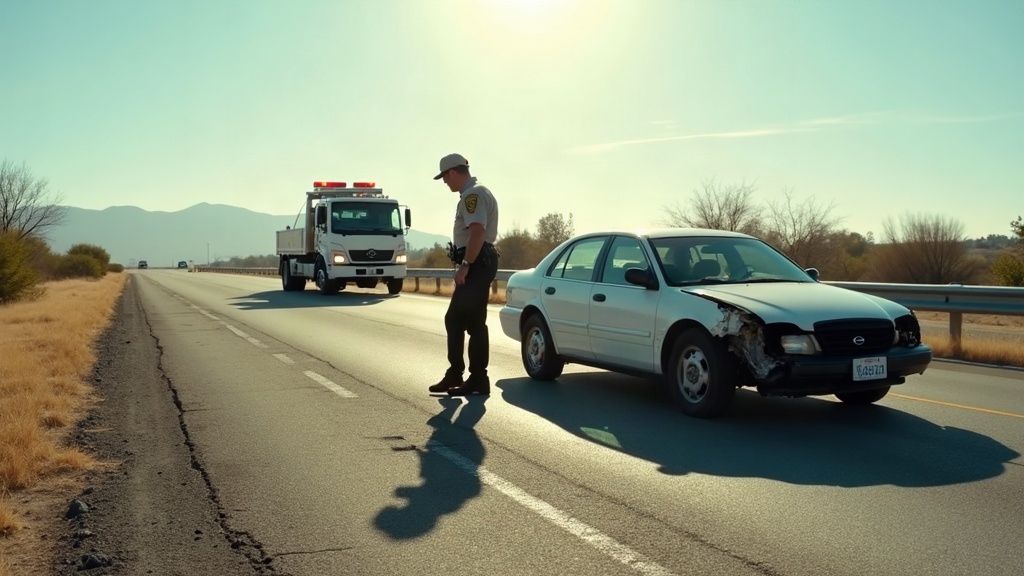
If you've been in a car accident in California and the mechanic recently worked on your vehicle, the repair shop may share legal responsibility for what happened. Repair shop negligence is one of the most overlooked causes of serious accidents, and insurance companies count on injured drivers not connecting the dots.
We've recovered over $150,000,000 for injured people across Southern California. Here's what a specialist looks at first when a bad repair may have caused a crash.
The 8 signs at a glance:
- Sudden brake or steering failure shortly after a repair
- Mismatched or reused parts that should not have passed inspection
- Warning lights ignored, disabled, or cleared without real repairs
- Missing or inconsistent paperwork for recent service work
- Repeat visits for the same unresolved mechanical problem
- How repair shop liability differs from a manufacturer defect claim
- Evidence to preserve, including receipts, work orders, and the vehicle itself
- When to involve an attorney and an accident reconstruction expert
1. Sudden Brake or Steering Failure Shortly After a Repair
If your brakes or steering failed within days or weeks of a shop servicing those exact systems, California law allows you to pursue the repair shop directly for the damages from that accident.
This is the clearest indicator of repair shop negligence. Brakes and steering systems do not spontaneously fail on well-maintained vehicles. When a failure happens shortly after the shop touched those systems, the timeline itself is evidence.
California courts apply a general negligence standard: did the repair shop fail to exercise the care that a reasonably skilled mechanic would have used, and did that failure cause your injuries? Under California Civil Code Section 1714, everyone is responsible for injuries caused by their want of ordinary care. A botched brake job or a steering component left improperly torqued meets that standard directly.
Practical takeaway: Write down the exact repair date, the date of the failure, and any symptoms you noticed in between, such as a soft brake pedal, pulling to one side, or a grinding noise the shop did not resolve.
2. Mismatched or Reused Parts That Should Not Have Passed Inspection
Mismatched, counterfeit, or reused safety-critical parts installed by a repair shop are a direct cause of accidents, and California law treats this as actionable negligence.
California Business and Professions Code Section 9884.9 requires every licensed auto repair dealer to provide a written work order and a final invoice listing every part used and every job completed.
California's Bureau of Automotive Repair (BAR), a division of the California Department of Consumer Affairs, licenses and regulates auto repair shops across the state. The BAR requires shops to use parts that perform at least as well as the original equipment or to obtain the customer's written authorization before using used or rebuilt parts. When a shop bills for new OEM (original equipment manufacturer) parts but installs inferior substitutes, that is both a consumer protection violation and a negligence theory in your personal injury case.
If an accident reconstruction expert or a forensic mechanic examines your vehicle and finds a part that does not match what the invoice says was installed, you have a documented gap between what the shop promised and what it actually did.
Practical takeaway: After an accident, request that the investigating officer note any visible component mismatches in the police report, and arrange for an independent mechanical inspection before any parts are removed or repaired.
3. Warning Lights Ignored, Disabled, or Cleared Without Real Repairs
A shop that clears a dashboard warning code without fixing the underlying problem and hands the keys back to you has created a hidden hazard. This is one of the more serious forms of repair shop negligence because the shop actively conceals the danger.
A repair shop that clears a dashboard warning code without fixing the underlying problem has created a hidden hazard, and California negligence law holds that shop responsible when that hazard causes a crash.
Under California Business and Professions Code Section 9884.7, a licensed auto repair dealer must not misrepresent the condition of a vehicle or the work performed on it. Clearing a code and returning a car without completing the actual repair is a form of misrepresentation. When that unresolved defect causes an accident, the shop had actual knowledge of the problem and chose not to correct it.
This situation often arises with ABS (anti-lock braking system) faults, airbag system warnings, and tire pressure monitoring failures, all of which directly affect vehicle safety.
Practical takeaway: If you have any text messages, voicemails, or written estimates from the shop mentioning a warning code, preserve those records immediately. They establish the shop's knowledge of the defect before the accident.
4. Missing or Inconsistent Paperwork for Recent Service Work
Missing, altered, or incomplete repair paperwork is not a minor administrative issue. In California, it is a statutory violation, and in a negligence case, it is a powerful signal that the shop knows it did something wrong.
California Business and Professions Code Section 9884.9 requires every licensed auto repair dealer to give customers a written authorization before beginning work and a written invoice when the job is done. The invoice must describe every service performed and every part installed, along with whether each part is new, used, rebuilt, or reconditioned.
When you ask a shop for records after an accident and they claim records were lost, the numbers don't match, or the invoice describes work that differs from what a mechanic later finds on the vehicle, a jury is entitled to draw adverse inferences from that inconsistency. Courts refer to this as spoliation of evidence when records are destroyed, and it can support sanctions or adverse jury instructions.
Practical takeaway: Request a complete copy of every work order and invoice from the shop in writing, by certified mail or email, within days of the accident. This creates a documented record of what the shop provided or refused to provide.
5. Repeat Visits for the Same Unresolved Mechanical Problem
If you returned to the same shop two, three, or four times for the same problem, and the problem persisted until it caused an accident, those return visits are among the best evidence in your case.
Each return visit establishes two things simultaneously. First, the shop had documented knowledge that the problem existed. Second, the shop repeatedly failed to fix it. This is not a single moment of carelessness but a pattern of negligence, which California courts take seriously in assessing both liability and damages.
Your invoices from those repeat visits form a timeline. That timeline shows the shop was not just unlucky with a single repair. It shows a sustained failure to exercise the ordinary care a reasonable mechanic would have applied. Under California Civil Code Section 1714, that pattern of conduct is the definition of negligence.
If you paid for the same repair multiple times without resolution and then suffered an accident, you may also have a separate consumer protection claim under California Business and Professions Code Section 17200, California's Unfair Competition Law, in addition to your personal injury claim.
Practical takeaway: Gather every invoice from every visit for the same issue. If you paid by credit card, your statement will show the dates even if you no longer have the paper receipts.
6. How Repair Shop Liability Differs from a Manufacturer Defect Claim
This distinction matters because it changes who you sue, what evidence you need, and how long you have to act.
A repair shop negligence claim says: the part was fine, but the shop installed it incorrectly or failed to identify a dangerous condition. The shop's conduct, not the part itself, caused the accident.
A manufacturer defect claim says: the part was defective when it left the factory, regardless of how it was installed. California applies strict products liability to manufacturers under the framework established in Greenman v. Yuba Power Products (1963), which means you do not need to prove the manufacturer was careless. You only need to prove the product was defective and the defect caused your injury.
In California, you can file a negligent repair claim against the shop and a product liability claim against the parts manufacturer at the same time, because they are independent legal theories.
Both claims can be pursued simultaneously in California. The shop and the manufacturer can each be held liable for their respective share of responsibility. California's Civil Code Section 1431.2 allows a court to apportion fault among multiple defendants in proportion to their contribution to the harm.
An accident reconstruction expert combined with a forensic engineer can typically determine within weeks whether the failure originated in the part's manufacture or in how it was installed or serviced.
Practical takeaway: Do not assume you can only pursue one theory. Tell your attorney about both the repair history and any history of recalled or flagged parts on your vehicle. A quick search of the National Highway Traffic Safety Administration (NHTSA) recall database can reveal whether a part on your vehicle was the subject of a prior recall.
7. Evidence to Preserve, Including Receipts, Work Orders, and the Vehicle Itself
The vehicle itself is the most important piece of evidence in a repair shop negligence case, and allowing an at-fault shop to take custody of it before an independent inspection destroys evidence you cannot recover.
Evidence disappears fast in vehicle negligence cases. Shops retool vehicles. Insurers push for quick repairs. Parts get discarded. Acting within days, not weeks, is the difference between a provable case and a dead end.
Here is the evidence you must preserve immediately:
The vehicle: Do not authorize any repairs until an independent mechanic or a court-ordered inspection has been conducted and documented in writing with photographs. If the shop or insurer insists on taking the vehicle, consult an attorney first. California courts have sanctioned parties who destroyed key physical evidence.
All paperwork: Every invoice, estimate, work authorization, warranty card, and receipt from the repair shop. Every communication with the shop, including text messages and emails.
Photographs and video: The vehicle from all angles, close-ups of the failed or suspected component, the accident scene, skid marks, and any debris on the road.
Your own records: The odometer reading when you dropped the car off and when you picked it up, any notes you made about symptoms after the repair, and any witnesses who heard you report a problem.
The police report: Request a copy of the accident report from the investigating agency within 10 days. It will document road conditions, witness statements, and any officer observations about vehicle condition.
Medical records: Every emergency room visit, doctor's note, and specialist referral from the date of the accident forward. These establish the injury timeline.
Practical takeaway: If you own a dashcam, preserve the footage immediately. Many dashcams overwrite memory within 24-72 hours. Copy the footage to a separate drive that day.
8. When to Involve an Attorney and an Accident Reconstruction Expert
California's personal injury statute of limitations is two years from the date of the accident under Code of Civil Procedure Section 335.1, and that clock runs whether or not you have identified every liable party.
Under California Code of Civil Procedure Section 335.1, you have two years from the date of the accident to file a personal injury lawsuit against a repair shop. If you are filing against a government entity, such as a publicly operated fleet maintenance facility, that deadline is six months under Government Code Section 911.2. Missing either deadline permanently bars your claim.
What most people do not realize is that the first weeks after the accident are the most critical for building the case. This is when:
- Physical evidence on the vehicle is still intact and traceable.
- Witnesses remember what they saw.
- Shop employees have not yet been coached by the shop's insurer.
- Repair records have not been altered or claimed lost.
An accident reconstruction expert examines skid marks, vehicle data recorders (the "black box" that most modern vehicles carry), road conditions, and the mechanical failure point to establish causation. A forensic mechanic disassembles and documents the failed component to determine whether the failure originated in the repair or in the part itself. Both experts are retained and directed by the attorney, which means their findings carry the weight of retained expert testimony in litigation.
We handle every personal injury case as if it is going to trial, because insurance carriers settle for more when they know the other side is prepared to fight. A repair shop's commercial general liability carrier will move quickly to assess and minimize exposure once they learn an attorney is involved. That is leverage you do not have if you try to negotiate alone.
If you were injured at work and driving a company vehicle at the time, your case may also involve a workers' compensation claim alongside the third-party personal injury claim against the shop. Both claims can be pursued simultaneously.
Practical takeaway: Call an attorney before you speak to the repair shop's insurer. Every statement you make to that adjuster can be used to reduce what you recover. The consultation is free and costs you nothing.
Frequently Asked Questions
How do I prove a repair shop caused my accident in California?
You prove repair shop negligence in California by establishing four elements: the shop owed you a duty of care as a licensed repair dealer, the shop breached that duty by performing substandard work, that breach caused your accident, and you suffered damages as a result. Evidence includes the repair invoices, the timeline between the repair and the failure, expert testimony from a forensic mechanic, and the vehicle itself. California Civil Code Section 1714 establishes the general duty of care standard for negligence claims.
Can I sue a mechanic for a car accident in California?
Yes. In California, you can file a personal injury lawsuit directly against the repair shop, the individual mechanic who performed the work, or both, depending on the circumstances. The shop is typically liable under a theory of respondeat superior for the negligent acts of its employees performed within the scope of employment. If the shop is a licensed auto repair dealer, it also faces regulatory liability under the California Bureau of Automotive Repair's standards.
What is the difference between a defective part claim and a negligent repair claim?
A defective part claim, also called a products liability claim, targets the manufacturer or distributor of a part that was defective when it left the factory. It does not require proving carelessness, only that the product was defective and caused injury. A negligent repair claim targets the shop that installed, serviced, or inspected the part and argues the shop's conduct, not the part's manufacture, created the dangerous condition. California courts allow both claims to be filed in the same lawsuit, with fault apportioned among defendants under Civil Code Section 1431.2.
How long do I have to file a claim against a repair shop in California?
California's personal injury statute of limitations is two years from the date of the accident under Code of Civil Procedure Section 335.1. If a government entity operated the repair facility, the deadline to file a government tort claim is six months from the incident under Government Code Section 911.2. Missing either deadline is fatal to the claim. Do not wait to consult an attorney.
What if the repair shop's insurer contacts me first?
Do not give a recorded statement to the shop's insurance adjuster without speaking to an attorney first. Adjusters are trained to ask questions in ways that produce answers that minimize the insurer's liability. You have no obligation to cooperate with the opposing party's insurer. Your obligation is to cooperate with your own insurer under the terms of your policy.
What if I was also injured at work and was driving a company car?
If the accident happened while you were performing work duties in a company vehicle, you may have both a workers' compensation claim against your employer and a third-party personal injury claim against the negligent repair shop. In California, workers' compensation covers medical costs and a portion of lost wages regardless of fault. The personal injury claim against the shop can recover damages workers' compensation does not cover, including pain and suffering. An attorney can file and manage both claims simultaneously.
If a repair shop's negligence put you in an accident, you have rights under California law, and the clock is running. Call (818) 794-9947 for a free case review with a workers' comp and personal injury attorney. No fee unless we win. Available in English and Spanish.
Reviewed by Minas Nordanyan, CA Bar #296806. Nordanyan Law, Van Nuys, California. Legal review completed September 2026.