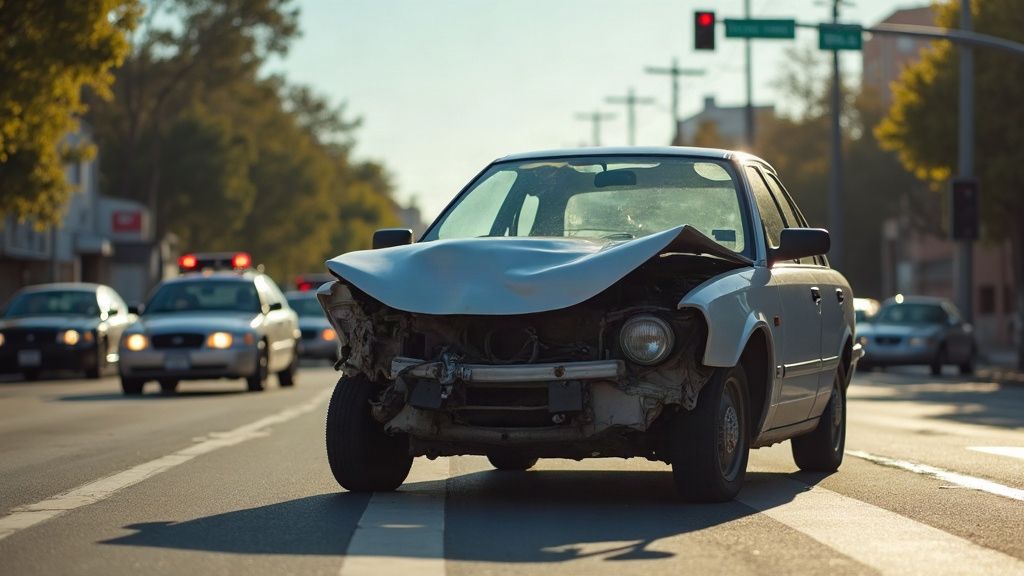
If you were hit by a fleeing suspect or caught in a police pursuit accident in California, you are dealing with one of the most legally complex injury claims in the state. You may be wondering whether anyone can actually be held responsible, whether the government is completely immune, and what steps you need to take right now to protect your rights.
The answers depend on California-specific law, and the deadlines are shorter than most people realize. This article walks you through exactly who can be held liable, how immunity laws work, what government procedures you must follow, and what your claim may be worth.
If you've been injured in a police chase in California, call (818) 794-9947 for a free case review. No fee unless we win.
Quick-Answer Summary
- The fleeing driver can be held fully liable under standard negligence law. No government immunity protects them.
- The law enforcement agency may be immune under Cal. Veh. Code §17004.7 if it adopted a compliant written pursuit policy and provided the required training. That immunity is agency-level, not unlimited.
- Government claims have a six-month deadline. You must file a government tort claim within six months of the accident under Cal. Gov. Code §911.2 before you can sue a public agency.
- The standard personal-injury statute of limitations is two years under Cal. Code Civ. Proc. §335.1, but the government claim deadline cuts that to six months as a prerequisite.
- Evidence matters. Dashcam footage, dispatch logs, and the agency's pursuit policy document are critical.
- You may have claims against more than one party at the same time.
When Police Pursuits Lead to Innocent Bystander Injuries
High-speed police chases kill and seriously injure innocent bystanders every year across California. A pursuit that starts on a freeway can end on a residential street. Suspects run red lights. They spin out. They barrel into cars stopped at intersections, crash through storefronts, or hit pedestrians who had no idea a chase was even happening nearby.
If that happened to you or someone you love, you are the innocent party in every sense. You followed the rules of the road. You were in the wrong place because of someone else's choices, including the fleeing driver and possibly the agency that authorized or continued the chase.
California law gives you avenues to pursue compensation, but the rules differ significantly depending on who you are claiming against. Understanding those differences is the first step.
California's Rules on Police Pursuit Liability
California does not treat all pursuit-related defendants the same way. The law splits them into two categories: the fleeing suspect and the government agency conducting the chase. Each category has its own liability rules.
Liability of the Fleeing Driver
The person running from police is not a government actor and gets no government immunity. If a fleeing driver caused your injuries, you pursue them the same way you would pursue any negligent driver in California: prove that they owed you a duty of care, that they breached it by driving recklessly, that the breach caused your injury, and that you suffered damages as a result.
A fleeing driver who causes your injuries during a police chase is not protected by government immunity and can be sued directly under standard California negligence law.
The practical challenge with fleeing drivers is often collectability. If the suspect has no insurance, no assets, and no income, a judgment against them may be difficult to collect. This is one reason why identifying all other potentially liable parties, including the agency and its insurer, matters so much.
Liability of the Law Enforcement Agency
This is where California law becomes more complex. A government agency is not automatically liable just because a pursuit it authorized caused injuries. The California Tort Claims Act generally permits lawsuits against public entities, but vehicle pursuit liability is governed by a separate, specific statute.
Government Immunity and Its Limits
Cal. Veh. Code §17004.7 is the statute that controls whether a California law enforcement agency is immune from liability for injuries caused during a pursuit.
How §17004.7 Immunity Works
Under §17004.7, an agency is immune from pursuit-related civil liability if it did two things:
- Adopted a written pursuit policy that meets the requirements spelled out in the statute, and
- Provided the required training and certification to its officers on that policy.
Under Cal. Veh. Code §17004.7, a law enforcement agency is immune from pursuit-related liability if it adopted a written pursuit policy that met the statute's requirements and provided the required training, whether or not the individual officer followed the policy.
This immunity is agency-level. The statute expressly provides that a finding that an individual officer did not comply with the pursuit policy does not, by itself, make the agency liable. The focus is on what the agency did institutionally, not on what happened in any single chase.
What This Means for Your Claim
If the agency had a fully compliant written policy and trained its officers on it, §17004.7 immunity will be a major obstacle to a government-liability claim. If the agency never adopted a compliant policy, never promulgated it properly, or failed to provide the required training, the immunity does not attach and the agency may face direct liability.
This is why obtaining a copy of the agency's written pursuit policy and its training records is one of the first steps a pursuit-injury attorney will take. The presence or absence of a qualifying policy is often dispositive.
When Immunity Has Limits
Section 17004.7 is a strong immunity, but California courts have recognized that it is not unlimited. Conduct that rises to the level of deliberate indifference or intentional wrongdoing may fall outside its protection. These situations are fact-specific and rare, but they do exist.
If a pursuing officer's conduct rose to the level of deliberate indifference or intentional wrongdoing, that extreme conduct may fall outside the protection of Veh. Code §17004.7 immunity.
Whether those circumstances apply to your case requires a careful review of the agency's conduct, the recorded communications during the chase, and the specific facts of how and why the pursuit was initiated and continued.
Holding the Fleeing Driver Responsible
Even when a government agency successfully asserts §17004.7 immunity, the fleeing driver remains a separate defendant with no immunity protection.
A successful negligence claim against the fleeing driver requires establishing:
- Duty: Every driver on a California road owes a duty of reasonable care to other road users.
- Breach: Fleeing from police at high speed, running traffic signals, and driving recklessly are clear breaches of that duty.
- Causation: The driver's reckless conduct directly caused the collision and your injuries.
- Damages: You suffered physical injuries, lost income, medical bills, or other compensable losses.
In some cases, the fleeing driver may also face criminal prosecution, and criminal conviction records can serve as powerful evidence in a civil damages case.
Special Claim Procedures for Government-Involved Accidents
This is the section most injured people miss, and missing it can permanently bar your claim.
If you intend to sue any California government entity, including a city police department, a county sheriff's department, or a state agency, you cannot file a lawsuit first. California law requires you to file an administrative government tort claim before litigation can begin.
The Six-Month Government Claim Deadline
In California, you must file a government tort claim within six months of a police pursuit accident before you can sue any public agency, under Cal. Gov. Code §911.2.
Under Cal. Gov. Code §911.2, a claim for personal injury against a public entity must be presented within six months of the date the cause of action accrued, which is generally the date of the accident. This deadline is separate from, and shorter than, the two-year personal-injury statute of limitations under Cal. Code Civ. Proc. §335.1.
Miss the six-month government claim deadline, and you may lose your right to sue the government entity entirely, regardless of how strong your case is on the merits.
What the Government Claim Must Include
Your government tort claim must generally identify:
- Your name and contact information
- The date, place, and circumstances of the incident
- A description of your injuries and damages
- The dollar amount of the claim, if known
- The names of any public employees responsible, if known
After You File: The Agency's Response Window
Once you file, the public agency has time to respond. Under Cal. Gov. Code §912.4, the agency generally has 45 days to accept or reject the claim. If the agency rejects it, you then have six months from the rejection notice to file a lawsuit in court. If the agency fails to act within the response window, you have two years from the accrual of the claim to file suit.
Why This Two-Track Deadline System Matters
If your case involves both the government agency and the fleeing private driver, you are managing two legal tracks simultaneously:
- Government track: Six-month claim deadline under §911.2, then a six-month window to sue after rejection.
- Private defendant track: Two-year statute of limitations under Cal. Code Civ. Proc. §335.1.
Missing the government-claim deadline while staying within the private-defendant deadline does not save you. You must hit both. An attorney can help you manage both tracks and make sure neither deadline slips.
Evidence That Strengthens a Pursuit-Related Claim
The strength of a police pursuit injury claim is almost always determined by what evidence is preserved in the first days after the accident. Some evidence disappears quickly.
Evidence your attorney will seek immediately:
- In-car and body-worn camera footage from every officer involved in the chase. Agencies retain footage for limited periods. A preservation letter or public-records request must go out fast.
- Dispatch audio recordings documenting the start of the pursuit, any authorization decisions, and communications during the chase.
- The agency's written pursuit policy and training records, which are central to the §17004.7 immunity analysis.
- Accident reconstruction reports prepared by the responding agency or an independent expert.
- Traffic camera and commercial surveillance footage from the route of the chase.
- Witness statements from people who saw the pursuit or the crash.
- Your medical records documenting injuries and treatment from the date of the accident forward.
- Vehicle damage documentation and the official collision report.
Dashcam footage, dispatch audio, and a copy of the agency's written pursuit policy are among the most important pieces of evidence in a police pursuit injury claim in California.
Preservation is urgent. If you wait weeks to consult an attorney, dashcam and dispatch recordings may already be overwritten or destroyed under routine retention schedules.
Compensation Available for Innocent Victims
If you have a viable claim, whether against the fleeing driver, the government agency, or both, the categories of compensation available to you are the same as in any serious personal-injury case in California.
Economic damages compensate for measurable financial losses:
- Medical bills, past and future
- Lost wages and lost earning capacity
- Rehabilitation and physical therapy costs
- Property damage, including your vehicle
Non-economic damages compensate for harms that do not come with a receipt:
- Pain and suffering
- Emotional distress
- Loss of enjoyment of life
- Scarring and permanent physical impairment
California does not cap non-economic damages in pursuit-accident cases the way it does in some medical malpractice cases, so the amount depends on the specific facts of your injury and its impact on your life.
Punitive damages are available only in cases involving intentional or malicious conduct, not simple negligence. They are uncommon in pursuit cases and not available against government entities under Cal. Gov. Code §818.
We never promise a specific outcome. What we do is build the strongest possible case with the evidence available and fight for every dollar you are entitled to under California law.
What to Do Right Now
If you were injured in a police pursuit accident in California, these steps protect your claim:
- Get medical care immediately and keep every record.
- Do not give a recorded statement to any insurance company or government representative before speaking with an attorney.
- Document everything: photos of the scene, your injuries, vehicle damage, and any visible skid marks or debris.
- Write down what you remember about the sequence of events while it is fresh.
- Contact an attorney quickly. The six-month government claim deadline under §911.2 starts on the date of the accident, not on the date you decide to act.
Call (818) 794-9947 for a free case review. No fee unless we win. Our team handles both personal-injury and workers' compensation claims in California, and we are here to answer your questions in English or Spanish.
FAQ: Police Pursuit Accidents in California
Can you sue the police for injuries caused during a chase in California?
It depends on whether the agency qualifies for immunity under Cal. Veh. Code §17004.7. An agency that adopted a compliant written pursuit policy and provided the required training is generally immune. An agency that did not meet those requirements may face direct liability. A lawsuit against any government agency also requires a prior government tort claim under Cal. Gov. Code §911.2.
What immunity do police have in pursuit accidents?
Cal. Veh. Code §17004.7 provides immunity to California law enforcement agencies for civil liability arising from vehicle pursuits, provided the agency adopted a qualifying written pursuit policy and provided the required training. The statute specifies that a finding of officer non-compliance with the policy does not, by itself, defeat the agency's immunity. The immunity is institutional, focused on what the agency did to prepare for pursuits, not on any individual officer's in-the-moment decisions.
Who is liable if a suspect crashes into you during a chase?
The fleeing suspect is liable under standard California negligence law. The government agency may also be liable if it does not qualify for §17004.7 immunity. These are separate legal claims that can be pursued simultaneously. You are not required to choose one or the other.
How long do you have to file a claim against a police department in California?
You must file a government tort claim within six months of the accident under Cal. Gov. Code §911.2. This is a strict prerequisite to filing a lawsuit against any California public entity. After the agency rejects your claim, you generally have six months to file suit in court. If the agency does not act on your claim within the statutory window, longer deadlines apply under the Government Claims Act.
California's standard personal-injury statute of limitations is two years under Cal. Code Civ. Proc. §335.1, but claims against a government entity require a tort claim filed within six months under Cal. Gov. Code §911.2.
What if both the police and the suspect contributed to my injuries?
California uses a pure comparative fault system under Cal. Civ. Code §1714. Multiple defendants can be found liable in proportions that reflect their respective fault. If the agency does not qualify for §17004.7 immunity, both the agency and the fleeing driver could share liability. Your recovery is calculated based on each party's percentage of fault.
What if the officer never filed an official report naming you?
You still have legal rights. A government tort claim under §911.2 is filed by you, not the agency. You do not need to be identified in an official report to initiate the claim process. Document your involvement with as much evidence as possible, including medical records, photos, and witness contact information.
Do I need a lawyer for a police pursuit injury claim?
Police pursuit claims involve at least two separate legal tracks, strict government-claim deadlines, a detailed agency-level immunity analysis, and time-sensitive evidence preservation. Most injured people benefit significantly from legal representation in claims of this complexity. Nordanyan Law handles cases on a contingency basis, meaning $0 upfront and no fee unless we win.
What if the police chase was related to my workplace, such as a delivery driver or bus passenger?
If you were injured during the course of your employment, you may have both a workers' compensation claim and a third-party personal-injury claim against the fleeing driver or the government agency. These claims can often be pursued together. Call (818) 794-9947 to discuss the specifics of your situation with a California attorney.
Reviewed by Minas Nordanyan, CA Bar #296806. This article is intended for general informational purposes and does not constitute legal advice. Every case depends on its specific facts. Contact Nordanyan Law for a free evaluation of your individual situation.