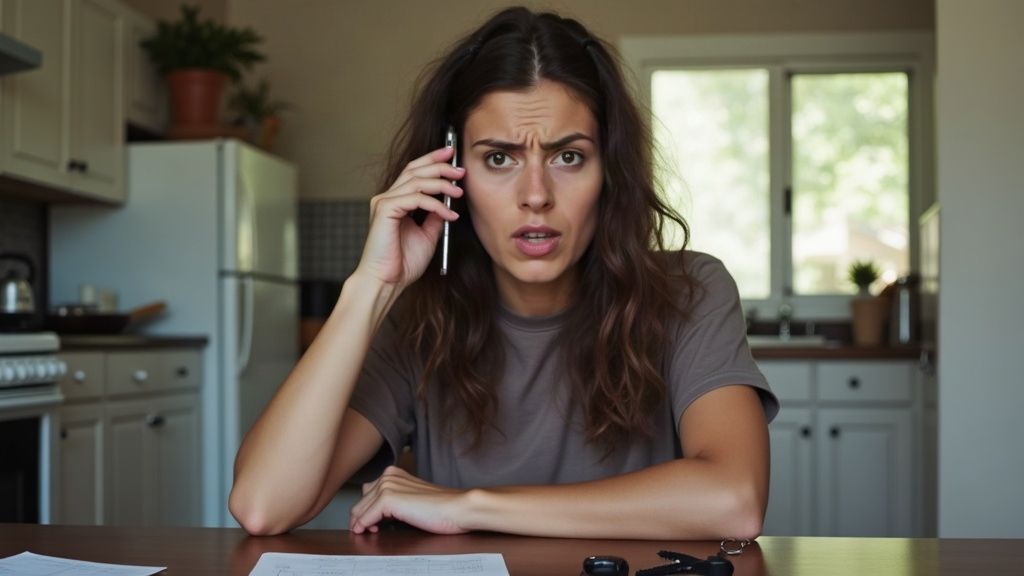
If you've been in a car accident in California and an insurance adjuster is asking for a recorded statement, stop before you agree to anything. What you say in those first minutes on the phone can follow your claim all the way to settlement, or courtroom.
This article explains exactly what a recorded statement is, what your legal obligations are under California law, the specific traps adjusters use, and what to do before you pick up that phone.
Quick-answer summary:
- You are generally NOT required to give a recorded statement to the other driver's insurer.
- You MAY be required to give one to your own insurer, depending on your policy.
- Anything you say can be used to reduce or deny your claim.
- California's comparative fault rule means even a small concession of blame cuts your recovery.
- You have the right to delay until you have spoken with an attorney.
- Nordanyan Law offers free consultations for injured California drivers. Call (818) 794-9947 before you speak to any adjuster.
What a Recorded Statement Actually Is and Why Insurers Request One
A recorded statement is an audio recording of a conversation between you and an insurance adjuster. The adjuster calls you, sometimes within hours of the crash, introduces themselves as being there to "help process your claim," and asks whether you consent to recording the call.
Most people say yes immediately. They want to be cooperative. They want their claim processed quickly. They believe they have nothing to hide.
But the adjuster is not a neutral party. They work for the insurance company, whose job is to pay out as little as possible on every claim. The recording becomes a permanent record that the insurer's lawyers can use against you if your claim escalates.
You are not legally required to give a recorded statement to the other driver's insurance company in California.
The request feels official, but it is not a legal summons. Saying "I'd prefer to speak with my attorney first" ends the request lawfully and does not harm your claim.
Your Own Insurer vs. the Other Driver's Insurer: Different Obligations
This is the most important distinction in the entire article. Many injured drivers don't realize their obligations are completely different depending on which company is calling.
The Other Driver's Insurance Company
You have no contractual relationship with the other driver's insurer. You never signed a policy with them. [SPEAKABLE] Your own insurer may require a statement under your policy contract, but that obligation does not apply to the adverse carrier.
You can decline, delay, or refuse their request entirely. The adverse carrier cannot deny your third-party claim against the other driver solely because you refused to give a recorded statement to them.
Your Own Insurance Company
Here the situation is different. Most California auto insurance policies include a "cooperation clause." Under Cal. Ins. Code §2071, the standard uninsured motorist and underinsured motorist policy form sets out the insured's duty to cooperate, which can include providing a statement when your own insurer is investigating a claim under your own coverage.
If you are making a claim under your own policy, for example, a collision claim, a medical payments (MedPay) claim, or an uninsured motorist (UM) claim, your insurer may be entitled to a statement as a condition of coverage. Refusing outright could give them grounds to delay or deny your own-policy benefits.
The practical rule:
- Other driver's insurer calling? You do not have to give a recorded statement.
- Your own insurer calling about a first-party claim? You likely do have a duty to cooperate, but you still have the right to have an attorney present or to review your policy language before speaking.
When in doubt, call an attorney before agreeing to either.
Common Traps Adjusters Use During Recorded Statements
Insurance adjusters are professionals. Many receive specific training on how to conduct recorded statement interviews in ways that surface information useful to the insurer. Here are the techniques most commonly used on unrepresented claimants in California.
The Early Contact Trap
An adjuster may call you the same day as the crash or the morning after. Your adrenaline is still running. Your injuries may not yet be apparent. Soft tissue injuries, traumatic brain injuries, and disc herniations frequently do not produce their full symptom picture for 24 to 72 hours or longer.
If an adjuster contacts you within days of a crash, your injuries may not yet be fully diagnosed, making any statement about your condition premature and potentially harmful to your claim.
If you tell the adjuster "I'm a little sore but I'm okay" on day one, that statement is preserved. When you receive a disc herniation diagnosis two weeks later, the adjuster will note the inconsistency.
The "Just Tell Me in Your Own Words" Opening
This phrasing sounds friendly and low-pressure. But the open-ended narrative format is designed to get you talking freely, increasing the chance you volunteer something damaging, a detail about speed, a guess about visibility, a casual admission like "I was in a hurry."
Adjusters are listening for any fact that could establish partial fault on your part.
The Minimizing Language Trap
The adjuster may ask, "How are you feeling today?" or "On a scale of one to ten, how bad is your pain?" The goal is to get you to use minimizing language. "Not too bad," "a six, maybe," or "better than yesterday" all become documented concessions the insurer uses to argue your injuries are minor.
Your actual answer should almost always be: "I am still under medical care and my condition is ongoing. I'd prefer to let my medical records speak to my injuries."
The Speculative Question Trap
Adjusters often ask questions you simply cannot answer with certainty: "How fast were you going?" "What was the other driver doing right before impact?" "Were you distracted at all?"
If you guess, the guess becomes the record. "I think I was going about 40" is now part of your file even if you had no idea. [SPEAKABLE] Adjusters are trained to ask open-ended questions that prompt you to guess, minimize, or speculate, all of which can be used to reduce what the insurer pays.
The right answer to any speculative question is: "I don't want to guess. I'd rather let the accident report and any witness statements reflect what happened."
The "Is There Anything Else I Should Know?" Close
This open-ended closing question is a catch-all. It invites you to volunteer information the adjuster did not think to ask. Anything you add here is fair game. End the call, if you speak at all, without volunteering extra detail.
How Innocent Wording Can Be Used Against Your Claim
California follows a pure comparative fault rule under Cal. Civ. Code §1714. That means your total recovery is reduced by your percentage of fault for the accident.
California's pure comparative fault rule means that any statement shifting partial blame to you can reduce your total compensation by that percentage.
Here is a concrete example. Suppose your injuries and damages are worth $100,000. If an adjuster's recording captures you saying "I may have been looking at my phone for a second," the insurer's lawyers may argue you are 20% at fault. Your $100,000 claim becomes an $80,000 recovery. On a larger claim, that reduction is tens of thousands of dollars lost based on a single sentence.
Words and phrases that routinely create problems in California car accident claims:
- "I'm fine" or "I'm okay", often used to argue no significant injury occurred
- "I think" or "I'm not sure but...", introduces doubt about facts you may actually know
- "I may have been..." or "It's possible I was..."**, language of admission under comparative fault analysis
- "I wasn't paying attention", direct contributory language
- "I guess the light might have been yellow", speculation on a factual element that determines fault
- "I was in a rush", suggests a mental state that adjusters tie to distracted or hurried driving
None of these statements need to be false to hurt your claim. An adjuster who captures any one of them has a documented basis to push back on liability or reduce your settlement offer.
When It's Okay to Decline or Delay a Statement
There is no bad time to say "I need to speak with an attorney before I give a recorded statement." Here are the situations where delay or refusal is especially important.
You are still seeking medical treatment. Until your treating physician identifies all injuries and you reach maximum medical improvement (MMI), you cannot accurately describe the full extent of your harm. Speaking before MMI is like describing a house fire while it's still burning.
Fault is disputed. If the other driver or their insurer is already suggesting you share responsibility, do not give a recorded statement without legal guidance. Anything you say will be used to build their fault argument.
You are still in pain, on medication, or emotionally distressed. California courts and the DWC recognize that trauma affects memory and perception. Statements given under physical or emotional distress may not accurately reflect events. Protect yourself by waiting.
The adjuster is calling within 48 hours of the crash. This is a timing strategy. Early statements before you've consulted anyone, your doctor, a family member, an attorney, maximize the chance of capturing something useful to the insurer.
You are unsure what your policy requires. Before you speak to your own insurer, read the cooperation clause in your policy or call an attorney to review it with you.
In all of these situations, a simple response preserves your position: "I am still in medical care and I've been advised to have an attorney review my options before I make any recorded statement. I will have my attorney be in touch with you."
How to Prepare If You Do Agree to Speak
If after consulting with an attorney you decide to give a statement, preparation is critical. Here are the basic ground rules.
Know only what you know. You are not required to fill silences or answer every question. "I don't recall" and "I don't know" are complete, honest, and legally safe answers.
Stick to the facts you are certain of. Where were you coming from? What direction were you driving? These basic navigational facts are safe. Anything requiring estimation or memory of fast-moving events should be answered carefully or not at all.
Do not speculate about fault. That is the adjuster's job to determine. It is not yours to offer.
Do not minimize your injuries. Describe your symptoms honestly and note that you are still under medical care. Avoid rating pain on a number scale, as numbers can be pinned to a specific date and used against you later.
Have your attorney present or on call. California law does not prohibit you from having your attorney on the line during a recorded statement. This is your right. An attorney who is on the call can object, guide you, and stop the interview if a question is improper.
Record the call yourself. California is a two-party consent state for phone recordings under Cal. Penal Code §632, which means you generally need to notify the other party that you are recording. Since the adjuster is already recording and disclosing that fact, you can state clearly at the start of the call that you are also recording for your records. Your own recording gives you a verbatim copy if the insurer's version is ever disputed.
Why Having Legal Guidance Before You Speak Protects Your Claim
The gap between what an adjuster hears and what you mean is where claims lose value. Attorneys who handle California car accident and personal injury claims understand how recorded statements are used in claim evaluations and can help you avoid the specific language patterns that insurers exploit.
Injured car accident victims in California represented by an attorney typically receive higher net settlements than those who negotiate directly with an adjuster, because attorneys understand how recorded statements are used in claim evaluations.
At Nordanyan Law, we have recovered over $150,000,000 for injured workers and accident victims across California. We handle every case as if it were going to trial, because insurers settle for more when they know the other side is prepared to fight.
If an insurance adjuster has called you, do not guess. Do not minimize. Do not speculate. Call (818) 794-9947 for a free consultation. No fee unless we win.
Frequently Asked Questions
Do I have to give a recorded statement to my insurance company?
It depends on your policy. Most California auto insurance policies include a cooperation clause that may require you to provide a statement when you are making a claim under your own coverage, such as a collision, MedPay, or uninsured motorist claim. Cal. Ins. Code §2071 establishes the standard form for UM/UIM policies. Before you speak, review your policy or have an attorney review it with you. You do not, however, owe any cooperation duty to the other driver's insurance company.
Can I refuse a recorded statement after a car accident?
Yes, when the request comes from the other driver's insurer. You have no contract with them and no legal obligation to submit to their recorded interview. If the request comes from your own insurer, an outright refusal may create a coverage issue, so it is better to consult an attorney about your specific policy before declining.
What happens if I say the wrong thing in a recorded statement?
Under California's pure comparative fault rule (Cal. Civ. Code §1714), any language that shifts even partial blame to you can reduce your total recovery by your assigned percentage of fault. Statements minimizing your injuries can be used to argue your harm is less serious than your medical records show. These statements become part of the permanent claim record and can be introduced in litigation.
Should I give a recorded statement to the other driver's insurance?
In most cases, no. You are not required to, and doing so without legal guidance creates significant risk. The adverse carrier's adjuster is not working in your interest. If the insurer attempts to use your refusal as grounds to deny the claim entirely, that is a separate legal issue your attorney can address.
How long can I delay giving a recorded statement?
There is no California statute that sets a specific deadline for you to give a recorded statement to an adverse carrier. You should respond to requests from your own insurer in a reasonable time under your policy, but "reasonable" typically means days to weeks, not hours. Use that time to consult with an attorney.
What should I say when an adjuster calls?
Keep it brief. Confirm your name and that you were involved in the accident. Say that you are still under medical care and that you have been advised to speak with an attorney before making any recorded statement. Provide your attorney's contact information if you have one, and end the call. Do not give additional details, discuss fault, or describe your injuries.
Can I have an attorney with me during a recorded statement?
Yes. California law does not prevent you from having your attorney present during a recorded statement interview. In fact, having your attorney on the line is one of the most effective ways to protect the accuracy and fairness of the record.
Does refusing a recorded statement affect my claim?
Not in the way adjusters sometimes imply. The adverse carrier cannot deny an otherwise valid liability claim solely because you declined to give them a recorded statement. If your own insurer suggests your coverage is at risk because you delayed a statement, consult an attorney immediately to assess whether that position is consistent with your policy terms and California law.
What if I already gave a recorded statement? Is my case ruined?
Not necessarily. An attorney can review the transcript or recording, identify which statements are potentially damaging, and build a strategy around the full record, including your medical documentation, the accident report, witness statements, and physical evidence. A prior statement that is unfavorable to your position is a challenge, not an automatic loss.
How do I get a copy of my recorded statement?
Request it in writing from the insurance company. California Insurance Code provisions and standard claims-handling regulations require insurers to maintain claim files. Your attorney can send a written demand for the recording and transcript as part of the discovery and pre-litigation claims process.
If an insurance adjuster has already called or will call soon, the best step you can take right now is to speak with an attorney before you speak with them. Call (818) 794-9947 for a free, confidential consultation with a California personal injury attorney. No fee unless we win.
Reviewed by Minas Nordanyan, CA Bar #296806. Last reviewed 2026-09-06. This article is for general educational purposes and does not constitute legal advice. Every case depends on its specific facts. Contact an attorney to discuss your situation.