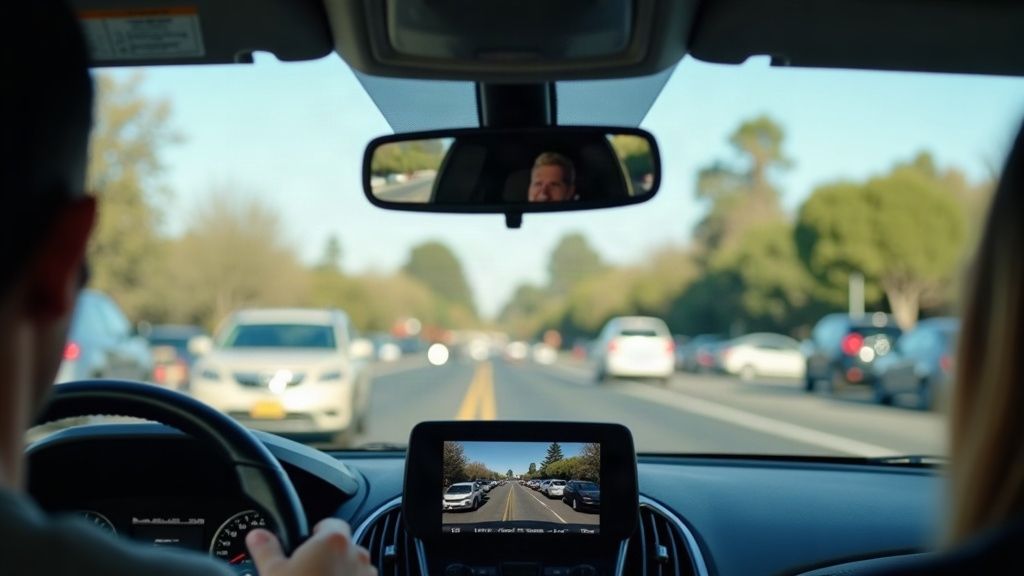
If you were hit by a reversing vehicle in California, or if someone is blaming you for a backing accident, the first thing you need to know is this: fault in these crashes is not always obvious, and the rules that decide it are specific. California has statutes that put a clear presumption on the backing driver, but that presumption is not automatic in every situation. The facts of where the crash happened, who was moving, and what the cameras recorded all matter enormously.
We've recovered more than $150,000,000 for injured people across Southern California. Backing and reversing accidents are among the most disputed claim types we handle, because insurers routinely use any ambiguity in the facts to minimize what they pay. Here are the eight things that will determine how your claim gets resolved.
Quick summary:
- The reversing driver is usually presumed at fault under Cal. Veh. Code §22106.
- When both cars back up simultaneously, comparative fault splits responsibility.
- Pedestrians hit by reversing vehicles have the strongest legal protection.
- Surveillance footage is often decisive but disappears within 24 to 72 hours.
- Backing crashes require different evidence analysis than rear-end collisions.
- Driveway-exit backing accidents create a heavy fault presumption on the exiting driver.
- Commercial truck backing accidents can involve employer and contractor liability.
- Shared fault reduces, but does not eliminate, your recovery under California law.
1. The Backing Driver Is Usually Presumed at Fault
Under California Vehicle Code Section 22106, no driver may back a vehicle unless the movement can be made safely, making the reversing driver presumptively at fault in most backing accidents.
Cal. Veh. Code §22106 states plainly that no person shall move a vehicle backward unless the movement can be made with reasonable safety. That one sentence creates a legal presumption that follows the backing driver into every claim and every courtroom.
What this means in practice: if you were driving forward, stopped, or parked when another driver reversed into you, the law starts with the assumption that the reversing driver failed to exercise the care the statute required. The insurance adjuster working the other driver's policy knows this. A well-prepared claim presses that presumption rather than abandoning it.
Practical takeaway: Document your position before and at impact. Photos of the final rest positions of both vehicles, skid marks, and the surrounding traffic lanes help lock in the factual record that supports the legal presumption in your favor.
2. The Presumption Shifts When Both Cars Back Up at the Same Time
When both drivers are reversing at the same time and collide, California's comparative fault system assigns each driver a percentage of responsibility rather than placing all fault on one party.
The §22106 presumption assumes one car is moving backward and the other is not. When both vehicles are in reverse at the moment of impact, neither driver gets the benefit of that presumption automatically. Instead, the WCAB does not govern these cases, but California civil courts apply the state's pure comparative negligence framework, evaluating each driver's specific conduct.
Investigators look at which driver had the clearer line of sight, whether either driver used backup cameras or checked mirrors, how fast each was reversing, and whether one driver had already moved substantially into the travel lane before the other started to reverse. The driver who was moving faster, had less visibility, and failed to yield will typically carry the larger share of fault, but it is rarely a clean 50/50 split.
Practical takeaway: If both cars were reversing, photographs of both vehicles' tire marks and the geometry of the parking stalls matter more than either driver's account alone. An accident reconstruction specialist can often establish which car entered the conflict zone first.
3. Pedestrian Victims Hit by a Backing Vehicle Have Strong Legal Protection
A pedestrian struck by a reversing vehicle generally holds the strongest position of any victim in a backing accident claim, because pedestrians have the right of way in marked crosswalks, unmarked crosswalks, and in the driving lanes of a parking lot.
Cal. Veh. Code §21950 requires drivers to yield to pedestrians in crosswalks. California courts have also consistently found that parking lot driving lanes, where people on foot are expected to be present, impose a heightened duty of care on drivers who are reversing. A backing driver who strikes a pedestrian who was walking in an area where foot traffic was reasonably expected faces a difficult factual and legal defense.
Injuries to pedestrians from backing vehicles are often severe: soft-tissue damage, fractures, traumatic brain injuries, and spinal injuries are common because a pedestrian has no steel frame around them at the moment of impact. Medical documentation from the emergency room through all follow-up treatment is critical to the claim value.
Practical takeaway: If you were on foot when struck, photograph the scene immediately, get emergency medical care the same day, and preserve every garment you were wearing, because physical evidence of impact location can be determinative.
4. Parking Lot Camera Footage Often Decides These Claims
Parking lot and store surveillance footage is often the single most important piece of evidence in a backing accident claim, but many systems overwrite recordings within 24 to 72 hours of the incident.
Grocery stores, big-box retailers, apartment complexes, and office buildings all run surveillance systems that cover parking areas. These cameras often capture the angle, speed, and precise sequence of a backing collision in ways that no eyewitness can replicate. In our experience handling these claims in Southern California, footage has resolved disputed fault questions that would otherwise have required expensive reconstruction.
The problem is retention. Many private businesses overwrite or recycle their camera footage automatically. Some systems overwrite as quickly as 24 hours after recording. The moment you suspect a backing accident is disputed, a written preservation demand must go to the property owner or business manager. That letter puts them on legal notice that the footage may be evidence, and it shifts liability for spoliation to them if they delete it after receiving the demand.
An attorney can send that demand by certified mail the same day you call. Waiting creates real risk that the footage disappears before anyone thinks to ask for it.
Practical takeaway: If the accident happened in or near a commercial property, call an attorney the same day. The preservation demand letter is one of the first things we send.
5. Backing Accidents Differ from Standard "Who Hit Whom" Crashes
Unlike a rear-end collision, where the trailing driver's fault is heavily presumed because they had a clear view of the vehicle ahead, a backing accident involves a driver deliberately moving against the normal flow of traffic. The physical evidence analysis is different, the witness vantage points are different, and the legal presumptions are applied differently.
In a standard rear-end crash on a California highway, investigators look at following distance, reaction time, and brake marks. In a backing accident, they look at the sight lines from the reversing driver's mirrors and camera, the rate of reverse movement, whether the reversing driver activated hazard lights or used a spotter, and whether any obstructions limited visibility.
California's DIR occupational safety rules require commercial vehicle operators to use spotters under certain conditions, but private drivers have no such mandatory rule. Still, the absence of a reasonable lookout is evidence of negligence in civil court. Adjusters who treat a backing accident like a simple rear-end claim are undervaluing the complexity that benefits an experienced attorney.
Practical takeaway: Describe your movements precisely to your attorney. The sequence, your exact position, and whether you were stopped or moving are facts that change the legal analysis completely.
6. When Someone Backs Out of a Driveway and Into Street Traffic
A driver who backs out of a private driveway onto a public street must yield to all oncoming traffic under California Vehicle Code Section 21804, making driveway-exit backing crashes strongly favorable for the through-traffic driver.
Cal. Veh. Code §21804 requires any driver entering or crossing a roadway from a private road or driveway to yield to all traffic close enough to constitute a hazard. When a driver backs out of a residential driveway or a commercial lot entrance and reverses into traffic traveling on the street, two separate legal obligations converge: the §22106 duty to reverse safely, and the §21804 duty to yield before entering the roadway. Both point to the backing driver.
This combination means that a driveway-backing crash is among the cleaner fault analyses in California traffic law. The driver on the street who was struck has a strong legal position unless the investigation reveals the street driver was violating a specific traffic rule at the time, such as speeding or traveling in a prohibited direction.
Practical takeaway: If you were hit by a driver backing out of a driveway, note the time, the posted speed limit, and whether you were traveling within that limit. These details anchor your compliance with the rules that protect you.
7. Commercial Truck Backing Accidents Raise Unique Liability Questions
Commercial truck backing accidents can expose the trucking company, a maintenance contractor, or a cargo loader to liability, not just the individual driver, when defective cameras or the absence of a required spotter contributed to the crash.
When a delivery truck, tractor-trailer, or large commercial vehicle backs into a passenger car or a pedestrian, the claim becomes substantially more complex than a private-vehicle backing accident. Federal motor carrier regulations under the Federal Motor Carrier Safety Administration (FMCSA) impose specific duties on commercial carriers, including requirements for adequate mirrors and backup warning systems on certain vehicle classes. A failure to maintain functioning backup cameras or warning alarms can establish negligence against the trucking company, independent of the driver's individual conduct.
California's respondeat superior doctrine makes an employer liable for the negligent acts of an employee performed within the scope of employment. If the truck driver was making a commercial delivery when the backing accident occurred, the employer is a proper defendant. Beyond the employer, if a maintenance contractor allowed a broken backup camera to remain unfixed, or if improper cargo loading obscured the driver's rear sightlines, those third parties may also carry liability.
These cases also involve higher policy limits. Commercial trucking insurance policies are required to carry substantially higher minimum coverage than a standard personal auto policy. That means the potential recovery in a commercial truck backing accident is often materially larger than in a comparable private-vehicle crash.
Practical takeaway: Preserve the truck driver's name, company name, and the vehicle's DOT number from the placard on the trailer. Those numbers unlock the carrier's federal registration and insurance information.
8. Shared Fault Reduces Your Compensation Under California's Pure Comparative Negligence Rule
California follows pure comparative negligence under Civil Code Section 1714, so even a driver who was illegally parked or otherwise partially at fault when struck can still recover damages, reduced only by their own percentage of fault.
California is a pure comparative negligence state. Cal. Civ. Code §1714 establishes that everyone is responsible for injury caused by their own failure to use ordinary care. The "pure" part of the doctrine means there is no threshold below which your recovery is cut off entirely. If you were 30% at fault and the other driver was 70% at fault, you recover 70% of your total damages.
Insurers use this rule strategically. An adjuster may exaggerate your share of fault to lower a settlement offer. Common tactics in backing accident disputes include arguing that you were parked in a travel lane, that you were moving when you claimed you were stopped, or that you could have avoided the impact. Each of these arguments is a negotiating position, not a legal verdict, and each can be countered with proper evidence.
One important nuance: if you were illegally parked when the backing driver struck you, your illegal parking is relevant only if it actually contributed to causing the accident. Parking in a no-parking zone does not, by itself, make you responsible for a collision caused by a driver who failed to look before reversing.
Practical takeaway: Do not accept an insurer's fault percentage as final. The numbers are negotiable and should be evaluated against the actual evidence by an attorney before you agree to anything.
Frequently Asked Questions
Who is at fault when both cars are backing up in California?
When both cars are reversing at the moment of impact, California's pure comparative negligence system applies. Neither driver automatically bears all the fault. Courts and adjusters examine each driver's speed, sight lines, and awareness to assign individual percentages of responsibility. The driver with the better visibility who failed to yield typically carries the larger share.
Is the backing driver always at fault in a parking lot accident?
Not always, but the presumption runs against the backing driver under Cal. Veh. Code §22106. That presumption can shift if the other driver was speeding through the lot, driving in the wrong direction, or otherwise violating a traffic rule that contributed to the crash. California's comparative fault rules mean both drivers' conduct is evaluated.
What evidence proves fault in a reversing car accident?
The most important evidence categories are: surveillance camera footage from the property or nearby businesses, photographs of both vehicles' final positions and damage patterns, witness statements, the vehicles' event data recorders (EDR) if available, and the police or traffic collision report. In commercial truck cases, driver logs and vehicle maintenance records are also critical.
Can I be partly at fault if I was parked illegally when hit?
Yes, but your illegal parking is only relevant if it actually contributed to causing the crash. Under California's pure comparative negligence rule, your recovery is reduced only by your actual percentage of fault. A driver who backs into you without looking does not escape liability simply because you were parked in a restricted zone. The at-fault driver's failure to reverse safely remains the primary cause of the collision.
How long do I have to file a claim after a backing accident in California?
For personal injury claims against another private driver in California, the general statute of limitations is two years from the date of injury under Cal. Civ. Pro. Code §335.1. Claims against a government entity, such as an accident in a government-owned parking facility, require a government tort claim within six months under Cal. Gov. Code §911.2. Missing either deadline typically bars your claim entirely.
Should I accept the first settlement offer after a backing accident?
No. First offers from insurers in backing accident cases routinely undervalue the claim, particularly when fault is disputed. The offer may be calculated on an inflated fault percentage for you or on incomplete medical records. An attorney can evaluate whether the offer reflects your actual damages, including future medical costs, lost wages, and pain and suffering, before you agree to release your claim.
What if the backing accident happened in a private parking garage?
Private parking garage owners may share liability if poor lighting, inadequate lane markings, or low visibility mirrors contributed to the crash. A property liability claim against the garage owner can exist alongside a claim against the backing driver. California's premises liability law requires property owners to maintain reasonably safe conditions for foreseeable users.
Do I need a police report after a parking lot backing accident?
A police report is not legally required in every minor accident, but it is strongly advisable. California law requires you to report an accident to the DMV within 10 days if anyone was injured or if property damage exceeds $1,000. A written record from law enforcement establishes the facts at the scene before memories fade and before the other driver's account changes.
Backing accidents in California turn on specific statutes, real evidence, and the timing of how quickly that evidence is preserved. If you were hit by a reversing vehicle, or if an insurer is trying to shift fault onto you in a backing accident dispute, the facts in your specific situation determine what you can recover.
If you've been injured in a backing or reversing accident in California, call us at (818) 794-9947 for a free case review. No fee unless we win.