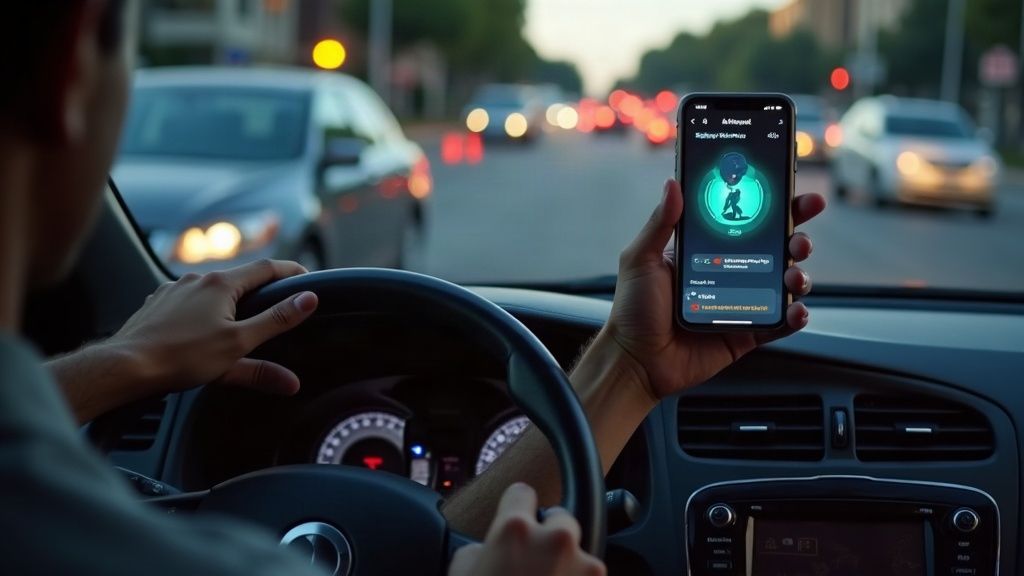
If you were hurt by an Uber or Lyft driver in California and the driver was logged into the app but had not yet accepted a ride, you may be standing in one of the most frustrating coverage gaps in modern auto insurance law. Your medical bills are real. The driver's insurance company may be pointing at Uber. Uber's insurer may be pointing back at the driver. This article explains exactly how California law allocates coverage in that specific situation, what your rights are, and what to do next.
Call (818) 794-9947 for a free case review. No fee unless we win.
Quick Answer: The Five Things You Need to Know
- California law divides rideshare accidents into three coverage periods based on the driver's app status at the moment of the crash.
- During Period 1 (app on, no ride accepted), California Insurance Code §11580.24 requires the TNC (transportation network company) to provide contingent liability coverage of at least $50,000 per person and $100,000 per accident for bodily injury, plus $30,000 for property damage.
- Most personal auto policies now contain a TNC exclusion that lets the driver's own insurer deny a Period 1 claim, making the TNC's lower-limit policy the only practical source of coverage.
- Periods 2 and 3 (ride accepted through passenger drop-off) trigger at least $1,000,000 in TNC liability coverage.
- The driver's app status is recorded by the platform and is the most critical fact in any coverage dispute.
The Three Phases of Rideshare Coverage and Why "App On, No Ride" Is Different
California law divides rideshare insurance into three periods, and the coverage that applies to your accident depends entirely on which period was active when the crash happened.
Period 0: The driver's app is completely off. The driver is operating the vehicle purely as a private individual. Only their personal auto policy applies. Uber and Lyft have zero insurance obligation.
Period 1: The driver's app is on and they are available to accept a ride, but no ride has been matched or accepted yet. This is the gap. The driver is not yet "on the clock" in the traditional sense, but they are using their vehicle commercially by remaining available to the platform.
Period 2: The driver has accepted a ride and is en route to pick up the passenger.
Period 3: The passenger is in the vehicle through the moment of drop-off.
The critical legal divide is Period 1 versus Periods 2 and 3. Once a ride is accepted (Period 2), Uber and Lyft maintain policies with at least $1,000,000 in liability coverage. Period 1 is different, both in the dollar limits and in how the coverage layers with the driver's personal policy.
How California's Rideshare Insurance Requirements Try to Close the Gap
California was among the first states to legislate rideshare insurance requirements. AB2293, which took effect July 1, 2015, established the three-period framework and set minimum coverage floors for each period. Those requirements are now codified in California Insurance Code §11580.24.
During Period 1, the driver's app is on but no ride has been accepted, and California Insurance Code §11580.24 requires the TNC to provide at least $50,000 per person and $100,000 per accident in bodily injury coverage.
The specific minimums under §11580.24 for Period 1 are:
- $50,000 per person for bodily injury
- $100,000 per accident for bodily injury
- $30,000 for property damage
These limits sound significant, but compare them to the $1,000,000 minimum that applies in Periods 2 and 3. For a serious crash, $50,000 per person may not cover emergency surgery, hospitalization, rehabilitation, and lost wages, let alone pain and suffering. The gap between Period 1 limits and Period 2 limits is twenty times the per-person bodily injury coverage.
The California CPUC (California Public Utilities Commission) regulates TNCs as a condition of their operating authority in the state, and the California Department of Insurance oversees the insurance policies that satisfy those requirements. Both agencies played a role in shaping the AB2293 framework and the continuing regulatory obligations Uber and Lyft carry.
What Happens When a Personal Auto Policy Excludes Commercial Ridesharing Use
Here is where injured parties are most often surprised. Even if the driver had what looked like a fully active personal auto policy, that policy may contain a TNC exclusion.
Most personal auto policies in California now contain a TNC exclusion, which means that during Period 1 the driver's own insurer can lawfully deny the claim.
The California Department of Insurance allows insurers to write policies that exclude coverage when the vehicle is being used as a TNC vehicle. When the driver's app is on, the vehicle is in commercial use for insurance purposes, even if no passenger has been matched. This means the driver's personal insurer can deny the claim on the grounds that the driver was operating a TNC vehicle at the time of the loss.
The practical result: during Period 1, the TNC's contingent liability policy under §11580.24 often becomes the only insurance covering the incident.
This is not a loophole or an oversight. California Insurance Code §11580.24 was written anticipating exactly this scenario. The TNC coverage exists precisely because the legislature recognized that personal policies would exclude TNC use, and someone injured during that window deserved a source of compensation. The limitation is in the dollar amounts, not in the coverage's existence.
Real-World Scenarios: Driver Waiting for a Ping Versus En Route to Pickup
Understanding the theory is one thing. Here is how it plays out in practice.
Scenario A: Driver sitting at a coffee shop, app open, no ride yet. The driver pulls out of the parking lot and strikes a cyclist. Period 1 applies. The driver's personal insurer will likely deny the claim. The cyclist's claim goes against Uber or Lyft's contingent policy with the §11580.24 minimums. If the cyclist's injuries exceed those limits, the driver may have personal asset liability for the difference, but collecting on a personal judgment is a separate challenge.
Scenario B: Driver has accepted a ride and is driving toward the pickup location. The driver runs a red light and hits another car. Period 2 applies. The $1,000,000 TNC policy is active. The injured driver of the other car has a substantially deeper pool of insurance coverage to pursue.
Scenario C: Driver's app is off, but Uber's logo is visible in the rear windshield. Period 0 applies. Neither Uber nor Lyft carries any obligation. The injured party must rely on the driver's personal policy alone. The logo on the window does not activate TNC coverage.
If you were hurt by a rideshare driver and the app was on but no passenger had been accepted, you may have a claim against both the driver and Uber or Lyft's contingent liability policy.
The difference between Scenario A and Scenario B, in terms of available insurance, can easily be hundreds of thousands of dollars. That is why establishing the driver's exact app status at the time of the crash is not an academic exercise.
Proving the Driver's App Status After a Crash
The driver's app status is the central factual question in any coverage dispute, and it is not always easy to establish. A driver facing personal asset exposure has little incentive to volunteer that the app was off. A driver trying to avoid liability with their TNC has little incentive to confirm the app was on.
The driver's app status at the moment of the crash is the single most important fact in a rideshare insurance coverage dispute, and that data is recorded by the TNC platform.
Here is how that status can be established:
TNC platform records. Uber and Lyft maintain timestamped logs of driver app activity. Those records show when the app was opened, when the driver was in available status, when a ride was matched, and when the ride ended. Those logs can be obtained through litigation discovery or, in some cases, through direct requests to the TNC's legal or insurance departments.
The police report. Officers who respond to rideshare accidents may note the driver's app status based on what the driver says at the scene. That statement, made when the driver may not fully appreciate its legal significance, can be valuable.
Witnesses. Passengers in the driver's vehicle, bystanders, or occupants of other vehicles may have seen the driver's phone or heard them describe what they were doing.
The driver's own statements. Anything the driver said to you, to police, or in subsequent communications may help establish the status question.
An attorney can send a preservation demand letter to the TNC promptly, before those digital records are overwritten or archived in ways that make them harder to access. If you delay, that evidence may become more difficult to obtain.
Who Can Be Named in the Claim: Driver, Personal Insurer, or Uber/Lyft's Policy
Depending on the period and the facts, there may be more than one party and more than one policy in play.
The driver personally. A driver is personally liable for their negligence regardless of what insurance pays. If insurance limits are insufficient to cover your damages, you can pursue a judgment against the driver's personal assets, though collecting on that judgment is a separate challenge.
The driver's personal auto insurer. During Period 1, the personal insurer will likely invoke a TNC exclusion. During Period 0, the personal policy is the only insurance in play and the insurer cannot apply a TNC exclusion if the app was genuinely off.
The TNC's contingent liability policy (Period 1). This is the §11580.24 coverage. It is "contingent" because it steps in when the driver's personal policy denies the claim. If the driver's personal insurer pays, the TNC coverage may not be triggered.
The TNC's primary liability policy (Periods 2 and 3). This is the $1,000,000-minimum policy. It is primary, not contingent, meaning it covers the claim without waiting to see whether the personal insurer pays first.
Your own underinsured motorist (UIM) coverage. If you carry UIM coverage on your own auto policy, and the at-fault driver's insurance is insufficient to cover your damages, your UIM coverage may bridge the gap. This applies whether the at-fault driver is a rideshare driver or any other motorist.
Navigating which of these sources applies, in what order, requires understanding both the facts of the crash and the specific policy language at issue.
Rideshare Accidents and Workers' Compensation: A Brief Note
If you are the rideshare driver who was injured (not a passenger or third party), the coverage picture changes again. Uber and Lyft classify drivers as independent contractors, not employees.
Cal. Lab. Code §2775, part of the AB5 framework, establishes a presumption of employment using the ABC test for most workers in California. However, Proposition 22, passed by California voters in November 2020, carved out app-based drivers and delivery workers from that employment classification. Under Proposition 22, Uber and Lyft drivers are classified as independent contractors for purposes of labor and workers' compensation law, and the TNCs are not required to carry workers' compensation insurance for them.
Instead, Proposition 22 requires TNCs to provide certain limited benefits to drivers who are injured while engaged in a rideshare trip, including occupational accident insurance. That coverage has different limits and different rules than California workers' compensation. If you are a driver who was hurt on the job, the intersection of Proposition 22, TNC occupational accident insurance, and any personal coverage you carry is a separate analysis from the third-party liability framework described in this article.
If that situation describes you, call us. The workers' comp and personal injury teams at Nordanyan Law handle both sides of the rideshare injury equation.
Steps for Passengers, Other Drivers, and Pedestrians Hurt During Period 1
If you were injured and you believe the driver was in Period 1 status when the crash happened, here is what to do now.
1. Get the police report. Request it as soon as it is available. It will contain the officer's observations about the driver's activity and any statements the driver made at the scene.
2. Document the driver's phone and app status. If it is safe and lawful to do so, note or photograph the driver's phone screen. Do not touch or take the phone. Record anything you observe about the screen's display.
3. Collect the driver's information. Name, license number, vehicle registration, and insurance card. The insurance card will show the personal insurer. The TNC's coverage is separate and must be accessed through a different process.
4. Identify witnesses. Names and contact information for anyone who saw the crash or the moments leading up to it.
5. Seek medical care promptly. A gap between the crash and your first medical visit is used by insurers to suggest your injuries are less serious or unrelated to the accident. Document your injuries from the start.
6. Do not give a recorded statement to any insurer before speaking with an attorney. Both the driver's personal insurer and the TNC's insurer may contact you quickly. You are not required to give a recorded statement, and doing so before you understand the coverage picture can harm your claim.
7. Contact an attorney who handles rideshare accident claims. The overlapping insurance framework, the preservation of TNC platform records, and the coverage dispute between the personal insurer and the TNC policy are not standard auto accident issues. An attorney familiar with this framework will know how to identify all available sources of coverage and how to prevent evidence from disappearing.
Call (818) 794-9947 for a free consultation. We handle rideshare accident cases on a contingency basis, meaning no fee unless we win.
Uber and Lyft maintain substantially higher limits during Periods 2 and 3, including at least $1,000,000 in liability coverage once a ride has been accepted.
FAQ
What insurance applies if a rideshare driver is logged in but has no passenger?
During Period 1, California Insurance Code §11580.24 requires the TNC (Uber or Lyft) to maintain contingent liability coverage of at least $50,000 per person and $100,000 per accident for bodily injury, plus $30,000 for property damage. This coverage is called "contingent" because it steps in when the driver's personal auto policy denies the claim, which often happens because personal policies contain TNC exclusions.
Is there a coverage gap between a driver's personal policy and Uber's policy?
Yes. During Period 1, the driver's personal insurer may deny the claim under a TNC exclusion, and the TNC's contingent policy carries limits far lower than the $1,000,000 coverage available in Periods 2 and 3. For serious injuries, that gap in dollar limits is significant. Your own underinsured motorist (UIM) coverage, if you carry it, may help bridge the gap.
Does it matter if the app was on when the accident happened?
Yes, it is the central question. Whether the app was on, and whether a ride had been accepted, determines which period applies and therefore which insurance responds to the claim. The difference between Period 0 (app off, TNC has no obligation) and Period 2 (ride accepted, $1,000,000 TNC policy active) is dramatic. That is why establishing the app status through TNC platform records is a priority in every rideshare accident case.
Who pays if I'm hit by an Uber driver who hasn't accepted a ride yet?
If the driver was in Period 1 (app on, no ride accepted), the claim would typically go first against the driver's personal insurer, which may deny it under a TNC exclusion. The TNC's contingent liability policy under §11580.24 would then apply. The driver is also personally liable for their negligence regardless of what insurance covers.
What if the Uber or Lyft driver's app was completely off?
That is Period 0. Neither Uber nor Lyft has any insurance obligation. Your only source of coverage from the driver's side is their personal auto policy. Having an Uber or Lyft sticker or logo on the vehicle does not activate TNC coverage if the app was not running.
Can I sue Uber or Lyft directly for my injuries?
Uber and Lyft typically argue they are technology platforms and that drivers are independent contractors, not employees, which limits their direct liability for driver negligence. The practical mechanism for recovering from the TNC is through the insurance policy they are required by law to maintain, not a direct negligence claim against the company in most scenarios. That said, fact patterns vary, and an attorney should evaluate whether any additional theories apply to your specific situation.
How do I find out what period the driver was in when the crash happened?
TNC platforms maintain timestamped records of driver app activity. Those records can be obtained through litigation discovery or a formal legal request. A police report may also reflect what the driver said at the scene about their app status. Acting quickly to preserve this evidence matters, because platform records are not kept indefinitely.
What if the driver had their own rideshare gap coverage?
Some drivers purchase endorsements or separate policies specifically designed to cover Period 1. If the driver had such coverage, it may step in to cover the claim or supplement the TNC's contingent policy. That is another reason to obtain full insurance information from the driver at the scene, not just the name of their personal insurer.
What if I was a passenger in the Uber when the crash happened?
If you were a confirmed passenger in the vehicle, you were in Period 3. Uber and Lyft's $1,000,000 liability policy was active. You have a claim against that policy for your injuries, as well as a potential claim against any other at-fault driver if the crash involved more than one vehicle.
How long do I have to file a claim after a rideshare accident in California?
Under Cal. Code Civ. Proc. §335.1, the statute of limitations for personal injury claims in California is generally two years from the date of injury. Different deadlines may apply if a government entity is involved or if the injured party is a minor. Missing the deadline bars the claim entirely. Consult an attorney as soon as possible to confirm the deadline that applies to your facts.
If you were hurt in a rideshare accident in California, the coverage picture is more complicated than a standard auto accident claim. The period the driver was in, the status of their personal policy, and the TNC's own insurance obligations all determine what you can recover and from whom.
Call (818) 794-9947 for a free consultation with Nordanyan Law. No fee unless we win. Available in English and Spanish.
Reviewed by Minas Nordanyan, CA Bar #296806. Last reviewed for legal accuracy October 2026. This article is provided for general informational purposes and does not constitute legal advice. The law applicable to your situation depends on the specific facts of your case. Past results do not guarantee future outcomes.