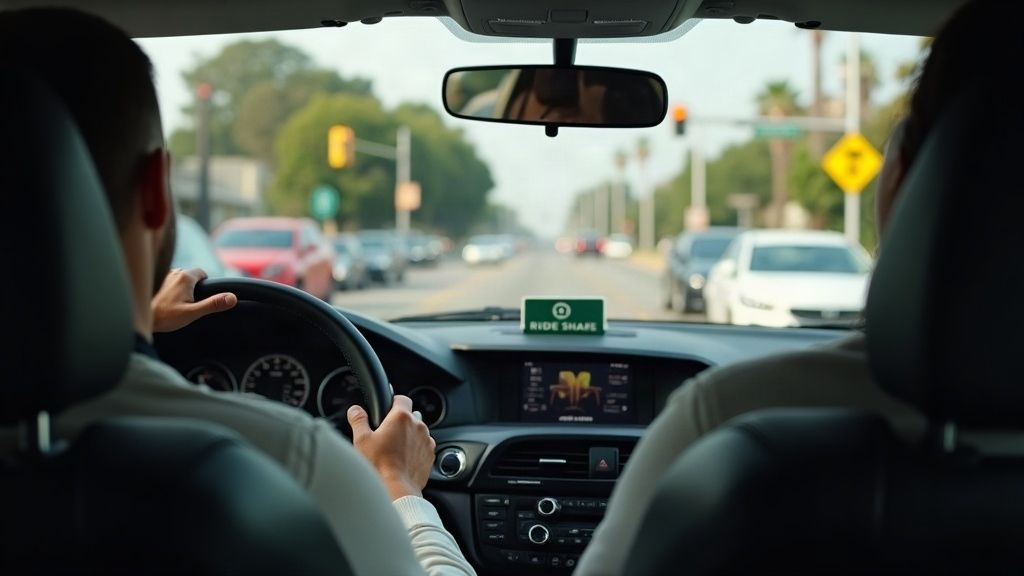
If you drive for Uber or Lyft in California and another driver hit you, you are dealing with one of the most complicated insurance puzzles in personal injury law. You have your own auto policy. The rideshare company has its own commercial policy. The at-fault driver has their own policy. And each one applies differently depending on what you were doing at the exact second of impact.
This article walks you through each coverage layer, explains why a workers' comp claim is usually not your path, and shows you how to protect your right to the maximum recovery.
Quick answers:
- Uber and Lyft carry at least $1,000,000 per occurrence in liability coverage while you are on an active trip.
- Because Proposition 22 classifies you as an independent contractor, workers' comp against Uber or Lyft is generally not available to you.
- Your primary legal path is a personal injury claim against the at-fault driver, often supplemented by Uber's or Lyft's uninsured/underinsured motorist (UM/UIM) coverage.
- California's minimum bodily injury limit is now $30,000 per person / $60,000 per accident, effective January 1, 2025.
- You have two years from the crash date to file a lawsuit under Cal. Civ. Code §335.1.
- If the at-fault driver is uninsured or underinsured, Uber's or Lyft's policy can step in as a secondary layer.
- Free consultation: call (818) 794-9947. No fee unless we win.
Why Rideshare Drivers Face Unique Claim Challenges After a Crash
Most injured drivers have a straightforward path: file against the at-fault driver's liability policy, then look to your own UM/UIM coverage if that policy is insufficient. Rideshare drivers face two extra layers of complexity.
The independent contractor classification. California voters passed Proposition 22 in November 2020. Under Prop 22, Uber and Lyft drivers are classified as independent contractors, not employees. That single fact changes almost everything about where you can look for money after a crash. Employees in California are generally covered by their employer's workers' compensation insurance. Independent contractors are not. So the workers' comp system that covers most injured California workers is largely closed to you when Uber or Lyft is the other party.
The app-status problem. Your coverage at the moment of impact depends entirely on whether you were offline, logged in but waiting, or actively transporting a passenger. The difference between Period 1 and Period 3 (explained below) can mean the difference between a $50,000 per-person coverage limit and a $1,000,000 limit. Insurance carriers scrutinize app logs, GPS records, and dispatch data to classify your status. Getting that classification wrong costs real money.
Personal auto policy exclusions. Most personal auto policies contain a "transportation network company" exclusion. If you are driving for hire at the time of the crash, your personal insurer may deny your claim entirely, even if another driver caused the accident. That denial pushes you toward Uber's or Lyft's commercial policy, which then applies by its own terms.
Whose Insurance Applies When You're Online, On a Trip, or Offline
California's Public Utilities Code §5430 et seq. (the Transportation Network Company laws) sets the minimum insurance requirements for rideshare companies operating in the state. The California Public Utilities Commission (CPUC) enforces those rules.
The framework divides every moment of a rideshare driver's workday into three periods.
Period 0: App Is Off
You are driving your car for personal reasons. The rideshare company's policy does not apply at all. Your personal auto insurance is your only coverage. If another driver hits you, you file against their liability policy and, if needed, your own UM/UIM coverage.
Period 1: App Is On, No Ride Accepted Yet
You are logged in and waiting for a match. California law requires Uber and Lyft to maintain contingent liability coverage of at least $50,000 per person / $100,000 per accident / $30,000 property damage during Period 1. This coverage is contingent, meaning it only activates if your personal auto insurer denies your claim first. If your personal policy covers the loss (rare, given most TNC exclusions), the rideshare company's Period 1 coverage does not apply.
Practical consequence: If you are hit during Period 1 by an at-fault driver who carries only California's current minimum $30,000 per-person policy, and your injuries exceed that amount, you will need to layer the at-fault driver's policy, any underinsured motorist coverage you personally carry, and potentially the rideshare company's Period 1 contingent UM/UIM coverage to make yourself whole.
Period 2: Ride Accepted, En Route to Passenger
You accepted a dispatch and are driving to pick up the rider. Uber and Lyft both increase their commercial liability coverage to at least $1,000,000 per occurrence during Period 2. UM/UIM coverage also applies at this tier.
Period 3: Passenger Is in the Vehicle
This is the highest-exposure period. The $1,000,000 commercial liability remains in force. If another driver causes a crash while you have a passenger aboard, both you and the passenger may have injury claims against the at-fault driver's policy, and both may have access to Uber's or Lyft's UM/UIM coverage as a secondary layer.
When an Uber or Lyft driver is hurt by another motorist during an active trip, Uber and Lyft each carry at least $1,000,000 in third-party liability coverage under California law.
Filing a Third-Party Claim Against the At-Fault Driver
Regardless of which period you were in, if another driver caused the crash, you have the right to file a personal injury claim directly against that driver. This is a third-party liability claim, and it is entirely separate from anything Uber or Lyft does.
What You Must Prove
California uses a fault-based system. To recover from the at-fault driver, you (or your attorney) must establish:
- The other driver owed you a duty of care on the road.
- The other driver breached that duty (ran a red light, failed to yield, was texting, etc.).
- That breach caused the crash.
- You suffered actual damages, including medical bills, lost wages, and pain and suffering.
These are standard negligence elements under California common law, and they apply whether you are a rideshare driver, a commercial trucker, or a private motorist.
Minimum Limits and the Underinsured Problem
California's current minimum bodily injury liability limit is $30,000 per person and $60,000 per accident, effective January 1, 2025 under Senate Bill 1107.
That $30,000 per-person floor is a starting point, not a finish line. If your medical bills alone exceed $30,000, the at-fault driver's minimum-limits policy is exhausted before you recover anything for lost earnings or pain and suffering. That gap is exactly what UM/UIM coverage is designed to fill.
Uber's and Lyft's commercial policies include uninsured and underinsured motorist coverage during Periods 2 and 3. If the at-fault driver has no insurance, or their limits are not enough to cover your damages, you can make a UIM claim against the rideshare company's policy after exhausting the at-fault driver's coverage.
Important: UM/UIM claims have their own procedural rules. You typically must give written notice to Uber's or Lyft's insurer before settling with the at-fault driver, or you may waive the UIM claim. An attorney handles this notice requirement as part of case management.
The Two-Year Deadline
The deadline to file a personal injury lawsuit against an at-fault driver in California is two years from the date of the crash under Cal. Civ. Code §335.1.
Two years sounds like a long time. It is not. Evidence disappears. Witnesses forget details. App logs and dashcam footage get overwritten. The earlier you engage an attorney, the more evidence is preserved.
If the at-fault driver works for a government entity (a city bus, a county vehicle), you face a much shorter six-month deadline to file a government tort claim under Cal. Gov. Code §911.2 before you can sue. This is uncommon in rideshare crashes but not unheard of.
How Uber's and Lyft's Insurance Tiers Actually Work
Both Uber and Lyft use the same basic three-period framework described above, though their specific insurers and policy language differ. Here is a side-by-side summary.
| App Status | Your Period | Liability Coverage | UM/UIM Coverage |
|, |, |, |, |
| App off | Period 0 | None from Uber/Lyft | None from Uber/Lyft |
| App on, no ride | Period 1 | $50,000/person (contingent) | Limited, contingent |
| Ride accepted | Period 2 | $1,000,000/occurrence | Yes |
| Passenger in car | Period 3 | $1,000,000/occurrence | Yes |
One thing both companies are consistent about: their commercial policies are excess over your personal auto policy during Period 1. During Periods 2 and 3, the commercial policy is primary.
If your personal insurer denies coverage because of a TNC exclusion during Period 1, the contingent coverage from the rideshare company activates. In practice, most personal policies do exclude commercial rideshare use, so the rideshare company's contingent layer usually does apply.
Common Injuries Rideshare Drivers Suffer During Long Shifts
Rideshare drivers spend more hours behind the wheel than most motorists. That increased exposure means more crash risk, but it also means certain injuries present differently than they do for an occasional driver.
Whiplash and soft tissue injuries. Rear-end crashes are the most common rideshare collision type. The sudden forward-and-back motion strains neck and shoulder muscles. Symptoms can be delayed by hours or days, which is why every rideshare driver involved in a crash should seek medical evaluation the same day even if they feel "fine."
Traumatic brain injury (TBI). Even low-speed impacts can produce a concussion. TBI symptoms include headache, confusion, memory gaps, and mood changes. A driver who hits their head on the steering wheel or door frame may not connect later cognitive symptoms to the crash.
Back and spinal injuries. Herniated discs and lumbar strain are common in rear and side-impact crashes. For a driver who already spends eight or more hours seated, a back injury can end their ability to work entirely.
Shoulder and wrist injuries. A driver gripping the wheel at impact can suffer rotator cuff tears or TFCC (triangular fibrocartilage complex) wrist injuries. These often require surgery and extensive physical therapy.
Psychological injuries. PTSD and driving anxiety are recognized compensable injuries under California personal injury law. A driver who cannot get back behind the wheel after a serious crash has a legitimate claim for lost future earnings on top of past medical bills.
Damages for all of these injuries are recoverable in a personal injury claim against the at-fault driver.
When Passenger Claims and Driver Claims Overlap in the Same Crash
If you had a passenger in the car when another driver hit you, both you and the passenger have independent claims against the at-fault driver. Those claims do not compete for the same money, each claimant has their own per-person limit available.
Under Uber's and Lyft's $1,000,000 per-occurrence commercial policies, the aggregate limit applies across all claimants from a single crash, not per person. If you, a passenger, and a second occupant all have serious injuries, the total available from that one commercial policy is $1,000,000 shared. That is why, in a multi-claimant crash, experienced counsel matters. Claim allocation, lien resolution, and settlement sequencing all affect how much each individual ultimately recovers.
An injured rideshare driver may pursue a third-party claim against the at-fault driver, an underinsured motorist claim under the rideshare company's policy, and a claim for lost earnings all in the same case.
Your claim as the driver does not diminish the passenger's claim, and the passenger's claim does not diminish yours. But when total damages across all claimants exceed the available limits, how those limits are allocated becomes a significant legal issue.
Why This Is a Personal Injury Claim, Not a Workers' Comp Case
This is the question we hear most often from rideshare drivers who call our office.
California's workers' compensation system is designed to cover employees who are hurt in the course of employment. Under the California Labor Code, an employer must carry workers' comp insurance, and an employee who is injured on the job files a claim through that system.
Because Proposition 22 classifies rideshare drivers as independent contractors, an injured Uber or Lyft driver generally cannot file a workers' compensation claim against Uber or Lyft.
Proposition 22 locked in the independent contractor classification for app-based transportation drivers in California. Because you are not an employee of Uber or Lyft under that framework, neither company is required to carry workers' comp coverage for you, and you cannot file a DWC claim against either company for a crash that happened while you were driving for them.
There is one narrow exception worth knowing: if you have a second employer whose work caused or contributed to the crash (for example, a delivery company that required you to drive a route that put you in the path of the at-fault vehicle), that employer's workers' comp policy might be relevant. But for a typical rideshare crash caused by a third-party motorist, the workers' comp system is not your path.
Your actual path:
- Third-party bodily injury claim against the at-fault driver's liability policy.
- UM/UIM claim under Uber's or Lyft's commercial policy if the at-fault driver is uninsured or underinsured.
- Your own UM/UIM coverage as a final layer (if you personally carry it and your policy does not exclude rideshare use).
- A personal injury lawsuit if the insurance claims do not fully compensate your damages.
Prop 22 did require Uber and Lyft to provide limited occupational accident insurance for drivers injured while the app is active. This is not workers' comp and does not carry the same benefits. Payout limits are set by the companies, not the WCAB, and the coverage is narrower than what an employee would receive. If you receive a benefits offer from Uber's or Lyft's occupational accident insurer, have an attorney review it before you accept. Accepting it could affect your right to pursue other claims.
An Uber or Lyft driver who is logged into the app but has not yet accepted a ride is covered by limited contingent liability, typically $50,000 per person, only if the driver's own personal insurer denies the claim.
What to Do Immediately After the Crash
The steps you take in the first 48 hours shape every claim that follows.
At the scene:
- Call 911. Get a police report number. You will need it.
- Take photos of all vehicles, the intersection, traffic signals, skid marks, and your injuries.
- Get the at-fault driver's name, license number, vehicle registration, and insurance card.
- Note whether you had a passenger and capture their contact information.
- Screenshot your Uber or Lyft app status at the time of the crash, or note the time so your attorney can request that data.
Within 24 hours:
- Seek medical care even if you feel okay. A same-day medical record documenting your condition is one of the strongest pieces of evidence in a personal injury case. Gaps in treatment give insurance adjusters room to argue your injuries were not serious or were caused by something else.
- Report the crash to Uber or Lyft through the app. Both companies have in-app accident reporting. This creates a timestamped record and starts the claims process with their commercial insurer.
- Do not give a recorded statement to any insurance adjuster, including Uber's or Lyft's insurer, without speaking to an attorney first.
Within the first week:
- Contact an attorney to discuss your options before you sign anything or accept any payment.
We've recovered over $150,000,000 for injured clients in Southern California. If you've been hurt in a rideshare crash, call (818) 794-9947 for a free case review. No fee unless we win.
FAQ
What happens if an Uber driver gets hit by another car in California?
If another driver causes the crash, you have a personal injury claim against that driver's liability insurance. The coverage available to you also depends on your app status at the moment of impact. During an active trip (Period 2 or 3), Uber's $1,000,000 commercial liability and UM/UIM coverage applies as a secondary layer. During Period 1, Uber's contingent coverage of $50,000 per person applies only if your personal insurer first denies the claim. You should seek medical care immediately, document the scene, and speak with a personal injury attorney before giving any statements to insurers.
Does Uber's insurance cover the driver if someone else caused the crash?
Uber's commercial policy provides liability coverage to protect others from claims by the driver, but it also includes UM/UIM coverage that benefits the driver when the at-fault party is uninsured or underinsured. The key point: Uber's UM/UIM coverage is available to the driver during Periods 2 and 3 when a third party causes the crash and that party's insurance is not enough to cover the driver's damages.
Can a rideshare driver sue the at-fault driver directly?
Yes. You have the same right to file a personal injury lawsuit against a negligent driver as any other California motorist. The fact that you were working for Uber or Lyft does not limit your right to sue the person who caused the crash. Under Cal. Civ. Code §335.1, you have two years from the crash date to file that lawsuit.
Is a rideshare driver covered by workers' comp if hurt by another motorist?
Generally no. Because Proposition 22 classifies Uber and Lyft drivers as independent contractors, not employees, those companies are not required to carry California workers' compensation insurance for their drivers. Your primary legal path is a personal injury claim against the at-fault driver, not a workers' comp claim. Uber and Lyft do provide a separate occupational accident benefit (not the same as workers' comp), speak with an attorney before accepting any payment from that program.
What if the at-fault driver has no insurance?
California requires all drivers to carry liability insurance, but uninsured drivers exist. If the at-fault driver is uninsured, you can file a UM (uninsured motorist) claim against Uber's or Lyft's commercial policy during Periods 2 and 3. You can also file against your own personal UM coverage if your policy does not exclude rideshare use. A police report and a prompt UM claim filing are both critical in this scenario.
What if the at-fault driver's insurance is not enough to cover my injuries?
This is called an underinsured motorist scenario. The current California minimum is $30,000 per person, but serious injuries routinely exceed that. After exhausting the at-fault driver's policy, you can file a UIM claim against Uber's or Lyft's commercial policy during Periods 2 and 3. Your attorney typically must give written notice to the rideshare insurer before settling with the at-fault driver to preserve your UIM rights.
How long do I have to file a claim after a rideshare crash in California?
Two years from the date of the crash for a personal injury lawsuit, under Cal. Civ. Code §335.1. If a government vehicle caused the crash, you may have only six months to file a government tort claim under Cal. Gov. Code §911.2. Do not wait. Evidence and app data are often overwritten within weeks of a crash.
Does my personal auto insurance cover me while I'm driving for Uber or Lyft?
Most personal auto policies contain a transportation network company exclusion that voids coverage while you are driving for hire. Check your policy declarations page. If your personal insurer denies the claim during Period 1, Uber's or Lyft's contingent coverage steps in. During Periods 2 and 3, the rideshare company's commercial policy is primary regardless of your personal policy's status.
Should I accept the settlement offer from Uber's or Lyft's insurer without a lawyer?
No. Insurance companies, including those representing Uber and Lyft, aim to settle claims for as little as possible. An early settlement offer rarely accounts for future medical costs, long-term lost earnings, or pain and suffering. Once you sign a release, you cannot reopen the claim. Have an attorney review any offer before you accept it.
How much does it cost to hire a personal injury attorney for a rideshare crash case?
Personal injury attorneys at Nordanyan Law handle rideshare crash cases on a contingency fee basis. You pay $0 upfront. We only collect a fee if we recover money for you. Call (818) 794-9947 for a free case review.
If you were hurt while driving for Uber or Lyft in California, every day you wait is a day evidence gets harder to preserve. Call (818) 794-9947 for a free consultation. No fee unless we win. Available in English and Spanish.
Reviewed by Minas Nordanyan, CA Bar #296806. Last legal review: 2026-08-20.