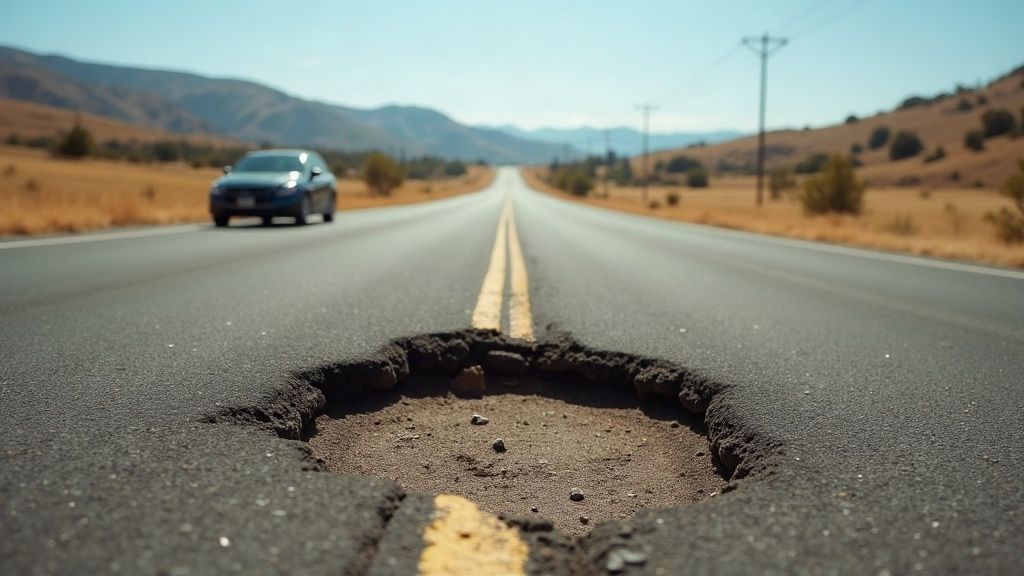
If you've been hurt in a crash caused by a pothole, a missing guardrail, or a road that simply shouldn't have been in the condition it was in, you're dealing with a type of claim that works nothing like a standard fender-bender. The other "driver" is a government agency, and government agencies fight these cases hard, with experienced teams and legal defenses you won't see in an ordinary auto case.
We've recovered over $150,000,000 for injured people across Southern California, including cases where a defective road or dangerous government-maintained property was the cause. Here is what every injured driver, or their family, needs to understand before taking a single step.
Quick summary:
- A "dangerous condition" means a road defect that creates substantial risk of harm to a careful user, under Gov. Code §835.
- These cases go against a government entity, not just another driver, and the rules are different.
- You have only 6 months to file a Government Tort Claim, not the standard 2 years.
- Common defects include potholes, poor signage, drainage failures, and missing guardrails.
- Strong evidence, photos, prior complaint records, expert analysis, is essential.
- Agencies fight hard using "no notice" and design-immunity defenses.
- Comparative fault can still reduce your recovery, but rarely eliminates it.
- Compensation can cover medical bills, lost wages, future care, and pain and suffering.
- An attorney review immediately after the crash is the single best protective step.
1. What Counts as a 'Dangerous Condition of Public Property'
Under California Government Code §835, a public agency is liable when a "dangerous condition" of its property creates a substantial risk of injury to a person using the property with reasonable care. The condition must have been caused by a negligent act or omission of an employee, OR the agency must have had actual or constructive notice of the condition in time to protect against it.
In plain terms: the road itself, or the hardware attached to it, has to be in a state that a reasonable person would recognize as hazardous. A small crack in a sidewalk probably doesn't meet the threshold. A pothole wide enough to blow a tire and send a vehicle into oncoming traffic very likely does. Missing traffic signs, washed-out lanes, failed drainage creating a flooded roadway, and broken guardrails at curve approaches are all conditions that California courts have found to meet the §835 standard.
Practical takeaway: The legal bar is "substantial risk of harm to a careful user", not perfection. If you were driving normally and the road caused your crash, that phrase is your starting point.
2. Why These Claims Work Differently Than Driver-vs-Driver Crashes
In a standard two-car crash, you file an insurance claim and, if necessary, a civil lawsuit under ordinary negligence law. In a road-defect case, the responsible party is a government entity, a city, county, state agency, or special district, and the entire framework shifts.
Government claims in California are governed by the California Government Claims Act (Gov. Code §§900 et seq.). Before you can sue, you must exhaust a mandatory pre-lawsuit administrative claim process. Government entities also carry sovereign immunity by default: they can only be sued where the legislature has expressly allowed it, which is why §835 is the specific waiver of immunity that makes these lawsuits possible.
Additionally, the standard of proof is different. You don't just show that the road was bad, you have to show the agency had notice and time to act, or that an employee's conduct created the hazard. Defense attorneys for cities and counties are typically full-time government litigators who handle nothing but these cases.
Practical takeaway: Road-defect claims are not DIY cases. The procedural landmines, notice requirements, immunity defenses, expert engineering needs, are real, and they catch unrepresented claimants constantly.
3. The Shorter, Stricter Filing Window for Claims Against Government Entities
In California, you must file a Government Tort Claim with the responsible public agency within 6 months of a road-defect accident, missing this deadline almost always eliminates your right to sue.
This is the single most important fact in this article. Under Government Code §911.2, a claim for personal injury or property damage against a public entity must be filed within 6 months of the incident. This is not the lawsuit itself, it is a mandatory notice step that must happen before you can even file a lawsuit.
Compare that to the standard 2-year statute of limitations for personal injury under California Code of Civil Procedure §335.1. Many injured drivers assume they have two years. They do not. Once the agency receives your claim, it has 45 days to accept or reject it under Government Code §912.4. If rejected, you then have 6 months from the rejection notice to file your lawsuit in court.
There are very limited exceptions for late claims, generally reserved for minors or situations of mental incapacity. "I didn't know about the deadline" does not qualify.
Practical takeaway: Six months goes by fast, especially when you are recovering from injuries. Start the clock from the date of your crash, not from when you feel better.
4. Common Road Defects That Cause Crashes
Prior maintenance requests, 311 complaint logs, and prior incident reports are among the most powerful evidence you can gather in a road-defect claim against a California agency.
California's road network spans tens of thousands of miles maintained by dozens of agencies, Caltrans for state highways, counties for unincorporated roads, cities for city streets, and special districts for everything in between. The variety of conditions that can constitute dangerous defects is wide:
- Potholes and pavement failures: The most common claim. A pothole large enough to cause a driver to lose control or blow a tire can meet the §835 threshold, particularly on higher-speed roads.
- Poor or missing signage: A missing stop sign, faded lane markings, or an obscured curve-warning sign directly causes crashes that a properly maintained road would prevent.
- Drainage failures: Water pooling on a roadway, especially at night or in limited visibility, creates hydroplaning hazards. Clogged drains and failed culverts fall within the agency's maintenance obligation.
- Missing or damaged guardrails: On mountain roads and highway on-ramps, a guardrail that has been damaged in a prior crash and not repaired is a known deadly hazard.
- Overgrown vegetation: Trees or brush blocking sight lines at intersections, when the agency has notice and the means to trim, can meet the dangerous-condition standard.
- Loose gravel or debris on the travel lane: Especially where the agency has conducted road work and failed to clean up.
Practical takeaway: If the condition that caused your crash was something a maintenance crew should have fixed, it is worth evaluating as a road-defect claim, even if another car was also involved.
5. Evidence That Strengthens a Road-Defect Claim
A public agency is liable for a dangerous road condition when it had actual or constructive notice of the defect with enough time to fix it, under Government Code §835.
Evidence in a road-defect case serves one primary purpose: proving the agency knew or should have known about the hazard. The most valuable types:
- Photographs taken the day of the crash: Document the defect, its size and location, the surrounding road conditions, your vehicle damage, and any visible skid marks or debris. Timestamp matters.
- Prior 311 complaints and maintenance request records: Public records requests to the agency's maintenance department can uncover complaints about the same pothole or sign going back months or years. This is direct evidence of constructive notice.
- CHP and local police reports: The incident report documents the location, weather, road conditions observed by the officer, and any contributing factors noted at the scene.
- Witness statements: Neighbors, other drivers, or nearby businesses who knew about the defect and can testify to how long it existed.
- Expert engineering analysis: A licensed civil or traffic engineer can evaluate whether the defect met the dangerous-condition standard and whether the agency's maintenance practices fell below the applicable standard.
- Medical records and billing: Document the injuries the defect caused, directly linking the road hazard to your medical costs and lost wages.
Practical takeaway: The agency's own maintenance records can make or break your case. A public records request filed immediately preserves documents that agencies are not always obligated to keep indefinitely.
6. Why Cities and Counties Fight These Claims Hard
Government agencies can raise design immunity under Government Code §830.6 to argue a road was built to an approved plan, making proof of poor maintenance or prior notice critical to winning.
Government agencies defend road-defect cases more aggressively than most defendants for a clear reason: every successful verdict against a city or county creates potential liability across every mile of road that agency maintains. Their defense teams, typically the city attorney's office or outside government-defense specialists, deploy a consistent set of arguments:
- No actual or constructive notice (Gov. Code §835.2): The agency argues it did not know and had no reason to know about the defect in time to fix it before your crash. This is where prior complaint records become dispositive, an agency that received three 311 calls about the same pothole cannot credibly claim no notice.
- Design immunity (Gov. Code §830.6): If the road was built according to a plan approved by a public employee exercising discretionary authority, the agency may be immune from liability for that design, even if the design turned out to be dangerous. This defense fails if the agency allowed the road to deteriorate from its original approved condition, but it is frequently raised.
- Discretionary function immunity: Decisions about how to allocate limited road-maintenance budgets are classified as discretionary governmental functions, partially shielding agencies from liability for prioritization choices.
- Contributory conduct of the driver: Agencies almost universally argue the driver was speeding, distracted, or otherwise at fault, shifting focus to the driver's behavior rather than the road's condition.
Practical takeaway: The agencies' defense playbook is well-rehearsed. Your evidence strategy has to anticipate and dismantle each of these defenses before the case ever reaches a courtroom.
7. How Comparative Fault Can Still Apply
California follows a pure comparative fault rule from Li v. Yellow Cab Co., meaning your damages are reduced by your share of fault but you can still recover even if you were partly responsible.
California's pure comparative fault rule, established by the California Supreme Court in Li v. Yellow Cab Co., 13 Cal.3d 804 (1975), means your recovery is reduced by the percentage of fault attributed to you, but you can still recover something even if you were significantly at fault. If a jury finds the agency 70% responsible and you 30% responsible for a crash that caused $100,000 in damages, you recover $70,000.
In road-defect cases against government entities, the agency's defense team will make comparative fault a central argument. Common theories they raise:
- You were driving above the posted speed limit when you hit the pothole.
- You were distracted and failed to observe a road hazard that a careful driver would have seen and avoided.
- You were familiar with the road and knew about the condition, courts have found that prior knowledge of a hazard can reduce an injured person's recovery.
- You failed to maintain your vehicle (worn tires, for example) which contributed to losing control.
Note that California Civil Code §1431.2, enacted by Proposition 51, addresses a separate issue: in cases with multiple defendants, each defendant is only liable for their proportional share of non-economic damages (like pain and suffering), even though they remain jointly and severally liable for economic damages like medical bills and lost wages. This rule applies in multi-defendant road-defect cases involving both a government agency and, for example, a negligent contractor.
Practical takeaway: Even if you were partly at fault, you very likely still have a claim worth evaluating. The agency's comparative-fault argument is a negotiating tool as much as a legal defense.
8. What Compensation May Realistically Cover
A successful road-defect claim can cover medical bills, lost wages, future medical care, vehicle damage, and pain and suffering, the amount depends heavily on how clearly the agency had notice of the hazard.
A successful road-defect claim against a California public agency can recover the same categories of damages as any personal injury lawsuit, subject to the comparative fault reduction discussed above:
- Medical expenses: Emergency room, surgery, hospitalization, physical therapy, specialist visits, and prescription costs, both what you have already paid and what future care will cost.
- Lost wages: Income you lost while recovering, including for self-employed claimants who can document their earnings.
- Loss of future earning capacity: If your injuries affect your ability to work at the same level going forward, that future wage loss is a recoverable element.
- Property damage: Repair or replacement value of your vehicle, plus rental costs while it was being repaired.
- Pain and suffering: Non-economic damages for the physical pain, emotional distress, and reduced quality of life caused by your injuries.
- Permanent disability or disfigurement: Where injuries result in lasting impairment, that ongoing harm is compensable.
What these cases do not include: punitive damages. California Government Code §818 bars punitive damages against public entities, regardless of how egregious their conduct was.
Practical takeaway: The absence of punitive damages against government entities means your economic and non-economic compensatory damages are the full measure of recovery, which makes thorough documentation of your medical and financial losses even more important.
9. When to Get Help Evaluating a Road-Defect Case
Road-defect cases against California government agencies are among the most procedurally demanding personal injury claims in the state. Three realities make early attorney involvement critical:
The 6-month deadline is unforgiving. A standard personal injury attorney might ask you to come in within a month or two. In a road-defect case, you need that conversation within days of your crash, because investigating the defect, gathering prior maintenance records, and preparing a proper Government Tort Claim all take time, and the clock starts the moment you're hurt.
Evidence disappears quickly. Agencies repair potholes. Signs get replaced. Road conditions change. If no one photographs and documents the defect promptly, the physical evidence supporting your claim may be gone within days.
The agency's defense team is already working. The moment a Government Tort Claim arrives, the agency's risk-management office opens a file. They preserve their records. Their version of events starts taking shape. You need someone building your version of events with equal urgency.
We fight for injured people across Southern California, including people hurt because a government agency let a dangerous road condition exist longer than it should have. If you were in a crash caused by a pothole, a failed sign, a flooded roadway, or any other road defect, we'll evaluate your case for free and tell you honestly what we think it is worth.
Call (818) 794-9947 for a free case review. No fee unless we win.
Frequently Asked Questions
Can you sue the California government for a pothole accident?
Yes, in most cases. Under Government Code §835, a public agency is liable for a dangerous condition of its property if it had actual or constructive notice of the condition in time to remedy it, or if the condition was created by an employee's negligence. You must first file a Government Tort Claim within 6 months of the incident before a lawsuit can proceed.
How long do you have to file a claim against a government agency in California?
You have 6 months from the date of the incident to file a Government Tort Claim with the responsible public agency, under Government Code §911.2. This is a mandatory step before any lawsuit. It is much shorter than the standard 2-year personal injury statute of limitations under Code of Civil Procedure §335.1.
What counts as a dangerous road condition in California?
Under Government Code §835, a "dangerous condition" is one that creates a substantial risk of injury to a person using the public property with reasonable care. Examples include large potholes, missing or obscured traffic signs, failed drainage causing road flooding, broken guardrails, and overgrown vegetation blocking sight lines, particularly where the agency had notice and time to fix the hazard before the crash.
Who is responsible for road maintenance in California?
Responsibility depends on the type of road. State highways are maintained by Caltrans, an agency of the California Department of Transportation. County roads are maintained by county departments of public works. City streets are maintained by city public works or transportation departments. Disputes sometimes arise about which agency controls a specific stretch of road, which affects which entity you must file your Government Tort Claim against.
What happens if the agency denies my Government Tort Claim?
Under Government Code §912.4, the agency has 45 days to accept or reject your claim. If it rejects your claim, you have 6 months from the date of that rejection notice to file a lawsuit in California Superior Court. If the agency takes no action within 45 days, the claim is deemed rejected by operation of law.
Can I still recover damages if I was partly at fault for the crash?
Yes. California's pure comparative fault rule, from Li v. Yellow Cab Co., 13 Cal.3d 804 (1975), allows you to recover damages reduced by your percentage of fault. If you were 25% at fault and the agency was 75% at fault, you recover 75% of your total damages. The agency's defense team will almost certainly argue comparative fault, so documenting that you were driving carefully matters.
Does the government have special defenses in road-defect cases?
Yes. The most common are the "no notice" defense under Government Code §835.2, arguing the agency did not know about the defect, and design immunity under Government Code §830.6, arguing the road was built to an approved plan. Agencies also argue discretionary immunity for budget and prioritization decisions. These defenses are why strong evidence of prior complaints and maintenance history is so important.
Can punitive damages be awarded against a California government agency?
No. Government Code §818 expressly prohibits punitive or exemplary damages against public entities in California, regardless of how reckless or deliberate the agency's conduct was.
What if both a government agency and a private contractor contributed to the dangerous condition?
Both can be liable. A contractor hired to repave a road who did defective work, and the agency that failed to inspect and correct it, may both be named as defendants. In multi-defendant cases, California Civil Code §1431.2 limits each defendant's liability for non-economic damages to their proportional share of fault, while economic damages remain jointly and severally recoverable. An attorney can help identify all potentially liable parties before the Government Tort Claim deadline passes.