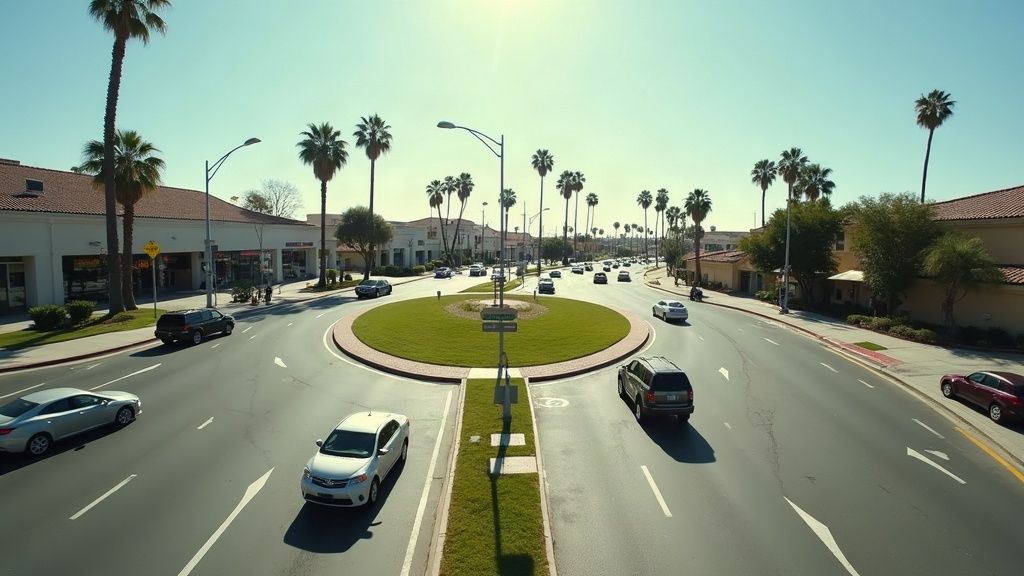
If you were hit in a roundabout in California, you already know these collisions feel like chaos. Two vehicles in a tight circle, everyone moving, and no one agreeing on who had the right of way. What you may not know is that roundabout accident claims follow a specific set of rules, and how your attorney builds the evidence record often determines whether you recover full compensation or walk away with far less than you deserve.
We've recovered over $150,000,000 for injured people across Southern California. Here are eight things you need to know before you file a roundabout accident claim.
Quick summary:
- California roundabouts give the right of way to circulating traffic, not entering vehicles.
- Failure to yield at entry is the leading cause of roundabout collisions.
- Multi-lane roundabouts create disputed-lane-change fault scenarios that require strong evidence.
- Motorcyclists and cyclists face the greatest physical risk in roundabout crashes.
- Surveillance footage is often the most decisive evidence in a roundabout claim.
- California's pure comparative fault rule lets you recover even if you were partly at fault.
- You must act fast: evidence disappears and deadlines apply.
- An attorney should be involved before you talk to the other driver's insurer.
1. Why California Is Adding More Roundabouts
California has been actively converting traditional signalized intersections to roundabouts because traffic safety data consistently shows roundabouts reduce the frequency and severity of injury crashes compared to conventional stop-light intersections.
The California Department of Transportation (Caltrans) has supported roundabout construction across the state, particularly at rural highway junctions and suburban commercial corridors. The Federal Highway Administration has also documented that roundabouts reduce fatal and injury crashes at converted intersections compared to signalized intersections, a finding that has accelerated California's adoption.
For drivers, more roundabouts means a higher probability of being in a roundabout-related collision at some point, and a greater chance that your personal injury claim will turn on roundabout-specific rules that differ from traditional intersection law.
Takeaway: The number of roundabouts in California will keep growing. Understanding how liability works inside them is now a practical necessity, not an edge case.
2. The Basic Right-of-Way Rules Inside a Roundabout
In California, vehicles already inside a roundabout have the right of way. Entering drivers must yield to circulating traffic before merging in.
California has no single codified roundabout right-of-way statute; roundabout yield is enforced through posted yield signs and markings at each entry. California courts and traffic authorities apply this yield-on-entry principle to roundabouts: the circulating lane is the through road, and the entry point is treated as a yield-controlled approach.
In practical terms, a driver at a roundabout entry who collides with a vehicle already circulating inside has almost certainly violated the right-of-way. That violation is strong evidence of negligence in a personal injury claim.
What does not affect the yield rule: the color of your vehicle, how long you have been waiting, or whether you believe the circulating driver was going faster than the posted advisory speed.
Takeaway: If you were already in the circle when the collision happened, the entering driver had the legal obligation to yield to you.
3. Common Causes of Roundabout Collisions
Most roundabout crashes in California fall into a short list of recurring causes, each of which maps to a specific negligence theory in a personal injury claim.
Failure to yield at entry. The most common cause. A driver enters without waiting for a gap in circulating traffic, striking a vehicle already in the circle. This is a direct violation of Vehicle Code section 21801 and typically establishes clear fault.
Distracted driving. Roundabouts require active decision-making at entry, lane tracking through the circle, and accurate exit identification. A driver who is looking at a phone, adjusting a navigation system, or otherwise distracted cannot safely navigate these demands.
Speeding through the circle. California roundabouts carry posted advisory speeds, often between 15 and 25 miles per hour. Drivers who enter or circulate above those speeds reduce the reaction time available to other drivers and increase the energy of any impact.
Wrong-way entry. Roundabouts are one-way. Drivers unfamiliar with the layout, particularly at newly constructed roundabouts, occasionally enter from the wrong side, creating a direct head-on conflict with circulating traffic.
Misjudging the gap. A driver correctly identifies a gap in traffic but misjudges the closing speed of a circulating vehicle, entering too late. At roundabout speeds, this misjudgment produces a side-impact collision at the entry merge point.
Takeaway: The cause of the collision determines which negligence theory applies. Your attorney needs to identify the specific conduct that produced the crash, not just that a crash occurred.
4. How Multi-Lane Roundabouts Complicate Fault Determinations
Multi-lane roundabouts are among the most disputed accident scenes in California personal injury claims because both drivers often believe they had the right of way.
In a single-lane roundabout, fault analysis is relatively straightforward: one driver was inside, one was entering, and the entering driver should have yielded. Multi-lane roundabouts introduce a second layer of complexity: lane discipline inside the circle.
California traffic law requires drivers to maintain their lane unless they signal and safely change lanes. Inside a roundabout, drivers must select the correct lane before entry, based on their intended exit, and hold that lane through the circle. A driver in the outer lane who drifts inward strikes a driver legally in the inner lane. A driver in the inner lane who exits from an outer-lane exit cuts across a driver traveling in the outer lane.
These lane-change collisions inside the circle frequently produce he-said-she-said disputes because both drivers may have had a technical right to be in the roundabout at the same time. Fault then turns on which driver crossed a lane line without a clear path, which requires physical evidence: tire marks, vehicle damage angles, and, most critically, camera footage.
Under California Vehicle Code section 22107, a driver may not change lanes until they can do so safely and without interfering with other traffic. A violation of section 22107 inside a roundabout is a strong basis for negligence.
Takeaway: In a multi-lane roundabout collision, the driver who crossed a lane line without a safe path is typically at fault under Vehicle Code section 22107. Proving that requires physical evidence, not just your account of the event.
5. Motorcycle and Bicycle Risks Specific to Roundabouts
Motorcyclists and cyclists carry the same right-of-way protections as any other vehicle in a California roundabout, but they face much greater physical harm when other drivers fail to yield.
California law treats motorcycles as vehicles with equal rights on the roadway. A motorcyclist circulating inside a roundabout has the same right of way as a passenger car. A cyclist riding in the roundabout is entitled to the same protections. When a driver entering the roundabout fails to yield and strikes a motorcyclist or cyclist, the liability analysis is the same as if they had struck a car.
The practical problem is that drivers systematically underestimate the speed of motorcycles and bicycles in a roundabout. A circulating motorcycle at 20 miles per hour closes a gap faster than the entering driver anticipates, and the entering driver pulls forward into the motorcycle's path. The result is a T-bone or sideswipe collision in which the motorcyclist has no structural protection.
Injuries in these crashes are typically far more severe than in comparable car-on-car collisions: fractures, road rash, traumatic brain injury (TBI), and spinal injuries are common. That severity drives higher damages in a personal injury claim, which is precisely why the opposing insurer works harder to argue comparative fault against the motorcyclist or cyclist.
If you were injured on a motorcycle or bicycle in a roundabout, expect the insurer to claim you were traveling too fast for conditions or that you were not visible. Both arguments require a direct evidentiary response from your attorney.
Takeaway: Motorcyclists and cyclists have full legal right-of-way protection in California roundabouts. When the other driver's insurer argues visibility or speed, your attorney needs camera footage and an accident reconstruction expert to counter it.
6. What Evidence Matters Most in a Roundabout Crash Claim
Surveillance camera footage is frequently the most decisive piece of evidence in a roundabout crash claim, because eyewitness accounts of fast-moving circular traffic are often inconsistent.
Roundabouts are compact, fast-moving environments. Human perception under stress is unreliable, and the geometry of the circle means two witnesses standing in different positions see entirely different approach angles. That is why physical and video evidence consistently outweigh witness testimony in roundabout liability disputes.
Camera footage. Many California roundabouts, particularly in urban and suburban areas, are covered by traffic management cameras operated by city or county transportation departments. Adjacent businesses, gas stations, and residences often have security cameras with sightlines to the roundabout. This footage must be preserved immediately, because most systems overwrite recordings within 24 to 72 hours. Your attorney can send a preservation demand to the relevant agencies and property owners before the footage is gone.
Vehicle damage patterns. The location and angle of damage on each vehicle tells the story of where in the roundabout the impact occurred, which vehicle was entering, and which was circulating. A forensic review of damage patterns often directly contradicts one driver's version of events.
Tire and skid marks. Braking and acceleration marks inside the roundabout circle or at the entry point indicate speed, direction, and reaction timing. These marks fade or are washed away quickly. Photograph them at the scene if you are physically able to do so.
The police report. California Vehicle Code section 20008 requires a written report to law enforcement when a collision involves injury or death. That report, and any citation issued at the scene, is admissible evidence of fault.
Medical records. The nature and timing of your injuries, documented from the date of the crash forward, establish the link between the collision and your claimed damages.
Takeaway: Camera footage is the single most time-sensitive piece of evidence. If you cannot preserve it yourself, call an attorney the same day so a preservation demand can go out before the footage is overwritten.
7. How Comparative Negligence Applies When Both Drivers Misjudge Entry Timing
California follows pure comparative fault, a doctrine established by the California Supreme Court in Li v. Yellow Cab Co. (1975) 13 Cal.3d 804. Under pure comparative fault, an injured driver who is partially responsible for a collision can still recover damages. The court or jury assigns each party a percentage of fault, and the injured driver's recovery is reduced by their own percentage.
This matters in roundabout claims because many collisions involve some misjudgment by both drivers. Consider a common scenario: Driver A is circulating in the inner lane of a multi-lane roundabout. Driver B is entering and fails to fully yield, beginning to merge when the gap is too small. Driver A, seeing the conflict developing, accelerates to try to clear the merge point rather than braking, making the impact worse.
A jury might find Driver B 80 to 85 percent at fault for the entry violation and Driver A 15 to 20 percent at fault for the decision to accelerate rather than brake. Under pure comparative fault from Li v. Yellow Cab, Driver A can still recover 80 to 85 percent of their total proven damages, not zero.
That recovery percentage applies to all damages: medical expenses, lost wages, future care costs, and pain and suffering. The insurer for Driver B will work to maximize Driver A's fault percentage because every point of comparative fault reduces the insurer's payout. Your attorney's job is to hold that percentage as low as the evidence supports.
Takeaway: Being partly at fault in a California roundabout crash does not bar your recovery. Under pure comparative fault from Li v. Yellow Cab Co. (1975), your damages are reduced by your percentage of fault, not eliminated.
8. Steps to Take After a Roundabout Collision
After any roundabout collision involving injury, call 911, document the scene immediately, and consult a personal injury attorney before speaking with the opposing insurer.
Here is the sequence that protects your health and your claim.
1. Move to safety if you can. If the vehicles are operable, move them to the shoulder or a nearby parking area. Staying in a roundabout lane after a crash creates a secondary collision risk.
2. Call 911. Report the collision and request medical assistance even if you believe your injuries are minor. Adrenaline suppresses pain, and symptoms of whiplash, TBI, and internal injury routinely appear hours or days after the crash. A police response also generates the official report your claim will rely on.
3. Document the scene before anything changes. Photograph the position of both vehicles, visible damage, tire and skid marks, entry and exit points, and any posted signage or advisory speed signs. Video the full roundabout layout if you can. This takes two minutes and can determine your case.
4. Gather witness information. Roundabouts often have bystanders: pedestrians on adjacent sidewalks, drivers waiting at other entries, business employees with a sightline. Get names and phone numbers before people leave.
5. Do not admit fault or speculate about what happened. Tell the police what you observed. Do not tell the other driver, their insurer, or bystanders that you think you may have misjudged the gap. Those statements are admissible.
6. Seek medical care the same day. Go to an emergency room or urgent care clinic. A same-day medical record ties your injuries directly to the crash date. A gap in care is the first argument an insurer uses to minimize your injuries.
7. Call an attorney before you speak with the opposing insurer. The other driver's insurance company will contact you quickly, often within 24 hours. Their adjuster is trained to gather information that reduces your claim. You are not required to give a recorded statement to the opposing insurer. Your attorney handles that contact on your behalf.
Takeaway: The seven steps above are not optional additions after a roundabout crash. Each one builds a piece of your claim. Missing any one of them gives the opposing insurer an argument to use against you.
Frequently Asked Questions
Who has the right of way in a California roundabout?
Vehicles already circulating inside the roundabout have the right of way. A driver entering the roundabout must yield to circulating traffic before merging in, under California Vehicle Code section 21801. This yield-on-entry rule applies at all California roundabouts regardless of whether a yield sign is posted.
Are roundabouts safer than traditional intersections?
Federal traffic safety research has documented that roundabouts reduce fatal and serious injury crashes compared to traditional signalized intersections. The reduction is primarily attributed to lower vehicle speeds and the elimination of left-turn conflicts across oncoming traffic. However, roundabouts do not eliminate crashes, and collisions that do occur can still cause serious injuries, particularly for motorcyclists and cyclists.
What causes most roundabout accidents?
The most common cause of California roundabout collisions is failure to yield at entry. A driver enters the roundabout without waiting for a sufficient gap in circulating traffic and strikes a vehicle already inside the circle. Other frequent causes include distracted driving, speeding through the circle, wrong-way entry, and lane-change violations inside multi-lane roundabouts.
Can you be at fault in a roundabout even if you had the right of way?
Yes. Having the right of way does not eliminate your own duty to drive with reasonable care. If you had the right of way as a circulating driver but you were also speeding, distracted, or made a lane change without a clear path, a jury can assign you a percentage of fault. Under California's pure comparative fault rule from Li v. Yellow Cab Co. (1975) 13 Cal.3d 804, your recovery is reduced by your percentage of fault, but not barred entirely.
How long do I have to file a roundabout accident claim in California?
California's general statute of limitations for personal injury claims is two years from the date of injury, under California Code of Civil Procedure section 335.1. If the at-fault driver was a government employee operating a government vehicle, a government tort claim must be filed within six months of the injury date under California Government Code section 911.2. Missing either deadline can bar your recovery entirely.
What if the roundabout itself was poorly designed and contributed to the crash?
Poor roundabout design, inadequate signage, defective pavement, or missing yield line markings can create a premises liability or government entity claim separate from the driver-fault claim. If you believe the physical condition of the roundabout contributed to your crash, preserve your evidence of those conditions and discuss a potential public entity claim with your attorney. Government entity claims carry shorter deadlines than standard personal injury claims.
Do I need an attorney for a roundabout accident claim?
You are not legally required to hire an attorney. However, roundabout claims frequently involve disputed fault, multi-party liability, complex evidence questions, and insurers who move quickly to minimize payouts. An attorney who handles California personal injury claims can preserve time-sensitive evidence, calculate your full damages, and negotiate from a position of documented strength rather than guesswork.
What damages can I recover in a California roundabout accident claim?
Recoverable damages in a California personal injury claim include: past and future medical expenses, lost wages and lost earning capacity, property damage, and non-economic damages including pain and suffering and loss of enjoyment of life. In rare cases involving egregious conduct, punitive damages may also be available. Your total recovery is subject to reduction by your comparative fault percentage under Li v. Yellow Cab Co. (1975).
Roundabout collisions move fast and the evidence disappears faster. If you were injured in a roundabout crash anywhere in Southern California, call (818) 794-9947 for a free case review. No fee unless we win.