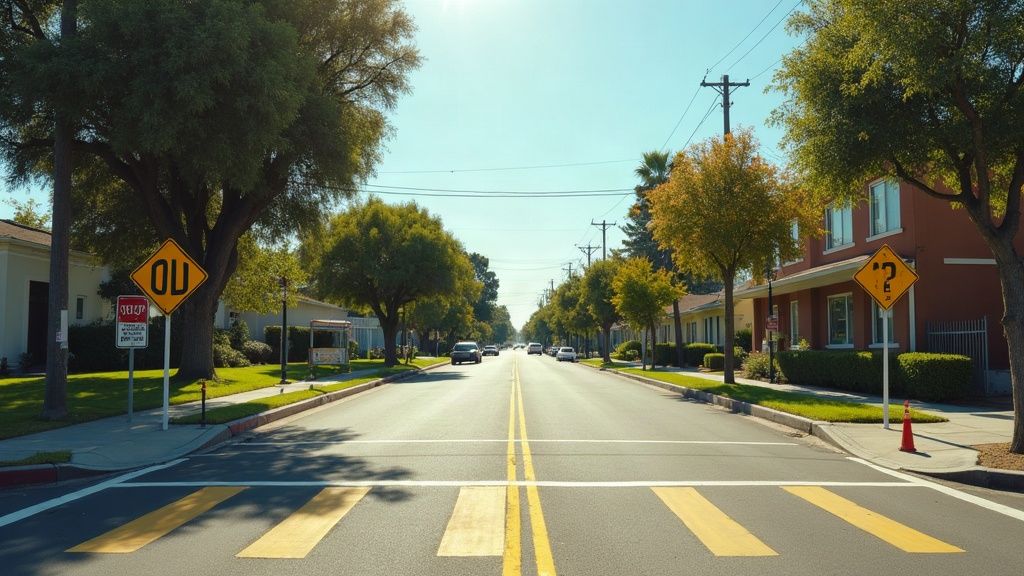
If your child was hurt near a school in California, you are facing a claim that is more complex than a standard car accident case. School zone accidents involve special traffic laws, potential government defendants, unique rules for children's injuries, and evidence that can disappear within 48 hours. The nine facts below are what every California parent needs to understand before talking to an insurance adjuster or signing anything.
Quick summary of all nine points:
- California's 25 mph school zone speed law creates a negligence per se argument when a driver violates it and causes harm.
- Drop-off lane collisions, distracted driving, and crosswalk failures are the leading causes of these crashes.
- Liability can extend to drivers, school districts, crossing guards, and property owners.
- Cal. Veh. Code §22454 requires every driver to stop for a school bus displaying red warning lights.
- Children's injury claims are evaluated over a lifetime, and the statute of limitations is typically tolled until age 18.
- School surveillance video and parent dashcam footage must be preserved immediately before it is overwritten.
- California's pure comparative fault rule rarely assigns meaningful fault to young children.
- Parents must call 911, document the scene, and consult an attorney before speaking to insurers.
- These claims routinely trigger multiple insurance policies at once.
1. How California's School Zone Speed and Safety Laws Factor Into Liability
California requires drivers to reduce speed to 25 miles per hour in a school zone when children are present on or adjacent to the roadway. That obligation comes from Cal. Veh. Code §22352(b)(1). A driver who exceeds the posted limit and strikes a child does not just face a traffic citation. In a civil personal injury claim, that violation supports a negligence per se argument, meaning the driver's failure to obey a safety statute designed to protect children is treated as evidence of negligence itself.
Beyond speed, California law requires drivers to yield to pedestrians in marked crosswalks under Cal. Veh. Code §21950, to stop for school buses with activated warning lights under §22454, and to obey crossing guard directions under §21456. Each of those violations strengthens the liability argument in a school zone claim.
Practical takeaway: Document the posted speed limit signs at the scene with photographs immediately, because they establish the legal standard the driver was required to meet.
2. Common Causes of School Zone Accidents, From Drop-Off Chaos to Distraction
California law requires drivers to slow to 25 miles per hour in a school zone when children are present, and a driver who exceeds that limit and injures a child faces a negligence per se argument in court.
School zones are dangerous precisely because they concentrate pedestrians, cyclists, and vehicles in a small area during a very short time window. The most common causes of serious injury in California school zone accidents include:
- Drop-off and pick-up lane collisions. Parents pulling in and out of double-parked lanes, combined with children moving between vehicles, create a high-collision environment. A driver who strikes a child while maneuvering in a school drop-off zone owes the same duty of reasonable care as any driver.
- Failure to yield at crosswalks. Cal. Veh. Code §21950 requires a driver to yield to any pedestrian in a marked crosswalk. A child stepping off the curb at a designated crossing has the right of way.
- Distracted driving. A driver using a phone, adjusting a radio, or attending to a child in the back seat is far more likely to miss a pedestrian suddenly entering the roadway.
- Illegal U-turns and double parking. Both block the sightlines of other drivers and pedestrians. A driver who parks illegally and obstructs a child's visibility creates a dangerous condition even if that driver is not the one who ultimately causes the collision.
Practical takeaway: Knowing the exact cause of the crash shapes which defendants you name and which insurance policies apply.
3. Who Can Potentially Be Liable, Including Drivers, Schools, and Crossing Guards
Liability in a California school zone accident is rarely limited to the driver who made direct contact with the child. California follows a fault-based tort system, and multiple parties can share responsibility for the same collision.
- The at-fault driver is the most obvious defendant. Their auto liability policy is typically the first layer of coverage.
- The school district can be liable when its employees act negligently in the scope of their duties. Under California Government Code §815.2, a public entity is liable for the torts of its employees acting within the scope of employment. A crossing guard who fails to stop traffic before waving children into the crosswalk, or a school administrator who designed an unreasonably dangerous drop-off lane layout, can create district liability.
- The property owner adjacent to the zone can face a premises liability claim if overgrown vegetation, a parked truck, or a poorly placed fence blocked sightlines and contributed to the collision.
- A school bus contractor can be liable if the bus was operated negligently or the stop was placed in an unreasonably hazardous location.
Government entity claims carry an important procedural requirement. Before you can sue a California public school district, you must first file a government tort claim with the district under California Government Code §911.2. The deadline is six months from the date of the incident for personal injury claims. Miss it and you lose your right to sue the district entirely.
Practical takeaway: If a school employee contributed to the crash, the six-month government tort claim deadline runs independently of the personal injury statute of limitations. Both must be tracked.
4. Special Rules Around School Bus Stops and Flashing Warning Signals
Under Cal. Veh. Code §22454, every driver must stop for a school bus displaying flashing red lights, and a violation of that law is powerful evidence of negligence in a personal injury claim.
Cal. Veh. Code §22454 is one of the clearest liability statutes in California traffic law. It requires every driver approaching a school bus from either direction to stop when the bus displays flashing red warning lights and stop signals. Moving past a stopped bus displaying red lights is a misdemeanor, not just a traffic infraction.
In a personal injury claim, a driver who passed a stopped school bus and struck a child at the bus stop has violated a statute specifically enacted to protect children in exactly that situation. That is the textbook definition of negligence per se in California.
Bus stop liability can also reach beyond the individual driver. If a school district or a private bus contractor placed a bus stop on a street with no sidewalk, inadequate sight distances, or heavy truck traffic, and a child was injured at that location, the entity responsible for stop placement may share in the liability.
Practical takeaway: Obtain the school bus's GPS logs and the driver's report immediately. They document exactly where the bus was stopped and whether warning lights were activated.
5. How Injuries to Children Are Evaluated Differently in a Claim
Children are not small adults in the eyes of California personal injury law. Their claims are evaluated differently in at least three ways.
Statute of limitations tolling. For most personal injury claims brought on behalf of a minor, Cal. Code Civ. Proc. §352 tolls the two-year statute of limitations until the child turns 18. That means the child generally has until age 20 to file. The government tort claim deadline against a school district, however, is NOT tolled in the same way. That six-month deadline runs from the date of injury regardless of the child's age.
Lifetime damages. A child who suffers a traumatic brain injury, spinal cord damage, or severe orthopedic fracture is entitled to damages that stretch over a lifetime. Lost earning capacity must be calculated from the child's projected career, not a few years of missed wages. Future medical costs for a growing child may include surgeries, physical therapy, and developmental support that adult claimants do not face.
Standard of care for the child. California courts hold a child to the standard of care expected of a child of similar age, experience, and intelligence, not to an adult standard. A six-year-old who darts into a crosswalk is judged against what a reasonable six-year-old would do, which is a very different question from adult pedestrian negligence.
Practical takeaway: Never accept an early settlement for a child's injuries before the full extent of those injuries is known. Growing children often develop complications months or years after an accident.
6. Why Witness Statements From Other Parents and Video Matter So Much
School zone accidents happen in some of the most video-covered environments in any California neighborhood. School buildings often have exterior surveillance cameras covering the drop-off lane, the crosswalk, and the street approach. Dozens of parents waiting in pick-up lines may have dashcams or may have been recording video on their phones at the moment of impact. Traffic signal cameras and private business cameras are often mounted nearby.
That evidence is irreplaceable, and it disappears fast. School surveillance systems commonly overwrite footage on a 30-day or shorter loop. Private dashcam footage is often deleted when the driver clears the device. California law allows an attorney to send a litigation hold letter demanding that a school district or a private party preserve specific evidence immediately. Without that demand, the footage may be lawfully overwritten before litigation begins.
Witness statements from other parents are also valuable because those witnesses typically have no financial stake in the outcome and are perceived as highly credible by insurers and juries. A parent who saw the driver run the crosswalk or pass a school bus stop sign is a far more powerful witness than any expert reconstruction.
Practical takeaway: If you were at the scene, collect contact information from every parent or adult witness before leaving, and call an attorney the same day so a preservation letter can go out immediately.
7. How Comparative Fault Questions Are Handled When a Child Is Involved
California's pure comparative fault rule, established by the California Supreme Court in Li v. Yellow Cab Co. in 1975, allows an injured child to recover damages even if the child was partly at fault, with the award reduced only by the child's own share of responsibility.
California follows the pure comparative fault doctrine established by the California Supreme Court in Li v. Yellow Cab Co. (1975) 13 Cal.3d 804. Under that rule, an injured person can recover damages even if they were partly at fault. The recovery is reduced by the plaintiff's percentage of fault, nothing more.
For a child plaintiff, this matters in two practical ways. First, insurance carriers sometimes argue that the child was jaywalking or stepped into traffic without looking, and use that argument to reduce the settlement offer. Under pure comparative fault, that argument can only reduce the award in proportion to the child's actual percentage of fault. It cannot eliminate the claim entirely.
Second, courts apply an age-appropriate standard when evaluating a child's fault. California courts have long recognized that very young children, typically under age five or six, are generally held incapable of contributory negligence at all. Older children are measured against the standard of a child of similar age and judgment, not an adult. A driver arguing that an eight-year-old should have known better faces an uphill battle in California.
Note that Cal. Civ. Code §1431.2, enacted by Proposition 51, addresses a separate but related question: when multiple defendants share fault, each pays only their proportionate share of non-economic damages like pain and suffering. Both the comparative fault rule and the Proposition 51 apportionment rule can come into play when a school zone accident involves multiple liable parties.
Practical takeaway: Do not let an insurer use a child's misstep as a basis for denying the claim. Comparative fault reduces an award, not eliminates it, and courts set a low fault threshold for young children.
8. Immediate Steps Parents Should Take After a School Zone Crash
Parents must call 911 immediately after a school zone accident, photograph the scene before any vehicles are moved, collect every witness's contact information, and consult an attorney before making any recorded statement to an insurance adjuster.
The first 24 hours after a school zone accident are the most important in the entire claims process. Here is what to do, in order.
- Call 911. A police report documents the scene, the driver's information, and the officer's observations while details are fresh. It is one of the most important documents in the claim.
- Do not move the child unnecessarily. Unless the child is in immediate physical danger at the location, wait for paramedics. Moving a child with a potential spinal injury can worsen it.
- Photograph everything. Take photos of the vehicle, its position relative to the crosswalk or bus stop, all traffic signs in the area, any tire marks, and your child's visible injuries. Do this before any vehicles are moved.
- Collect witness information. Get the full name and phone number of every parent, driver, or bystander who saw the crash.
- Seek medical care immediately. Even if the child seems fine, adrenaline masks pain. A same-day medical evaluation creates the medical record that links the injuries to the accident.
- Call an attorney before talking to any insurer. Insurance adjusters may call the same day. Anything you say can be used to reduce the claim. An attorney can handle all insurer communication on your behalf.
Practical takeaway: The call to an attorney and the call to 911 are the two most important calls you make on the day of the crash.
9. Why These Claims Often Involve More Than One Insurance Policy
School zone accident claims in California frequently involve multiple insurance policies at once, including the at-fault driver's auto policy, the school district's liability policy, and the injured child's own uninsured or underinsured motorist coverage.
Most California parents assume a school zone accident claim means one defendant and one insurance company. In practice, these cases routinely layer multiple policies.
- The at-fault driver's auto liability policy. This is the starting point. Under SB 1107, effective for policies issued or renewed on or after January 1, 2025, California's mandatory minimum bodily injury coverage increased from $15,000 per person to $30,000 per person. For a seriously injured child, that minimum is almost always insufficient.
- The school district's liability policy. If the district or a district employee shares fault, the district's self-insurance or commercial liability policy becomes available. California school districts typically carry substantial coverage limits, but you must have filed the government tort claim before you can access it.
- An umbrella or excess liability policy. If the at-fault driver carries an umbrella policy, it sits above the auto policy limits and can provide significantly higher coverage.
- The family's own uninsured or underinsured motorist (UM/UIM) coverage. If the at-fault driver was uninsured or underinsured, the family's own auto policy may step in to cover the gap. This coverage is purchased on the family's own policy, not the driver's, and is often overlooked.
- MedPay or Personal Injury Protection. Some California families carry medical payments coverage on their own auto policy that pays regardless of fault. It can cover immediate medical bills while the liability claim is being resolved.
Coordinating multiple policies requires understanding how each policy interacts with the others, including subrogation rights that allow one insurer to recover from another.
Practical takeaway: A single-policy settlement that ignores the school district's coverage or the family's own UM/UIM policy may leave substantial compensation on the table.
Frequently Asked Questions
Who is liable for a school zone car accident in California?
Liability depends on how the accident happened. The at-fault driver is almost always a defendant. A school district can be liable under California Government Code §815.2 if a district employee, such as a crossing guard, acted negligently. Property owners with sight-obstructing vegetation or signage, and bus contractors who placed a stop in an unreasonably dangerous location, can also face liability. California allows multiple defendants to share fault.
What happens if a child is hit near a school crossing?
The child's family should call 911, document the scene, collect witness information, and seek immediate medical care. An attorney should be contacted the same day so that school surveillance video and dashcam footage can be preserved before being overwritten. For claims against the school district, a government tort claim must be filed within six months of the incident under California Government Code §911.2.
Are school zone speed limits strictly enforced in accident claims?
Yes. California requires drivers to travel at no more than 25 mph in a school zone when children are present under Cal. Veh. Code §22352(b)(1). A driver who exceeds that limit and causes a collision faces a negligence per se argument in the civil claim, meaning the speed limit violation is itself treated as evidence of negligence.
Can a school district be held responsible for a drop-off accident?
A school district can be held liable when a district employee's negligence contributed to the accident, such as a crossing guard who waved children into traffic unsafely, or when the district designed a drop-off zone with inadequate safety features. Government Code §815.2 makes California public entities responsible for employee torts committed in the scope of employment. To sue the district, the family must first file a government tort claim within six months of the injury date.
How long do parents have to file a school zone accident claim in California?
For the personal injury claim against private defendants, California's two-year statute of limitations under Cal. Code Civ. Proc. §335.1 applies, and it is typically tolled until the child's eighteenth birthday under Cal. Code Civ. Proc. §352. For claims against the school district, the government tort claim must be filed within six months of the date of injury regardless of the child's age.
Does a child's comparative fault reduce the claim?
Under California's pure comparative fault rule from Li v. Yellow Cab Co. (1975) 13 Cal.3d 804, a child's recovery is reduced only by the child's own percentage of fault. Very young children are generally held incapable of negligence at all. Older children are judged by the standard of care expected of a child of similar age and experience, not an adult standard.
If your child was injured in a California school zone accident, the evidence that matters most can disappear within days. Call (818) 794-9947 for a free case review. No fee unless we win.
Reviewed by Minas Nordanyan, CA Bar #296806. Last reviewed September 2026.