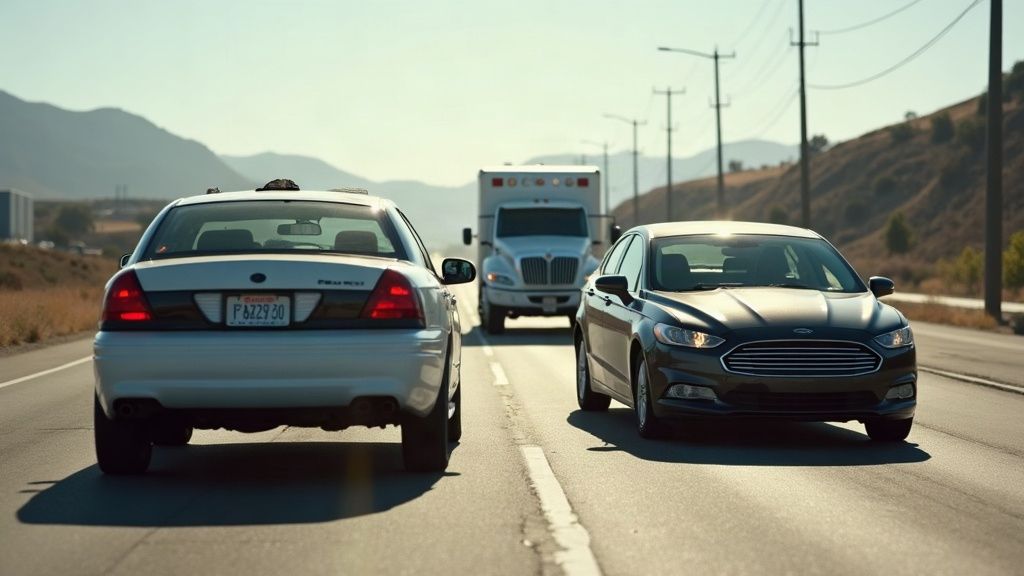
If you were sideswiped on a California road, one thing is almost certain: the other driver is blaming you, the insurance adjuster is telling you the claim is "complicated," and you are not sure what your rights actually are. That uncertainty is not an accident, it is how disputed sideswipe cases get settled for far less than injured drivers deserve.
Sideswipe accident claims in California have their own evidentiary challenges, their own fault rules, and their own insurance-adjuster playbook. Understanding them before you give a recorded statement or accept an offer can change the outcome of your case.
Here is what you need to know.
Quick summary:
- A sideswipe is defined by lateral, side-to-side contact between moving vehicles.
- Unsafe lane changes and improper merges are the leading causes, and the legal basis for fault.
- California's comparative fault rules mean both drivers can share responsibility.
- Witness statements are often the most important evidence in a disputed sideswipe case.
- Injuries are sometimes delayed, get checked out quickly after any sideswipe crash.
- Scrape patterns on the vehicles themselves can prove which car crossed the line.
- Insurers routinely dispute sideswipe fault to reduce payouts, expect it.
- Document the scene thoroughly before vehicles are moved.
- California's two-year filing deadline under Code of Civil Procedure §335.1 is hard and unforgiving.
1. What Actually Counts as a 'Sideswipe' Collision
A sideswipe collision occurs when two vehicles make lateral contact along their sides while both are in motion. The defining feature is side-to-side impact, not a rear-end strike, not a head-on crash, but a scraping or glancing blow along the length of one or both vehicles.
Sideswipes can happen between vehicles traveling in the same direction (the most common type on California freeways), between vehicles going in opposite directions on a two-lane road, or between a moving vehicle and a stationary object parked at the roadside. The common thread is that neither vehicle has to come to a complete stop for the collision to occur.
This distinction matters legally. Because both vehicles are typically moving, each driver's position in their lane at the moment of contact becomes the central fact question. California law addresses this directly: Cal. Veh. Code §21658(a) states that a vehicle shall be driven as nearly as practicable entirely within a single lane and shall not be moved from that lane until the driver has first ascertained that the movement can be made with safety.
That statute is the legal anchor for most sideswipe fault determinations in California.
Takeaway: If you were hit along the side of your vehicle while you were traveling in your lane, the driver who moved out of their lane likely violated Cal. Veh. Code §21658(a), and that is the starting point for your claim.
2. Common Causes: Lane Changes, Merging, and Drifting
Most California sideswipe crashes trace back to one of three driver failures: an unsafe lane change, an improper merge, or a driver drifting out of their lane.
Unsafe lane changes are the leading cause on multi-lane freeways like the 405, the 101, and Interstate 10. A driver who changes lanes without checking their blind spot, without signaling, or without enough clearance violates Cal. Veh. Code §22107, which prohibits unsafe turning movements from a direct course.
Improper merging is common at on-ramps, where a driver entering the freeway fails to match speed or yield to traffic already in the travel lane. Cal. Veh. Code §21804 places the duty on the merging driver to yield to approaching traffic.
Drifting is increasingly common and increasingly dangerous. Distracted driving, texting, adjusting navigation, reaching for a drink, causes drivers to drift across lane lines without realizing it. Fatigue has the same effect. A driver who drifts into your lane has still violated §21658(a) even if they were not making an intentional lane change.
Takeaway: Identifying which category of driver failure caused your sideswipe is the first step toward building a liability case, each failure maps to a specific California Vehicle Code violation that supports your claim.
3. How Fault Is Typically Determined in These Crashes
California is a pure comparative fault state. Under this rule, established by the California Supreme Court in Li v. Yellow Cab Co., each party to an accident can be assigned a percentage of fault, and their recovery is reduced by that percentage. Even if you are found 40% at fault, you can still recover 60% of your damages.
In a sideswipe case, fault determination typically rests on several factors:
- Which vehicle crossed the lane line (the most important question)
- Whether either driver signaled before moving
- Pre-crash speeds and following distances
- Any traffic code violations documented by the responding officer
- The physical damage pattern on each vehicle (see item 6)
- Witness accounts of which car moved laterally first
The police report is the first document an adjuster will review. If the reporting officer cited one driver for a lane change violation, that citation carries significant weight, though it is not conclusive. California insurers and courts still conduct their own fault analysis.
Shared fault is genuinely common in sideswipe cases. Two drivers simultaneously drifting toward each other, or a lane-changer swerving to avoid a road hazard while the other driver was speeding, can both contribute to the collision. Shared fault reduces your recovery but does not eliminate it.
Takeaway: Comparative fault works in your favor in California, you can recover even with partial fault, but every percentage point matters, which is why thorough documentation and legal representation directly affect how much you receive.
4. Why Witness Statements Matter More in Sideswipe Cases
In a rear-end collision, physics tells most of the story. In a sideswipe, the physical evidence is often sparse, a scrape here, a paint transfer there, and both drivers are usually pointing at each other. That is why independent witness statements carry unusual weight in sideswipe claims.
A bystander, a nearby driver, or a passenger in a third vehicle who saw which car crossed the lane line first can resolve a disputed claim that no amount of damage analysis alone can settle. Witnesses can establish:
- Which vehicle moved laterally first
- Whether a turn signal was used
- The relative speeds of each car
- Whether either driver appeared distracted
Witnesses are time-sensitive. People leave the scene, memories fade, and contact information becomes impossible to track down within hours of the crash. If you are physically able to do so after a sideswipe, your first priority after calling 911 is to identify anyone who saw what happened and get their name and phone number before they drive away.
Dashcam footage from other vehicles in the area is the modern equivalent of a witness statement, and sometimes better. If another driver had a dashcam running, their footage may have captured the entire sequence. Asking nearby drivers at the scene whether their dashcam was recording takes thirty seconds and could be decisive.
Takeaway: Do not leave the scene of a sideswipe without collecting witness contact information and asking nearby drivers about dashcam footage, those two steps can make or break a disputed liability case.
5. Common Injuries from Sideswipe Impacts
Sideswipe collisions are sometimes dismissed as "minor" because the vehicles do not collide head-on. That assumption is wrong, and it costs injured drivers real money when they accept a quick settlement before understanding the full extent of their injuries.
The lateral force in a sideswipe can cause:
Whiplash and cervical spine injuries. The sudden sideways jolt moves the head and neck in ways the muscles are not braced for. Whiplash from a lateral impact can be as severe as whiplash from a rear-end strike.
Shoulder injuries. The shoulder nearest the point of impact, often pressed against the door or armrest, can sustain rotator cuff tears, labral tears, or contusions. Drivers sometimes also injure the opposite shoulder by gripping the steering wheel hard during impact.
Wrist and arm fractures. A driver who braces for impact instinctively straightens their arms against the steering wheel. The force transmitted through an outstretched arm can fracture the radius, ulna, or wrist bones.
Traumatic brain injuries (TBI). If the sideswipe causes the vehicle to spin, veer into a barrier, or roll, the occupant's head can strike the window, door frame, or pillar. Even without direct head contact, the rotational forces alone can cause a concussion or more serious TBI.
Delayed onset is a real risk. Adrenaline at the scene can mask pain. Symptoms of whiplash, concussion, and soft-tissue injuries often do not appear until 24-72 hours after the crash. Waiting to see a doctor gives the insurance adjuster grounds to argue your injuries were not caused by the accident.
Takeaway: Get a medical evaluation the same day or the following morning after any sideswipe crash, not just to protect your health, but to create the medical record that ties your injuries to the collision.
6. Vehicle Damage Patterns That Help Prove What Happened
When two drivers tell opposite stories, the cars often tell the truth. The scrape and damage patterns on each vehicle are a form of physical evidence that a trained eye, or an accident reconstructionist, can read to establish which car crossed into the other's lane.
Key patterns to document and understand:
Location of damage. Damage concentrated on the front quarter panel and front door of one vehicle, combined with damage on the rear quarter panel of the other, suggests the first vehicle was moving forward into the second, consistent with a lane-change scenario where the changing driver struck a vehicle they did not see.
Length and angle of scrape. A long, diagonal scrape running from front to rear on one side indicates extended lateral contact, the vehicles were traveling together in contact for some distance. A short, concentrated gouge suggests a more sudden impact.
Paint transfer. Paint from the other vehicle deposited on yours confirms the point and direction of contact. A forensic analysis can match paint color and composition to the specific vehicle.
Tire marks. If a driver swerved to avoid contact, or if a vehicle was pushed into a barrier, skid marks or tire scrub marks on the pavement can indicate direction of travel and evasive action.
Photograph everything before the vehicles are moved. Take wide shots showing lane markings, close shots of every scrape, and detail shots of paint transfer. If the scene is unsafe to photograph, let law enforcement document it, and request a copy of any photographs taken in the police report.
Takeaway: The physical evidence on the vehicles is often your strongest objective proof of fault, photograph it thoroughly at the scene and preserve every image with the original timestamp and location data intact.
7. Why Insurers Sometimes Dispute Sideswipe Fault
Insurance adjusters are experienced at managing ambiguous sideswipe claims to minimize payouts. Sideswipe cases present several features that make dispute the default posture:
Both drivers usually blame each other. Without a clear guilty party, the adjuster's opening move is to argue shared fault, even when the evidence clearly favors one driver, because a shared-fault finding reduces the insurer's exposure.
Physical evidence is often limited. Unlike a rear-end crash where the contact pattern is obvious, sideswipe damage can be consistent with multiple scenarios. Adjusters exploit that ambiguity.
No independent witnesses are often present. When there are no third-party witnesses and no dashcam footage, the adjuster knows the claim may be hard to prove at trial, and uses that leverage.
Quick settlement offers exploit unfamiliarity. An adjuster who contacts you within 48 hours of the crash with a settlement offer is typically making that call because they know injured drivers who have not yet spoken to an attorney accept lower amounts. Once you sign a release, you cannot reopen the claim no matter how severe your injuries turn out to be.
California requires insurers to conduct a fair and thorough investigation under the California Code of Regulations Title 10, §2695.7. An insurer that denies a sideswipe claim without a reasonable basis for that denial may be acting in bad faith, a separate and significant legal issue.
Takeaway: An insurance adjuster disputing sideswipe fault is not a sign your claim is weak, it is a standard tactic to reduce the payout. Document everything, do not give a recorded statement without legal counsel, and do not sign a release before you understand the full value of your claim.
8. Steps to Document the Scene Effectively
What you do in the first 30 minutes after a sideswipe collision shapes the strength of your claim more than almost anything that happens afterward. Here is the documentation sequence to follow if you are physically able:
- Call 911. Request police and, if needed, medical response. A police report is an official record of the facts on the day of the crash.
- Stay at the scene. Leaving before police arrive can complicate your claim and may violate Cal. Veh. Code §20002 if there is property damage.
- Photograph before vehicles move. Capture both vehicles in their final positions, every scrape and gouge, lane markings, road signs, traffic signals, and any skid marks or debris on the pavement.
- Collect witness information. Name, phone number, and a one-sentence description of what they observed. Do this before they leave.
- Ask about dashcam footage. Check your own dashcam if you have one. Ask any nearby driver if their dashcam was recording.
- Exchange information. Name, license, registration, insurance carrier, and policy number from the other driver.
- Do not discuss fault. Tell the other driver and the officer what happened factually. Do not apologize or speculate about what caused the crash, those statements can be used against you.
- Request the police report number. You can obtain the full report from the responding agency, typically within 5-10 business days.
- Seek medical evaluation the same day. Even if you feel fine, get checked. Document the evaluation.
- Notify your own insurer. California law and most policies require prompt notice of an accident, delay can complicate your uninsured/underinsured motorist (UM/UIM) coverage if the other driver is uninsured.
Takeaway: The documentation window at the scene is short and irreplaceable, every photograph, every witness contact, and every official report you secure in those first minutes adds direct, measurable value to your claim.
9. When to Involve a Lawyer for a Sideswipe Claim
Not every sideswipe requires an attorney. A minor scrape with no injuries and clear liability may resolve through a straightforward property damage claim. But the following situations call for legal representation:
You were injured. Once injuries enter the picture, even soft-tissue injuries, the value and complexity of the claim increase substantially. An attorney can identify all compensable damages: medical bills, future treatment, lost wages, loss of earning capacity, and pain and suffering.
Fault is disputed. If the other driver or their insurer is blaming you, you need someone in your corner who knows how to build a liability case with the available evidence.
The insurer's offer feels low. If an adjuster offers you a quick settlement, it is almost certainly lower than the full value of your claim. Once you accept and sign a release, you cannot go back.
You are a worker injured in the course of employment. If the sideswipe happened while you were driving for work, a delivery, a sales call, a work errand, you may have both a personal injury claim against the at-fault driver AND a California workers' compensation claim against your employer. These claims run in parallel and the interplay between them requires careful handling so that one does not inadvertently reduce the other.
The other driver was uninsured or underinsured. California requires drivers to carry minimum liability insurance under Cal. Veh. Code §16020, but many do not. UM/UIM claims against your own insurer have their own procedures and deadlines.
The filing deadline is approaching. California's statute of limitations for personal injury claims is two years from the date of the accident under Code of Civ. Proc. §335.1. Once that deadline passes, the court will dismiss your case regardless of how strong your evidence is.
We've recovered over $150,000,000 for injured Californians, including drivers hurt in disputed fault crashes where the insurer's initial position was that our client was at fault. We handle every personal injury case as if it will go to trial, because that preparation is exactly why insurance carriers settle for more.
Takeaway: If you were injured, if fault is disputed, or if the filing deadline is approaching, the cost of not calling an attorney is almost always higher than the cost of calling one, and the consultation is free.
Frequently Asked Questions
Who is at fault in a sideswipe accident in California?
The driver who moved out of their lane without first confirming it was safe is typically at fault. Cal. Veh. Code §21658(a) requires every driver to remain in a single lane until the movement can be made safely. The driver initiating an unsafe lane change, an improper merge, or a drift across the lane line bears primary responsibility. That said, California's pure comparative fault rules mean both drivers can share fault if both contributed to the crash.
What is the average settlement for a sideswipe accident?
There is no single average, because sideswipe settlements depend on the severity of injuries, the clarity of fault, the at-fault driver's insurance policy limits, and whether the injured party has lost wages or requires future medical care. Minor sideswipes with no injuries may resolve as property damage only. Cases involving serious injuries, spinal injuries, TBI, fractures, can result in significantly larger recoveries. The right question is not "what is average" but "what is my case actually worth given my specific injuries and facts."
How do you prove fault in a lane-change accident?
Proving fault in a lane-change sideswipe relies on several categories of evidence: the police report and any citations issued; the physical damage pattern on each vehicle (which can show which car moved into the other); witness statements from people who saw which vehicle crossed the lane line first; dashcam footage from either vehicle or nearby traffic; and expert accident reconstruction if the case involves serious injuries. An attorney experienced in California personal injury claims can gather and preserve this evidence before it disappears.
Can both drivers be at fault in a sideswipe crash?
Yes. California's pure comparative fault system allows fault to be apportioned between both drivers. If Driver A was making an unsafe lane change and Driver B was speeding, a jury or adjuster might find each driver partially responsible. Each driver's recovery is then reduced by their own percentage of fault. Shared fault does not eliminate your right to recover, it adjusts the amount.
Should I give a recorded statement to the other driver's insurer after a sideswipe?
No. You are not legally required to give a recorded statement to the adverse insurer. Adjusters use recorded statements to find inconsistencies they can use to reduce or deny your claim. Politely decline, and speak with an attorney before giving any recorded statement to anyone other than your own insurer.
What happens if the other driver in a sideswipe is uninsured?
If the at-fault driver carries no insurance or insufficient insurance, you may be able to file a claim under your own uninsured/underinsured motorist (UM/UIM) coverage. California law does not require drivers to carry UM/UIM coverage, but it is available and widely held. An attorney can review your own policy and advise you on whether a UM/UIM claim is available and how to pursue it without inadvertently jeopardizing your rights.
How long do I have to file a sideswipe accident claim in California?
California's statute of limitations for personal injury claims is two years from the date of the accident under Code of Civ. Proc. §335.1. Property damage claims have a three-year deadline under Code of Civ. Proc. §338. If the at-fault driver was a government employee operating a government vehicle, you must file a government tort claim within six months of the incident, a much shorter window.
Can dashcam footage really change the outcome of a sideswipe claim?
Yes. Dashcam footage showing which vehicle crossed the lane line is often dispositive, meaning it can resolve a disputed claim that would otherwise come down to one driver's word against the other's. If your own dashcam captured the collision, preserve the footage immediately and do not allow it to be overwritten. If another vehicle near the scene had a dashcam running, ask for the footage at the scene or as soon as possible afterward.
If you were sideswiped on a California road and fault is in dispute, or if you are not sure whether the insurer's offer covers what your injuries are actually worth, call Nordanyan Law at (818) 794-9947 for a free case review. No fee unless we win.