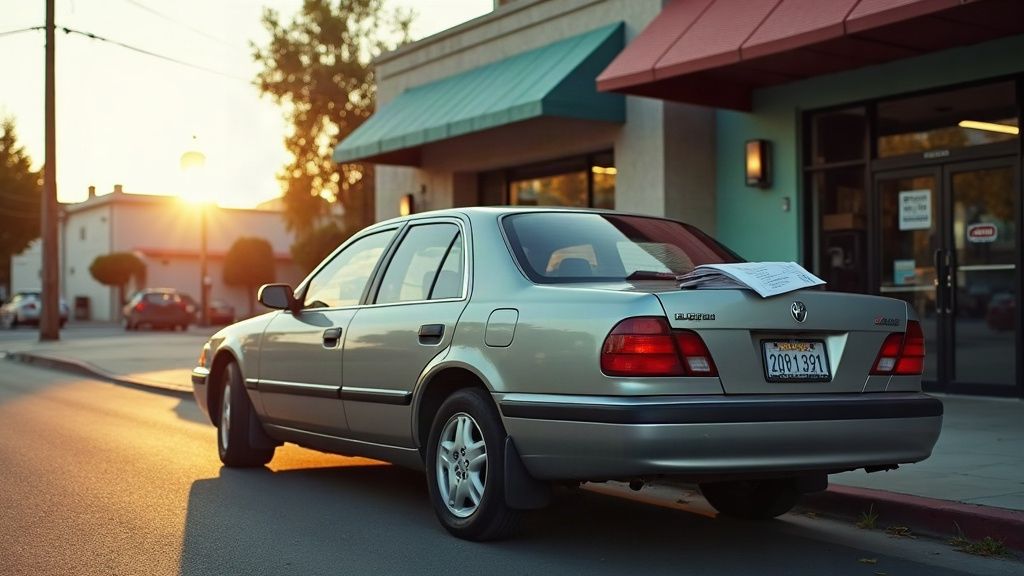
If your car was hit by another driver in California and the insurance company paid for repairs, you may still be owed money. Repairs restore how your car looks and drives. They do not restore what it's worth on the open market. That gap is called diminished value, and California law gives you the right to pursue it as a separate property-damage claim.
Most injured drivers never ask. Most insurers never offer. The result: millions of dollars in legitimate losses go unclaimed every year across Southern California.
Here are nine concrete signs that you may have a diminished value claim worth pursuing.
Quick summary:
- Your car had frame or structural repairs after the crash
- The vehicle was new or low-mileage before the accident
- A dealer or buyer lowered their offer after seeing the accident history
- The shop used aftermarket or salvage parts in the repair
- Your CarFax or vehicle history report now flags the collision
- You plan to sell or trade in the car within the next few years
- The at-fault driver's insurer only paid for repairs, nothing more
- You never requested a diminished value appraisal
- You are unsure whether California law allows a separate diminished value claim
1. Your Car Needed Frame or Structural Repairs, Even If Fixed Properly
Frame or structural damage is the strongest single indicator of a diminished value loss. When a collision bends, cracks, or deforms a vehicle's unibody or frame, buyers and dealers treat that history as a permanent red flag, regardless of how skilled the repair work was.
The reason is straightforward. A structurally repaired vehicle has a documented vulnerability that an unaffected vehicle does not. Private buyers discount it. Dealers offer less at trade-in. Even certified pre-owned programs often exclude vehicles with prior structural damage.
California law treats this market-value drop as a compensable property loss in a third-party claim against the driver who caused the crash. If the at-fault driver's insurer paid to fix the frame but paid nothing for the resulting value loss, the diminished value portion of your damages may still be open.
Takeaway: Get the repair records and identify whether "frame," "unibody," or "structural" appears anywhere in the estimate or completion documents.
2. The Vehicle Was Fairly New or Low-Mileage Before the Crash
The newer and lower-mileage a vehicle, the more a buyer expects it to be accident-free. That expectation is where diminished value comes from.
A three-year-old vehicle with 22,000 miles commands a strong market price precisely because buyers assume clean history. When an accident removes that assumption, the market-value gap can run into several thousand dollars, even after a perfect repair. A fifteen-year-old vehicle with 180,000 miles carries a smaller gap because buyers already price in wear.
California courts and appraisers recognize that diminished value is proportional to pre-accident condition. Higher pre-accident value generally means a larger dollar loss to pursue.
Takeaway: Pull the Kelley Blue Book or NADA value your vehicle carried the day before the accident. Compare it to current dealer offers. The spread tells you whether a claim is worth pursuing.
3. A Dealer or Buyer Offers Noticeably Less After Seeing the Accident History
When a dealership or private buyer pulls a vehicle history report and immediately lowers their offer, that price drop is real-world market evidence of diminished value. It is not an opinion. It is a documented transaction.
Save every written offer you receive, especially offers made before and after the buyer learned about the accident. If a dealer offered $24,000 before running the report and $19,500 after, you have $4,500 in documented market-value loss. That gap can anchor a third-party claim against the at-fault driver's insurer.
Takeaway: Never accept a reduced offer verbally. Ask dealers and private buyers to put their offer in writing before and after they view the vehicle history.
4. The Repair Shop Used Aftermarket or Salvage Parts
When an insurance company directs a repair shop to use non-OEM (original equipment manufacturer) or salvage-yard parts, the repair costs less for the insurer. The cost is transferred to you in the form of lower market value.
Buyers and appraisers distinguish between a vehicle repaired with factory-spec parts and one repaired with aftermarket equivalents or salvage components. The distinction shows up in resale price. California law allows an owner to argue that this parts-quality difference is part of the total property-damage loss.
Check the repair estimate and completion invoice line by line. Any part labeled "aftermarket," "LKQ," "recycled," or "remanufactured" is a non-OEM replacement that may have reduced your vehicle's market value.
Takeaway: Request a copy of the repair order. If it lists non-OEM parts, include that documentation in your diminished value appraisal request.
5. Your CarFax or Vehicle History Now Flags the Collision
A collision entry on a CarFax, AutoCheck, or similar vehicle history report is permanent. Every future buyer will see it. Every future dealer will factor it into their offer. That entry is one of the most concrete, documentable signs of diminished value.
The stigma attached to an accident record is well-recognized in automotive appraisal practice. Even a minor collision that required only cosmetic repairs can suppress resale value when it appears on a report, because buyers have no way to evaluate the severity from the report alone.
Takeaway: Run a vehicle history report now if you have not already. Print it and keep it as part of your claim documentation. The report is evidence.
6. You Plan to Sell or Trade In the Car Within the Next Few Years
Diminished value becomes a realized loss the moment you sell or trade in your vehicle. If you plan to do so within the next two to three years, the financial impact is not hypothetical. It is approaching.
Pursuing a diminished value claim now, while the accident is recent and well-documented, is far easier than trying to reconstruct the connection years later. Repair records, photos, insurer correspondence, and witness information are all more accessible today than they will be at trade-in time.
California Code of Civil Procedure §338 gives you three years from the date of the accident to bring a property-damage claim, including diminished value. That clock runs whether or not you plan to sell soon, so acting while documentation is current protects your rights.
Takeaway: Do not wait until the trade-in counter to discover the loss. A professional appraisal now gives you a documented baseline to negotiate from.
7. The At-Fault Driver's Insurer Paid for Repairs but Nothing Else
Repair costs and diminished value are two separate, independently compensable losses. Paying one does not extinguish the other.
When the at-fault driver's insurer sends a repair check and closes the property-damage file, many injured drivers assume the matter is settled. It is not, unless they signed a release of all claims. If no release was signed, or if the release was limited to repair costs only, the diminished value loss may still be open.
California Civil Code §3333 allows recovery of all damages caused by a wrongful act, including property losses beyond the cost of repair. A third-party diminished value claim against the at-fault driver's insurer is grounded in this principle.
Takeaway: Review any documents you signed with the at-fault insurer. If you did not sign a general release, your diminished value claim may still be alive.
8. You Never Asked for a Diminished Value Appraisal
Most insurance companies will not offer a diminished value payment unless the vehicle owner requests one and provides a professional appraisal to document the loss.
Insurance adjusters are not required to identify and pay diminished value on their own. Their job is to pay what is presented and documented. If no one presents a diminished value appraisal, the line item simply does not appear in the settlement.
A professional appraisal, conducted by a certified auto appraiser who specializes in post-accident market-value analysis, produces a written report documenting the vehicle's pre-accident value, the collision damage, the repair quality, and the resulting market-value gap. That report is the cornerstone of any diminished value claim.
The cost of an appraisal is typically recoverable as part of the claim if the diminished value is paid or awarded. It is not a sunk cost, it is an investment in documenting what you are owed.
Takeaway: Search for a certified diminished value appraiser in Southern California before contacting the insurer. The appraisal gives you a number to negotiate from rather than a number to accept.
9. You're Unsure Whether California Law Lets You Pursue This Separately
In California, you can pursue a diminished value claim against the at-fault driver's insurer separately from the cost of repairing your car.
California follows the general tort principle that a wrongful act entitles the injured party to full compensation for all resulting losses. Under California Civil Code §3333, the measure of property-damage recovery is the full value of the loss sustained, not merely the cost of physical repairs.
Diminished value is a recognized component of that full loss in third-party claims. You are suing (or claiming against) the at-fault driver for what their negligence cost you. The market-value drop your vehicle suffered because of their negligence is part of that cost.
One important boundary: California courts have generally limited diminished value recovery in first-party claims, meaning claims against your own insurer under your own collision coverage. The stronger legal footing is in a third-party claim against the at-fault driver's insurer. If you were not at fault and the other driver's insurer is involved, California law supports your right to pursue this.
The statute of limitations for property damage claims in California, including diminished value, is three years from the date of the accident under Code of Civil Procedure §338. Do not let that window close without at least evaluating whether the claim is worth pursuing.
Takeaway: Talk to a California personal injury attorney before you accept any final settlement from the at-fault insurer. Once you sign a general release, the diminished value claim is gone.
What Diminished Value Actually Means in Dollar Terms
Diminished value is the permanent drop in a vehicle's market price caused by its accident history, even after all repairs are completed.
The amount varies widely based on the vehicle's pre-accident value, the severity of the damage, the quality of the repairs, and current market conditions. A luxury SUV with frame damage may lose $8,000 or more in market value. A mid-range sedan with structural repairs may lose $3,000 to $5,000. Even a vehicle with cosmetic-only repairs can lose $1,000 to $2,000 simply because the collision appears on the history report.
Professional appraisers typically use one of three methodologies:
Inherent diminished value is the most commonly claimed type. It is the loss in market value that persists after a proper, complete repair, based solely on the accident history.
Repair-related diminished value addresses situations where the repairs themselves were substandard, leaving the vehicle in a worse mechanical or cosmetic condition than a proper repair would have produced.
Immediate diminished value is the difference between the vehicle's pre-accident and post-accident value before any repairs are made. This figure is most relevant in total-loss situations.
Most California third-party diminished value claims are built around inherent diminished value, which requires a before-and-after market-value comparison supported by comparable sales data.
How the Claim Process Works
Diminished value is the permanent drop in a vehicle's market price caused by its accident history, and pursuing the claim requires a professional appraisal, a written demand to the at-fault insurer, and, if necessary, a civil lawsuit or insurance arbitration.
The steps, in order:
- Obtain repair records, before-and-after photos, and any written dealer or buyer offers.
- Commission a certified diminished value appraisal.
- Submit a written demand to the at-fault driver's insurer with the appraisal as supporting documentation.
- Negotiate, or, if the insurer disputes or undervalues the claim, file a claim in California small claims court (for losses up to $12,500 under California Code of Civil Procedure §116.221) or pursue the matter through a personal injury attorney.
If your diminished value loss is significant, which it often is when frame damage, structural repairs, or a high-value vehicle are involved, a personal injury attorney can manage the negotiation and litigation at no upfront cost. Our firm handles diminished value claims on a contingency basis: no fee unless we recover for you.
Frequently Asked Questions
What is a diminished value claim in California?
A diminished value claim in California is a property-damage claim for the permanent drop in a vehicle's market value caused by an accident, even after all repairs are completed. California law, under Civil Code §3333, recognizes this loss as separately compensable in third-party claims against the at-fault driver's insurer.
Can I claim diminished value if my car was repaired?
Yes. Diminished value exists precisely because the vehicle was repaired. The claim is not about the repair costs themselves. It is about the market-value gap between a vehicle with a clean history and the same vehicle with a documented accident on its record.
Does insurance automatically pay diminished value in California?
No. California insurers are not required to volunteer a diminished value payment. You must request it, document it with a professional appraisal, and submit a written demand. If the insurer denies or undervalues the claim, you can negotiate, arbitrate, or litigate.
How is diminished value calculated after an accident?
A certified appraiser compares the vehicle's pre-accident market value (using comparable sales data) to its post-repair market value, accounting for the accident history, repair quality, parts used, and current resale market conditions. The difference is the inherent diminished value. The appraiser's written report is the primary document used to support the claim amount.
How long do I have to file a diminished value claim in California?
Property-damage claims in California, including diminished value, are subject to a three-year statute of limitations under Code of Civil Procedure §338, running from the date of the accident. Missing this deadline typically bars the claim entirely.
Can I pursue a diminished value claim against my own insurer?
California courts have generally limited diminished value recovery in first-party claims against your own collision insurer. The stronger legal basis is a third-party claim against the at-fault driver's insurer. If you were not at fault, contact the other driver's insurer directly or consult a California personal injury attorney to evaluate your options.
Do I need an attorney to pursue a diminished value claim in California?
Not always. For smaller losses, a self-represented claim or California small claims court may be practical. For vehicles with significant structural damage, high pre-accident value, or where the insurer disputes the appraisal, an attorney can typically recover more than the cost of representation. We handle these claims on a contingency basis, so there is no upfront cost to you.
Your car is worth less than it was before the accident. That loss is real, it is documented, and California law gives you the right to pursue it. If two or more of the nine signs above apply to your situation, your claim is worth a professional review.
Call (818) 794-9947 for a free case evaluation. We handle personal injury claims, including diminished value, on a contingency basis. No fee unless we win.
Reviewed by Minas Nordanyan, CA Bar #296806. Last reviewed August 2026.